


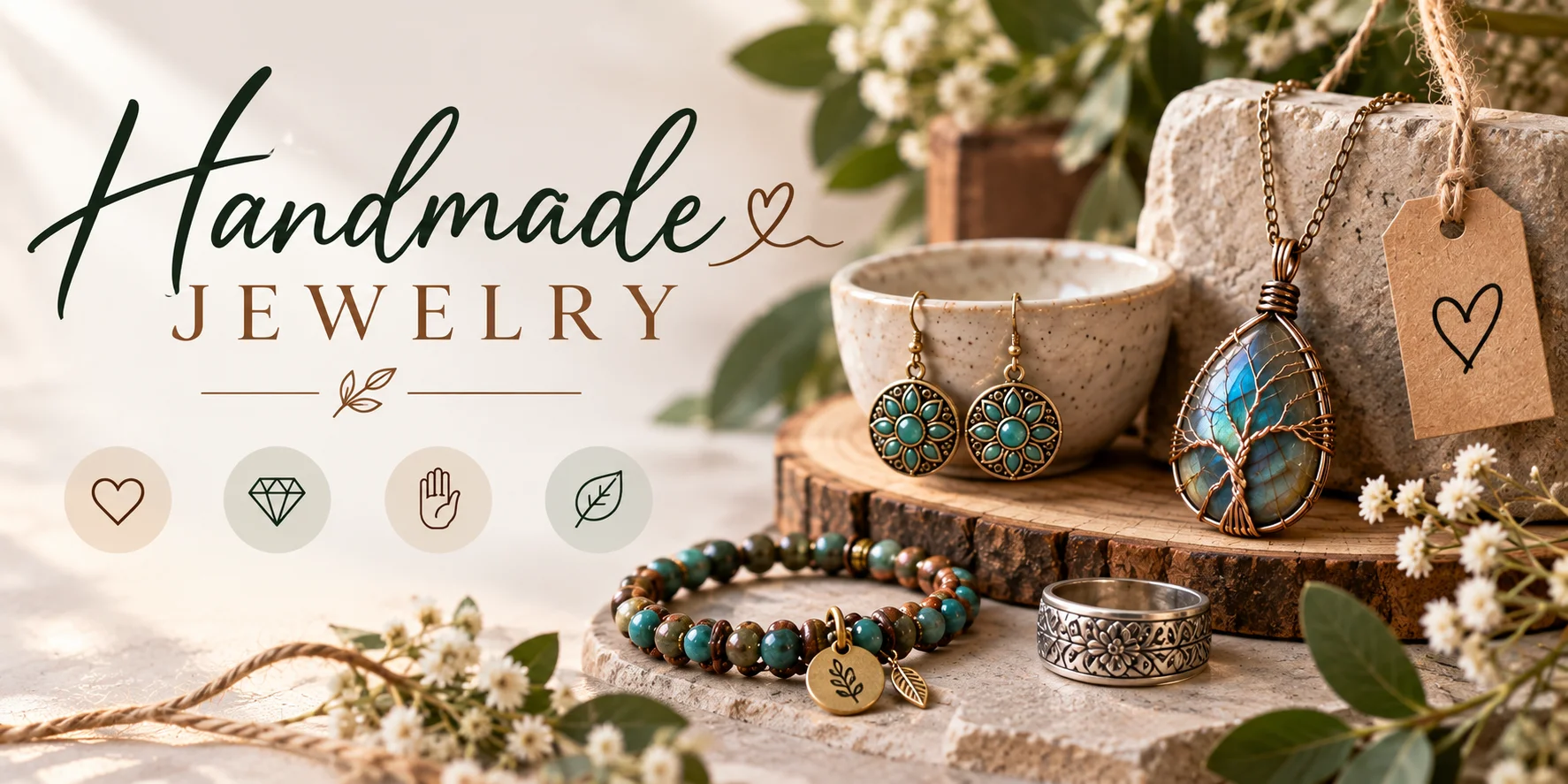
Three years ago I bought a pair of earrings off a wooden cart outside Anarkali Bazaar. Three hundred fifty rupees. The seller swore up and down his aunt hand-beat every piece herself. Silver-toned, tiny bells, the kind that jingle a bit when you turn your head. Cute. Genuinely cute. By the second wear my earlobes had gone this faint green. One bell fell off before the week was even out.
That’s the story I tell people now when they ask why I got picky about handmade jewelry. Not because the whole idea’s a scam it isn’t, not even close but because “handmade” gets stuck on things that have no business wearing that label. It took me longer than it should have to learn the difference. So if you’re standing in front of a market stall right now, or scrolling some shop at 1am wondering whether that ring is actually worth what they’re asking this one’s for you.
What Is Handmade Jewelry?
Basics first. Handmade jewelry is pieces made by a person’s actual hands, not a machine stamping out five hundred identical copies an hour. Someone sat down, cut the metal, shaped the wire, strung the beads, soldered the joint themselves. A real person made real choices along the way, one piece at a time.
That doesn’t mean zero tools were involved, by the way. Most artisans use pliers, hammers, sometimes a small torch real equipment, nothing wrong with that. The line isn’t “no tools allowed.” The line is whether a human being is making the decisions and doing the work piece by piece, versus a mold just pumping out identical units all day long. Sounds like a small distinction. It really isn’t. It changes the price, the quality range, how the thing feels sitting in your palm, even how it ages over the years.
Why Choose Handmade Jewelry?
Honest answer: because it’s not the same thing twice. Mass-produced jewelry is built to be identical that’s the entire point of it. Consistency, low cost, fast turnaround, ship a thousand units, done. Handmade works backwards from that. Every piece carries small variations. A curve that sits a little differently. A bead that’s a hair off from its neighbor. That’s not a flaw, not really. That’s just the maker’s hand showing through.
There’s the money side too, and I’m not going to pretend that doesn’t matter to people. Buying handmade usually means your money’s going to an actual small business a person, sometimes a family workshop, sometimes just someone working out of a spare room with a torch and a YouTube tutorial they found back in 2019. It lands somewhere specific instead of disappearing into a supply chain nobody can actually trace. And look handmade pieces just tend to have more personality. A factory ring looks like a factory ring, every sing time. A handmade one looks like someone actually decided something about it. I’m not saying mass-produced is bad, to be clear. Plenty of it is perfectly fine, especially for basics you’ll barely think about. But if you want something with a bit of soul to it, handmade where you go looking.
Popular Types of Handmade Jewelry
There’s a decent range here, and each type comes with its own little quirks worth knowing before you buy.
Handmade Necklaces
Necklaces are probably where handmade work shows off the most, honestly there’s just more surface area to play with. Beaded strands, hammered pendants, wire-wrapped stones, chain-and-charm setups where every link’s been opened and closed by hand. What I’d actually watch for: the clasp. Seriously, the clasp. A gorgeous necklace with a flimsy clasp is a necklace you’ll lose within the year. Ask about it directly if the photos don’t make it obvious.
Length matters more than people think going in, too. A choker sits completely differently on a short neck versus a long one. A pendant that lands at the collarbone on one person hangs mid-chest on someone shorter. If you’re buying for yourself, get a rough sense of where you want it to sit before you scroll any further.
Handmade Earrings
Earrings are the easiest entry point into handmade jewelry, no question. Lower price, lower commitment, and fairly forgiving if the sizing’s a touch off unlike a ring, an earring doesn’t need to fit your finger exactly. You’ll find everything from delicate wire studs to big dramatic pieces with beads and tassels swinging off them. The thing nobody warns you about: weight matters way more than it looks like in a photo. A pair that seems lightweight in a flat-lay shot can genuinely drag your earlobe down by hour six of wearing it. Sensitive ears or stretched piercings? Ask the maker for the actual gram weight before you buy. Don’t just go off the listed size.
Handmade Bracelets
Bracelets show the most material variety of the bunch beaded, braided cord, hammered cuffs, chainmail if you find the right maker for it. They’re also the most forgiving category on fit, since most designs have some built-in stretch or adjustability. Cuffs are the exception, though. A hammered metal cuff doesn’t stretch, not really. It either fits your wrist or it doesn’t, and sending back a custom-shaped piece of metal isn’t always simple or even possible. Measure your wrist first. Ten seconds with a tape measure, or a piece of string and a ruler if that’s what you’ve got lying around.
Handmade Rings
Rings are the trickiest of the four, full stop. Size has to land close to exact, the band needs to sit right on your finger shape, and any stone-set piece needs decent craftsmanship or the setting works itself loose over time. This is also where I’ve noticed the biggest gap between good handmade work and rushed handmade work. A well-made ring feels solid. Sits flush. Doesn’t spin around unless it’s built to spin. A rushed one feels thin, catches on your sweater, sometimes has a seam you can actually feel with your thumbnail if you run it along the inside. Buying a ring without trying it on first? Get your size properly confirmed. There’s a way to do that at home, coming up in a second.
How to Choose the Right Handmade Jewelry
So how do you actually pick the right piece instead of just grabbing whatever looked nice in a thumbnail at 11pm? A few things worth running through.
Consider Your Personal Style
Sounds obvious. People skip it constantly anyway, chasing whatever’s trending instead of what they’ll actually reach for six months from now. Do you lean minimal already, or do you like things that make a bit of noise? Mostly gold-toned, or silver? Would this piece actually work with what you already own, or is it a one-off you’ll wear twice and then forget in a drawer?
I’ll be honest I think mixed-metal stacking rings are a little overrated right now. Everyone’s doing the gold-and-silver combo like it’s some huge discovery. A single, well-made ring beats five thin ones stacked together, in my opinion. Might be an unpopular take. Your taste could run the exact opposite way, and that’s completely fine too.
Choose the Right Material
Material affects pretty much everything price, how it wears over time, whether your skin decides to react to it or not. Sterling silver, gold vermeil, solid gold, brass, copper, mixed beads and stones. Each one comes with trade-offs, no material does everything well.
If your skin’s sensitive, this part isn’t optional, it’s the whole ballgame. Nickel-heavy alloys will make some people break out, or turn a ring finger green within days. Sterling silver and gold vermeil are usually the safer bets usually isn’t always, though. Ask the maker directly what the base metal is, especially with vermeil, since that’s really just a thin gold layer sitting over a base metal underneath.
Pick a Comfortable Size and Fit
Here’s a formula that actually works for rings if you don’t have a proper sizer on hand.
Try this — wrap a strip of paper or a bit of string snugly around the base of your finger, mark where it overlaps, measure that length in millimeters, then divide by 3.14. That gives you a rough internal diameter for the ring. Match it against a standard ring size chart (easy enough to find) and you’ll land within half a size, which is close enough for most handmade rings anyway, since a lot of them can be gently resized after the fact.
For necklaces and bracelets, easiest trick is measuring against something you already own and already love the length of. Lay it flat, measure it, compare.
Think About When You Will Wear It
Daily-wear jewelry and occasion jewelry are two different shopping decisions, even though most people treat them as one.
Something you’ll wear every day needs to survive a shower you forgot to take it off for, a gym bag, the occasional yank from a toddler who’s decided your necklace looks interesting. Delicate, intricate handmade pieces with lots of small dangling parts are gorgeous for a wedding or a dinner out. They’re a genuinely bad match for your gym routine, though. Save them for the occasions.
How to Choose Handmade Jewelry as a Gift
Gifting’s its own puzzle. This is where I see people freeze up the most, honestly.
My cousin got married last November in Faisalabad, and her mother-in-law gave her a hand-hammered gold-plated jhumka set as part of the wedding jewelry made by a local artisan, nothing from a big brand. Nothing about it was flashy or expensive-looking in some showy way, but half the guests at that wedding asked where it came from. That’s the thing about a good handmade gift. It doesn’t need to be loud to land.
A few things that genuinely help when you’re picking handmade jewelry for someone else:
- Notice what they already wear. Gold or silver, delicate or bold this tells you more than any trend list ever will.
- Look for something with even a small story attached. The material, the technique, where the maker’s based. A little context makes a gift feel more thought-through.
- Lean slightly classic over trendy unless you know their taste really well. Trends fade fast. Simple, well-made pieces don’t.
- Check the return or resize policy before buying, especially with rings. Not every small shop offers this, so just ask.
- If the shop includes a note about the maker, keep it and pass it along. Adds weight to the gift, costs nothing extra.
One thing I’d personally skip — engraved pieces for someone you’re not fully sure about, relationship-wise, or whose taste you genuinely don’t know well. Engraving locks in permanence on something you might’ve gotten wrong.
What Materials Are Commonly Used in Handmade Jewelry?
Quick rundown of what you’ll actually run into while shopping around. Sterling silver’s the workhorse, honestly most handmade jewelry you’ll come across leans on this. Durable, affordable next to gold, tarnishes over time but polishes right back up with minimal effort. Gold vermeil is sterling silver with a thick layer of gold plated over it, so it looks like solid gold for a fraction of the price. The catch: that layer wears thin eventually, especially with daily contact, lotion, perfume all of it speeds up the fade.
Solid gold is the real thing, various karats depending on the piece. Expensive, doesn’t tarnish, ages beautifully over decades if you take care of it. Handmade solid gold pieces are usually commission work or small-batch, priced to match. Brass and copper show up a lot in bohemian and rustic-style handmade pieces. Affordable, warm-toned, but they can react with skin that green-finger thing again and need regular polishing to keep their shine.
Beads and natural stones cover glass, wood, semi-precious stones like amethyst or turquoise, sometimes freshwater pearls. Quality swings wildly here. Which is exactly why the next section matters more than people give it credit for. Wire and findings are the small stuff connectors, clasps, ear hooks and they’re easy to overlook. But cheap findings are where a lot of “handmade” pieces quietly cut corners. Worth checking.
How to Tell if Handmade Jewelry Is Well Made
This is the part I wish someone had actually explained to me before that Anarkali Bazaar purchase. A checklist you can run through, whether you’re holding the piece in your hand or just looking at photos on a screen:
- Check the back and the underside. Cheap pieces look fine from the front and rough everywhere the seller assumes you won’t look.
- Feel the weight. Solid metal has real heft to it. Suspiciously light pieces are usually hollow, or plated way too thin.
- Look closely at the joints and clasps. Soldered joins should look clean, not blobby or uneven. Clasps should click firmly shut, not feel loose or slightly bent.
- Ask about the base metal, plainly, no hedging. “Is this solid, plated, or vermeil?” A maker who actually knows their craft answers that without hesitating.
- Read reviews for specific complaints, not just star ratings. “Turned my finger green after two wears” tells you way more than four stars ever could.
- Look for small, intentional imperfections not sloppy ones, the kind that show a real hand was involved. A bit of variation is good. Actual crookedness or gaps aren’t the same thing at all.
Ever bought something online that looked completely flawless in the listing photo, then felt totally different the second it landed in your hand? That gap almost always traces back to one of the points above.
How to Care for Handmade Jewelry
Handmade pieces usually need a touch more attention than mall-bought stuff, mostly because the materials tend to be more natural and, frankly, more reactive. Take it off before showering, swimming, sleeping moisture is the enemy of tarnish and thread-strung pieces both. Perfume and lotion should go on before the jewelry, not after. The chemicals in most sprays speed up tarnishing fast, especially on silver and anything plated.
Store pieces separately. Not all tangled together in one drawer, which is what most of us do anyway, let’s be real. Chains knot themselves the second you look away, and harder stones can scratch softer metals sitting right beside them. A soft pouch or lined box does the job fine. For silver, a polishing cloth every few weeks keeps tarnish from building up no need for harsh chemical dips unless it’s gone properly dark. For beaded or strung pieces, keep them out of direct sunlight for long stretches. Some stones and dyes fade quicker than you’d expect.
Common Mistakes to Avoid When Buying Handmade Jewelry
A few things I’ve watched go wrong, mine included:
- Buying purely off photos without checking material details. A gorgeous photo tells you nothing about weight, base metal, or finish quality.
- Ignoring sizing and just hoping it’ll “probably fit.” It usually doesn’t. Resizing a ring after the fact isn’t always cheap or even possible.
- Assuming “handmade” automatically means high quality. It doesn’t, not on its own — see: my green earlobes, again.
- Not asking questions before buying. Small shops and independent makers are almost always happy to answer a quick message. Use that.
- Skipping the return policy entirely. Handmade sellers vary a lot here — some offer nothing, some offer full exchanges, and you won’t know which unless you check first.
- Overpaying just because something’s labeled “artisan.” That word gets used loosely these days. Look past the label to the actual piece in front of you.
Is Handmade Jewelry Worth Buying?
Short answer yes, if you buy smart about it.
It’s not automatically better than mass-produced jewelry in every single case. A cheap, rushed handmade piece can genuinely be worse than a decent mass-market one, no contest. But a well-made handmade piece, from someone who actually knows their craft, tends to hold up better, feel better, and mean more than something pulled off a factory line. The value isn’t just in the object itself, either. It’s in knowing an actual person made a real decision about the thing you’re wearing. That’s worth something, even if it’s hard to put a clean number on it.
Final Thoughts
I still have those green-earlobe earrings, actually. Kept them in a drawer as a reminder to ask better questions before I hand over money. Next time you’re eyeing a handmade piece, give it thirty seconds check the clasp, ask about the metal, feel the weight. The rest tends to sort itself out from there.
FAQs
What Is Handmade Jewelry?
Jewelry made by hand rather than churned out by machines someone shaping, cutting, stringing, or soldering each piece themselves. Tools are fine, it’s the hands-on decision-making that counts.
Why Is Handmade Jewelry So Popular?
Mostly because it’s unique, and the money tends to go to an actual small maker instead of a big anonymous factory. It also just carries more personality than something off an assembly line, more often than not.
How Do I Choose the Right Handmade Jewelry?
Start with your own style, pick a material your skin can actually handle, get the sizing right rather than guessing, and think about whether it’s for daily wear or occasions those are two different decisions, not one.
What Types of Handmade Jewelry Are Available?
Necklaces, earrings, bracelets, and rings cover most of it. Each has its own quirks worth knowing before you commit clasps for necklaces, weight for earrings, sizing for rings, and so on.
Is Handmade Jewelry Good for Everyday Wear?
Some of it, sure. Simple, sturdy pieces in solid metals handle daily life just fine. Delicate or heavily detailed pieces are better saved for occasions than tossed in a gym bag.
What Materials Are Used to Make Handmade Jewelry?
Sterling silver, gold vermeil, solid gold, brass, copper, beads, natural stones, and pearls, mainly. Each one has its own durability, price point, and skin-reaction quirks worth asking about.
How Can I Tell if Handmade Jewelry Is Good Quality?
Check the back and the joints, feel the weight, test the clasp properly, ask the maker about the base metal directly, and read reviews for specific complaints rather than star counts alone.
Is Handmade Jewelry a Good Gift?
Yes, especially when it matches what the person already wears rather than chasing whatever’s trending. Classic tends to age a lot better as a gift than trendy does.
How Do I Care for Handmade Jewelry?
Keep it away from water, perfume, and lotion where you can manage it, store pieces separately rather than tangled together, and polish silver every few weeks so tarnish doesn’t build up.
Is Handmade Jewelry Worth Buying?
Worth it when it comes from someone who actually knows their craft. Not every handmade piece is well made, so a little checking before you pay saves a lot of regret later.