


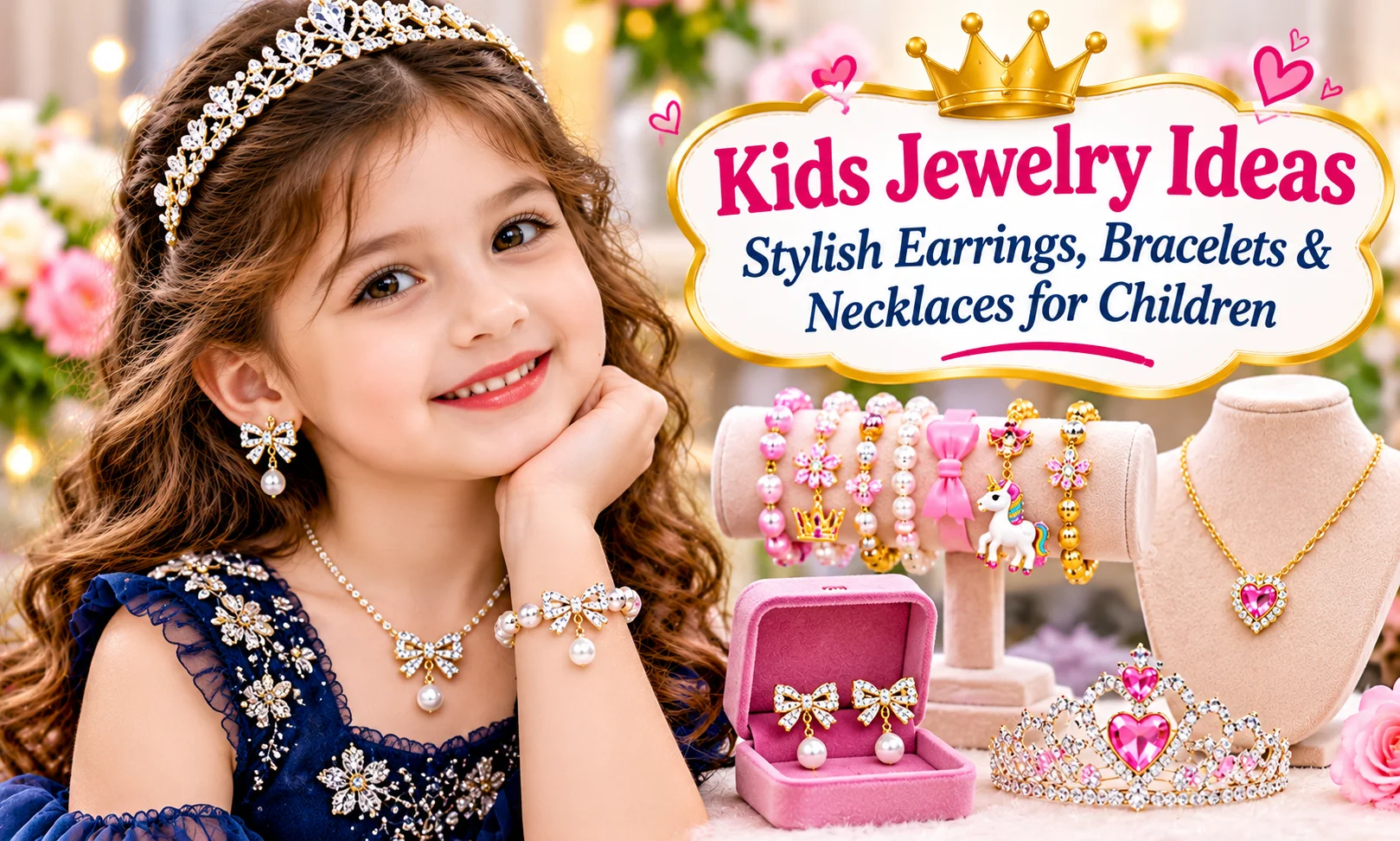
The earring went into the cake, frosting slowly. That’s the part I remember. Not a dramatic drop, a gradual slide down a small ear while everyone was singing, then a soft landing in a swirl of pink icing, where it sat like a tiny shipwreck until somebody’s fork found it.
The earrings were unicorns. I’d ordered them online for a birthday, about $14, and in the product photos they looked small and sweet pastel pink, little gold horns, exactly what a kid would gasp over. What arrived was different. Closer to postage stamps than studs, heavy in the hand, one post already bent in the mail. We straightened it, more or less, and put them in anyway, because it was a birthday and hope is a powerful force. One unicorn started sliding within ten minutes. The other ended up in the cake. Nobody ate that slice.
I think about those unicorns whenever I’m looking at jewelry for kids now. Not because the gift was a disaster, the birthday girl was unbothered, she had cake but because everything that went wrong went wrong in the most ordinary ways. Too big. Too heavy. A post that couldn’t survive the mail, let alone a day on a seven-year-old.
Most of it doesn’t break. It just disappears
Here’s something nobody tells you when you start buying children’s jewelry: breakage is not the main enemy. Loss is. Kids’ jewelry leads a rough, wandering life. It comes off mid-cartwheel. It gets traded to a best friend in a deal nobody approved. It goes into a jeans pocket, and the jeans go into the wash, and that’s that story.
Which is why the most useful jewelry purchase I know of isn’t jewelry at all: a small divided jewelry box with a lid, in one fixed spot. That’s the whole system. The box. Jewelry lives in the box, in the same little compartment every time, because the only way anyone finds both studs on a school morning is if both studs went home to the same square the night before. Not the windowsill. Not a pocket. The box.
A soft pouch covers everything the box can’t. Sleepovers, trips to grandma’s, soccer season whenever earrings come out and need somewhere to go. Toss a few spare backs into that pouch while you’re at it. Earring backs are the socks of the jewelry world. They vanish in pairs and singles alike, and having a spare turns a small tragedy into a ten-second fix instead of a ruined morning.
One more habit, for the good pieces: photograph the keepsake set sitting in the box gold studs, locket, bracelet, all together. Twenty seconds. On the day something goes missing, you’ll know exactly what you’re looking for and exactly what “the set” is supposed to contain.
Which kid are we actually shopping for?
Every good pick I’ve made started with the child and worked backward. Every bad one started with a pretty listing. So before any ideas, the kid. Because kids’ jewelry ideas are only ever as good as the kid they’re matched to.
Age first, and age means more than size. A four-year-old and a ten-year-old might as well live on different planets, jewelry-wise. The four-year-old will absentmindedly put a charm in her mouth while thinking about something else entirely. The ten-year-old has firm opinions, a best friend she matches with, and a sharp sense of which pieces have become babyish. Age decides what’s safe, what’s comfortable, and honestly what’s even wanted.
Habits come next, and this one people skip. Some kids are careful with small things in a way that seems almost grown-up. Others lose things that are physically attached to them. Neither kind is doing anything wrong but the careful one can be trusted with a fine chain, and the other one needs sturdy pieces, clasps that lock down, and nothing whose loss would cause actual tears at school. Know which kid you’ve got.
Then ears the basic question gift buyers somehow forget to ask. Pierced or not? If not, clip-ons become the whole conversation. If yes, recently pierced or long healed? And sensitive? That detail quietly decides which metals are worth your money, so find out before you spend it.
What does she actually like? Easiest research you’ll ever do, because children are not subtle. Favorite color. Favorite animal. The current all-consuming interests are soccer, ballet, dinosaurs, and space. A kid wears the pieces that feel like her. The tiny guitar charm gets worn by the kid who just started lessons. The tasteful random pendant somebody picked because it looked classy sits in a drawer until it’s outgrown. Ask, or just listen for a week. She’ll tell you. Repeatedly, at volume.
Last thing: what’s it for? Everyday wear is one job. A school photo is a different job entirely. So are a party, a recital, being a flower girl, or being a keepsake that mostly lives in its box. Plenty of pieces fail one job and are perfect for another. Dress-up jewelry is a real and wonderful category — it just shouldn’t be sent out to do everyday jewelry’s work.
School and sports get a vote too. Some schools have rules, especially about anything that dangles. Sports generally mean everything comes off, which raises two questions: where does it go during practice, and can the child work the clasp by herself? A seven-year-old who can’t yet manage a small lobster clasp needs something simpler, or that necklace will live at the bottom of a gym bag until the end of term.
Bracelets first, because bracelets are the personal ones
I’m putting bracelets before earrings, which is backwards from most guides, and I have my reasons. Earrings are for other people to see. A bracelet is right there in front of the kid wearing it, all day, during math, during lunch, during the boring parts. She looks at it, fiddles with it. So the bracelets that survive aren’t the prettiest ones — they’re the ones with a story, or the ones that keep changing, or the ones tying her to a friend or a sister. Those stay on wrists. The rest migrate to dressers.
The charm bracelet is the oldest idea here and I still think it might be the best, because it isn’t really a single gift — it’s a gift that keeps happening. Start with a plain bracelet and one charm. A tiny ballet slipper the year she starts dancing. A soccer ball on the next birthday. A little initial. A small heart from a grandma. One charm at a time, birthdays and holidays, and after a few years she’s wearing a timeline. It spreads the cost out too, which is a quiet mercy for grandparents, and it answers the what-do-we-get-her question for years.
Two warnings, both learned the obvious way. Charms need attaching properly, on sturdy little rings, soldered or well closed — not glued. A glued charm will be on the carpet by Friday. And for younger kids a charm bracelet is sometimes a piece, worn with an adult around, because charms are exactly the size and shape of things small children put in their mouths.
DIY charm kits are the crafty offshoot of the same idea, and for roughly the seven-to-eleven crowd they’re a genuine hit. A bracelet base, a pile of charms and beads and letter tiles, and she designs her own, trades pieces with friends, remakes the whole thing next month when her taste changes. Which it will. Kit quality is all over the place, so give the materials a look and a sniff and skip anything chalky or chemical-smelling. But for a kid who likes making things, a good kit beats a finished bracelet, because she gets the making and the wearing.
Initials and names come next, in the same family. An initial bracelet — one letter on a small disc — or a beaded bracelet spelling out a name in letter beads. Kids at certain ages are fiercely proud of their own names, and a bracelet that carries it gets worn. My one hesitation: save the full name for older kids, past the stage of cheerfully telling it to every stranger who asks. An initial gives the same hit of mine with far less information on public display.
Birthstone bracelets work on the same principle as all birthstone jewelry — the color is hers, her month, her thing. A stretchy beaded bracelet with one birthstone-colored bead among pearly ones is pretty, inexpensive, and personal all at once. A finer one, silver with a real stone, is a keepsake. Both are fine. They’re just doing different jobs, and trouble only starts when you expect one to do the other’s.
Then there are the beaded friendship stacks, which are basically the social currency of the elementary school years. Stretchy beaded bracelets worn three or four at a time, matched with a best friend’s stack, traded, pulled apart, remade. The beads are usually plastic or glass or soft silicone, the colors are loud, and the entire point is abundance and sharing rather than preciousness. A set like this costs very little — and I’ve watched a twelve-dollar set get more daily wear than a silver bracelet that cost five times as much. Kids are doing different math than adults.
Silicone bracelets get their own mention because they fill a gap nothing else fills. A soft silicone band is waterproof, hard to break, easy to rinse clean, and no big deal if it vanishes at the pool. For active kids and camp kids, it’s the option that fits the actual life being lived. It isn’t fine jewelry and doesn’t pretend to be. It plays the role in the bracelet drawer that sneakers play in the shoe rack.
Fit is the secret headache of kids bracelets, so: bangles and sliders. A classic bangle is lovely and unforgiving — it can’t adjust, and small wrists grow fast, so a bangle that fits in September can be dangling by spring. Buy bangles close to when they’ll be worn. Adjustable slider bracelets, the kind with a sliding bead or knot that cinches the cord, forgive growth, guesswork, and buying from three time zones away. Unsure of size? Adjustable. Every time.
For older kids there’s the tennis-style bracelet, that unbroken line of sparkle around the wrist. It’s the dress-up heavyweight: weddings, photos, the school dance. It is not an everyday piece, and the plan falls apart if you treat it like one. One afternoon, a safer setting, then back in the box. And know this — the clasp matters more than the sparkle. A gorgeous bracelet on a weak clasp is on its way to being lost between the restaurant table and the car.
A word about boys, because most bracelet sections quietly assume girls and plenty of boys wear bracelets happily when the styles leave room. Dark cord bracelets. A leather-look band with a plain metal plate. Wooden beads, stone-look beads, a braided band in his team’s colors, a small skateboard or guitar pick charm. These read as cool instead of pretty, which is the entire distinction for a lot of boys. The rules underneath don’t change: a material that doesn’t irritate, a closure he can work himself, nothing that gives up the first time it catches on a backpack strap. Plenty of girls wear all of these too.
Earrings, where almost everybody starts
Earrings are where most kids’ jewelry begins, partly because of first piercings and partly because a pair of studs is the easiest gift in the world to give. Small box. Big reaction. So here’s what tends to get worn, and what tends to end up in the frosting.
For everyday wear, tiny studs do nearly all the work, and screw-back studs are the version I’d choose if I could only choose one. The back twists onto the post instead of just sliding on, so it doesn’t work loose overnight and it doesn’t get stripped off by a hoodie. For a kid fresh from a piercing, keeping earrings in around the clock for a stretch, that staying-put quality isn’t a detail. It’s the whole thing.
Shapes, then. The classics are classics because kids like them: tiny hearts, stars, flowers, little round pearls when you want something softer. Birthstone studs are the gift buyer’s quiet favorite — personal without needing a name engraved or a photo printed. A January kid in deep red, garnet-colored studs. A June kid in pearls. It hands the gift a little story, and kids are easy marks for a story about themselves.
Animal studs are where it gets fun. Ladybugs. Bees. Tiny cats, butterflies, owls. And the fruit and food shapes, which sound ridiculous until you see little enamel strawberries on a six-year-old and realize they’re somehow perfect. Enamel makes a lot of these sing, because enamel carries the color. A plain metal cherry is fine. A red enamel cherry is the one she asks for by name. Enamel studs with smooth edges and decent backs might be the most given and most worn kids earrings in existence.
One thing worth separating out: the starter pair. The first real pair after a piercing, once the initial studs can come out, sets the tone. Small. Smooth. A kind metal, backs that stay put. Save the adventurous shapes for pairs two or three, when you know how her ears behave. Dull opinion. I hold it firmly.
Sibling matching deserves its moment too, because the joy it produces is wildly out of proportion to the cost. Sisters in the same tiny star studs, different colors. Big sister and little sister in matching hearts, one gold tone, one silver. Kids are deadly serious about belonging, and matching earrings are belonging you can wear. Holiday studs run on the same fuel — pumpkins in October, snowflakes in December. Nobody needs holiday earrings. That is precisely why kids love them.
No piercing? Clip-ons, and a plain word about magnets
Plenty of kids don’t have pierced ears and want earrings anyway, and clip-on earrings are the standard answer. The good ones are a world away from the pinchy torture devices some of us remember: padded clips, adjustable tension, lightweight fronts. For dress-up, parties, and photos they’re genuinely great, and they let a kid join in without a piercing booked before she’s ready.
Magnetic earrings come up a lot, so I’ll be plain: a magnet holds a decorative front against the ear, looks like a real stud. That’s the appeal. But magnets and small children are a bad combination. One loose swallowed magnet is a medical emergency; two can be worse. So magnetic styles are a no for little kids, full stop. I’d skip them for any child still in the put-things-in-mouth years. An older, responsible kid is a family’s own call. A toddler gift? Never. Clip-ons do the same job without keeping anybody up at night.
Huggies and drops: the older-kid end of the drawer
Huggie hoops are the small hoops that hug the earlobe and click shut, and for older kids they’re a lovely step up. There’s no separate back to lose, because the closure is built in. The click deserves a check now and then — a worn hinge loosens quietly — but a well-made huggie on a nine- or ten-year-old is about as practical as earrings get while still feeling grown-up. Tweens adore them, mostly because studs start to read as little-kid. Fair enough — huggies are the real thing.
Short drops are the last stop, and they come with conditions. A small drop — a little pearl, a charm just below the lobe — can be beautiful for a party or a recital. But drops catch on hair. On scarves. On the grabbing hands of younger siblings. They’re for older, careful wearers, for short stretches, and never for sports, rough play, or sleep. If a kid completely forgets she’s wearing earrings — most kids do — drops aren’t her pair yet. No rush. Ears aren’t going anywhere.
Necklaces: the biggest feelings, the strictest rules
Necklaces are the trickiest of the three categories, and I say that fondly. Chains tangle. Chains snap. Chains get yanked by a toddler sibling with no respect for property. A necklace also sits against the skin all day, and for little kids it comes with safety rules that are not suggestions. And yet. Get it right and a necklace is the piece kids attach to hardest, because it tends to carry the most meaning. The initial she never takes off. The locket with the tiny photo inside. Big feelings, small chain.
The initial pendant is probably the single most-worn necklace in kids jewelry. One letter, small, on a plain chain. It goes with everything, it’s unmistakably hers, and it doesn’t broadcast a full name to the world. Older kids sometimes graduate to a nameplate, the whole name spelled out across the chest, and tweens tend to love those. Same caution as the name bracelets: a nameplate is a style choice for an older kid, not a default for a six-year-old.
The locket is the romantic of the group. A small heart or oval that opens. Inside goes a tiny photo, or a note folded down to the size of a postage stamp, or nothing at all yet, because for plenty of kids, opening and closing it is the entire point. Lockets make wonderful grandparent gifts, since the photo does the emotional heavy lifting. One practical note: cheap lockets often have flimsy hinges and clasps, and a locket that pops open loses its photo — the one part of the gift no store can replace. Squeeze it, open it, close it twice before it goes in the gift bag. Two minutes. Worth it.
Birthstone pendants do their usual quiet trick — one small stone, her color, her month. Hearts, stars, and moons are the shapes that never seem to leave the stage. A tiny heart. A small star with a bit of sparkle in it. A crescent moon for a kid in a space phase, which is most kids at some point or other. Animals too: a small elephant, a dolphin, a unicorn — flat and light this time, some of us have learned. And hobby charms are the secret weapon of the stuck gift buyer. A tiny soccer cleat. A music note. A paint palette. A charm that matches a kid’s current passion beats a generic pretty pendant nearly every time, because it says somebody was paying attention.
Enamel pendants bring the color for younger kids — rainbows, flowers, smiling suns. Pearls come out for occasions: one small pearl on a fine chain for a wedding or a first recital, classic, a touch formal. Both have their place. The mistake is confusing their jobs and sending the pearl to school on a Tuesday.
Now the unglamorous part that quietly decides whether any of this works: length and clasps. For older kids, a chain around 14 to 16 inches usually lands right — above the chest, out of the way. Too long and the pendant swings into everything, catches on zippers, gets chewed on, which happens far more than anyone admits. Too short is just uncomfortable, and an uncomfortable necklace lives in a drawer. Tweens doing the layered look, two or three chains at staggered lengths, can pull it off beautifully — but that’s the older end of the range, and it wants chains sturdy enough to untangle without tears.
For younger wearers, the clasp matters more than the chain. A breakaway clasp is made to pop open if a necklace gets caught or pulled, instead of tightening, and for a preschooler wearing a necklace at a party with an adult nearby, that’s the sensible design. And the standing rules, which are rules: necklaces come off for sleep, for swimming, for sports, and for rough play. Off, in the box, every time. The age section just below has more on the youngest kids, none of it negotiable.
Matching mom-and-child necklaces are the soft spot of this whole topic. A small heart for the kid, the bigger matching heart for mom. Two halves of one pendant. A tiny star and a larger star. Children find this almost unbearably sweet, and if we’re honest, so do the moms. For a first day of school, or any wobbly moment when a kid could use a portable reminder that somebody loves her, a matching set does a job no solo necklace can. Cheesy? Slightly. Does it work? Completely.
What changes between two and twelve
Age guides are usually written like laws. Children have not read them. But the broad shape here is real, because safety and independence change so much between two and twelve that the same advice can’t possibly cover both ends. Loosely, then — with room left for the actual kid in front of you.
Under three: it’s for keeping, not wearing
For babies and toddlers, jewelry is mostly not for wearing at all. It’s for keeping. A tiny bracelet bought when she was born. A small pendant with an initial. A pair of studs meant for someday. These pieces live in a box, come out for photographs under a close watch, and carry the feelings of whoever gave them — a perfectly respectable life for a piece of jewelry. Some of the most treasured pieces in any family have been worn about four times, total.
What babies should not have is a necklace worn loose around the neck — not awake, not sleeping, not in a car seat. It’s a strangling risk, and there’s no cute version of that sentence. Same goes for small loose parts and charms that can detach. Which brings up amber teething necklaces, because they’re sold everywhere and the promises are big. The FDA warned back in December 2018 that teething necklaces and bracelets can strangle or choke babies, and the American Academy of Pediatrics does not recommend jewelry for infants. There’s also no solid proof the amber does anything for teething pain. Hard pass from me. If the idea appeals, the safer direction is a teether made of food-grade silicone that a parent wears or holds — baby chews on the parent’s pendant, supervised, and no baby wears a string of beads.
Three to five: dress-up rules the world
Three to five is the dress-up era, and jewelry at this age is play. Big colorful beads. Clip-ons for a party. A sparkle bracelet worn to the grocery store because why not. Sessions are short, an adult is around, and the requirements are simple: chunky enough not to be a choking hazard, smooth enough not to scratch, inexpensive enough that losing it gets a shrug instead of a search party. A breakaway clasp on the rare necklace. The fine pieces mostly stay boxed, out for photos. Honestly, the play stuff is where the joy lives at this age. A five-year-old in plastic pearls and a tiara, eating pancakes, is jewelry achieving its highest purpose.
Six to eight: the real start
Somewhere around six to eight, real jewelry starts making sense for a lot of kids. They can manage simple clasps, or nearly. They have preferences and will share them. They can be trusted with a charm bracelet on a school day and enamel studs they chose themselves. This is the starter-collection age: friendship stacks, DIY kits, birthday pieces with a little meaning baked in. It’s also an age when things still get lost at a rate that would make an insurance company sit down, so it is not yet the moment for the expensive piece. Sturdy, mid-priced, secure backs, adjustable everything. That’s the brief.
Nine to twelve: taste arrives, and it has notes
Tweens have taste. It is specific, it is non-negotiable, and it will be explained to you in detail. This is the age of huggie hoops, layered necklaces, nameplates, and tennis-style sparkle saved for the school dance. Short drops for an occasion are on the table now. A small collection can be kept track of, mostly. And what their friends wear matters enormously, which isn’t a flaw — it’s just the weather at this age. The best tween gifts let her express the current version of herself, a step up in quality from the little-kid pieces — these are the ones sometimes kept for years.
The occasion quietly makes half the decision
Most jewelry confusion, I’ve decided, comes from ignoring the occasion. The same piece that’s wrong for Tuesday can be perfect for Saturday. So, occasions.
Birthdays are the big one, and a birthday gift can be fun-first. The next charm for the bracelet. The bright studs. The beaded set in her favorite color. Birthday jewelry gets worn at the party itself, so it should survive cake, running around, and being shown individually to every guest. First earrings are a different animal — a milestone. The pair that follows a piercing should be kind to ears above everything else, small and secure, and it will be remembered all out of proportion to its size. Because to the kid, it is the size. It’s huge.
Holidays run on sparkle and theme. Snowflake studs in December, heart pieces in February, something green in March. These aren’t deep purchases and shouldn’t be priced like them — they’re seasonal joy, and kids look forward to pulling them out each year.
Weddings are at the far end of the scale. A flower girl’s outfit calls for small, classic, comfortable. Tiny pearls, a small heart pendant, one slim bracelet. She’ll be in those photographs forever and in that outfit for hours, so comfort beats wow by a mile, and anything fiddly will be off by the reception anyway. School pictures want the same restraint — simple, close to the face, small studs, nothing that swings. Recitals and family photos sit in the same neighborhood.
Grandparent gifts deserve a mention, because grandparents buy a huge share of kids jewelry and they buy with their whole hearts. The keepsakes, the gold, the birthstone pieces — so many arrive from that direction. If you’re the parent watching, the kindest move is quiet guidance on size and metal, offered early, so the heartfelt gift is also a wearable one.
And then my favorite category: just because. A five-dollar beaded bracelet on a random Tuesday because it happened to be her color. No occasion, no milestone, nothing. Kids remember those too. Sometimes best.
The long game tying this together is the starter collection, built slowly. Not everything at once — everyday studs, one fun pair, a bracelet, one necklace that means something. Four or five pieces gathered over a couple of years of birthdays and holidays can carry a kid through nearly every event childhood throws at her. Bought in one afternoon, it’s a pile. Built slowly, it’s a collection, and kids feel the difference even when they can’t explain it.
Five questions I run through before I pay
After the unicorn incident I started running a little check before buying any jewelry for kids, and it has yet to fail me. Five questions, thirty seconds: Age + Activity + Metal + Fastening + Fit.
Age first — how old is the kid, really, not how grown-up she acts at breakfast. Age settles the basics: necklace or no necklace, small parts or none, play piece or real piece.
Then activity. What will she actually be doing in this? School days, dance class, swimming lessons, one wedding. Activity destroys more jewelry than everything else combined, so be honest about it.
Metal deserves the most care, so here’s the metal talk, the way I’d say it to a friend. Metal is the part touching skin all day, and the names worth hunting for are the plainly labeled ones. Solid 14k gold is the classic — hard-wearing, well tolerated by most ears. 925 sterling silver is the other big one, and the 925 stamp means the piece is 92.5% silver, the rest added for strength. 316L surgical stainless steel is widely used for sensitive ears and new piercings and is usually better tolerated than random metals — though it is not literally nickel-free, whatever a listing implies. For very reactive skin, titanium and niobium are the safest bets going, which is why piercing studios lean on them.
Why the fuss? Because nickel is the usual culprit when a kid’s ears go red, itchy, and angry at new earrings. Not always. Often enough that it’s the first suspect. One wrinkle: white gold can contain nickel, since nickel is often what makes white gold white — so gold isn’t automatically the safe answer. Yellow or rose gold, or palladium-based white gold, is the easier road for a nickel-sensitive kid. And if a spot gets irritated: piece off, let the skin settle, don’t push through it.
The pieces to be skeptical of are the mystery ones — very cheap plated jewelry with no materials listed anywhere. A thin coating over an unknown base is a gamble; the coating wears, and then skin meets whatever was hiding underneath. Plated pieces have a legitimate home in the dress-up box, where wear is brief. But for all-day wear, listed materials beat a bargain. A related trap: the word hypoallergenic. It sounds like a promise. It isn’t a regulated one. The materials list is the real information — read that instead.
Construction rides along with metal. Smooth bezel settings, where metal wraps a stone’s edge, snag far less than sharp prongs. Secure backs stay on. A smooth enamel front outlasts faceted sparkle on a young kid. Unglamorous, all of it — and it’s the difference between jewelry that gets worn and jewelry that gets mourned.
Fastening, the question everyone forgets. Screw back, secure click, breakaway clasp, strong lobster clasp, adjustable slider. Can the kid work it by herself? Will it stay closed through the actual day? And finally, fit. Posts not too long. Hoops not too wide. Chain length in that 14-to-16-inch zone for older kids, bracelet with a little growing room or an adjuster in it.
Running those five and most bad purchases quietly disqualifies themselves. The unicorns, for the record, fail on fit, activity, and fastening before the frosting even enters the story.
One birthday basket, split three ways
Let me make the money part concrete. Here’s a basket I’d happily hand an eight-year-old on her birthday — a sample, to be clear, a way of dividing a budget, not a story about a specific real kid. Three pieces. A beaded bracelet set at about $12, the colorful stackable kind, half of which will be traded to a best friend within the month, and that’s fine. A personalized initial necklace at about $34, in sterling silver — the piece with the meaning in it. And screw-back enamel studs at about $24, strawberries, say, with backs that stay put. Total: about $70.
Now set that against spending the whole seventy on one fragile piece. One delicate necklace, fine chain, tiny clasp — either worn twice and then kept in its box because everyone’s a little scared of it, or worn daily and broken by October. The basket gives her an everyday rotation, one piece that feels special, and nothing whose loss would ruin anybody’s week. That spread is the entire trick.
The rough bands behind it: dress-up and play pieces usually live around $5 to $15, sterling silver commonly sits in the $20 to $60 range, and solid gold is the $100 to $300 and up neighborhood. The classic mistake is paying keepsake money for a play job — or expecting play money to do a keepsake’s work.
FAQs
My child keeps losing earrings. Is there any hope?
Yes, and it starts with backs, not lectures. Screw-back studs and click-shut huggies remove most of the escape routes earrings use. After that it’s the one-box rule: jewelry lives in one divided box in one place, plus a pouch for sleepovers and spare backs in a drawer. Some loss is childhood tax; it never fully stops. But it slows way down once the backs stay on and the system is boring.
Can my toddler wear an amber teething necklace?
I wouldn’t, and I’m in good company. The FDA warned in December 2018 that teething necklaces and bracelets can strangle or choke babies, and the American Academy of Pediatrics doesn’t recommend jewelry for infants. There’s also no solid evidence that amber eases teething pain. If the idea appeals to you, a food-grade silicone teething pendant that you wear, and the baby chews while you’re holding her, gets closest to the idea without a cord around a baby’s neck.
How long should a necklace be for a child?
For an older child, roughly 14 to 16 inches tends to sit right — above the chest, out of harm’s way. Much longer swings, catches on things, and gets chewed. For babies and toddlers, the right length is none. No necklace.
What is a good first piece of real jewelry for a child?
If her ears are pierced: a small pair of studs in a kind metal, backs that screw on or click shut. The piece that gets worn most and worried about least. Ears not pierced? A simple bracelet in a color she picked herself does the same job. First pieces should be boring in all the right ways. Adventures can come second.
What metal is best if my child’s ears get irritated easily?
Start with what piercing studios trust. Titanium and niobium are the safest bets for very sensitive skin. Solid 14k gold suits most kids too — just remember white gold can contain nickel, and nickel is the usual troublemaker behind red, itchy ears. 316L surgical steel works well for many kids and is a common pick for new piercings, though it isn’t literally nickel-free. No metal is right for every child. If a pair makes her ears hot and angry, take them out and let things settle. Her ears get the final say, every time.
Are clip-on earrings okay for kids without pierced ears?
Yes — they’re the go-to option, and the padded, adjustable kind are nothing like the pinchy clips you might remember. Keep them lightweight, keep sessions reasonable, and take them off if her ears get sore.
How much should I spend on kids’ jewelry?
Whatever fits the job. Five to fifteen dollars buys play and dress-up pieces that can be lost without a family meeting. Twenty to sixty covers most sterling silver, the solid middle where birthdays and first real pieces live. Solid gold starts around a hundred and climbs, and that money makes sense for keepsakes, not the school run. Splitting a budget across two or three pieces, like the roughly seventy-dollar basket earlier, usually makes a kid happier than one expensive piece she’s afraid to wear.
Is it okay to buy the cheap multipack earrings from a big store?
For dress-up and short party wear, sure — with eyes open. Check that nothing’s sharp and nothing’s glued in a way that will pop off into small hands, and accept that the materials are usually a mystery, so these aren’t the pair for all-day wear in sensitive ears. If a cheap pair makes her ears hot and itchy, believe her ears and retire the pair. Play pieces for play, listed materials for the everyday pairs, no guilt either way.
The unicorns are still around, by the way. Dress-up box. They come out for tea parties now, worn briefly and gloriously by someone who understands their limitations, and then they go back in the box. Turns out that was the right job for them all along.