


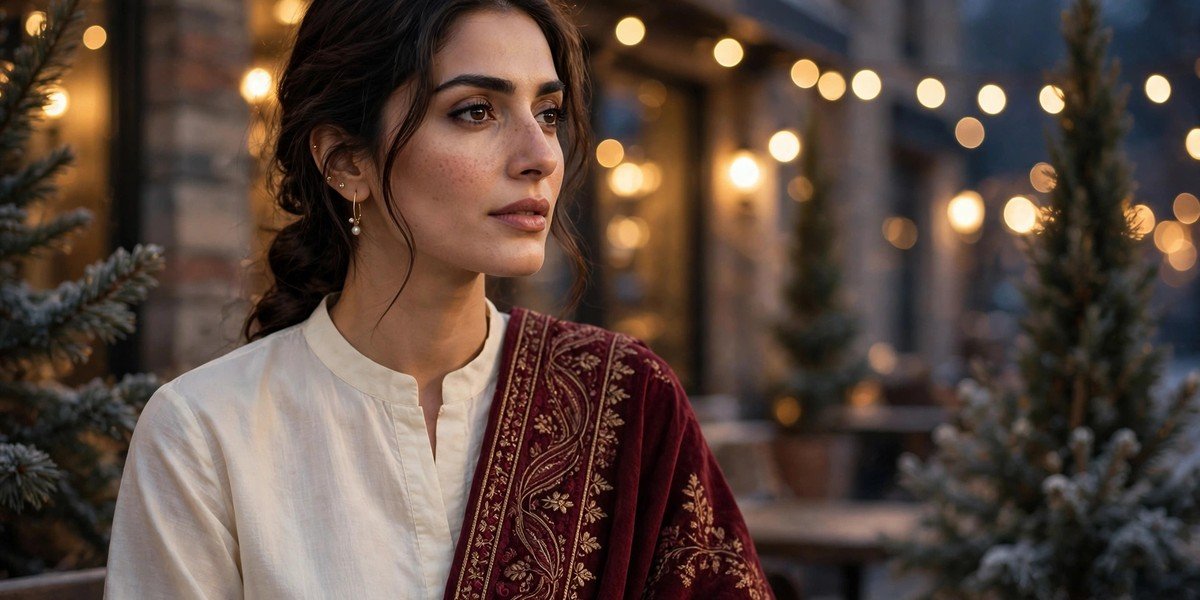
Three winters ago I went to a family dawat in Lahore wearing a shawl, and I use the word “wearing” very generously.
What I had actually done was grab my mother’s good wool shawl, wrap it around myself twice like I was burrito-ing a small child, and clamp both ends under my arms so it wouldn’t escape. I looked like a parcel. A warm parcel, granted. But a parcel. Halfway through the evening my grandmother caught my sleeve, sat me down on the sofa like I was nine years old again, unwrapped the whole thing, folded it once lengthwise, and laid it over one shoulder with about as much effort as it takes to put a towel on a rack.
“Bas?” I said. That’s it?
“Bas,” she said. “Ab lag rahi ho insaan.” Now you look like a person.
I’ve thought about that moment every single winter since. Because here’s the thing nobody tells you — a shawl is the single easiest winter layer we own, and somehow the one most of us get wrong. It slips. It drags. It bunches up at the neck like it’s trying to strangle you politely. And it’s never the shawl’s fault. It’s the drape. Thirty seconds of drape, to be specific.
So let me save you the public unwrapping by a grandmother. Here’s everything she knew, plus a few things I’ve figured out through my own extremely thorough programme of trial and embarrassment.
First, the 30-second drape check
Before any of the seven styles below, there’s a little check I run every time I pick up a shawl now. Three things. Takes no time at all once it’s a habit.
- Length check: Held up against you, the shawl should reach roughly to your knees or just above when draped, and both ends should be more or less even unless you’re deliberately doing an uneven throw. One end at your hip and one at your ankle is not a look. It’s a slow accident.
- Fall check: Shake it out and fold it once, lengthwise, before it goes anywhere near your shoulders. Shawls worn straight off the shelf, full width, no fold — that’s where the blanket effect comes from. The fold is what gives you a clean edge and a controlled fall.
- The one-free-hand rule: Whatever style you choose, you must end up with at least one hand completely free. If you’re holding the shawl closed with both hands, it isn’t styled, it’s being hosted. You should be able to hold a cup of chai, fix your hair, and hug an auntie without the whole arrangement collapsing.
That’s the whole formula. Length, fall, one free hand. Every style below passes this check, and honestly, if you only remember the check and forget the styles, you’ll still look better than half the women at any winter function. I say this with love, as a former parcel.
The 7 ways to wear a shawl
1. The classic one-shoulder drape
This is the one my grandmother installed on me, and it’s still the one I reach for most. Fold the shawl lengthwise once. Drape it over one shoulder so the front end falls to about your mid-thigh and the back end hangs a little lower. Let it sit. Don’t pin it, don’t fuss with it. The whole charm is that it looks like it landed there on its own.
It works beautifully over a plain kurta — this is the winter wedding guest uniform across Pakistan for a reason. A solid kurta, one embroidered or bordered shawl over the shoulder, jhumkay, done. It’s also lovely over a saree for evening events, where the drape continues the line of the pallu instead of fighting it.
When doesn’t it work? Very windy outdoor events, and anywhere you’ll be serving food or chasing children. A one-shoulder drape is a guest’s style, not a host’s. Learned that carrying a tray of kebabs through a garden in Islamabad. The shawl survived. The kebabs, mostly. My dignity, no.
2. The both-shoulders front drape
Both ends over both shoulders, hanging down the front, like the way our mothers and aunties have worn shawls forever — because it works. Fold once, place the middle at the back of your neck, and bring both ends forward so they hang evenly down your chest. You can leave them loose, or cross one end over the other at the front for extra warmth.
This is the warmest of the everyday styles, which makes it the office and university staple from November to February. Over a kurta it reads neat and put-together. Over a plain sweater and trousers it suddenly looks like you planned the outfit, even if the sweater is four years old. Nobody knows. That’s the magic.
One small tweak that changes everything: keep the two front ends at slightly different lengths — just two or three inches. Perfectly equal ends can look a bit uniform-ish, like a school scarf. A slight mismatch looks effortless. Strange, but true.
3. The belted shawl
Okay, this one divides families. Drape the shawl over both shoulders, front ends hanging down, and then belt it at the waist — over the shawl — with a slim belt. The shawl becomes part of the outfit’s structure instead of a layer floating on top of it. Nothing slips. Nothing flaps. You can actually move.
I actually think the belted shawl is the most underrated style on this list, especially over a plain kurta or a fitted sweater dress. It gives you a waist, which a winter outfit usually surrenders around wedding season. Same thing, calorically.
Use a plain belt, thin to medium width, no giant buckle competing with the shawl’s border. And this works best with lighter shawls — wool, fine pashmina, a soft blend. Try to belt a thick velvet shawl and you’ll look like you’re wearing a tied-up cushion. Ask me how I know. Actually don’t.
4. The over-the-head modest style
For a lot of women in Pakistan this isn’t a “style” at all, it’s just how a shawl is worn — brought up over the head, one end thrown back over the opposite shoulder, the whole thing framing the face. And honestly? Done well, it’s one of the most graceful looks there is. There’s a reason every painter who ever came to the subcontinent lost his mind over it.
The trick is in two small things. First, don’t pull it tight — let it sit a little loose around the face, with some fabric framing rather than wrapping. Second, throw one end back so the front has that diagonal line; a shawl worn over the head with both ends hanging straight and even in front can look heavy.
This style suits embroidered and bordered shawls best, because the border frames your face like it was designed for exactly that. It works over kurtas, over sarees, over abayas. For funerals and religious gatherings it’s often the respectful choice, and for a winter evening dawat it’s simply beautiful. It also happens to be the warmest style on this entire list. Ears covered. Argument over.
5. The shoulder wrap with a brooch or pin
Drape the shawl around both shoulders like a wrap, bring the two front ends together slightly off-centre, and close them with a brooch or a pretty pin. Old-fashioned? A little. Elegant? Completely. This is how you turn a shawl into something that looks like it belongs to the outfit rather than visiting it.
The pin does real work here — it means the shawl stays put through dinner, hugs, and the inevitable trip to help in the kitchen that you swore you wouldn’t take. Use a pin with some presence: an antique-style brooch, a pearl pin, even a nice safety-pin style clasp from a jewellery shop. A tiny, weak pin on a heavy wool shawl is a heartbreak waiting for its moment.
This style loves plain shawls, because the brooch becomes the decoration. It works over kurtas, over plain dresses, over a saree blouse-and-skirt, anything that gives the wrap a smooth base. It’s also the most forgiving style for shawls that are slightly too short for a full drape — pinned, nobody can tell.
6. Shawl over a coat or blazer
Here’s one most Pakistani women haven’t tried, and I don’t know why, because our winters in Lahore and Islamabad are exactly built for it. Put on your coat or blazer as usual. Then take the shawl, fold it lengthwise twice so it’s narrower, and drape it over the coat — one shoulder, or around the neck with both ends hanging in front. It sits on top like a wide, soft scarf with drama.
Why bother? Because a plain black coat worn all winter gets boring by mid-December, and a shawl changes it completely without buying anything. A maroon shawl over a grey coat one week, a cream one the next. Same coat, different woman, apparently.
Two rules. Keep the shawl narrower than usual — folded twice — or it’ll swallow the coat’s shape. And match the weight: a heavy pashmina over a structured blazer is fine, but a thick knitted shawl over a padded coat makes everyone look like they’re storing things. This style also works in reverse logic for travel — shawl over whatever jacket you wore on the plane, instant outfit.
7. The casual side throw
The lightest touch of all. Fold the shawl, drape it over one shoulder, and let it just… hang there, front end shorter than the back, completely unbothered. No pinning, no crossing, no arranging. This is the chai-with-friends style, the quick evening walk style, the “my kurta was plain and needed company” style.
Because it’s so unstructured, this one lives or dies by the shawl itself. A beautiful border, a good colour, fabric with a nice fall — the side throw shows all of it off. It’s also the best way to wear a slightly dressy shawl in the daytime without looking dressed up: throw it casually over a plain kurta and jeans-adjacent outfit and the contrast does the styling for you.
Fair warning, though: this is the style most likely to attempt an escape. It’ll slip in the car, at the dinner table, reaching for the raita. Follow the one-free-hand rule in reverse — one hand stays loosely aware of the front end, the other lives its life. After a few wears it becomes automatic, like holding a dupatta. Same skill, warmer fabric.
Shawl types and fabrics, honestly
The style only works if the fabric cooperates, so a quick, honest tour of what you’ll actually find in Pakistani shops:
Pashmina (and “pashmina-style”): The queen. Real pashmina is feather-light and seriously warm, with a soft, fine weave that drapes like water — it folds small, falls beautifully, and makes every style on this list easier. The catch is price and honesty: a lot of what’s sold as pashmina in mid-range shops is a viscose or wool blend wearing a fancy label. A blend isn’t a disaster — many are lovely — but it shouldn’t cost real-pashmina money. More on prices below.
Wool: The workhorse. Warm, sturdy, available everywhere, holds a drape well because it has some body. Pure wool can be a bit heavy and occasionally scratchy against the neck; wool blends are softer. Best for the both-shoulders drape and as an everyday winter layer. If you buy one shawl for actual cold, make it wool.
Khaddar: Thick, textured, very desi, very warm. Khaddar shawls don’t drape, they sit — which makes them great for the front drape and over-the-head style, and hopeless for the belted look or anything that needs flow. They also read casual-rustic, so pair them with simple kurtas rather than formal wear.
Velvet (makhmal): Pure wedding energy. Heavy, rich, usually embroidered or with cut-work borders, and it falls in that slow, luxurious way that photographs adore. It’s also genuinely warm. But velvet is a commitment — it’s heavy on the shoulder, it does not do casual, and a full velvet shawl in the daytime looks like you got the event time wrong by twelve hours. Save it for evenings and shaadis, where it’s unbeatable.
Embroidered wool or pashmina blends: The middle path most of us actually live on. A wool or blend base with embroidery on the borders or one corner (the palla). These are the most versatile shawls in a Pakistani wardrobe — dressy enough for a dawat, plain enough in the middle for office. If you’re buying your first “good” shawl, buy this.
Colours and pairing, without overthinking it
A few pairing rules I actually use:
- One star per outfit. If the shawl is embroidered, printed, or bright, the outfit underneath goes plain. If the outfit is busy, the shawl goes plain. Two stars auditioning at once is how you end up looking like a very warm curtain display.
- Maroon, black, and cream are the holy trinity. A maroon shawl lifts any plain black or beige kurta. A black shawl works over almost anything except a black outfit (then it disappears into it — fine if that’s the goal). A cream or ivory shawl over a deep-coloured kurta is the easiest elegant contrast there is.
- Match the shawl to your shoes or bag, not to your kurta. Tonal matching head to toe looks dated. A shawl that picks up a colour from your khussay or your clutch looks deliberate.
- Skin tone matters more than trends. Mustard is gorgeous and also makes some of us look unwell. Hold the shawl up to your face in the shop, in daylight if possible. Two seconds. Saves regret.
Mistakes that turn a shawl into a blanket
Since I began this article as a cautionary tale, let me finish the set:
Wrong length. A shawl that’s too long for your height will drag, trail, and catch on everything — chair arms, car doors, once, memorably in my case, a rickshaw. If you’re petite, look for shorter shawls or fold more aggressively. The drape should end around your knees at the longest, not audition for a train.
Both ends dragging. Even at the right length, if you don’t fold the shawl, the full width hangs like bedsheet edges. Fold once. Always. The fold is the difference between fabric and styling.
The shiny festive shawl on a plain daytime outfit. A sequinned or heavy gold-bordered shawl over a simple office kurta at 11 a.m. doesn’t look dressed up, it looks like the shawl is going somewhere better than you. Keep the glamorous ones for after dark, where they belong and where they shine, literally.
Gripping it with both hands all evening. The hostage hold. If you find yourself clutching your shawl closed at the chest for an entire event, the style has failed — switch to the pinned wrap or the belted style and free your hands. A shawl you’re fighting all night makes you look cold and cross, which is presumably not the vibe.
Wearing it over a bulky outfit. Shawl over a puffy jacket over a thick sweater — layers have a legal limit, and the shawl stops being a layer and becomes storage. Pick one warm layer to star, let the shawl be the other.
Where to buy, and what to pay (PKR, 2026)
Local markets: Liberty and Ichhra in Lahore, Tariq Road and Zainab Market in Karachi, Jinnah Super and the F-10 markaz in Islamabad — plus seasonal shawl stalls that appear every November like they were summoned. Plain wool shawls here run about Rs. 800–2,000. Wool-blend embroidered shawls, Rs. 2,000–5,000 depending on the work. Velvet wedding shawls start around Rs. 3,500 and climb with the embroidery.
Mid-range brands and mall shops: You’re paying for consistency and lighter, softer blends. Plain and lightly embroidered shawls roughly Rs. 2,500–6,500. This is also where most “pashmina” labels live, so do the touch test: real softness, fine weave, and it should feel warm within seconds in your palm.
Real pashmina: Genuine pashmina, and especially hand-embroidered Kashmiri pieces, are a different universe — Rs. 15,000 at the very low end for a plain genuine piece, Rs. 30,000–80,000 and far beyond for hand-embroidered work. Buy these from known, trusted sellers, ideally with a return promise, because this is the single most faked item in the winter market. If someone offers you “pure pashmina” for Rs. 4,000 on a sidewalk, I have a bridge in Karachi to sell you as well.
The budget sweet spot: For most women, one embroidered wool-blend shawl around Rs. 3,000–4,500 from a good market shop will do weddings, dawats, office and winter evenings for years. Buy that one well instead of three cheap ones that pill by January.
Keeping it alive: care and storage
Shawls die in storage more than in use, so: before summer, get them washed or dry-cleaned — wool and pashmina go to a dry cleaner you trust, not the home washing machine, and definitely not a hot wash unless you want a shawl for a doll. Velvet should be dry-cleaned only and stored flat or rolled, not folded sharp, because velvet creases remember.
Fold them with a sheet of plain paper or a muslin cloth between folds if you can — it stops borders and embroidery from snagging each other. Keep a few neem leaves or a lavender pouch in the box; moths consider a stored pashmina a restaurant. And air your shawls for a few hours on a breezy day once mid-summer: sounds old-fashioned, works completely. My grandmother’s shawls are older than me and softer than mine, and this, apparently, is the whole secret.
FAQs
Can I wear a shawl with a saree?
Yes, and it’s one of the prettiest winter combinations there is. Drape the shawl over the shoulder opposite to your saree’s pallu, or over both shoulders in the front drape for a formal event, so the two fabrics don’t compete on the same side. A velvet or embroidered shawl over a plain silk saree is peak winter wedding guest. Just keep the shawl’s border simpler than the saree’s if the saree is heavily worked.
How do I keep my shawl from slipping off my shoulders?
First, fold it lengthwise — full-width shawls slip far more. Second, choose a style with an anchor: pin it with a brooch, belt it, or throw one end over the opposite shoulder so the weight holds it. Fabric matters too; wool and khaddar grip, while slippery satin-backed and very smooth shawls slide. A small safety pin at the shoulder, hidden in the fold, is what half the aunties at any dawat are doing. Now you know.
How much does a real pashmina shawl cost in Pakistan?
A genuine plain pashmina generally starts around Rs. 15,000, and hand-embroidered Kashmiri pieces commonly run from Rs. 30,000 to Rs. 80,000 or more. Most shawls sold between Rs. 2,000 and Rs. 6,000 as “pashmina” are wool or viscose blends — many are genuinely nice shawls, just not pashmina, and they should be priced as blends. Buy real pashmina only from a trusted seller.
Can I wear a shawl to the office?
Absolutely — in Pakistani offices the both-shoulders front drape over a kurta is practically a winter uniform. Keep it plain or lightly bordered, fold it neatly, and avoid the very festive velvet and sequinned shawls, which read as evening wear. A shawl also solves the office air-conditioning problem in January when the heating, mysteriously, is set for a Karachi summer.
Which shawl fabric is warmest for very cold weather?
Pure wool and real pashmina are the warmest — pashmina gives the most warmth for the least weight, and wool is the cheaper, sturdier option. Khaddar is also properly warm and great for everyday wear in cold cities like Quetta or Islamabad. Velvet feels warm and heavy but is more about looks; for a Murree-in-January level of cold, layer a wool shawl over a coat instead of relying on any single shawl.
How should I store my shawls in summer?
Clean them first — dry-clean wool, pashmina and velvet — then fold them with paper or muslin between the folds and store them in a dry place with neem leaves or a lavender pouch against moths. Don’t hang heavy shawls, as they stretch, and don’t seal them in plastic in a damp room. Air them once during the summer and they’ll come back in November smelling fine and ready to work.
My grandmother, by the way, still has that shawl — the one from the dawat, hers, that I borrowed and burrito-ed. She wears it the same way she fixed mine: one fold, one shoulder, no fuss at all. Some winters I watch her get ready and think the whole fashion industry is just slowly relearning what she never forgot. Fold it once. Let it fall. Chai in one hand, life in the other.