


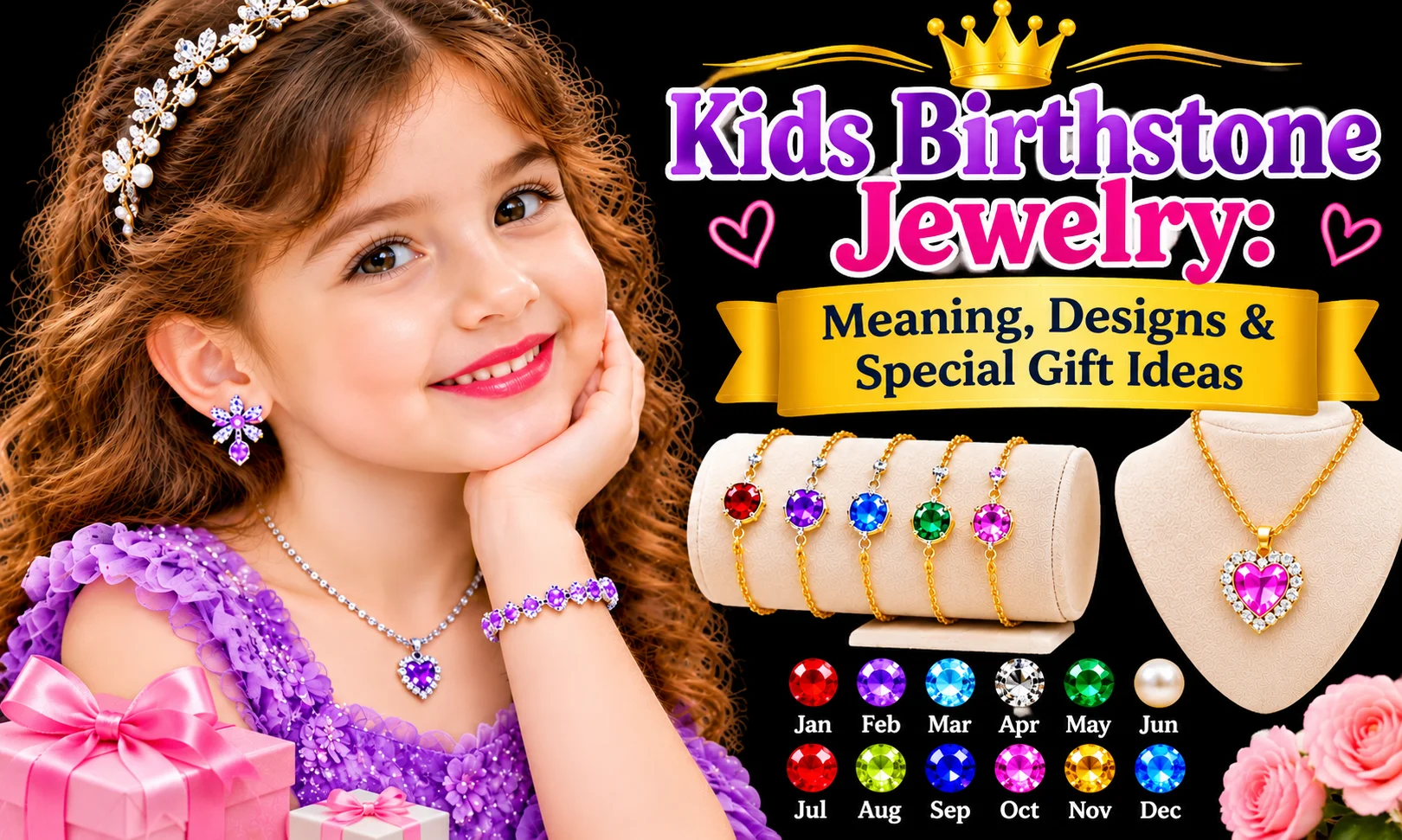
She opened the box, looked at the blue stone, and smiled. You know the smile. The polite one. The one kids do when they are trying hard not to look confused in front of everybody. We were at the birthday table, cake already cut, and her mom leaned in and whispered, that’s sweet, hers is actually opal. Sapphire is September.
Oh.
Behind me, a woman I did not know, holding a balloon for a kid who was not even mine, said, oh honey, everybody does that once. Maybe everybody does. I still heard it in my ears all the way home. Now rewind. Saturday. A little kiosk in the middle of the mall in Schaumburg, bright lights, tiny velvet trays, made me feel way too pleased with myself because I had remembered my niece’s birthday at all. Blue stone, I thought. October babies get blue, right? Paid $24, asked for the little pink box, carried it to that party like I had it all worked out.
I did not have it worked out.
That is, no joke, how most people first run into birthstone jewelry for kids. Not from a big plan. From a gift. From a month they half remember. From a kid who will spot a wrong color in about four seconds, then be sweet about it, which somehow makes it worse. So this time we are doing it backwards, sort of. We are not starting with the stone chart. The chart is coming, all twelve months of it. But we are starting where the gift actually starts. With the day. With the kid’s age. With what they will keep on past lunch. The stone is the easy bit to look up. The rest is where people trip.
The Occasion Comes First, Honestly
People say birthdays like that is the whole answer. Sure, birthdays are the big one. A kid turns seven, eight, nine, they are deep into the age where a small box that is clearly not a toy gets their full attention. They open it slowly. They read the card twice. But birthdays are not the only day this works, and some of the other days work better.
A new baby, for a start. And hold on, because a newborn is not wearing anything, we will get to that in the age part and I mean it. A newborn piece is a gift for the parents, really. A tiny stone for the month the baby came, kept in a box, brought out later. This was yours from the start. Christenings work the same way. Baptisms too, naming ceremonies, the family days where everybody dresses a bit better than usual and takes photos on the steps. A simple pendant or a locket suits those days because nobody expects the baby to wear it. It gets put away safe and brought out on other big days.
Then the school days, which I think are underrated. First day at a new school. Elementary graduation, if your school does that, lots do now. A kid walking into a new building with a small stone at their neck has a brave little thing that is theirs and nobody else’s. And the kid notices that you noticed they were nervous. That is the gift, under the gift. Holidays are trickier. Christmas, mainly. If a birthstone piece is the main gift, in a box, with a card, fine, lovely. If it is stuffed in a stocking between candy and novelty socks, it will be on the floor by noon and under the couch by New Year’s. Main gift or not at all.
And the quiet ones. A get well gift after a hospital stay. A small stone after a scary dentist thing, a cast coming off. Nobody expects jewelry then, which is why it lands. A toy says to feel better. A little stone in a box says, we saw that was hard, and you did it. Sibling gifts too. A new baby arrives, the house goes mad, and the older kid gets a bracelet with her own stone right next to the baby’s stone. She is not left out of the new thing. She is in it. Literally, her color is in it. That heads off a chunk of the jealousy before it starts. Not all of it. But some.
The box and the card are not extra
Quick thing, while we are on giving. A small box, not a bag. A bit of tissue so it does not rattle loose. That is ten cents and thirty seconds. The card matters more. Write two or three lines by hand. What the stone is. What it stands for. Who it is from. Your handwriting, wobbly bits and all. Do not print a long paragraph off the listing, kids can smell a copy and paste from across the room. That card is what stays in the box for ten years. The wrapping is in the trash by dinner.
Write the wobbly version. It is better.
How Old Are They, Really?
This is the part people skip, and it decides everything else. A pretty piece at the wrong age is just a thing in a drawer a parent feels guilty about. Drawers are full of those already. Age decides the shape. Age decides the metal you should pay for. Age decides if the thing gets worn at all, or kept, or chewed on. Yes, chewed on. We have to talk about that end of it first.
Babies and toddlers are a keepsake story
For babies, and toddlers under three, think box first. Worn second. If worn at all, and mostly it should not be. Plain version. Anything small near a baby who puts everything in her mouth is a choking risk. Stones, earring backs, little charms, all exactly the size a small child wants to test with her mouth. Chains and cords round a small neck are a strangling risk too.
So no, a baby does not sleep in a necklace. Not nap in it. Not ride in the car seat in it. Not just for a minute while you run to the kitchen. For a photo, with an adult right there, hands right there, and the piece off again the second the photo is done? That is different. That is how most of those sweet newborn pictures actually happen.
I know that sounds like a downer in a gift article. It is not. It is the bit that lets everybody relax. Buy the stone for her month, put it in the nice box, give it to her parents, and let it wait. A keepsake is meant to wait.
Four to nine is two different kids
Somewhere at four, five, six, it flips. Kids this age want a thing that is theirs out in the world. At school. At the park. Where people can see it. Keep it dead simple at the little end. Light. A short pendant that does not swing into their lunch. A soft adjustable bracelet they can get off themselves. Nothing sharp, nothing fiddly.
And expect it to come off a lot. For the playground. For swimming. For sleep. For art, dear lord, for art. Any project involving glue or glitter, the jewelry is in a dish on the counter. Make it a habit early and it stops being an argument. At four to six, losing things is not a flaw either. It is a hobby. Backpacks eat small objects. So this is the age for simulated stones and plated metal and prices that make you shrug instead of gasp when something goes missing. No shame in that. None.
Seven to nine is a different child again. Be more careful. Not careful, careful, do not get carried away, but they start knowing where their stuff is. They have opinions. Strong ones, about colors, about letters, about whether a heart is babyish now, apparently hearts become babyish at eight and a half, who knows. An initial next to their stone suddenly matters a lot. So does a charm bracelet they can add to, one charm for this birthday, one for the school play.
Ten, eleven, twelve, and the style flip
Then comes the shift nobody warns you about. The cute shapes stop working. A pendant a kid adored at eight gets left in the dish at eleven because it looks young. She did not stop liking the gift. She stopped being eight. What she wants now looks like what older kids wear, and, honestly, what adults wear. A fine chain. A small plain stone. A bracelet that stacks next to a friendship band without looking like it came from the toy aisle.
Which makes ten to twelve a good moment to spend a bit more, if you are going to. A careful eleven year old with a dish by her bed and an actual routine can look after sterling silver, a small gold piece even. She is proud of being trusted with the real thing, and that pride does half the looking after for you.
Teens? Ask them. Set the budget, let them pick the style inside it, and do not be hurt if they pick the plainest thing on the page. Plain is the point at that age.
What They Will Actually Leave On
Forget the photos on the product page. Those kids are standing still. Yours is not. A good design for a kid comes down to boring stuff. Does it snag? Does it twist? Does it itch? The best design is the one still on the child when you pick them up. Not in a pocket. Not in the mulch.
Necklaces first, because they are the easy yes
A children’s birthstone necklace is the one most people land on, and there is a reason. One small stone. Maybe an initial next to it. Short chain so it sits where you can see it and does not end up in the soup. Shapes are endless and you do not need a strong view on them. Hearts, stars, moons, little animals, or a plain round stone that reads a bit older. Let the kid’s taste lead. If she is in a dinosaur phase, a sparkly heart is a no.
The initial ones are the ones I see kept longest. In a house with brothers and sisters sharing everything down to the good socks, a letter makes it clear whose this is. Hers. Not borrow it and give it back. Hers. Lockets get their own word. A locket with a stone on the front and a tiny photo inside is old fashioned in the nicest way, and kids go quiet over them. Treasure with a secret in it. Just know a hinge is a weak spot. Open and close it when it arrives. Stiff or crooked on day one, send it back on day one. And for a young kid a locket is an occasional piece, not built for recess.
Bracelets, and why the fit is the whole ballgame
A birthstone bracelet for kids stands or falls on one thing. Can it adjust?
Kid wrists are tiny. Then, what feels like six weeks later, they are not. So look for extra links, or a sliding clasp that pulls to size, because a bracelet that fits in September and strangles by Christmas will stop being worn and nobody will say why. Charm bracelets are the classic and they have earned it. Start with the birthstone charm. Then a birthday adds a little book, a soccer ball, a charm from a trip. Slowly it stops being a bracelet and starts being a record of who this kid has been so far. Corny. Also great.
Family bracelets are the other big one. Several stones in a row, one per child or grandchild, and that is the piece grandmothers actually wear every day. Write down whose color is whose, too, on the card. Future you will not remember. And for the toddler crowd a bracelet is a photo prop, full stop. Beads and charms are mouth sized. Off it goes when the photo is done.
Earrings and rings, with a bit of care
Earrings first. Studs. Only studs to start with, small ones that sit flat. Nothing that dangles or catches on a sweater being yanked over a head by a kid who is late for the bus. That catch hurts, it can tear, and one bad yank can put a kid off earrings for a year. Look for screw-back studs. The back twists on instead of pushing on. Push backs fall off in their sleep, I swear they grow legs, and then you have one earring and a post that pokes. A screw back stays put. Freshly pierced ears follow the piercer’s rules first, though. No swapping early because a birthday is coming.
Out for swimming and contact sports. Back in after. Rings, now. I like rings. Kids like rings. And rings are still the trickiest gift on this page.
Fingers grow fast and rings do not. Snug in fall, stuck by spring, and a stuck ring on a scared kid is a bad afternoon. Rings also spin, slip off over soapy hands, vanish into sandboxes. An adjustable ring, the open kind you can widen a bit, is the only version I would give an older kid, and for under sevens I would skip rings completely and put the money into a pendant she will still have in a year.
What It Costs, and a Way to Choose That Is Not Just Scrolling
What it costs and how you pick are the same job, really. There is a smarter order than falling for a photo first. Start with the honest ranges, the same ones all through this piece. Plated pieces with simulated stones run about $15 to $40. Sterling silver runs about $40 to $120. Solid gold starts around $120 and climbs fast, and fast is doing some work in that sentence.
None of those brackets is the good one. They are different jobs. Fifteen to forty is the lose it and shrug bracket, and for a five year old that is the correct bracket. A hundred and twenty up is the hand it down bracket, and a seven year old does not need one of those no matter what a sales page says at 11pm.
Month plus metal plus length
Here is the little method that has saved me since the mall thing. It is not clever. That is why it works.
Month plus Metal plus Length.
Month gives you the stone, that part is fixed, it is just a look up. Metal comes from the kid, their age and their skin. Length comes from their age again, how long the chain is, how the bracelet fits. Settle those three and look at what is left. The style bit, hearts or moons or plain, almost picks itself out of what is left inside your budget.
And do the money as an actual sum, not a vibes based guess. Watch. Say the necklace is $58 in sterling silver. Engraving a name or date on the back, $9. A proper gift box instead of a pouch in a padded envelope, $7. Shipping, $6. Add it up and you are at $80 all in. Eighty. Not sixty is that quietly turns ninety something at checkout.
Priya, Maya, and the necklace that lasted a month
A real one now, because a sum on its own is dry as dust.
Priya wanted a gift for her daughter Maya, turning eight, September birthday, so sapphire, the deep blue one. Not for the birthday party, actually. For the first day of third grade, which in their house was the bigger deal that year. She went sterling silver, 14 inches, a small round blue stone with Maya’s initial next to it. $62 before shipping. Sensible. Thought through. Maya wore it that first morning. Took it off for gym, exactly like she was told. Put it in the front pocket of her backpack, exactly like she was told.
Gone by October anyway. Eight is eight. A pocket is not a jewelry box no matter how many times anybody says it is. Priya was annoyed, mostly at herself, then she did the smart thing. She bought the same looking necklace again in the simulated version for $26. Maya could not tell the difference. Neither could Priya, if she is honest. Neither could I.
And here is the bit that matters. The gift did not shrink when the price did. Maya still had her blue stone for her month, still had her initial, still told people September means wisdom, chin up like a tiny professor. The meaning survived the downgrade fine.
Metal, Skin, and Getting the Fit Right
These two get lumped together here because they are lumped together on a real kid. The wrong metal itches. The wrong size slides off. Either way the piece ends up in the same place, a drawer, next to a hair tie and a battery nobody can identify.
The metals, minus the sales talk
Sterling silver first, because it is where I send most people. Real silver, bright, a bit soft so it picks up little scratches, and it goes dull slowly, tarnishes, which sounds bad and is mostly just a wipe with a soft cloth to fix. Check for the 925 stamp, tiny, usually on the clasp or the back of a pendant. That stamp is how you know it is actually sterling. Then gold, and gold needs sorting out because the words get slippery. Solid 14k gold, yellow or rose, is the expensive one that earns it. No peeling. No fading. It can be worn and worn and handed on, and for a teen keepsake it makes real sense.
Gold plated is not that. Plated means a thin skin of gold over a base metal, and Gol vermeil means a thicker skin of gold over sterling silver. Better, but still a skin. Both wear at the edges in time, fastest on bracelets and rings, because they rub on everything a kid touches, which is everything. That wear is not a defect. It is friction, and it means a plated piece has a lifespan.
Stainless steel is the one nobody brags about and everybody should look at. Tough. Cheap. Does not tarnish. Great for a boy’s pendant on a cord, or any kid who is hard on their things.
Allergy bit, because there is one kid in every family. Nickel is the usual villain when jewelry makes skin red and itchy. If your child has reacted to cheap jewelry, or the metal button on jeans, assume nickel until something proves otherwise. Look for nickel free and hypoallergenic on the listing, and stick to sterling silver, solid gold, or surgical grade steel. Also check the piece is sold as lead and cadmium free. Good sellers say it right on the page, because parents ask, and parents are right to ask.
And if a rash shows up on day two anyway, off it comes. Labels are labels. Skin is skin. The skin wins.
Sizes that save you a return
Necklaces are mercifully simple. Younger kids, say four to eight, usually sit right at about 14 inches. High, visible, out of trouble and out of the spaghetti. Older kids, nine up, and most tweens, do better at about 16 inches. Already owns a necklace she likes? Measure that one end to end and copy the number. Done.
Bracelets have the finger-gap rule, which is not fancy and does not need to be. On the wrist, you want to just slip one fingertip between the bracelet and the skin. That is the fit. Can not get a fingertip in, too tight, she will take it off somewhere and that somewhere will be a mystery. Two fingers sloshing around, too loose, it will catch on sleeves and desk corners until it takes itself off.
Rings, we did rings. Growing fingers, adjustable or skip it, gift receipt in the box either way.
Before the money leaves your account
A short run through the page you are about to pay on, because this is where mistakes actually happen.
Metal, stated plainly, stamp mentioned. Clasp type, and here a lobster clasp beats a little spring ring on anything a kid will wear hard. Chain type counts too, a very fine chain snaps easier than a slightly thicker one. And the stone words, created, simulated, or natural, in writing, not in a photo caption.
Engraving? Name, date, initials, lovely. Order one to two weeks early for it, longer near the holidays, because a person does that work, a person with a queue. Then spell the name. Then spell it again, out loud. Engraved pieces often can not go back at all, which is fair, but you want to know that before tired midnight you type an extra letter into a box.
Looking After It Without a Whole Routine
Good news. Kids’ pieces do not need a spa day. They need a few small habits, and the main one is not even about cleaning.
On last, off first. That rule covers half of everything here. Jewelry goes on after sunscreen, after hairspray, after the getting dressed wrestling match. It comes off before swimming, sports, sleep, rough play, the bath. Same list every time.
The wipe helps more than you would think. Ten seconds, soft dry cloth, after wearing. That is the difference between silver still bright in spring and silver gone a sad gray. Store it in its own soft pouch or its own slot in a box, not in a jumble with six other things scratching each other in the dark.
Pearls and opals need a bit of fussing. Keep them away from perfume, hairspray, and pools. A barely damp cloth is all the cleaning they get, then back in the pouch, dry.
Once a month, tug the clasp and check the stone for a wobble. A wobble today is a lost stone in a school hallway next month.
If a stone does fall out, do not bin the whole thing in a temper. I get a temper. Still do not. Find the stone if you can, pop it in a tiny bag with the piece, take both to a local jeweler and ask. Resetting a small stone is often a small repair.
The Stones, At Last
Right. The chart. The part half the people reading this scrolled for, and I made you wait for it, and I am not even sorry. You needed the age and clasp stuff first.
You do not have to learn these by heart. Nobody does. I say that as a woman who bought a blue stone for an October baby in a mall, out loud, with confidence. What is worth picking up is the color and the little line of meaning, because that line goes on the card, and it is the bit kids keep. Mine means brave. Mine means calm.
The first half of the year
January is Garnet. Deep red, prettier than the red you are picturing, not cherry sweet red, more like jam held up to a window. People link it to protection and loyalty. It is one of the tougher stones here too, so it behaves in pieces that get knocked about.
February is amethyst, purple, from a pale lilac wash to a dark grape that looks nearly black till the light catches it. The meaning is calm, calm and clear headed. February parents say that one with a lot of hope in their voice.
March is aquamarine. Pale blue, pool water first thing in the morning before anybody jumps in. Calm again, but with courage tucked in next to it, and calm and brave at once is kind of the whole job description for a school kid. It is a harder stone, and light blue goes with everything a kid owns.
April, slow down. April’s stone is diamond, clear, bright, and stands for strength. And a real diamond is a poor buy for a small kid. I actually think tiny real diamonds for little kids are overrated. The stone is hard, sure, the hardest one here. But the pieces cost real money, the settings are small and fiddly, one lost earring is a bad night, and a five year old sees a clear sparkly thing that looks just like a crystal or cubic zirconia. Buy that instead. Same strength line on the card, and a lost stud is annoying instead of a family meeting.
May is emerald. Green, properly green, garden after rain green. Hope and new beginnings, which fits May so well it feels rigged, everything blooming, school nearly done. Real emeralds are on the soft side and most have little flaws inside, normal for emeralds. On a kid’s bracelet headed for a playground, a lab created or simulated green often makes more sense. She is not checking it with a loupe. She is checking if it is green. It is green.
June has options, which confuses people more than any other month. The main stone is a pearl. White, soft looking, purity and a quiet newness, which is why pearls turn up so much for newborns. June also has alexandrite, which changes color in different light, and moonstone, with its milky glow. Pearl too formal? Pick one of those. One real caution though. Pearls are delicate. They scratch, they hate sprays, they do not want to swim. One small pearl on a pendant, off before play. That is the shape that works.
The second half of the year
July is ruby. Red, a different red from January, brighter, louder. Love and protection. A July kid is not after a shy gift, in my experience, and ruby does not give them one. Ruby is hard, which helps, but real ruby gets pricey fast even small, so plenty of July pieces use a lab created ruby or a good red crystal.
August is peridot, light green, nearly yellow green, new leaves with sun behind them. The meaning is happiness. Just happiness. Bare feet, no school yet, nobody thinking about September. Peridot is not the hardest stone here, so pendant over ring, a ring meets every door handle in the county.
September is sapphire. Blue, the deep classic blue. Wisdom and trust. Yes, the stone from my story at the top. Sapphire is hard and wears well, one of the best real stones for a piece that will actually get used.
October. My nemesis. October is opal, white with little flashes of pink and green and blue moving inside it as the light changes. It will not sit still and be one color. Creativity is the meaning, and it fits. The other October stone is pink tourmaline, clear cheerful pink, harder, often easier in a kid’s piece. Because opal is soft. It can crack if knocked, it does not love water or a rough day. Opal pendant for nice occasions, good. Opal ring at recess every day, that stone is on borrowed time.
November is citrine, yellow, warm, pale lemon to nearly amber. Joy and energy. Citrine is friendly to buy, pretty, hard enough for a pendant or studs, priced so your eyes do not water, which matters in November because those birthdays land right in the run up to the holidays. Gold tone metal with a yellow stone looks planned together. They sort of were.
December is turquoise, and we are done. Blue again, nothing like sapphire blue. Flatter, milkier, sometimes dark lines through it. Luck and friendship. People have given turquoise for a very long time, and there is something plain and unshowy about it that suits December, a month already doing plenty. Turquoise is softer and a bit porous, so out of pools, away from sprays. A pendant will outlast a ring in most kids’ real lives.
Created, Simulated, and the Words That Trip People Up
Short part. Important part. Product pages use two words that sound the same and are not, and this is where people feel tricked when mostly they got beaten by vocabulary.
A lab created stone is a real stone. Chemically the same as one that grew in the ground, it just grew in a lab instead of in rock over a very long time. A lab created sapphire is a sapphire. They cost less, look cleaner, and for a necklace a kid will love hard and lose anyway, that trade makes sense. It made sense to Priya.
A simulated birthstone is a lookalike. Not that stone. Crystal, glass, or cubic zirconia colored to match the month, so a simulated emerald is a green stone doing a very good emerald job, and there is nothing wrong with that if you knew it is what you paid for. The trouble is paying real stone money for a simulated piece because the listing was vague and you were shopping at midnight, tired, one eye open. Been there. Awake, in a mall, still got it wrong.
So read the word. Created, lab grown, simulated, crystal, natural. Five different stories. And natural, at the top of the price pile, has its place, a keepsake, a teen who will care for it. But natural does not mean tough. Sometimes paying more gets you a more delicate stone.
Why a Small Stone Sticks in a Kid’s Head
Right at the end, the bit I could have put at the top, because it is why any of this works.
A birthstone is personal without being heavy. It says, I know when you were born. I know which one is yours. I picked it on purpose, for you, not for a generic kid. For a child working out who they are in those literal ways kids do, my color, my number, my month, my stone, that lands.
It works across ages too, which most gifts do not. A grandmother who can not keep up with whatever cartoon has taken over the house this month can still get a stone right. Probably. Check the month first. And when her stone sits next to her grandchild’s in one piece, the whole story is just there in the metal, no speech needed.
And boys, since it keeps coming up. Boys wear kids’ birthstone jewelry too. A stone on a dark cord. A plain bracelet. A dog tag shape with a small stone in the corner. My nephew would not have touched anything sparkly at nine, not where his friends could see. A plain pendant on a cord, though? He wore it till the cord gave up.
Money does not change any of this either. A thoughtful cheap piece beats an expensive wrong one. I have the little pink box to prove it.
FAQs
How far ahead should I order a personalized piece?
Give it one to two weeks, minimum, and more if a holiday is anywhere near. Engraving is a person doing careful work with a queue, then shipping does what it wants on top. The buffer is the difference between handing over a box and handing over a phone with a tracking page on it.
Can boys wear it too?
Yes. Give him a say in the style, keep it plain if plain is what he wants, a cord pendant or a simple steel bracelet, and he will wear it. That is the whole answer, really.
What if the stone falls out or the piece breaks?
Do not throw it away in the heat of the moment, and do not glue it yourself. If you have the stone, bag it up with the piece and take both to a jeweler for a price. Small stones going back in is often a modest job. On a cheap piece, a new one can cost less than the fix.
What age can a child actually wear birthstone jewelry?
Depends on the child and the hour, but here is the shape of it. Under three, do not. Keepsake in a box, or on for one photo with your hands right there, then off.
From about four or five, short wears with an adult around are fine. A pendant for a family dinner, off again for the park, for swimming, for bed. From around seven, plenty of kids can wear a simple piece through a normal day, though see Maya and the backpack pocket above. Eight is eight. Expect a loss somewhere in these years and buy like you expect it.
Is it okay to give family stones instead of just the child’s own?
Yes, families do it all the time. A piece with a stone for each child, or each grandchild, tells a bigger story than one stone does, and kids hunt for their own color in the row every single time. Just write whose stone is whose on the card. You think you will remember it in five years. You will not.
What if my child was born right on the edge of two months?
Pick either. Some families go with the month the baby was due, some with the color the kid actually likes. Nobody checks your pick against a chart later. The stone police are not real. I checked, after the mall.
How do I clean a child’s birthstone piece?
Warm water, one drop of mild soap, soft cloth. Wipe, rinse, pat dry. That covers silver, gold, and most hard stones. Pearls and opals skip the soak, barely damp cloth only, then away dry. Skip harsh cleaners too. Small settings do not need that much power.
Are real birthstones worth it for kids?
For little kids, no, no drama attached. A real stone costs more, looks the same to a six year old as a lab created or simulated one, and hurts a lot more when it goes missing, and things go missing. That is not a flaw in your child. That is childhood.
Where it really starts to make sense is later. A careful eleven or twelve year old. A teen who kept the cheaper piece alive for two years and proved the point. A keepsake for a family means to hand it down. Then yes. Till then, buy the color, buy the meaning, buy the clasp that works.
The little pink box from the mall is still around here somewhere, wrong blue stone and all. Nobody threw it out. Get the month right if you can, write the card by hand, and let the rest be a bit loose. It is a small stone. It is not a small thing to a kid, and that is enough.