


So Zain shows up to his own engagement dinner dripping in gold, three rings on one hand, a chain you could probably tow a car with, a beaded bracelet stacked right next to a watch that cost more than the suit he had on. His fiancée’s aunt just looks him up and down, dead serious, in front of the entire table, and asks if he’s wearing all of that on purpose.He wasn’t.
Didn’t know any better, is the honest answer, and nobody really does until somebody sits them down and walks them through it. That’s the whole problem with jewelry for men. Women grow up around magazine columns, YouTube tutorials, mothers who somehow already know all of this without being taught. Guys mostly just wing it: trial and error, copying whatever an older brother does, grabbing something off a mall kiosk two days before a wedding and hoping nobody asks where it’s from.
So here’s the actual breakdown: what’s out there, what’s worth spending money on, and how you avoid becoming Zain 2.0 at your own dinner.Not trying to make you the guy who clocks a fake watch from across a room here. Just the basics nobody sat down and explained properly the first time.
The Main Types of Jewelry Men Actually Wear
Start simple. There are really only six categories most guys need to know about, and you almost certainly don’t need all six.
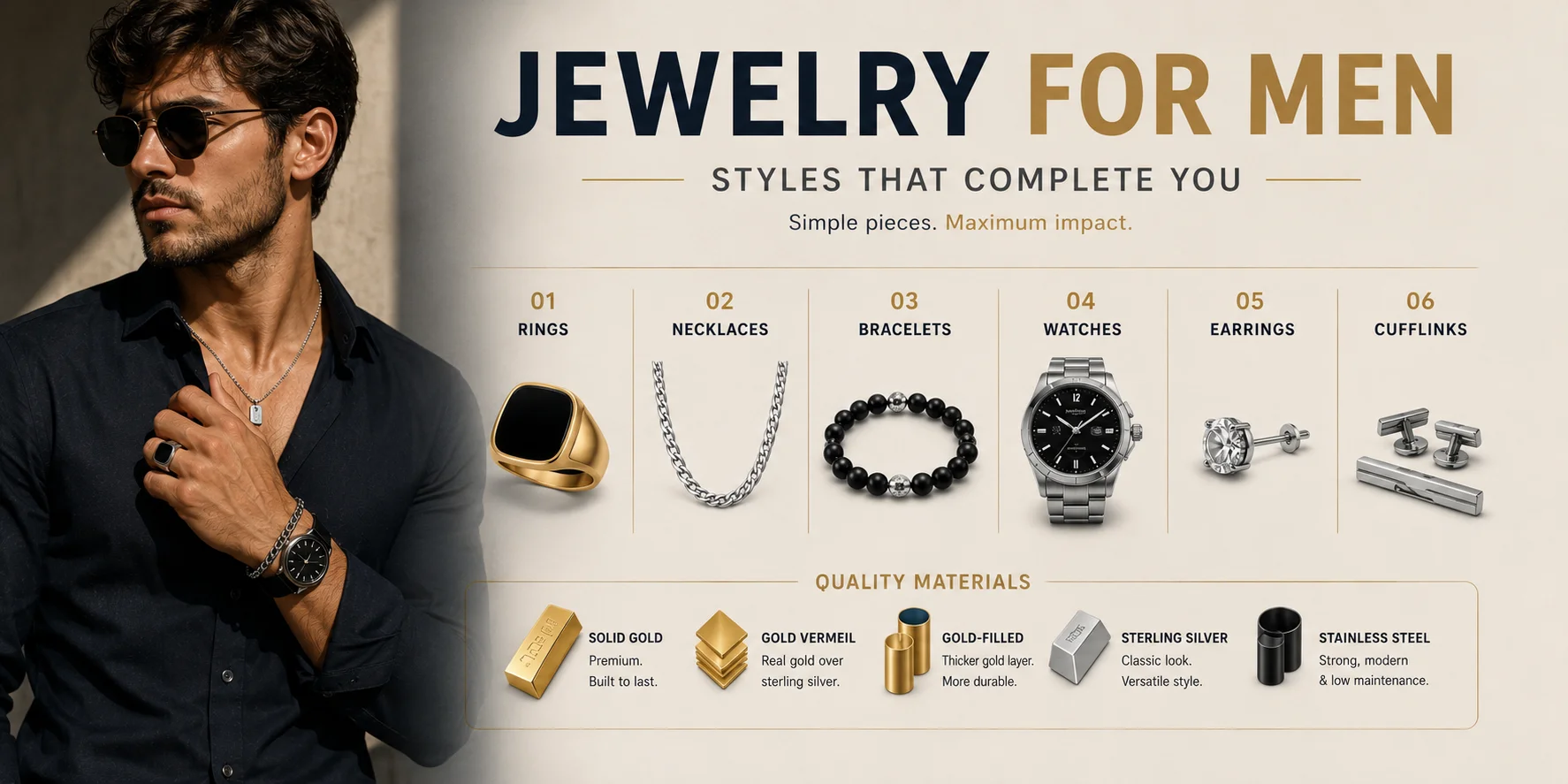
Rings. Signet rings, plain bands, the occasional statement piece with a stone or an engraving if that’s your thing. A signet ring is arguably the single most “put together” piece a man can wear, and it’s been that way for a few hundred years now. Traditionally worn on the pinky, though plenty of guys wear one on the ring finger too these days. Wedding bands play by their own rules, since they’re one of the only rings a guy wears every single day for decades. Comfort and durability matter here more than anywhere else on the list, more than most guys think about before they buy one.
Chains and necklaces. Cuban links, box chains, rope chains, thin pendant chains, take your pick. This is the category that gets guys into trouble fastest, and not because the options are complicated. It’s the size that trips people up. Go bigger and it doesn’t automatically look better, and the length matters way more than most guys ever stop to think about. Typically these run 16 to 24 inches. Anything under 18 sits high and tight, almost choker-like. Anything over 22 disappears under a shirt collar before you know it. 20 to 22 is the sweet spot for most guys and most shirts, neck depending.
Bracelets. Leather cuffs, beaded bracelets, chain-link, ID bracelets. Easy to wear, easy to layer, and probably the hardest category on this whole list to get wrong, even by accident.
Watches. Technically jewelry, and the one piece almost every guy should own before anything else here. Quartz if you want cheap and close to maintenance-free, which is most guys honestly. Automatic if you don’t mind paying more, winding it now and then, or just wearing it enough that it stays accurate on its own, and there’s something to be said for how much more special that feels on the wrist even if nobody else notices. One dress watch with a leather strap, one everyday watch with metal or rubber, and you’re covered for basically anything that comes up.
Earrings. Studs, mostly, though small hoops show up on some guys too. Whether this one works for you comes down to your industry honestly, and your own style, and frankly how much you care what other people think, because people are going to think things regardless of what you decide. A single stud sits differently on a guy than a matching pair does. Quieter. Easier to miss if you’re not looking for it. That’s probably the reason so many guys start there with a first piercing instead of going straight to both ears.
Cufflinks and tie bars. Only relevant if you wear a lot of dress shirts, but when you do, this is the detail that separates “dressed up” from “put together, full stop.” A silk knot works in a pinch if you don’t own cufflinks yet. I’d stick to simple metal cufflinks in a tone that matches your watch or belt buckle, close to foolproof as this stuff gets. The novelty ones, tiny golf clubs, whiskey glasses, whatever, can wait until you’ve already got a plain pair sitting in the drawer.
That’s it. Six categories. Some guys try to wear something from all of them at once. It’s a lot.
A Quick Word on Materials
Solid gold’s the real deal, no question, the stuff that won’t tarnish or fade and will genuinely outlast you by generations if you take even minimal care of it. It’s also expensive, and a little overkill for your first few pieces if you ask me, because you’re going to bang that ring against a doorframe or a gym rack within the first month of owning it and feel sick about it.
Gold vermeil is a much better place to start than most guys realize. It’s sterling silver with a real, reasonably thick layer of gold over the top. Looks like gold, wears like gold for years if you take care of it, costs a fraction of the solid stuff. I think it’s underrated for anyone just getting into this.Gold-filled is a step above that, mechanically bonded rather than just plated on, and noticeably more durable for daily wear.
Then there’s gold plated, the cheap end of things. Thin layer, wears off within months, and on some guys it’ll turn the skin a faint green. I paid something like 40 dirhams for a chain from a stall in Dubai’s gold souk once, on a dare, expecting nothing good. My neck turned faintly green by day three. Worth it for the story I still tell people. Not something I’d wear daily, not even close.
Stainless steel and titanium do the heavy lifting in men’s jewelry, the stuff you wear every day without babying it. Doesn’t tarnish. Doesn’t turn your skin funny colors. Takes a beating and just keeps going, which is why it ends up on watches and gym pieces and anything else that’s going to see real abuse day to day. Sterling silver lives somewhere in the middle of all this. Real, it’s classic, and yeah it tarnishes eventually, but a polishing cloth sorts that out in under a minute so it’s hardly a dealbreaker.
The Karat Thing, Briefly
Karat’s just a measure of how much actual gold is mixed into the metal, 24 parts total. Pure gold is 24 karat, and it’s too soft on its own for most everyday jewelry, so you mostly see it saved for certain cultural pieces rather than something you’d wear to the gym. Drop down to 22 karat and that’s the stuff filling South Asian and Middle Eastern jewelry counters, including plenty of what’s sitting in Dubai’s gold souks right now, noticeably richer and deeper in color than what most Western shoppers are used to seeing. 18 karat is the Western fine-jewelry standard, wedding bands especially, a decent balance between purity and something that’ll survive daily wear. 14 karat is what most of America wears day to day, tougher, cheaper. 10 karat is about as low as it goes and still gets to call itself gold, legally speaking. Mostly you’re paying for durability at that point, not the metal.
I check for a stamp now before I buy anything, tiny thing, usually hiding inside the ring band or right by the clasp, something like 14K or 925 for silver. No stamp doesn’t automatically mean it’s fake, but it’s enough for me to start asking questions before any money changes hands. Started carrying a cheap magnet around too, which feels a little ridiculous pulling out at a jewelry counter if I’m honest, but real gold and silver won’t stick to one, so a piece that snaps on hard is telling you something. Not a perfect test. Some fake alloys dodge it too. Still, better than walking in blind.
Skin Tone Matters More Than You’d Think
Here’s a thing almost nobody mentions to beginners. Flip your wrist over under natural light and look at your veins for a second. Read more green than blue? You’re warm-toned, and gold’s going to sit better on you, yellow gold especially. More blue than green, you’re cool-toned, and silver or white gold or platinum is usually the sharper call. Not a hard rule. Plenty of guys break it and look great anyway. But if you’ve ever bought a ring and felt like something was a little off without knowing why, this is usually why.
Not sure which camp you’re in? Hold a gold piece up against your wrist next to a silver one, in actual daylight and not whatever fluorescent lighting the store’s using, and just look. One of them’s going to sit better against your skin than the other, and you’ll probably know which the second you see it side by side like that.
Finding a Style That’s You
Jewelry’s got genres, kind of like music does, and nobody really explains that part either. Most guys end up wearing a genre that has nothing to do with the rest of their closet.
Minimalist. One thin chain, one simple band, maybe a small stud if that’s your thing. Quiet. Doesn’t compete with whatever you’re wearing. Ages fine over the decades too, which not everything on this list can say. Start here if you’re not sure yet, honestly, since it’s close to impossible to get wrong.
Classic and heritage looks like signet rings, leather-strap watches, cufflinks, the whole tie-bar situation, and it’s basically the office-appropriate lane of the four. Reads as “put together” even to people who couldn’t care less about jewelry, which describes most of the working world.
Streetwear and statement goes the other way entirely. Chunky Cuban links, stacked rings, layered bracelets, sometimes a grill if you’re really committed. Bold on purpose, and it works when the rest of the outfit is loud too. It looks strange with a suit though, and I’ll say it plainly: a thick chain over a dress shirt and blazer is trying way too hard.
Last one’s vintage. Pocket watches. Antique-style signets. Or, if you got lucky, an actual heirloom somebody in your family held onto longer than you’ve been alive. Less about buying something new here, more about what gets handed down, or what you happen to stumble on secondhand at a flea market some Saturday.
Notice how some guys just look put together without seeming to try? Nine times out of ten it’s because they picked a lane and stuck to it, instead of grabbing a bit from all four like a buffet.
Doesn’t have to be forever, this lane you pick. Give it six months, though, before you start bouncing between all four, because that’s usually what makes a guy look intentional instead of just undecided.
How to Wear Men’s Jewelry (Without Overdoing It)
Rule that works, almost every time, especially if all of this is new to you: watch, plus exactly one more thing. That’s really the entire formula, nothing more complicated than that.
Try this if you’re starting from zero:
- Watch plus a simple ring. Band or signet, nothing loud.
- Watch plus a plain chain. No pendant, no charms, just the chain itself.
- Watch plus a bracelet. Leather or beaded, something that doesn’t clank around.
Live with that combination for a while, a few weeks or a whole season, whatever feels right. Once it stops feeling like a costume and starts feeling like just… you, add a second piece. Keep the metals matching while you do it, gold with gold and silver with silver, at least until you actually know what you’re doing. Mixing them on purpose is a move some guys pull off eventually. Not one to start with.
Once you’re comfortable, try layering two chains instead of one. Shorter one sits up near the collarbone, longer one hangs underneath it, and different textures help if you can manage it, a flat box chain against a rounded rope chain works well together. Keep the metal tone the same even as the shapes change.
By Occasion
- Office or work. Minimal. Watch, one simple ring, subtle cufflinks if your shirts take them. Skip anything that makes noise when you type or clicks against your keyboard all day.
- Casual, weekends. This is where you get to have some fun with it. Layer a bit more. Add the second ring. Wear the chain that has some actual personality to it.
- Weddings and formal events. Watch, one ring, cufflinks if it’s a proper French cuff shirt. Leave the chunky chain at home, or wear something so thin it basically disappears under a dress shirt collar.
- First dates or job interviews. Treat it like the office rule, but dialed back even further. This isn’t the moment to introduce three new pieces someone’s never seen on you before.
- Gym and daily grind. Stainless steel or titanium only. Rings come off before you lift, every single time, unless you enjoy a trip to the emergency room.
Most guys overthink the wedding one and completely underthink the office one, and it’s usually the reverse of what it should be.
Building a Collection Over Time
Nobody needs all of it on day one. Trying to buy all of it on day one is exactly how a guy ends up with a drawer full of stuff he never wears.Watch first. Non-negotiable, and it’s the one piece that gets used daily no matter what else ends up in the collection. Then one everyday piece, the ring or chain from the formula above, worn constantly for a few months before anything new gets added.
Once that feels completely normal, occasions start to matter. Something nicer for going out, something tougher for the gym, cufflinks eventually if formal events keep showing up on the calendar. No rush on any of it. Some of the best-dressed guys out there took three, four years to build what they’ve got, one piece at a time, instead of one manic weekend at a mall.
Tight budget’s genuinely fine too. One good stainless steel watch and a single gold vermeil ring will beat five cheap pieces bought in one afternoon, no contest. Think less shopping spree, more slow build, the kind of collection you’ll still be reaching for a decade from now.
Common Mistakes (That Almost Every Guy Makes at Least Once)
Mixing metals badly. Not on purpose, just by accident, because the watch is silver and the chain is gold and nobody noticed until a photo showed up online.
Buying cheap chains for daily wear, then acting surprised when they turn a wrist or a neck green within a week. That’s not a you problem. That’s just cheap metal doing exactly what cheap metal always does.
A ring that’s the wrong size causes its own quiet disaster. Spinning around your finger all day, or worse, cutting off circulation by dinner, because getting it properly sized felt like one extra errand nobody had time for. Takes a jeweler about ten minutes. Save yourself the swelling.Ignoring scale, too. Five-foot-six guy in a chain built for someone twice his size just ends up looking like he raided his older brother’s closet, proportions and all.
Skipping the hallmark check, especially on a market stall or an online listing that seems a little too cheap for what it claims to be. Takes five seconds. Saves a lot of regret.And this one’s underrated: never maintaining anything. A quick polish now and then. Keeping things dry. Taking rings off before a shower instead of after you’ve already noticed the tan line starting. Small habits though. That’s really the whole difference between jewelry that still looks good in five years and jewelry that’s already looking tired after one season of getting ignored.
Anyway. Remember Zain?
What Happened With Zain
Someone, thankfully, pulled him aside a few weeks after that engagement dinner and explained the watch-plus-one rule.
He ended up selling two of the three rings back to the shop, for less than half what he’d paid originally, which stung, lesson very much learned the expensive way. Kept the watch. Kept one plain gold chain. Dropped the bracelet completely. Wore exactly that, nothing more, to the actual wedding three weeks after the dinner that started this whole thing.
His mother-in-law told him he’d grown up. He hadn’t really, not in any way that counted. He’d just stopped wearing his entire jewelry box to one event, and apparently that’s close enough to the same thing for most people.
FAQs About Jewelry for Men
Is it okay for men to wear jewelry at work? Depends entirely on the office you’re walking into. Watch and a simple ring, most places won’t even register it. Three stacked rings and a visible chain at a law firm, though, people are going to notice that. Creative fields give you a lot more room to work with.
What should a beginner buy first? Watch. That’s genuinely the whole answer if you want the short version. Everything else can wait a few months. Buying five pieces in one excited afternoon just means a drawer full of stuff that never leaves the box.
Can men mix gold and silver jewelry? Eventually, sure. Guys who’ve been doing this a while mix metals on purpose and it reads as intentional. Early on, it usually just looks like you weren’t paying attention. Match your metals until you’ve got a real reason not to.
How many rings is too many? Two per hand, roughly, before it tips into cluttered. Though if we’re being honest, one ring does the job for most guys most days.
Does men’s jewelry need special care? Depends what it’s made of. Silver wants an occasional polish. Gold barely asks for anything. The cheap plated stuff needs babying: dry storage, no showers, and it still won’t last forever no matter how careful you are with it.
Is a signet ring old-fashioned? Used to get called that. Not so much anymore. Plain, unengraved signets have had a real comeback the last few years, and at this point they read classic more than dated.
What chain length should I get? 20 to 22 inches, for most necks and most shirt collars. Shorter if you like it sitting higher and tighter. Longer if a second chain’s coming eventually and you want room to layer.
Is it weird for a man to wear a necklace with a pendant? Not if the pendant means something. A religious symbol, an initial, something with a real story behind it, all of that’s fine. The random decorative pendant with no reason for existing is the one that reads a little try-hard.
How much should a beginner budget for their first few pieces? Less than people assume. A decent steel or titanium watch runs fifty to a few hundred dollars. A vermeil chain or ring, similar range. Save the real spending for later, once you know what you’ll wear every day instead of guessing.
Do I need to match my jewelry to my belt and shoes? Not as strictly as the old style guides claim. Keeping metals roughly consistent still looks sharper than mixing everything at random. Call it a guideline, not a law.
Should I take jewelry off before sleeping or showering? For anything plated or delicate, yes, always. A steel watch or a solid gold band can handle it fine. Plated stuff in the shower every single day is basically speedrunning its own death.
Jewelry’s supposed to be the last five percent of getting dressed, not the whole outfit. Start with one piece. See how it feels for a while. You can always add more later.
You can’t really take back an aunt’s comment at your own engagement dinner, though.