


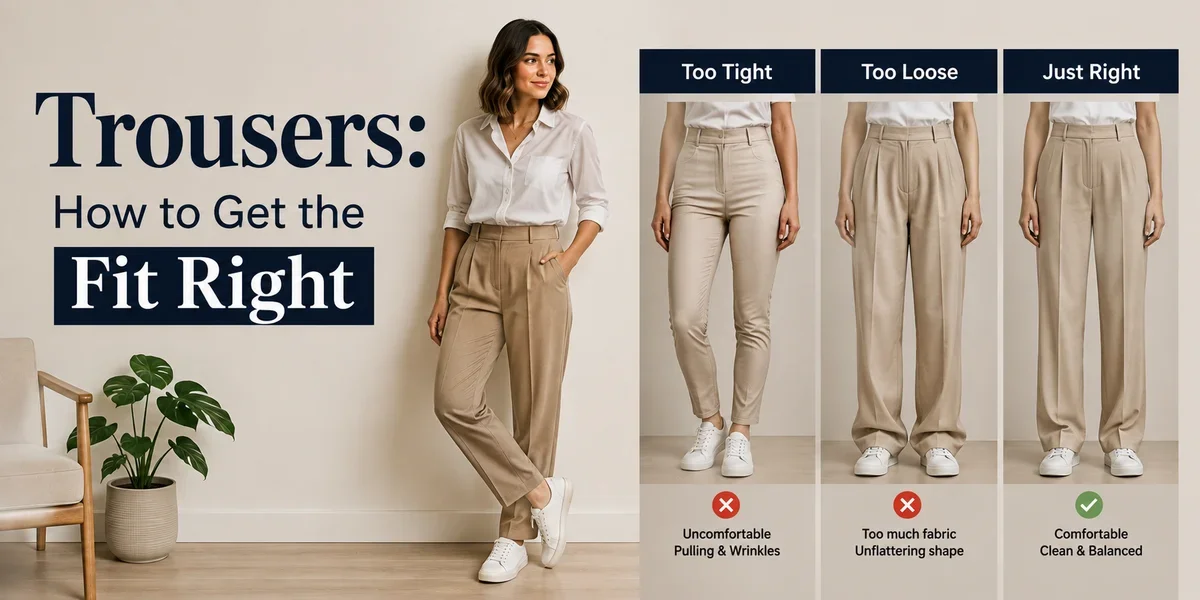
There’s a photo of me from a cousin’s wedding in 2019 that I’ve genuinely never been able to look at.
Grey trousers, bought the week before for 3,200 rupees, from a shop with one of those mirrors that makes everything look about 20% better than it is. The salesman said they’d “sit down” after a few wears. That was his exact phrase and I nodded like I understood it.
They never sat down. What they did instead was pull across the thigh in diagonal creases that fanned out from the crotch like bad WiFi bars, and the hem collapsed over my shoes in a little puddle, and the seat went shiny inside four months from an office chair.
I wore them for two years anyway. Because I’d already paid, and throwing away money you’ve spent feels worse somehow than looking bad in it.
Anyway. That was the education.
The thing nobody warned me about, and the thing that took me an embarrassing number of wrong purchases to actually absorb, is that trousers are the hardest garment in your wardrobe to buy. A shirt that’s slightly off you can rescue. Tuck it, roll the sleeves, throw a jacket on, stand at an angle. Trousers won’t let you do that. They’re half your visible body and they either work or they announce, in every photo anyone takes of you for the next three years, that they don’t.
So. Everything I’ve worked out since, mostly by getting it wrong first.
Why this is harder than shirts
Four measurements are working at once. Waist, seat, thigh, inseam. Get three of them right and miss one and the whole garment reads wrong, and the annoying part is that you usually can’t tell which one is broken. You just know something’s off.
Waist too loose and the trousers hang low on your hips. That drops the crotch, which shortens your leg line, which makes you look shorter than you actually are. Strange trade for a bit of comfort.
Waist right but seat too tight, and now there are horizontal pull lines across your backside. You will never see these in your life. Everyone walking behind you sees them all day.
Thigh too tight gives you the diagonal creases I mentioned. Thigh too loose and the fabric caves inward and you get a sort of droop between knee and hip that reads as sloppy even when everything else is clean.
Inseam wrong is the most common failure of all and there’s a whole section on it further down.
Here’s the structural reason all of this keeps happening to people. We buy trousers standing still. Good lighting, facing a mirror, slightly posed, sucking in maybe five percent without noticing we’re doing it. Then we go and wear them sitting, walking, taking stairs two at a time, crossing legs in a meeting, crouching down to plug something in behind a desk. Totally different loads on the cloth.
Shirts have give in them. Trousers barely do.
Rise. Start here, honestly.
Rise is the measurement from the crotch seam up to the top of the waistband. Nothing more complicated than that. And it’s the most ignored number in the whole category, which is odd, because it changes how you look more than fabric or cut or colour does.
Rise decides where your waist visually sits. And where your waist visually sits decides how long your legs look. That’s the entire mechanism.
Low rise sits down on the hips. It cuts you at the widest part of you and shortens the leg. Some people wear it genuinely well and I’m not going to pretend they don’t. Most of us aren’t those people.
Mid rise sits just below your natural waist. Safe default. Nearly every high street brand builds here because it offends nobody in particular.
High rise sits at or slightly above your natural waist, roughly where your torso is narrowest. For most human bodies this is the most flattering option available and it isn’t a tight contest. It’s also why old photographs of men in 1940s suits look so unreasonably good. Their trousers came up to their actual waist rather than their hips.
I switched to higher rise about four years ago and it’s the only clothing decision I’ve ever made that people commented on without understanding why. Two colleagues asked me separately, within about a month of each other, if I’d lost weight. I hadn’t lost anything. My trousers just started in a different place.
One catch though. High rise needs a top that plays along. A long untucked shirt hanging over a high rise trouser looks like you’re hiding something, because you’ve covered up the one feature that was doing all the work. Tuck it in, or wear something short enough that the waistband shows.
Fabric, and how the same pattern turns into a different garment
Two pairs of trousers. Identical cut, identical size, same factory. Different cloth. They will not fit the same. Won’t drape the same, won’t crease the same, won’t die the same way either.
Wool is the best trouser fabric ever made and I’ll happily argue that with anyone. It breathes properly. It resists wrinkling, drapes with real weight, holds a crease for days. Tropical weight wool, call it 7 to 9 oz, works in serious heat far better than almost anyone expects, because wool moves moisture out instead of just sitting in it. Heavier flannel at 11 or 12 oz is winter cloth and feels lovely and costs a bit. The downsides are price and slightly fussier care.
Cotton covers chinos, twill, corduroy, canvas. Cheap and tough, machine washable, no drama at all. It wrinkles fast though, and it doesn’t drape. Cotton sits closer to the leg and reads casual by default. Which is often precisely what you’re after, so no complaints there.
Linen is wonderful for four months of the year and a bit of a mess for the other eight. It creases the second you sit down. If wrinkles bother you, just skip it, don’t try to win that fight. If you can accept that rumpled is the actual look, nothing else feels that good at 42 degrees.
Polyester and blends. Some blends are decent now. That four to six percent elastane in a cotton trouser is doing real comfort work and I’m not snobby about it. But full polyester doesn’t breathe, holds smell in a way you notice by evening, and picks up a plasticky sheen after a dozen washes. There’s a reason every cheap uniform trouser on earth is made of it.
Denim technically belongs in this category but it has its own universe of rules and its own arguments, so I’m leaving it mostly alone.
Weight beats fibre
This is the bit people never check, and it decides how trousers hang.
Heavier cloth falls straighter. It hides small fit problems, moves properly when you walk, doesn’t cling. Lightweight cloth does the opposite. It shows every line underneath and telegraphs cheapness even on a garment that isn’t cheap.
If you’ve ever put on a pair and thought why do these look flimsy, nine times out of ten the answer is weight. Not fibre content, not the brand.
You can test it in a shop without knowing any numbers. Pinch the fabric and let it drop out of your hand. If it falls and hangs, good sign. If it floats or crumples on the way down, it’ll do that on your leg too.
Cuts, and what each one mechanically does
Set the trend conversation aside for a second. Here’s what each shape does to your outline.
Straight is the same width from knee to hem. Boring in the best available way, works on nearly everyone, goes out of style very slowly. If you’re starting from nothing, start here.
Tapered is roomy through seat and thigh and narrows from the knee down. If you’ve got muscular or fuller legs, this is your cut. The narrowing at the ankle stops the whole thing reading baggy.
Slim is narrow throughout. Fine if you’re built for it. The failure mode is genuinely unpleasant though, because slim trousers on legs they weren’t cut for will pull at the thigh and wrinkle sideways and look like they’ve been borrowed off a smaller sibling.
Wide leg runs full from hip to hem. Extremely comfortable, currently everywhere, and it wants either some height or a high rise or it just swallows you whole. Fitted top, always. Wide up top plus wide down below is one big rectangle with a head on it.
Pleated adds room across hip and thigh without adding waist. Mocked for twenty years, back now, because it solves an actual physical problem.
Flat front has no pleats. Cleaner to most eyes and slightly less forgiving.
Straight and tapered probably cover 80% of what most people need. I own more tapered than anything and the pair I reach for most often is an unremarkable mid-weight cotton twill in a color I can only really describe as wet sand.
Quick defence of pleats
Pleats have a reputation problem dating from roughly 1994 and they don’t deserve it.
What a pleat does is give your thigh somewhere to go without making the waistband bigger. If your legs are heavier relative to your waist, which is very common, especially if you cycle or lift or just have those genes, flat front trousers will always fight you a bit. You’ll size up for the thigh and then need the waist taken in by an inch and a half.
Single forward pleat is the safe version. Double pleats are a stronger look and want a bit more confidence behind them. Reverse pleats, the ones that open toward the pocket, are the traditional British thing and read slightly dressier.
Just try a pair before you decide. Most people who say they hate pleats have never actually worn a decent pair.
The hem, where nearly everyone loses
Break is the amount of fabric that pools at the bottom of the leg where trouser meets shoe.
No break means the hem sits at or just above the shoe. Sharp, modern, shows the shoe off properly. Get it too high and you look like you’ve outgrown them.
Slight break means the hem just touches, with one small fold. Correct for most people and most cuts.
Full break means the hem covers the shoe and folds visibly. Traditional, and on modern cuts it mostly reads as sloppy rather than classic.
Off the rack hems are too long. Nearly always. Manufacturers cut long because you can shorten fabric but you can’t invent it, which makes complete sense from their end and is a problem from yours.
Hemming costs almost nothing. In Faisalabad I pay 300 to 500 rupees. Dubai, maybe 40 to 80 dirhams. London, ten or twenty quid. It is the highest return money you will ever spend on clothing and the number of people walking around in trousers two inches too long because it seemed like a hassle is honestly a bit depressing. Look around next time you’re in a mall. You’ll start seeing it constantly and then you won’t be able to stop.
Get them hemmed wearing the shoes you’ll actually pair them with. Trainers and dress shoes have different heel heights and that gap shows.
And ask about a turn-up if the cloth has weight to it. Cuffs add a little downward pull that helps trousers hang straight, plus they look deliberate. Don’t cuff anything lightweight or very casual though. Reads fussy.
The ninety second fitting room check
I run this every single time. Takes about a minute and a half. Has saved me a lot of money.
- Button the waist without inhaling. If you have to breathe in, it’s the wrong size. Two fingers should slide between waistband and body, which is roughly correct ease.
- Turn sideways and look back over your shoulder. Horizontal pull across the seat means too tight. Loose fabric sagging means too big.
- Sit all the way down. Not a perch on the edge of the bench. Properly sit. Nothing should dig, strain, or pull.
- Cross your legs. This is where tight thighs give up, and it’s the step people always skip.
- Walk fifteen steps. Then check whether the trousers have twisted on your leg or ridden up. Some fabrics rotate and you only find out in motion.
- Squat down. Yes, in the shop. If the seat feels like it’s about to go, size up and get the waist taken in instead.
- Check the hem against your real shoes and note roughly how much needs to come off.
- Step back three metres from the mirror. Problems that vanish at arm’s length are usually the exact ones visible from across a room.
What this list is really testing is whether the trousers work while your body is doing things. Bad purchases sail through the standing-still test. That’s the whole trap.
What to actually say to a tailor
This is where most people go quiet, because they don’t have the vocabulary, and then they just accept whatever gets suggested. Understandable. Here’s the short version.
A tailor can shorten your hem, take in or let out the waist by usually an inch or an inch and a half, taper the leg from knee to ankle, adjust the seat a bit, add or remove a turn-up, move a button.
A tailor cannot change the rise. Cannot fix cloth that’s worn thin. Cannot add fabric that isn’t in the seams. Cannot rebuild the crotch shape into something it wasn’t.
So the useful phrases are: take in the waist about an inch, taper from the knee down, hem to a slight break with these shoes.
And then one question almost nobody asks, which is the most useful of the lot. How much is left in the seams if I need it later? Some trousers have generous seam allowance and some have basically nothing, and knowing which is which tells you whether this pair is a ten year garment or a two year one.
Go to the same tailor repeatedly if you can manage it. Mine knows I want a slightly shorter hem than he’d naturally cut, and after three visits I stopped having to mention it.
A real example, and it’s mostly not about buying anything
A client of mine last year runs a small appliance repair operation in Dubai. He spends his days walking into strangers’ flats, and those strangers are deciding within ten seconds whether to hand him an AED 3,000 washing machine. He asked me about upgrading how he looked and had assumed the answer was a whole new wardrobe.
It wasn’t. He already owned four pairs he wore regularly. Two navy, one charcoal, one khaki cotton.
We hemmed all four to a slight break, about 200 dirhams for the lot. Took the two navy pairs in at the waist by roughly an inch and a half, because he’d lost weight over the previous year and never adjusted them, so they’d been riding low and dropping the crotch, which was quietly making him look shorter in every photo on his own website. Retired the khaki cotton, which was thin and faded and shiny at both knees. No tailor fixes worn out fabric.
Then one replacement pair. Mid-weight charcoal wool blend, tapered, mid to high rise, AED 320 or thereabouts.
Five weeks, a bit under AED 550 total. He told me two customers had commented that business must be going well. Same man, same shirts, same shoes, same van. Just trousers that fit and that stopped in the right place.
That’s the part I keep circling back to. Tailoring what you already own beats buying new almost every time, as long as the cloth is still alive and the cut is roughly right underneath.
Six pairs, in this order
Fewer than you think. Five or six well-fitted pairs will cover an entire working and social life.
- Charcoal grey wool. Straight or tapered, mid to high rise. The most versatile trouser color there is. Any shirt, brown or black shoes, formal or not.
- Navy wool. Second most versatile. Reads a bit warmer than grey.
- Stone or tan cotton chinos. The casual workhorse, and the pair that’ll wear out first.
- Black. Evenings, formal-ish things, anywhere black is simply expected. Black is harder to wear well than people assume. Shows lint aggressively, goes flat in daylight. But you need a pair.
- Olive or brown twill. For when you’re bored of the first four, which you will be by about month eight.
- One seasonal pair. Linen if summer runs long where you live. Flannel or corduroy if winter does.
Buy in that order, and get each pair fitted before you buy the next one. Six fitted pairs beat fifteen mediocre ones by a very wide margin.
Colour lesson that took me far too long: mid-tone neutrals do the heavy lifting. Grey, navy, stone, olive. Bright or distinctive trouser colours are memorable, and that’s exactly the problem, because people notice when you wear the same distinctive item twice inside a week. Nobody has ever noticed grey.
Waistbands, belts, side adjusters
Small category, oversized effect.
If you need a belt yanked tight to keep trousers up, the waist is too big and that belt is bunching the fabric into little vertical folds around your hips. Everyone can see that, including you if you look. A belt should be a finishing detail, not structural.
Side adjusters, those small tab-and-buckle things on the hips of dressier trousers, let you fine-tune half an inch either way and skip the belt entirely. Which looks cleaner with a tucked shirt. Worth looking for, not worth paying a big premium over.
Extended waistband, the tab that crosses over and buttons, does a similar job and looks nice on smarter trousers.
While you’re checking, feel the waistband lining. A properly made trouser has a curtain lining in there, which is the thing that stops the waistband rolling and collapsing over years of wear. Cheap trousers skip it. You can feel the difference through the cloth with two fingers, no expertise required.
Proportion with shoes
Fast one, because it changes a lot and takes ten seconds.
Chunky trainers or heavy boots want a slightly fuller hem, otherwise the trouser looks jammed on top of the shoe. Narrow dress shoes want a narrower hem or the trouser drowns them.
The number that governs this is hem opening, measured flat across the bottom of the leg. Something between 16 and 19 cm suits most people with most shoes. Under 15 and you’re in skinny territory. Over 22 and you’re firmly wide leg, which is a real look and completely fine, just be doing it on purpose.
Measure a pair you already love. Now you’ve got a target for every future purchase, forever.
Mistakes I still see constantly
Buying by the waist number alone. Sizing varies wildly between brands and even between seasons inside one brand. A 32 here is a 34 there. Try them on. Every time, no exceptions.
Skipping tailoring. It’s the biggest single gap between people who look put together and people who don’t, and it’s not a money thing. It’s a trip you didn’t make.
Ignoring the seat. Everyone checks the waist. Almost nobody checks the seat, and the seat is where most trousers actually fail.
Trousers too long. Most common problem on earth.
Assuming stretch fixes fit. Elastane makes the wrong size tolerable, not correct. Trousers that only fit because they’re stretching look stretched, the cloth goes thin and shiny at the stress points, and they give up much faster.
Washing wool in a machine. It’ll shrink and you’ll be sad about it. Wool is remarkably self-cleaning anyway. Hang it by an open window overnight and most of what worried you is gone.
Front pockets stuffed with everything. Wallet, keys, phone, all in front, all distorting the drape. Keep them close to empty and the trousers hang the way somebody designed them to.
Wearing the same pair on consecutive days. Cloth needs a recovery day, wool particularly. That one habit roughly doubles how long a pair survives.
Care, which matters more than people think
Rotate. I’ve said it twice now and I’ll say it again because it’s the highest impact thing on this list.
Hang trousers upside down, clipped by the hem. Gravity pulls the crease straight for you. Folding them over a hanger bar puts a horizontal crease across the thigh that eventually sets permanently, and once it’s set nothing brings it back.
Brush wool occasionally with a soft clothes brush. Sounds precious, takes twenty seconds, and it lifts grit out of the surface before it grinds into the fibres. That’s actually how wool wears out, by the way. Abrasion from dirt, not from being worn.
Cotton goes inside out on a cool wash and then hangs to dry. Tumble dryers are the main reason chinos shrink and go stiff and weirdly board-like around the knees.
Deal with stains fast. A blot with cold water inside the hour usually beats a professional clean three days later.
If you must iron wool, use a pressing cloth or iron it inside out. Direct high heat on wool is exactly how shine gets created, and shine is the end. Those fibres are flattened and there’s no recovery.
When the knees or the seat go shiny, that’s it, they’re done. Retire them or reassign them to painting the house.
Secondhand is genuinely worth a look
Slightly off the usual advice, but here it is.
The best trousers I own cost me almost nothing. Landa bazaar, a Saturday, mid-morning, about forty minutes of digging through a pile, and I came out with proper mid-weight wool trousers. Well made, curtain lining, real seam allowance. 850 rupees. Another 400 at the tailor for hem and waist.
Old trousers are often built better than new ones at the same price. Heavier cloth, more generous seams, more thought in the construction. The catch is obvious: you’re limited to whatever happens to exist in your size on that particular day, and there’s nothing you can do about a rise that’s wrong for you.
Rules if you’re going hunting. Check the crotch seam for wear first. Then the knees and seat for shine. Then the inside of the waistband. If those three are clean, everything else is just a tailoring job.
Two things I think are overrated
Technical performance trousers with sixteen listed features. Water resistant, four way stretch, wrinkle free, hidden zip pocket, anti-microbial treatment. Some of that is real. Most is marketing, and the cloth usually feels synthetic in a way you notice by hour six. A decent wool trouser has been quietly solving these same problems for about a century.
And expensive trousers bought before you know your own fit. There is absolutely a point where paying more gets you better cloth and a better pattern and better construction. But a 40,000 rupee pair that fits badly looks worse than a 4,000 rupee pair that fits well, and that’s not a moral position, it’s just what your eye registers when it looks at you. Learn your measurements on cheap trousers first. Then upgrade the cloth.
Cheap trousers plus a good tailor is the actual value play and it’s strange how few people ever run it.
FAQs
What’s the difference between trousers and pants? Which English you speak, mostly. In British English, and across South Asia, the Gulf and most of the Commonwealth, trousers is the garment and pants means underwear. In American English pants is the garment. Same item either way. Trousers also carries a slightly dressier feel in American usage.
How do I find my trouser size without a measuring tape? Take a pair that already fits and measure it flat instead of measuring yourself. Waist straight across the top, then double that number. Inseam from crotch seam down to hem. Now you have real reference figures to check against any size chart, which is much better than guessing off a label.
How much room should the waistband have? Two fingers between waistband and body, standing relaxed. Enough that it doesn’t dig when you sit and not so much that a belt has to hold everything up.
Can trousers be let out if they’re too tight? Sometimes. Most have an inch to an inch and a half hiding in the back seam that a tailor can release. Beyond that, no. Taking in is easy, letting out depends entirely on what the manufacturer left behind for you.
How many pairs do I actually need? Five or six fitted pairs covers most people fully. The hidden bonus of owning that many is rotation, because each pair gets rest days and lasts considerably longer.
Should trousers touch my shoes? A slight touch with one small fold suits most people and most cuts. No break works nicely on slimmer trousers. Full break, where fabric pools on top of the shoe, tends to read as accidental on anything modern.
Are pleated trousers back in style? Yes, and more usefully, they’ve always been functional. A single forward pleat adds room across hip and thigh without adding waist size. If your legs are heavier relative to your waist, pleats will simply fit you better.
What’s the most versatile trouser colour? Charcoal grey, comfortably. Navy second.
How often should trousers be washed? Cotton, every three or four wears, or when there’s visible dirt. Wool, as rarely as you can get away with. Air it out between wears and dry clean twice a season at most. Overwashing wool destroys it faster than actually wearing it does.
Why do my trousers wrinkle behind the knee? Some of that is unavoidable, it’s where your leg bends. Excessive bunching usually means they’re too long or too loose through the calf, so there’s extra fabric with nowhere to go. A slight taper plus a shorter hem sorts out most of it.
Do wool trousers need dry cleaning every time? No, and they shouldn’t get it. The solvents wear the cloth down over time. Air them, brush them, spot clean small marks, and send them for a proper clean maybe three times a year.
Best trouser fabric for hot weather? Tropical weight wool, 7 to 9 oz. Sounds backwards, works brilliantly, because wool moves moisture out rather than trapping it against you. Linen is the other strong answer if you can live with the creasing. Avoid polyester in real heat, it doesn’t move air and it holds smell.
Can I wear trousers with trainers? Yes, when the proportions work. Straight or tapered, hemmed a touch shorter than you would for dress shoes, in something casual like cotton twill. Wide leg over bulky trainers gets visually heavy very fast.
How do I stop trousers going shiny? Rotate so no single pair takes daily abrasion. Don’t iron wool directly under high heat, use a pressing cloth. And keep the front pockets light, because friction from keys and a wallet is a common cause of shine on the thigh specifically. Once it appears it’s permanent.
Is stretch in trousers good or bad? Small amounts, good. Four to six percent elastane in a cotton or wool blend adds real comfort without changing the drape. Go higher and they start behaving like leggings and lose the structure that makes trousers look like trousers rather than tights.
Should I buy trousers online? You can, if you know your own measurements and the brand publishes a proper chart covering waist, seat, thigh and inseam. Order two sizes, keep the one that works, return the other. Ordering off a single waist number is how you end up with a drawer full of pairs you never wear.
How do I tell if trousers are well made? Feel inside the waistband for a curtain lining. Check whether the pockets are cotton or thin synthetic. Look at whether the seams are properly finished or just overlocked and left. Turn the whole thing inside out, honestly. Good construction looks tidy in there too, and bad construction has nowhere to hide.
What’s the ideal hem width? Between 16 and 19 cm flat across the bottom works for most people with most shoes. Measure a pair you already love and use that number as your permanent reference.
Do I have to iron trousers every time? Not if you hang them properly and rotate. Most wrinkling drops out overnight on a hanger. Steam is gentler than an iron and faster for light creasing.
My trousers twist on my leg when I walk. Why? Usually the cloth was cut slightly off-grain at the factory. Sometimes a tailor can improve it, often not. It’s a manufacturing fault rather than a fit issue, and it’s a good argument for actually walking around the fitting room before you buy.