


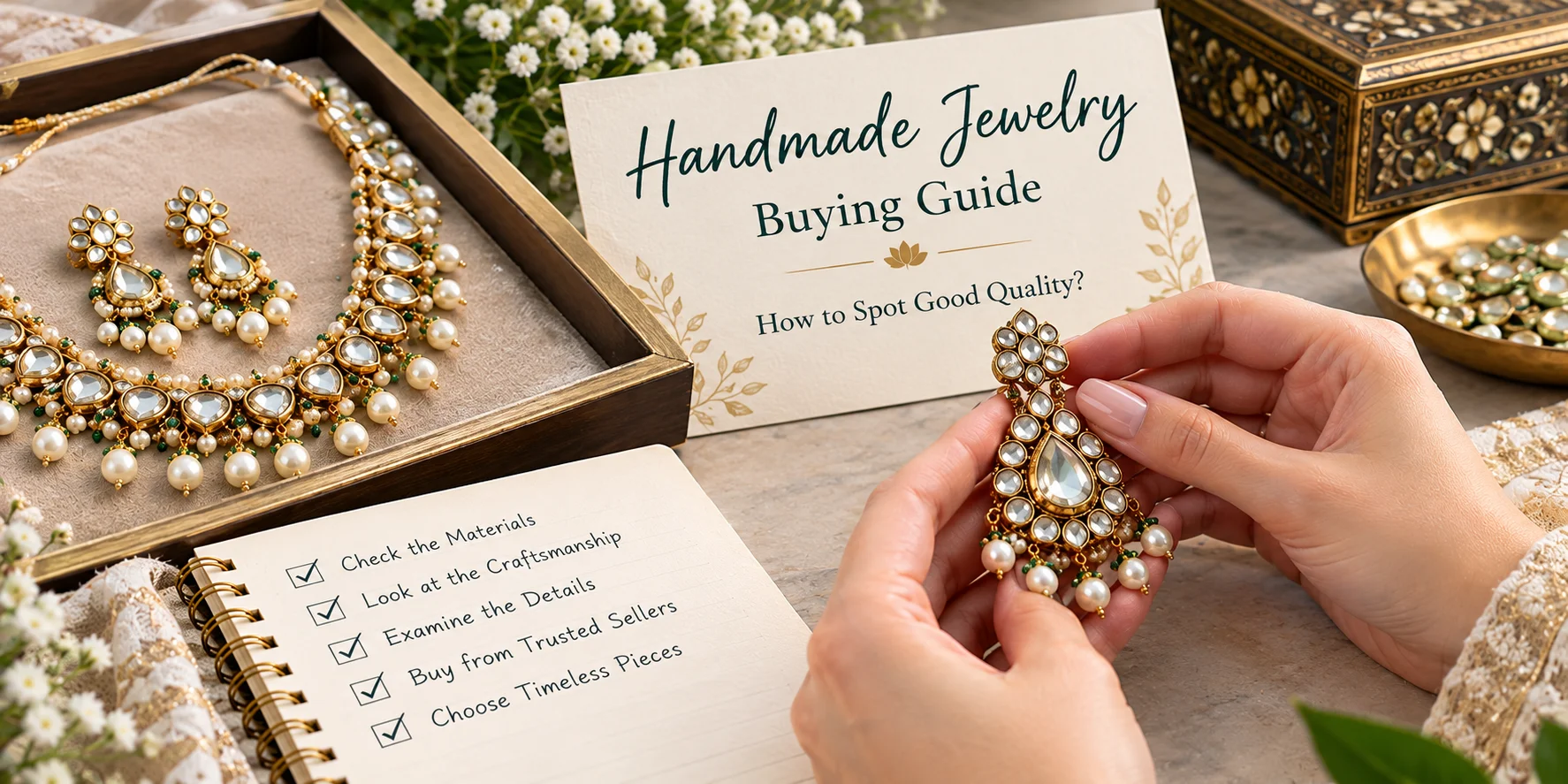
So I ruined a perfectly good Saturday because of earrings. Paid $85 at this little craft fair the kind with Edison bulbs strung overhead and sellers who all look like they went to art school grabbed a pair of what I was told were sterling silver hoops, wore them to a birthday dinner that Friday, and by Sunday morning both my earlobes had turned an impressive shade of green. Returned home, looked at the earrings under better light. Brass. Obviously brass. The “silver” coating was already flaking at the post. The booth had been gorgeous. Linen table runner, little hand-stamped price tags, a framed photo of the maker at her worktable. I’d assumed the presentation meant quality. Big mistake.
That’s the trap with handmade jewelry the story sells you before you’ve actually looked at the thing. And look, I’m not here to be cynical about small makers or craft markets. Most people selling handmade pieces genuinely love what they do. But love for the craft and technical skill are two different things, and neither of them automatically means the materials are what the label says. So this is me telling you what I wish someone had told me before I dropped money on green earrings.
Why “Handmade” Doesn’t Tell You As Much As You Think
There’s no standard. No certification. No governing body that checks whether the thing tagged “handmade” was actually made by a human pair of hands. A piece that was machine-stamped in a factory, shipped overseas, and then strung onto a chain by someone in a home studio technically handmade by some definitions. A piece that took a metalsmith six hours of torch work to fabricate from raw sterling sheet also handmade. Same word on the tag.
This matters more than people realize, because when you’re at a market or scrolling an Etsy shop, you’re making decisions mostly on aesthetics and vibes. A beautifully photographed piece looks better than a poorly photographed one regardless of what it’s made of. A warm, personal seller bio creates emotional investment before you’ve even checked the clasp. None of this makes sellers bad people. But it does mean you can’t just shop on instinct.
Here’s the other thing nobody says enough: quality isn’t the same thing as longevity, and longevity isn’t the only reason to buy handmade. Some people want a one-of-a-kind piece for a single event. Some people are buying to support an artist they believe in, knowing the piece might not outlast the year. Both are completely fine reasons to spend your money. Just know what you’re choosing that’s all.
Start With the Metal, Because That’s Where the Lies Usually Live
Before you think about design, before you think about price, look at what the thing is actually made of.
Sterling silver is what most handmade jewelry sellers are working with, and real sterling is 92.5% pure silver the rest is usually copper added for durability. It should be stamped 925 somewhere on the piece. Inside the ring band. On the clasp. On the back of a pendant. Small, delicate pieces sometimes genuinely can’t fit a stamp, and that’s real. But if you’re being sold “sterling” earrings with no stamp and the seller can’t tell you why, that’s the first flag.
Silver-plated is a completely different product. Base metal brass or copper most often with a thin coating of silver on top. That coating wears. It chips. It exposes what’s underneath. Plated jewelry isn’t inherently terrible, but it’s not sterling, and selling it as sterling is just dishonest. Worth asking flat out: solid sterling or silver-plated? A confident seller answers in about two seconds.
The gold situation is messier. Gold-filled is not the same as gold-plated, even though people use them interchangeably all the time. Gold-filled has a thick layer of real gold mechanically bonded to a base metal core it’s marked 12/20 or 14/20, meaning a full twentieth of the piece’s weight is actual gold and it holds up. Gold-plated has a thin wash of gold on top, often less than half a micron, and it wears off faster than you’d think, especially on pieces that get daily friction like rings and bracelets. Vermeil sits somewhere between the two: sterling silver base, thick gold coating on top has to be at least 2.5 microns to actually qualify as vermeil. Better than regular gold plate but not solid gold.
Solid gold 10K, 14K, 18K is always stamped. If the seller can’t show you the stamp or verify it another way, don’t assume.
Copper is one I want to specifically mention because a lot of genuine artisans work with it on purpose. It’s warm-toned, ages beautifully, develops interesting patina. But copper oxidizes, and on some people’s skin chemistry that produces a greenish tint. Totally harmless, fully chemical, has nothing to do with quality of craftsmanship. A good copper jewelry maker tells you this upfront and suggests a protective sealant or gives care notes. If they don’t bring it up at all either they don’t know their materials well enough, or they’re hoping you won’t figure it out until after you’ve already left the booth.
Stones, because this is its own situation.
Natural and synthetic aren’t the same thing, but synthetic isn’t automatically worse. Synthetic amethyst is literally the same material as mined amethyst made in a lab, chemically identical. Dyed howlite imitating turquoise is a completely different story it’s not turquoise, and if someone’s selling it as turquoise, they’re misrepresenting what you’re buying.
Just ask: is this natural, treated, or lab-created? Any seller who actually knows their stones answers this without a beat. They’ll tell you the rose quartz is natural, that the blue topaz has been heat-treated to reach that color, that the “lapis” is dyed jasper. That level of specificity is a good sign. Vague answers or visible discomfort with the question less good.
Glass, resin, Czech glass beads all totally legitimate materials. Just don’t let someone call machine-made Swarovski crystal “natural crystal.” Genuinely different products.
The Construction Stuff Nobody Thinks to Check
Design catches your eye. Construction is what you’re actually stuck with. If you’re buying in person, pick the piece up. Feel the weight. Look at the back of it, not just the front face. If you’re buying online, zoom into every product photo and look for these specific things.
Solder joints. Anywhere two metal pieces connect where a bail meets a pendant, where wire loops around a stone, where prongs meet a setting base should look clean. Smooth. Almost invisible if the work is good. What you don’t want: gaps, blobs, pitting, spots that look scorched or lumpy. That’s someone who rushed the work or is still figuring out torch control. A properly done solder joint essentially disappears into the piece.
Prong settings. If there’s a stone held by prongs, press it lightly with your fingernail. Should not move at all. A stone that wiggles is a stone that’s going to fall out probably into a drain or a parking lot. Also check the prong tips. Rounded is right. Sharp is wrong. Sharp prongs snag on everything.
Bezel settings are where a strip of metal wraps around the stone’s perimeter instead of prongs holding it. The metal should sit flush against the stone all the way around. Any gap means the stone can shift over time.
Wire wrapping ranges from genuinely stunning work to structurally falling apart. Good wrapping is tight and even, and the wire ends are fully tucked in. Run your finger over the piece. If you feel any snags or wire tails sticking out, that’s going to scratch you or catch on your clothes every single time you wear it.
Clasps. Lobster clasps should snap shut with a real audible click not a soft almost-there, a definite snap. Toggle clasps need a bar that’s meaningfully wider than the ring opening, or the weight of the necklace will work it open while you’re wearing it. Spring ring clasps are weaker and not ideal for anything heavy.
Findings — that’s the word for the small hardware components: ear wires, jump rings, clasps, head pins should match the stated metal of everything else. This is where corners get cut without buyers noticing. Sterling components on brass-plated ear wires means the ear wires turn green while the pendant stays silver. If the ear wires look slightly different in color or texture from the rest of the piece, ask what they’re actually made of.
Jump Rings: Small, Often Ignored, Frequently the Thing That Fails
Most buyers never think about these. I’m bringing them up because they account for a surprising number of lost pendants and bracelets that come apart. A jump ring is that small circular ring connecting one component to another pendant to chain, charm to bracelet, section to section. They come in open (can be pried apart and reassembled) and soldered (permanently closed) versions.
Open jump rings are fine and normal that’s how jewelry gets put together. But once assembled, they should be fully closed. Ends flush. No gap, no overlap. You can check with your fingernail: run it around the ring and feel for a seam that catches. If it catches, the ring wasn’t closed properly, and eventually whatever was hanging from it is going to slide free.
On rushed or cheaper pieces you’ll find rings with visible gaps, rings that got slightly bent out of round during assembly, or rings that are marginally too small for the metal gauge they’re supposed to secure meaning they’re under constant tension. They’ll fail eventually. For anything you want to wear regularly and actually keep, soldered rings are the more reliable choice.
How to Actually Talk to a Seller Without It Feeling Weird
Most buyers skip this part. Don’t. Real jewelry makers love these conversations. They have opinions about wire gauges, stone cutters, which torch setup they prefer, why they use one type of solder over another. Asking about materials isn’t interrogating anyone — it’s the equivalent of asking a chef what’s in the dish. Most are genuinely delighted someone cares enough to ask.
Before you buy, ask:
- What’s this actually made from sterling, plated, gold-filled?
- Are the findings the same metal?
- Is this stone natural, treated, or synthetic?
- How do I care for it, and what should I keep it away from?
- If something comes loose or breaks, what do you do?
That last one tells you the most. A maker who says “send it back, I’ll fix it” is confident the work holds up. They’re not anxious about seeing you again. The ones who get vague or suddenly very busy that response means something too.
And watch how they answer, not just what they say. “This is 925 sterling, the chain is 14K gold-filled, the findings are all sterling” is a person who knows their product cold. “It’s silver, I think, my supplier labeled it silver” is a different situation entirely. Not a villain. Just someone guessing at what they’re selling you. That distinction matters when real money is involved.
The Price Conversation
Here’s something I’ll just say directly: genuinely handmade jewelry can’t be that cheap. Not if the materials are what they’re claimed to be. It’s not about snobbery. It’s arithmetic. Sterling costs money. Stone settings and clasps and ear wires cost money. The torch and pickle pot and polishing setup cost money. The hours of labor cost money. A pair of solid sterling earrings with a real stone, made by an actual person in a real studio, cannot sell for eight dollars and be what it says it is. The numbers literally don’t work.
What does it actually cost from someone who’s doing this properly? Rough range, not universal: Plain sterling wire earrings: $25–60 from a genuine artisan. Add a stone, more complex design, finer finishing $50–150 easily. Sterling rings with stone settings start around $60 at the low end for solid work. Anything with solid 14K gold starts at $150+ and runs much higher from there.
Prices way below this range deserve a question. Sometimes it’s a newer maker building a customer base and genuinely pricing low to get started that can be a real find, and supporting someone early is worth something. But sometimes it’s the materials not matching the claim. You can usually tell which by how they talk about their work. Confidence and specificity go one way. Vagueness goes the other.
In Person vs. Online: Different Problems
At a market, you can actually touch the piece. Feel the weight good metals have real heft to them. Test the clasp. Look at the back. Walk away if something feels off without dealing with a return label. Big advantages.
The trap is the atmosphere. Craft markets are engineered to feel good nice lighting, curated display, the maker right there smiling at you. That creates a buying mood that has nothing to do with whether the clasp is solid. I’ve left markets with pieces that felt right in the booth and got home and thought “wait, why is this already loose.” Check the actual piece. Not just the overall experience.
Online you lose touch entirely. Everything you’re working from is under the seller’s complete control. So: Listing specificity matters. “Silver” tells you nothing. “Sterling .925, hand-textured, oxidized and polished” tells you a lot. “Handmade with love” is a mood, not information. “Fabricated from 20-gauge sterling sheet with a copper bezel” is information.
Reviews: only the specific ones matter. “Gorgeous, obsessed!” is useless. “Worn this bracelet almost every day for five months, clasp is still perfect and stone hasn’t moved” that’s useful. “Stone is exactly like the photos and the wire work is clean and tight up close” that tells you something real.
Product photos: look for close-ups. The back of the piece. The clasp mechanism. The stone setting from the side. If all you have is soft-focus styled shots from a distance, you have no idea what the construction actually looks like. Message the seller before you buy if you have a real question. How fast they respond, how confident they sound, how much they actually know all of that tells you more than the listing description does.
Hallmarks and Stamps
Small marks pressed directly into metal telling you what it’s made of. Not every piece has them, and missing stamps don’t automatically mean fraud but knowing what the marks mean is worth knowing.
Silver:
- 925 — sterling silver
- 999 — fine silver (purer, softer, less common in jewelry)
- 800 — continental silver, often on older European pieces
Gold:
- 375 — 9K
- 585 — 14K
- 750 — 18K
Gold-filled:
- 14/20 or 1/20 14K GF — a twentieth of the total piece weight is 14K gold
In the US, hallmarking isn’t federally required on handmade jewelry, though misrepresenting the karat is illegal. UK law requires hallmarking on gold above a certain weight. So what a missing stamp means depends on where the piece was made.
What stamps can’t tell you: whether the stone is natural or treated, whether the construction is solid, how it’ll hold up with daily wear. One useful data point. Not the whole picture.
Before You Buy: The Quick Checklist
Two minutes, every time.
Metal:
- Specifically identified? (Sterling, gold-filled, plated — not just “silver”)
- Do the findings match the stated metal?
- Hallmark present? If not, can the seller explain?
Stone (if applicable):
- Natural, treated, synthetic, or imitation?
- Does the seller know and say clearly?
- Zero movement when pressed?
Construction:
- Solder joints clean and flush?
- Wire wrapping tight with no sharp ends?
- Clasp closes with a real click?
- Jump rings fully closed, no seam that catches?
Seller:
- Answers material questions directly and confidently?
- Clear on what “handmade” actually means for their work?
- Has a repair or return policy?
Price:
- Makes sense for the stated materials and the time involved?
- If it’s surprisingly low, do you know why?
What “Handmade” Actually Covers
There’s a spectrum most buyers don’t think about, and it matters. One end: the jeweler starts with raw sheet metal and wire and makes everything by hand cuts, shapes, solders, sets stones, finishes. Every element of the piece is theirs. Most time-intensive, usually highest prices. Middle: maker uses commercial components pre-cast shapes, manufactured chain, commercial clasps and adds their own work on top. Stamping, texturing, stone setting, patina application. Still genuinely handmade. Still requires real skill. Just different kind of skill.
Further along: a designer who sends specifications to a manufacturer to produce. They designed it. Their hands didn’t make it. And then: people reselling commercial jewelry with a handmade tag on it. No artisan involvement at all. First three are all legitimate categories. The last one isn’t. But all four get called “handmade” in the world. Which is why knowing which one you’re dealing with matters. Honest makers tell you. “I fabricate the metal components myself but I use commercial chain” is a sentence that tells you exactly what you’re getting. Vague “everything is handmade” with no elaboration is harder to read.
Things to Walk Away From
Skin turning green after a couple wears from something sold as sterling. That’s copper or brass underneath. Not dangerous. Not what you paid for. Finish peeling or flaking. Thin plating over poorly prepped base metal. Not something that gets better with time.
Stone that visibly moves when you press it. Will fall out. Ear wires with rough or unfinished tips. You’re putting these through your earlobes. Rough ends scratch, and rough ends mean the finishing on the rest of the piece is probably similar.
Sellers who get defensive or evasive when you ask basic questions about materials. Real makers like these questions. It’s a chance to talk about their work. Prices that seem too good for what’s being claimed. Said it already. Worth saying again.
Where the Good Stuff Is
Juried craft fairs and art markets especially ones that select for quality still produce some of the best finds. Look for the maker who’s actually there, who can tell you how the piece was made, who’s been working at this for years before they built a following. Some excellent work lives in booths that haven’t gone viral.
Etsy, but selectively. Filter for made-to-order. Read the About section. Look for shops with process photos bench work, in-progress shots, materials laid out. Those details are harder to manufacture than a nice product image.
Instagram: search #handforgedjewelry and #sterlingjewelry rather than the broader #handmadejewelry which catches too much noise. Artists who post process content pieces in progress, close-ups of their bench work are usually actually doing the work.
Jewelry galleries and dedicated studio shops: these typically vet the makers they carry, which adds an accountability layer. Prices tend to be higher but you usually have more information about what you’re buying.
Word of mouth: still the most reliable. If you like what someone’s wearing, ask where it came from. You already know the piece held up on a real person. That’s actual evidence.
Caring for It
Even well-made jewelry deteriorates with bad care. And what it needs depends on what it’s made of another reason knowing your materials matters. Sterling silver tarnishes. That’s just what it does sulfur compounds in the air and on skin react with silver and darken it. Normal, reversible, not a sign of bad quality. A silver polishing cloth handles most of it. For heavier tarnish, warm water with a drop of dish soap and a soft toothbrush. Rinse completely and dry before storing. Keep sterling in an airtight bag or pouch between wears to slow the tarnish.
Oxidized silver the intentionally darkened look should be polished lightly and only on raised areas. Polish it all over and you strip the patina the jeweler put there on purpose. Gold-filled shouldn’t live through showers and pool sessions. Chlorine and salt water both break down the gold layer over time. Take it off before sleeping too. Stones each have their own requirements. Pearls hate perfume and hairspray they go on last. Opals are sensitive to temperature and low humidity. Turquoise absorbs oils and changes color. Amethyst and citrine can fade with prolonged direct sun. A seller who actually works with stones will tell you this upfront.
Wire-wrapped pieces shouldn’t go in ultrasonic cleaners the vibration loosens stones. Soft damp cloth is enough. Don’t throw pieces together loose they scratch each other. Small pouches, compartmented boxes, or individual fabric wraps.
One Thing Most Guides Won’t Tell You
There’s a version of this whole topic that doesn’t fit neatly into a tips list: sometimes you buy a piece knowing it’s not perfect, and that’s fine. I have a ring I bought from a twenty-two-year-old at a pop-up market in 2021. She’d been making jewelry for about eight months. The wire wrapping isn’t totally even and one of the coils sits slightly crooked in certain light. She told me upfront it was copper with a sterling coating honest about it, mentioned it might need care over time. I paid $18 for it.
Still have it. Still wear it sometimes. Held up better than I expected, and every time I wear it I think about the conversation we had how she’d taught herself from YouTube videos and was saving up for a proper torch. That’s a thing you can do. Buy the imperfect piece from the maker who’s still figuring it out, knowing what you’re getting, because you want to support someone early or the design is interesting or $18 is a reasonable gamble. Just know you’re doing that. Don’t go in expecting fine jewelry and come out with a copper ring and feel misled.
The checklist above is for when you want real quality pieces you’re going to wear regularly, pieces at a real price point, pieces you’re buying as something that matters. For those, the questions matter. The stamp matters. The construction matters. But not every purchase has to be that serious. And honestly, that judgment knowing which situation you’re in before you hand over the money is the real skill this whole guide is trying to build. Not suspicion. Not running through a checklist at every table. Just the quiet ability to look at a piece, ask one or two real questions, read how the seller responds, and know whether you’re buying something that will hold up or something that’s more of a gamble. Most people get there eventually. Usually after a pair of earrings turns their earlobes green on a Friday night.
FAQs
Q: How do I know if a piece sold as sterling silver is actually real?
Look for the 925 stamp directly on the metal not the tag, not the packaging, on the metal itself. Inside a ring band, on the clasp, on the ear wire, on the back of a pendant. Tiny delicate pieces sometimes genuinely can’t hold a stamp and that’s legitimate, but in that case the seller should be able to explain why and ideally provide supplier documentation if you ask for it. If they can’t tell you clearly, treat that as your answer.
Q: Is it okay to buy jewelry from Etsy or is it all fake?
Neither. Etsy has genuine skilled artisans and it has sellers misrepresenting materials, and they often sit next to each other in search results. The platform itself doesn’t tell you which is which you have to look at each seller individually. Read the About section, look for process photos, check reviews for specifics about durability and material accuracy, and message the seller with a direct question before you buy anything at a real price point. How they respond tells you a lot.
Q: What’s the difference between gold-filled and gold-plated? Does it actually matter?
Matters quite a bit in practice. Gold-plated is a very thin wash of gold over base metal sometimes less than half a micron and it wears through, sometimes within months depending on how much friction the piece gets. Gold-filled has a much heavier layer of real gold mechanically bonded to the metal core and it holds up for years with reasonable care. Gold-filled pieces are marked 14/20 GF or similar. If a listing says “gold” with no further specification and the price is $20, it’s plated.
Q: Can I get handmade jewelry wet?
Solid sterling and solid gold can technically handle water, but repeated exposure to chlorine, salt water, and the chemicals in shampoos and soap degrades even quality metals over time. Gold-filled and plated pieces are more vulnerable water speeds up wear on the gold layer significantly. Wire-wrapped pieces with natural stones should stay dry entirely; moisture can work its way under the wire and loosen stones, and some stones absorb water in ways that damage them permanently. General rule: off before swimming, showering, or cleaning.
Q: Why did my skin turn green from a “silver” ring?
That’s copper reacting with your skin chemistry sweat, oils, pH. Sterling silver doesn’t do this. If your ring is turning your finger green, the ring isn’t sterling. It’s a copper or brass base with a silver coating that’s worn through at the point of contact. Fine silver can occasionally leave a faint dark mark in some situations but doesn’t produce the green that copper does. Green means copper. The ring wasn’t sterling.
Q: What should I do if a handmade piece breaks quickly after I buy it?
Contact the seller first, be specific about what failed, and include a photo if you can. Many artisan jewelers will repair or replace something that broke from a construction issue, especially if it’s recent. If the seller won’t engage and you paid through Etsy or PayPal, check the buyer protection options both platforms have dispute processes worth using. Going forward, asking about repair policies before you buy saves a lot of difficulty later.
Q: Is expensive handmade jewelry always better quality?
Not automatically, but cheap is almost always lower quality. High price doesn’t guarantee anything some makers charge a lot on brand strength alone and the craftsmanship doesn’t always match. But very low prices almost always indicate something: materials that aren’t what they’re claimed to be, very fast labor, or both. Use the other signals how the seller talks about their materials, whether the construction looks clean up close, whether they actually know what they’re selling and treat price as one factor among several, not the main one.
Q: How do I tell if a gemstone is natural or synthetic?
Ask the seller directly and see how they handle it. A seller who knows their stones answers this immediately: natural, lab-created, heat-treated, imitation they know what they have. Natural doesn’t automatically mean better; lab-created stones are chemically identical to mined ones and can be genuinely beautiful at a better price. But you should know which you’re holding. Red flags: color that’s too perfectly even, price way below what a natural stone that size would cost, and vague or avoidant answers from the seller.
Q: Is handmade jewelry a good investment?
Usually not financially. The resale market for handmade jewelry is thin unless the maker becomes well-known, and that’s hard to predict. If holding value is the goal, solid gold and platinum from established sources are more reliable. But if “good investment” means “worth spending money on” yes, for the right piece from the right maker. A piece you wear regularly for years is worth considerably more in practical terms than something cheap you throw out after three months. Different kind of return.
Q: What’s the best way to clean handmade jewelry at home?
For most sterling pieces, a silver polishing cloth handles everyday tarnish and is gentle enough for regular use. For more thorough cleaning, warm water with a very small amount of dish soap and a soft toothbrush rinse completely and dry before storing. Skip this for soft stones like turquoise, pearls, opals, and malachite, which react badly to water and soap. Gold-filled pieces tolerate the same gentle routine. Commercial silver dip is effective but harsh and strips intentional patinas and can damage certain stones, so it’s worth avoiding unless you know exactly what you’re cleaning and it has no stones.
Q: How do I find good handmade jewelry makers online?
Process content is the most reliable signal. Someone posting in-progress photos, bench work, close-ups of raw materials before they become finished pieces that’s hard to fake and usually means they’re actually making the work. On Instagram, hashtags like #handforgedjewelry, #sterlingjewelry, and #metalsmiths pull up more genuine makers than the broader #handmadejewelry which catches too much noise. On Etsy, made-to-order listings and detailed material descriptions and About sections that name a specific location and process are more reliable indicators than star counts. And the original reliable method asking someone where they got the piece you’re already looking at on them still works better than any search algorithm.