


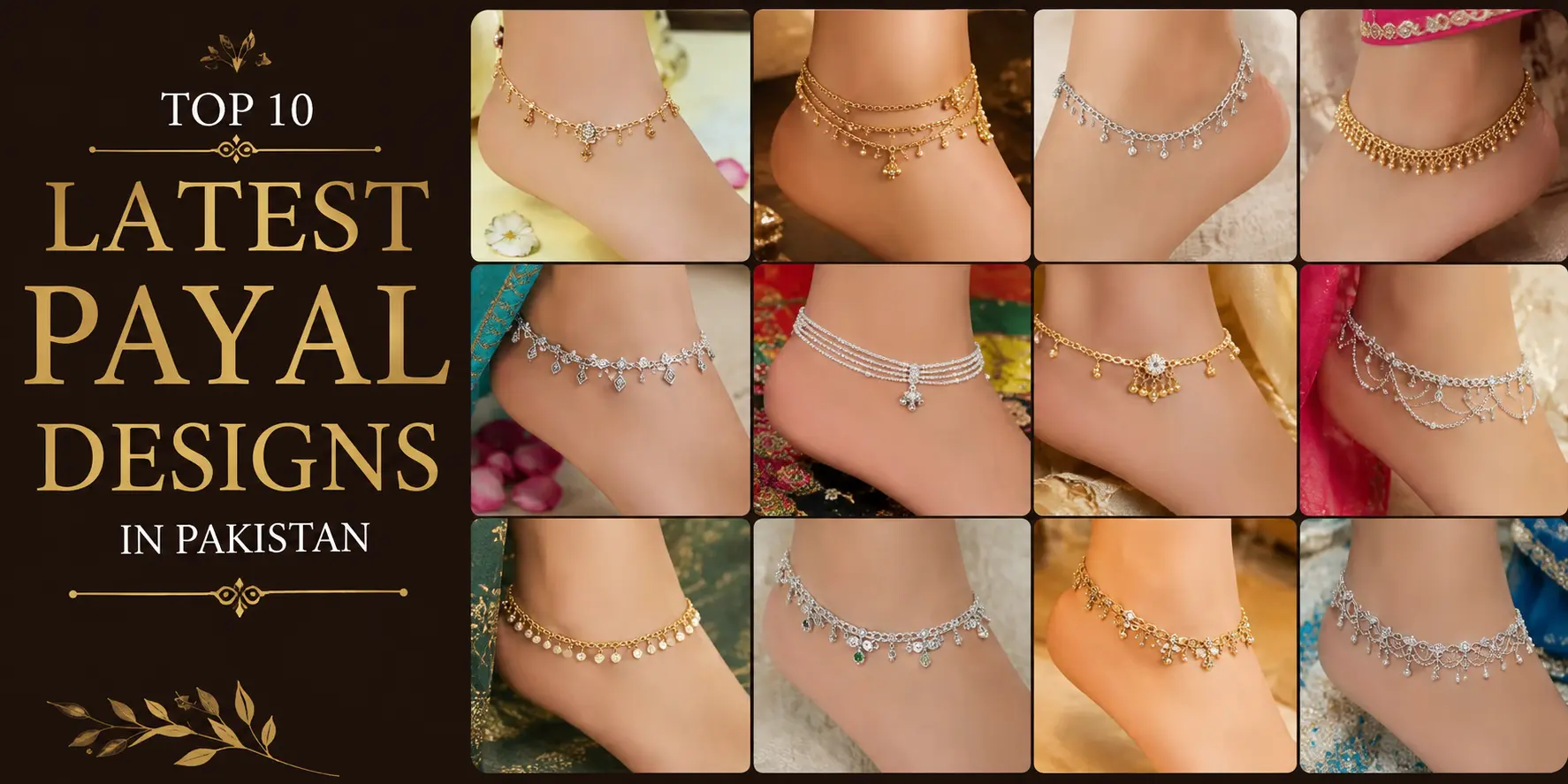
My cousin lost one payal at her own mehndi. Not the pair. One.The clasp came open somewhere in the middle of the dholki, second or third song, and nobody noticed until she sat down and looked at her feet. So the rest of the night was one bare ankle and one very loud jingling ankle, which honestly looked worse than wearing none at all. Her chachi kept telling her to just take the other one off. She refused, on principle.We found it at two in the morning. Under the sofa. Slightly bent, one bell gone.And the annoying part is that the design itself was fine. Thin silver, three small ghungroo clusters, the sort of pair that photographs beautifully. What failed was a cheap S-hook clasp that the shop never mentioned and she never thought to ask about.
I’ve bought payal differently ever since.
So this isn’t only a rundown of what’s trending. I want to go through the payal designs you’ll actually find in Pakistan right now, which ones hold up in real life, the two or three I think are overrated, and how to check a pair before you hand over your money.
Why Payal Came Back
For a while there, payal felt like a dadi thing. Something you dug out of a drawer once a year for a wedding, usually with a snapped thread and a bell missing.Then it turned around, and I think three things happened at once.Fashion swung back toward the desi-minimal look, where people started wearing one thin silver anklet with jeans instead of saving jewellery for functions. Instagram did its usual work. And gold went somewhere completely unreasonable price-wise, so silver stopped looking like the budget option and started looking like the interesting one.Now you’ll see a bride in full kundan wearing payal, and a girl in Lahore in sneakers wearing payal, and the two pieces have nothing in common except the ankle they sit on.
The list below covers both ends of that.
1. Classic Ghungroo Payal
The one everybody pictures first. Silver chain, rows of small bells, that sound.Oldest design here and still the most asked for, and the reason is just the sound. Nothing else does that. There’s a reason mothers used to put ghungroo payal on toddlers, you could locate a child anywhere in the house by ear.What’s changed is bell density. Older ghungroo payal packed the bells shoulder to shoulder all the way around, so you got weight, a lot of noise, and a real chance of the whole thing catching on your shalwar hem. The version selling now spaces them out. Clusters of three or four, clean chain in between. Lighter, still audible, much better behaved around fabric.
If you only want one pair that works for a mehndi and an Eid lunch and a random Tuesday, it’s probably this.Do test the bells in the shop though. Some of the cheaper ones are hollow stamped metal with a loose ball rattling inside, and after a month of walking the ball wedges and the bell goes dead. Then you’re wearing silent decoration.
2. Thin Minimal Chain Payal
Complete opposite. One delicate chain, no bells, maybe a small charm, maybe nothing.These took off hard over the last two years, which makes sense. They’re cheap, they go with anything, they don’t announce themselves. You can wear one to the office. You can wear one under trousers and only you know.
The chain styles you’ll see most:
- Snake chain, smooth and flat, sits close to the skin. Sleek. Kinks permanently if you bend it wrong, so don’t.
- Rope chain, twisted, a bit of texture, catches light well.
- Box chain, square links, tougher than it looks for the thickness.
Now, an opinion. I think the single thin chain payal is a little overrated worn on its own. On a bare ankle it can read as though you got interrupted halfway through getting dressed. Where it actually works is layered, two or three chains at slightly different lengths, or one thin chain against something chunkier. That looks deliberate. One lonely 1mm chain sometimes just looks like you lost the rest of the set.
3. Oxidized Silver Payal
Blackened antique finish, heavy patterns, coin drops, sometimes small bells hanging off an oxidized base.If you’ve bought from any of the artisan-style brands recently you’ve seen these. They lean Balochi and Sindhi and Kashmiri in feel, bold shapes, filigree, the raised parts polished bright so the pattern stands out against the dark.
They photograph incredibly well, which is a big part of why they’re everywhere.
The practical bit people skip is that oxidation is a surface finish, not something the metal permanently is. It wears off. And an ankle is about the worst place on the body for a surface finish, between the fabric rubbing and the shoes and the dust. Handmade oxidized sterling holds up alright and ages into something nice. The mass-produced stuff is often oxidized brass with a coating, and in Karachi in July that coating goes green faster than you’d believe.
4. Bridal Kundan and Polki Payal
Wedding territory.
Wide statement pieces, kundan set into silver or a gold-plated base, sometimes polki, sometimes meenakari hidden on the back, almost always with a fringe of small pearls or ghungroo along the bottom edge. They cover a good two inches of ankle and they’re built to be seen under a lehenga.
The interesting shift here is colour. For years bridal payal came in red-and-green kundan by default. Now brides ask for ivory, dusty pink, powder blue, sage, softer stones that sit with the pastel lehenga trend instead of arguing with it.
There’s also more coordination than there used to be. Payal designed alongside the maang tikka and the haath phool as one set, rather than bought separately in a panic three days before the wedding.
One warning and I mean it. These are heavy. Walk in them for a full minute in the shop, not five seconds, a full minute. You find out very quickly whether the weight sits where it should or whether it slides down and bunches up at your heel.
5. Meenakari Payal
Enamel work. Sections of colour fired onto the metal, usually silver, in floral or geometric patterns.Meenakari payal are having a real moment here, particularly the Jaipur-influenced white, blue and green on a silver frame. They sit in a good middle zone, dressier than a plain chain, lighter than full bridal, colourful enough to hold an outfit together on their own.
They look great against plain clothes. A white lawn suit with a blue and green meenakari payal is one of those combinations that looks far more thought-through than it was.Enamel chips, though. It doesn’t scratch, it chips, and once a flake of colour is gone there’s no fixing it at home. So don’t sleep in them and don’t throw them loose in a bag with everything else.
6. Jhumki-Drop Payal
Small jhumka-shaped drops hanging off a chain, spaced out around the ankle. Tiny earrings for your feet, basically.I like these a lot and I’m not entirely sure why. Something about the shape being borrowed from somewhere it doesn’t belong. They swing as you walk, they catch light from inside the bell, and the sound is softer than ghungroo, more of a tap than a jingle.Good pick if you want movement and a bit of personality but ghungroo feels too traditional for everyday.
7. Pearl and Moti Payal
Pearls on silver wire, or pearl clusters dropping off a chain.
Soft, feminine, very popular for nikah and engagement days where the bride wants something quieter than kundan. Also popular with the guests at those events, which is probably the bigger market.Freshwater pearls look better than the plastic ones and cost less extra than you’d expect. Real ones are slightly irregular in shape with a warmth to the shine. Fakes are all perfectly round and a bit too white, and they chip to show grey plastic underneath. The easiest check is touch, real pearls feel cool for a second when you first pick them up, plastic just feels like whatever the room feels like.
Pearls are also soft, genuinely soft as gemstones go, and an ankle knocks into door frames and car doors and chair legs constantly. These are occasion payal. Not everyday payal. Go in knowing that.
8. Layered and Double-Strand Payal
Two or three chains off one clasp, sitting at staggered heights.This is the design that stopped me buying single chains. You get the visual weight of a wide piece using three thin ones, and because each strand moves on its own it never looks stiff.Best ones mix texture across the strands. Plain snake chain, one with small bells, one with charms, all in the same metal so it reads as a single piece and not three random anklets stacked by accident.
Combinations that work:
- plain chain, ghungroo chain, charm chain
- two plain chains at different thicknesses plus a pearl strand
- snake and rope chain, no charms at all, just the texture difference
If you already own two or three thin payal, try wearing them together tonight before buying anything. The layered look might already be in your drawer.
9. Silk Thread and Dori Payal
Not metal, or only partly.
Coloured silk thread, red or mustard or teal or multi-strand, with small silver and oxidized charms threaded on, tied with an adjustable dori knot instead of a clasp. Big around Basant and Eid and mehndi nights, and increasingly worn year-round by younger women because they cost almost nothing and come in every colour there is.They’re more comfortable than metal, honestly. No cold shock in December, no clasp digging in, nothing catching on your jeans, and the fit is never a problem.
They also fray and eventually snap, and that’s fine. They’re meant to be replaced, not maintained. I keep three pairs in a small tin and rotate them, and all three together cost less than one silver payal.
10. Gold-Plated and Gold-Tone Payal
Last one and the most divisive.
Real gold payal exist but they’re uncommon in Pakistan for a practical reason. That’s a lot of value sitting on a part of the body that takes knocks, and there’s a long habit of silver below the waist and gold above it. So most “gold” payal are gold-plated silver, or plated brass, or a gold-tone alloy.Good plating on silver looks genuinely lovely, especially the newer matte and brushed finishes rather than the mirror shine. And it pairs with your gold jewellery elsewhere, which the silver options obviously can’t do.
The catch is plating thickness. Cheap plating on an ankle piece lasts weeks. Weeks. It goes at the contact points first, back of the ankle bone and wherever the clasp sits, and then you own a two-tone payal that looks broken rather than vintage. If you want gold-tone, spend on the plating, and ask about the micron thickness. If the shopkeeper has no idea what you’re asking, that’s information too.
Two designs nearly made this list, for what it’s worth. Payal with an attached toe-ring chain, which looks stunning in photos and is a genuine nuisance to walk in, and the personalised name or initial payal, which is popular but tends to look cheaper in person than online. Your call on both.
Check This Before You Pay
Any design above can be a great buy or a waste of money depending on the specific piece in front of you. So run through this first. Takes two minutes and I do it every time now.
The clasp. Open and close it five times. Does it click shut, or does it just hook? You want a lobster clasp or a box clasp with a safety catch. Plain S-hooks are how my cousin ended up with one payal. If the pair you love only comes with an S-hook, most silver shops will swap it for very little.
Shake it. Hold it at ankle height and shake hard, twice. Anything loose enough to come off in your hand is definitely coming off on a dance floor.
Walk in it. Both on, length of the shop and back, at normal walking pace and not a shuffle. You’re watching for whether it slides over your heel, spins round, or grabs your trouser hem. An inch or two of movement is normal. Six inches means it’s too big.
Drag it across fabric. Your own dupatta or sleeve is fine. Any charm with a rough solder joint or an open jump ring will snag, and you’d rather find that out now.
On sizing, the rule worth remembering: measure your ankle snug with a tape, then add 2 to 2.5cm. That’s your length. Tighter and it digs in when your feet swell in the heat, looser and it flops around your foot. Standard payal here run 24, 25 and 26cm with 25 as the default, and if you’re between sizes buy the bigger one and have a link taken out.
What Happened in Sarafa Bazaar
Last year my sister-in-law got married in Faisalabad and I went payal shopping with her at Sarafa Bazaar. Saturday morning. Bad choice, the whole street was packed.She went in wanting a heavy kundan bridal pair. Fair enough, she’d seen something on a jewellery page for around thirty thousand and wanted the same idea. Third shop in, she found nearly that exact design. Wide, red and green kundan, pearl fringe, absolutely gorgeous.
She put them on. Walked maybe four steps. Stopped.
The pair was close to 120 grams, and the width meant it sat right across her ankle bone. She said it felt like wearing a bracelet on the wrong joint. And she’d already told me she planned to properly dance at her own mehndi, for hours, so.
So she changed the plan standing there in the shop.
What she bought instead was a medium-weight silver pair with spaced ghungroo clusters and a small kundan panel at the front only, not carrying all the way round. Fifty-five grams for the two. Silver was sitting somewhere near 4,200 a tola then, so with making charges she paid a bit under 26,000, which was less than the heavy pair, and she still got the front-facing kundan detail that’s the only part that shows in photographs anyway.
Then she spent 1,400 rupees on red silk thread payal with tiny bells for the dholki nights.
Two pairs, both cheaper than the single pair she walked in for, and she wore the silver ones again on Eid four months later. The heavy kundan pair would be in a box right now.Which is sort of the whole point. The most beautiful payal in the shop and the right payal for you are usually not the same object.
Prices, and Where to Look
Silver rates move constantly so treat all of this as zones, not numbers.
Artificial and imitation pairs run somewhere between 300 and 2,000 rupees. Fine for one event, or for testing a style before you commit to it in silver. Don’t expect them to last past the season. Silk thread payal are cheaper again, 200 to 1,500, and genuinely good value.
Sterling silver is priced by weight plus making charges, so ask the per-gram or per-tola rate, ask the weight, and do the arithmetic yourself in front of them. Making charges swing wildly between shops for identical work and that’s where you either save money or get skinned. Bridal payal with stonework start around twenty thousand and go as far up as you’d like, mostly driven by stone quality and the karigar’s reputation.
For actual shopping the old bazaars still beat the malls on both range and price. Anarkali and Liberty in Lahore, Sarafa in Faisalabad, Tariq Road and Bohri Bazaar in Karachi, Raja Bazaar in Pindi. Hyderabad and Multan both have serious silver traditions and you’ll find handwork there that never reaches a big-city retail counter.
Online you’ll see a wider range of latest payal designs than most shops carry, but sizing becomes your problem, and plenty of sellers won’t exchange for length. Measure first, ask about exchange second.Small thing that’s saved me money more than once: ask who the karigar is. Shops that work with a particular artisan will tell you straight away, often proudly. Shops buying bulk from a wholesaler get vague about it. Neither one is wrong, but you learn what you’re actually buying.
Keeping Them Looking Decent
Silver tarnishes. That’s chemistry, not a fault, and it goes faster on feet because of sweat and friction and dust.
Wipe them with a soft dry cloth after wearing, which takes ten seconds and does most of the work on its own. Store each pair in its own zip pouch with the air squeezed out, since air is what tarnishes silver. Take them off before showering and before lotion, and lotion is the worse of the two.
Plain silver can take a proper polish cloth once a month. Oxidized silver cannot, you’ll strip the finish, so just wipe it. Meenakari and pearls get dry cloth only, no polish, nothing liquid, definitely no ultrasonic cleaner.
Also take them off at night. Nobody does this. Do it anyway, because most broken payal I’ve seen were crushed in a bed or caught in a bedsheet rather than damaged anywhere out in the world.
There’s no single best design here, which is an unsatisfying thing to say after a list of ten. But the pair I reach for most isn’t the prettiest one I own. It’s a plain double chain with four bells that I bought without thinking about it much, and it’s outlasted everything else because it fits and the clasp works.
Buy the one you’ll wear on a Tuesday. The wedding pair sorts itself out.
FAQs
What is the difference between payal and anklet?
Nothing. Payal is the Urdu word for what English calls an anklet. You’ll also hear panjeb and jhanjhar, and while jhanjhar usually implies a heavier traditional piece with bells, most shopkeepers use all of them interchangeably.
Which payal design is best for daily wear?
A medium-weight plain silver chain, or a two-strand layered chain, with a lobster clasp. Skip enamel, pearls and delicate hanging charms for everyday because they’ll show wear fast. Sterling silver is the sensible daily choice mainly because it can be cleaned and repaired instead of thrown out.
How do I know if a payal is real silver?
Look for a 925 stamp. Silver is also non-magnetic, so a fridge magnet answers the question in two seconds. Beyond that, silver here is normally sold by weight against the day’s rate, so if a shop quotes you a flat price and won’t tell you the weight, ask why. A proper shop will put weight and purity on the receipt without being asked.
Should you wear payal on one ankle or both?
Both is traditional, one is the more current styling choice and very common with jeans. Neither is wrong. If you’re wearing a single one, the left ankle is more usual, though there’s no actual rule.
Can you wear gold payal in Pakistan?
You can, some people do, it’s just uncommon. Partly the old preference for silver on the feet and gold above the waist, partly the sense that a lot of value is sitting somewhere that gets knocked around all day. Gold-plated silver is much more popular and gets you close to the same look.
How much should a good silver payal cost?
Depends entirely on weight and the rate that day, so work it out rather than accepting a number. Per-gram rate times the weight, plus making charges. A light pair might come in at 40 grams, a bridal pair can pass 100. Get both figures before agreeing to anything, and compare making charges at two or three shops for similar work.
Do payal sizes matter or is one size fine?
They matter. Measure snug and add 2 to 2.5cm. Sizes here run 24 to 26cm with 25 as the default, and if you’re stuck between two, take the larger and have a link removed. A slightly loose payal is annoying. A tight one digs in and eventually gives out.
How do I stop my payal from breaking or falling off?
Get the S-hook swapped for a lobster clasp, which most silver shops will do cheaply. Then take them off at night, check the jump rings on any charms every couple of months, and don’t wear delicate pieces to events where you’ll be dancing.
Are oxidized payal good quality?
The style is lovely but oxidation is a surface finish and ankles are hard on surface finishes. Handmade oxidized sterling wears into a decent patina. Oxidized brass or alloy with a coating tends to go patchy or slightly green in humid weather. Ask what the base metal is before you decide.
What payal design suits a bride best?
Wide enough to show in photographs, light enough to dance in. Front-facing stonework with a plainer band round the back gives you most of the impact at a fraction of the weight. And whatever you pick, walk in it for a full minute in the shop, because bridal payal are always heavier than they look sitting on a display cushion.