


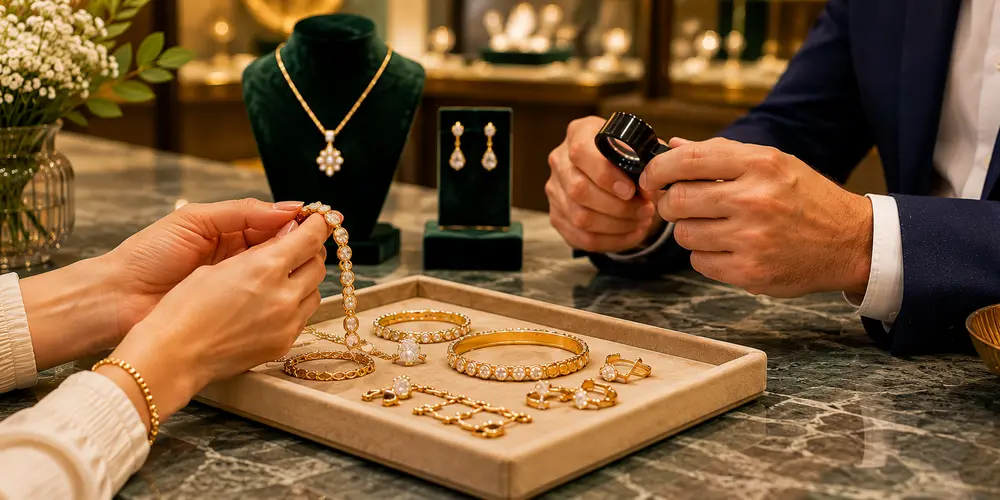
Most people skip this. Box off the dresser, into the car, and now they’re negotiating against somebody who does this forty times a day and can read a face in two seconds flat.
Phone flashlight on. Go find the stamps.Clasp, inside of the band, back of a pendant, that little post on an earring. They’re tiny and usually half worn off, so give it an actual minute rather than a glance.
You’re looking for one of these:
– 10K, 14K, 18K, 22K, 24K. Or the number versions, 417 / 585 / 750 / 916 / 999.
– 925 or Sterling. That’s silver.
– PLAT, PT950, or sometimes just 950.
– GP, GF, HGE, RGP. Bad news, these ones. Plated or filled.
– A maker’s mark, or a country hallmark. Sometimes it’s a tiny animal, or a letter sitting inside a little shield.
The GP / GF one catches people out constantly. Plated means a layer measured in microns sitting over brass or nickel or whatever was cheap that year, and the scrap value is more or less nothing. I watched somebody find this out in a shop once, about a necklace their mother had left them. There’s no gentle way for the counter guy to say it and he didn’t really try.
No stamp at all isn’t automatically bad, though. Loads of older handmade gold has nothing on it, especially pieces from South Asia and the Gulf, where a lot of gold moved on trust between families and jewelry who’d known each other since before either of them had grey hair. And stamps wear off. That’s what acid testing is for, and any buyer worth your time does it free while you stand there.
Weigh everything while you’re at it. I’ve got a little digital kitchen scale, cost about eight dollars, reads to 0.1 grams. Best eight dollars in that drawer. Put the weights in your phone notes and photograph the stamps zoomed right in.
Then sort the pile. Gold by karat, silver and platinum together, junk in a third heap. Never let anyone give you one number for a mixed pile. Ever. That’s where the margin hides, in the bit where your 22K bangle quietly carries nine plated rings on its back.
Stones, which are their own problem:
Gold has a public price. Fifteen seconds on your phone and you know it.Diamonds don’t, not really, and this is where most of the disappointment lives.
A ring that cost four grand new might be worth eight hundred secondhand. Sometimes a fair bit less than that. The rest went on the lease, the staff, the velvet box, the advertising, the twelve people who tried it on before you did. Gone. Not coming back through you.
Over half a carat, go hunting for a certificate. GIA, IGI, AGS are the names that move a price. A graded stone sells for meaningfully more than the same stone with no paper, purely because nobody’s guessing. Lost it? There might be a laser inscription on the girdle you can trace back, though you’ll want a loupe, or a jeweller who doesn’t mind squinting at it for you.
Lab grown, be realistic. Resale is rough and getting rougher, because production costs keep falling and the price falls out from under you. That’s not a reason to keep it forever. Just don’t walk in expecting anything close to what you paid.
MELT VALUE:
The number sitting under everything. It’s arithmetic, takes a minute, and it’s the most useful thing on this page by a distance.
grams × purity × gold price per gram:
Purity as a decimal, because nobody remembers these:
– 10K = 0.417
– 14K = 0.583
– 18K = 0.750
– 21K = 0.875
– 22K = 0.917
– 24K = 0.999
For the per-gram price, take spot per ounce and divide by 31.1. (Pakistan, India, most of the Gulf, you’ll see it quoted per tola instead. One tola is 11.664 grams. Convert first, then compare, or you’ll confuse yourself.)
So. 14K chain, 18 grams, gold sitting around $2,400 an ounce that morning.
– 2400 ÷ 31.1 = about $77 a gram
– 18 × 0.583 = 10.5 grams of actual gold in there
– 10.5 × 77 = call it $808
That’s melt.
And here’s the annoying bit: nobody pays melt. Buyers take a slice, because they’ve still got to refine it and ship it and insure it and pay rent on the shop. 70% to 90% is the normal band.Which makes your chain a $565 to $725 conversation. Somebody opens at $420, they’re just checking whether you did the maths.Do it before you leave. Every time.
Where to actually sell it:
There’s no best answer. There’s a best answer for your piece and your patience, and those are different for everybody.
Gold buyers and pawn shops. Cash today, lowest number anywhere. Fine for broken chains, odd earrings, the tangle at the bottom of the box, anything where the metal is the value and the design isn’t doing much work. Terrible for antiques or signed pieces or anything with a real stone, because they’ll weigh it, quote scrap, and your grandmother’s filigree ends up in a crucible next to somebody’s snapped bangle. I’d put them last. Although if you need money this afternoon, that’s a real reason and I’m not going to lecture anyone about it.
Consignment with a local jeweller. They display it, they take 20% to 40% when it goes. More than scrap, but you wait, and the waiting is genuinely unpredictable. Three weeks. Seven months. Nobody can honestly tell you which. Ask two things before signing: what happens if it doesn’t sell, and is it insured sitting in their case. In writing, not a WhatsApp message you’ll lose in six months.
Marketplaces. eBay, Etsy for real vintage (they’re strict about it), Facebook Marketplace, whatever’s big where you are. Best prices, most work, by a mile. Photos, descriptions, questions from people who were never buying anything, packing, shipping, fees, and occasionally someone who swears the box arrived empty. eBay’s cut is around 13% plus processing, so build it in first rather than discovering it later. Ship insured, signature required, and film yourself packing the box. Feels ridiculous. Do it anyway.
The mail-in diamond companies. Decent ones quote a range upfront, insure both directions, send it back free if you say no. This is my pick for engagement rings, honestly. A local shop hates a used solitaire because it’ll sit in the case for a year, whereas these places have a buyer lined up before you’ve posted it. Read the return terms twice.
Auction. Only if the thing is genuinely special. Cartier, Van Cleef, Bulgari, Tiffany with the box. Real provenance. A big coloured stone with paper behind it. Slow, and there’s a seller’s commission on top, but the right piece in the right sale goes well past anything a shop will hand you. Most auction houses look at photos for free, so send them and see. Worst case is a polite no, which costs you nothing but an email.
Someone you know. Great for them, alright for you, and a reliable way to make dinner awkward for the next four years. Price it off an independent valuation rather than off feelings, and no payment plans.
The three quote rule:
Simplest system I know. Works on nearly anything.
1. Work out melt at home and write it down.
2. Three offers minimum. A local shop, an online or specialist buyer, and one consignment or auction opinion.
3. Say yes to nothing on the first visit. “Thanks, I’m getting a couple of comparisons.” Then watch what the number does.
4. Take the best. Or the second best, if that person’s easier to deal with, which counts for more than people admit.
Step three is where the money is. A lot of first offers move 15% to 30% the second they clock you reaching for your keys. Not because they’re crooks. The first number was a business decision and so is the second one.
Weekday morning if you can swing it. Quiet shop, unhurried buyer, somebody who’ll sit and talk about the piece. Saturday afternoon you’re just a queue with a bag.
Photos are the whole job online:
Two identical rings. One sells for $600, the other doesn’t sell at all. The difference was photographs. That’s it, that’s the entire difference.
Daylight near a window, never direct sun. Plain background, so a grey or white card, or a folded bedsheet. One sharp zoomed shot of every hallmark, because that’s what buyers scroll to first, always. The piece sitting on your scale with the reading visible, which kills half the questions before anyone asks them. And one shot worn, so people understand the size of the thing.
Then photograph the damage. The scratch, the bent prong, the resize mark. Being upfront about flaws gets you fewer refund arguments and a better class of buyer, and it costs you almost nothing on price, because anyone serious spots the damage anyway.Write the listing like a person while you’re at it. Weight, purity, measurements, stone details, condition, what the thing actually is. Nobody in history has bought jewelry because a listing said “stunning.”
The Ring In The Drawer:
Rabia, someone I know through work, had an engagement ring left over from a marriage that ended in 2013. Round brilliant, bit over a carat, white gold setting.Somewhere back then she’d been told it was insured for $9,400, and that number lived in her head for a decade.
First shop offered $1,100. She left annoyed and the ring went back in the drawer for another two years, which I understand completely.When she finally dealt with it, three things were different.
She found the original GIA report in an old paperwork folder, which mattered more than everything else combined. G colour, VS2, excellent cut. She got quotes from two online diamond buyers instead of walking into one shop and taking the mood of it personally. And she sold the stone separately from the setting, because the mount was scratched and dated and nobody wanted it as a ring.
$3,850 for the loose stone. $95 for the gold out of the setting.
Just under four thousand, then. Against an insurance figure of $9,400 and an opening offer of $1,100.
The insurance number was never a price. It was a replacement-at-full-retail figure written for an insurer, which is a completely different question from what a person will pay you. The certificate roughly tripled her offers. And splitting the stone off the mount made more than the ring ever would have whole.Also, and I keep coming back to this one, she held it eleven years and the diamond didn’t go up. Didn’t really go down either. Jewelry mostly just sits there being jewelry.
Small things that cost people money:
Cleaning it wrong. Warm water, drop of dish soap, soft toothbrush, that’s the whole method. Do not go at an antique with a polishing cloth. That dark shadow down in the engraving is toning, collectors pay extra for it, and buffing it off is buffing off money.
Those mail-in envelopes that turn up unrequested. You post gold, they post a cheque, cheque is small. Some are perfectly legitimate. Getting your item back from the ones that aren’t becomes a project.Letting the piece leave the room. “Let me take this in the back and test it.” No. At the counter, where you can watch. Every legitimate buyer does this without blinking, so it isn’t rude to ask, though it does feel rude the first time.
Trusting the appraisal. Insurance appraisals are replacement-cost documents, routinely two to four times what you’ll actually get in cash. Nobody’s lying to you. Different question, different answer.Tax. Some countries treat profit on personal jewelry as a capital gain, some don’t, and the thresholds shift around. Big sale, ask an accountant once instead of assuming.
Fixing things before selling. This one splits opinion and I’ll admit I’ve changed my mind on it twice. Broadly: don’t. A snapped clasp or a worn prong costs you less in the offer than the repair costs you at the bench, and the buyer usually has a jeweller in-house anyway. The exception is a cheap fix on an expensive piece, so a $30 clasp on a gold chain is worth doing because a chain that doesn’t fasten looks like a chain nobody wanted. Anything beyond that, leave it and mention it in the listing.
And take ID with you. Licensed buyers usually have to record it by law, and some hold items for a waiting period before melting anything. Normal. Not sinister.
Should you wait fore gold to go up?
Probably not.Chain worth six hundred, a 5% move is thirty dollars. That isn’t worth six months of chart-watching and low-level anxiety. Just check spot the morning you go, so you’re arguing from today’s number rather than a headline you half remember from March.Big scrap lot, several hundred grams and up, sure, the percentages start to matter. Hold out for a decent week then.
What i wouldn’t bother with:
Cheap silver, piece by piece. Costume jewelry, unless it’s signed by a name collectors actually chase, so Trifari or Miriam Haskell or that tier. Mall-brand watches. Single earrings with no pair, unless they’re gold and going for scrap anyway.
The hours you’ll spend photographing and listing and answering messages and posting a $22 silver pendant are worth more than $22. Bag it up, donate it, or sell the silver as a job lot by weight and stop thinking about it.
Mildly unpopular opinion: selling jewelry piece by piece online is overrated for most people. Unless you enjoy the process, or you own genuinely collectible things, the hourly rate is bad. Two or three good pieces sold properly beats twenty small ones sold slowly.
LAST THING:
Give it a week between deciding to sell and actually selling.
Nothing to do with the market. It’s that after a week you stop negotiating with the memory and start negotiating with the person standing in front of you. Only one of those ends with a fair number.
FAQS
How much will I get for my gold jewelry?
70% to 90% of melt, usually. Work melt out before you go: grams, karat purity, today’s gold price. Design and brand and craftsmanship don’t enter into a scrap offer at all, which catches people off guard. Want more than melt? Then you need somebody who wants to wear the piece, not refine it.
Can I sell jewelry with no hallmark?
Yes. Very common, particularly with older handmade gold. Any real buyer will acid test or XRF it free in front of you.
Where do I get the most money?
Roughly: private sale to someone who’ll wear it, then auction if the piece is exceptional, then consignment, then the specialist online buyers, then shops and pawnbrokers last. The higher the payout, the longer the wait and the more work you do. Choose on how fast you need the money rather than which number sounds nicest, because the nicest number often takes eight months to turn up.
Do I need the box and receipt?
Scrap gold, no, nobody cares. Branded, absolutely. A Cartier or Tiffany piece with box and papers and service records can fetch 20% to 30% more than the same piece without, because the buyer isn’t gambling on whether it’s genuine.
Sell the whole ring, or break it up?
Depends on the setting. Plain, worn, or dated, you’ll usually do better selling the stone loose and scrapping the metal. Designer or genuinely nice, sell it complete. Get quotes both ways, it costs you an afternoon.
Is posting jewelry to an online buyer safe?
With the established companies, yes, as long as they insure both directions and return it free if you decline. Film yourself packing it. Skip anything that arrived in your letterbox unrequested.
How do I know if my diamond’s real?
A jeweller tells you in under a minute with a thermal tester, usually free. At home, breathe on it. A real diamond clears almost instantly while glass and CZ stay fogged for a second or two. You also generally can’t read printed text clearly through the top of a real one. None of that’s conclusive though, so get it looked at properly before you sell.
Does jewelry go up in value?
Mostly no, beyond the metal tracking the gold price. Signed antique pieces from the big houses can. Ordinary retail jewelry holds a fraction of what you paid, more or less forever.
Are pawn shop prices fair?
Fair for what they are, which is cash in ten minutes with nobody asking you to wait. Expect the lowest offer anywhere, often under melt.
What should I take with me?
ID at minimum, since most licensed buyers have to record it. Then certificates, receipts, appraisals, service records, anything you can dig out. Certificates especially. They move offers a lot, so go through the old folders before you go rather than realising afterwards.
Can I sell inherited jewelry with no paperwork?
Usually yes, provided you’ve got ID and the piece isn’t reported stolen. They might ask how you came by it, which is a routine anti-theft question and not an accusation. If probate’s still running, check with the executor first.
Gram or tola, does it matter?
Same metal, different quoting habit. One tola is 11.664 grams. Convert before you compare a Lahore or Dubai quote against a Western one, and remember what actually matters is the percentage of melt, not the unit it arrives in.
Should I get it valued first?
Only if it’s genuinely valuable, since a proper valuation costs money and eats into whatever you’re getting. For scrap gold it’s pointless, the melt calculation does the same job for free. For a signed antique or a large certified stone, yes, a written valuation from an independent appraiser is worth the fee because it changes how buyers talk to you. Everything in between is a judgement call.
How long does the whole thing take?
Pawn shop or gold buyer, same day. Specialist online buyer, usually a week to ten days once you’ve posted it. Consignment and auction, months, and nobody will give you a firm date. Plan around the slowest option you’re seriously considering rather than the fastest.
Can I sell gold jewelry that’s damaged or broken?
Yes, and it barely matters. Scrap is scrap, so a snapped chain weighs the same as an intact one. Just don’t expect the broken piece to fetch anything above melt.