


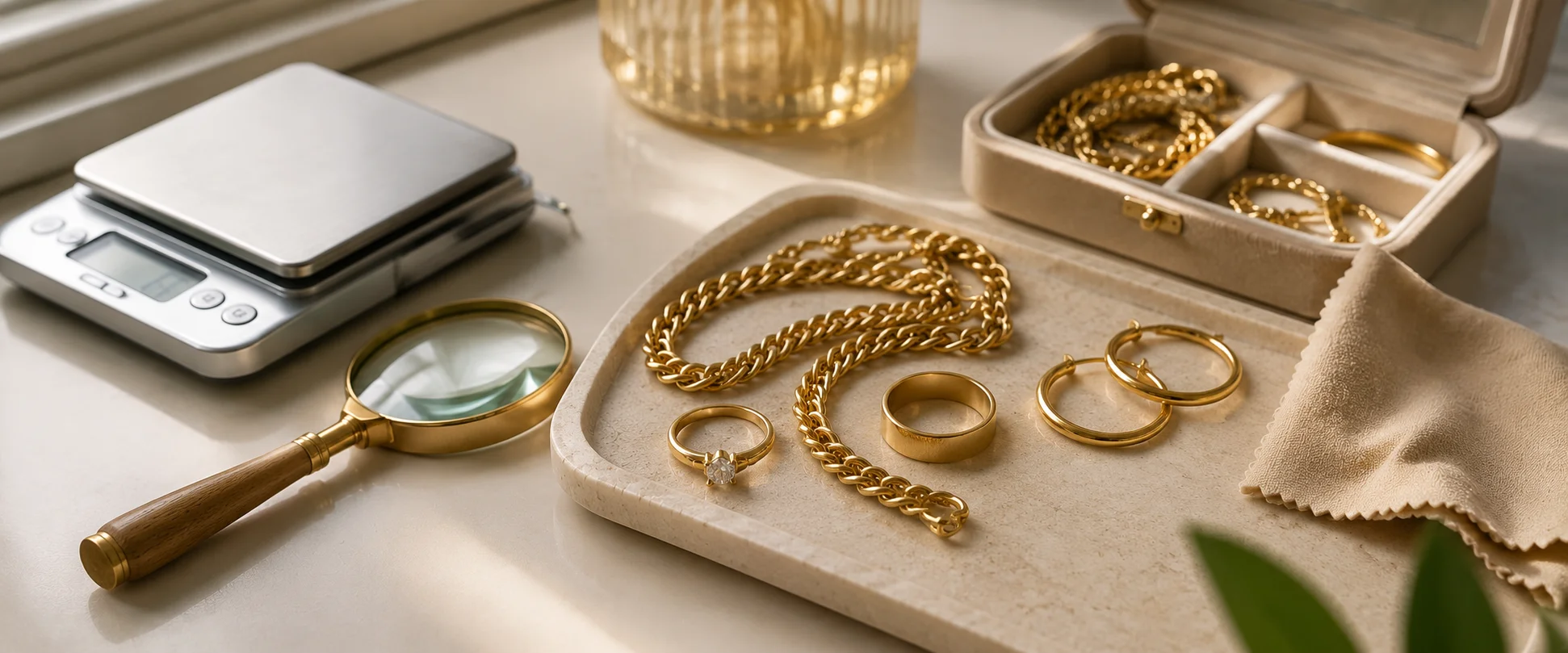
Three years ago I took my grandmother’s engagement ring into a pawn shop on the edge of town, expecting maybe eight hundred dollars, maybe more. The guy behind the counter looked at it for about four seconds, weighed it once, and slid a sticky note across the glass. $140. I actually laughed — out loud, in a pawn shop, which is not a great look — because the insurance paperwork folded up in my bag said this ring was worth $2,300.
That gap, between what something’s “worth” on paper and what a stranger will actually hand you cash for, is basically the whole story of selling jewelry. Nobody explains that part up front.
Maybe you inherited something you’ll never wear. Maybe you’re downsizing, or just need cash faster than a paycheck can get you there. Doesn’t really matter why — the process is basically the same either way.
A week later, mostly out of spite, I brought the same ring to an actual jeweler downtown — bell on the door, a guy in his sixties behind the counter, the whole scene. He weighed it, held the stone up to his loupe for a solid minute, and said something like, “Whoever quoted you $140 either didn’t look at this or figured you wouldn’t bother asking anyone else.” His offer: $610.Still not $2,300. But four times what I almost walked away with.So let’s actually walk through this properly, because there’s a real system to it once you know where to look.
First, Figure Out What You Actually Have
Before you sell jewelry any jewelry you need a rough sense of what’s metal, what’s stone, and what’s just… nice-looking. Sounds obvious. It isn’t, not really. I’ve met people who thought their whole ring was “the diamond,” when the diamond itself was smaller than a grain of rice and the actual value was sitting in the gold band around it.
Start with the stamps. Flip the piece over, get some decent light, use a loupe or even your phone’s macro camera. You’re looking for tiny marks like 10k, 14k, 18k, 925, or PT950 these tell you the metal purity. No stamp at all usually (not always) means costume jewelry, which can still hold value if it’s from a known designer, but the metal itself won’t be worth much on its own.
A magnet is a decent first check, too. Real gold and silver won’t stick to one, so if your “gold” necklace jumps toward a fridge magnet, well, you’ve got your answer already. Just don’t treat it as gospel some fake pieces use non-magnetic metals too, so think of it as a first filter, not a final verdict.
Gemstones are trickier. Unless you’re a gemologist and you’re probably not, I’m not either you can’t eyeball clarity or cut quality with any real accuracy. For anything that might be a real diamond over half a carat, it’s worth getting an actual grading report (GIA is the standard) before doing anything else. For colored stones, condition and whether they’ve been treated matters more than most people expect.
One more thing worth knowing: a certified stone almost always sells for more than an identical uncertified one, even though the stone itself hasn’t changed at all. Buyers don’t have to take your word for it anymore, and that certainty is worth paying for on their end.
And here’s the part that trips nearly everyone up: the appraisal number isn’t the selling price. If you’ve ever had a piece appraised for insurance, that number is not what you’ll get selling it. Not close, usually. Insurance appraisals are calculated at full retail replacement value — what it would cost to walk into a store and buy an identical piece brand new. Selling jewelry works nothing like that. You’re not the retailer anymore. You’re the wholesale side of the deal now, whether you like it or not.
A $2,300 appraisal turning into a $140 offer looks dramatic, sure, but the underlying math isn’t some kind of scam. It’s just two completely different numbers answering two completely different questions.
Where People Actually Sell Jewelry
Okay. Here’s where it gets useful. There isn’t one “right” place to sell jewelry it depends entirely on what you’ve got.
Local jewelers and pawn shops are fast, and you walk out with cash the same day. Good for straightforward gold or silver without much design value. The tradeoff is they need enough margin to resell (or melt) your piece and still turn a profit, so offers tend to run low.
Are all pawn shops out to lowball you? Not really some are genuinely fair, and I think they get a worse reputation than they deserve. But you still have to shop around. Never take the first number, mine included. Honestly? I almost did, and I still feel a little dumb about it.
Online marketplaces — eBay, Etsy for vintage or handmade pieces, Facebook Marketplace for quick local sales, Poshmark or Depop for costume and fashion jewelry specifically give you way more control over your asking price. But you’re doing all the work: photos, descriptions, shipping insurance, buyers messaging at 11pm asking if you’ll take half. More effort. Usually more money too, if you’ve got the patience for it.
Specialized jewelry and gold buyers are online services built specifically around this. Most work the same basic way: you request a kit, mail the piece in fully insured, and they send an offer within a few business days. If you don’t like the number, you can usually decline and get the piece mailed back — just double check who covers return shipping before you send anything in. This tends to land somewhere between a pawn shop and full retail, and it’s especially useful for gold and diamonds specifically. Once you accept an offer, payment usually shows up within a couple of days.
Consignment is usually the move if you’ve got something from a recognizable brand Tiffany, Cartier, David Yurman, Van Cleef, that tier. A shop, or an online consignment platform, lists it for you and takes a cut once it sells, often somewhere between 30 and 50 percent. Slower. But brand-name pieces sell for noticeably more when buyers can trust where they’re coming from, and consignment sellers know how to reach the right crowd. Ask upfront how long they’ll hold a piece before dropping the price or sending it back policies vary a lot from shop to shop.
Timing helps here too, in a smaller way. Consignment shops and resale sites tend to see more buyer traffic in the months before the holidays and right before engagement season picks up in December and January, so listing a nicer piece in October rather than March isn’t a bad instinct.
Auction houses are worth a call if a piece looks genuinely old, has maker’s marks you don’t recognize, or came out of an estate. Get a specialist to look at it before doing anything else I’d never hand an antique piece to a scrap buyer without asking someone first. Worst case, they tell you it’s not special. Best case, you just avoided an expensive mistake. Most major auction houses will do a free evaluation from photos alone, so there’s rarely a real downside to just asking. And keep an eye out for “signed” pieces ones stamped with a well-known designer’s name, even in costume jewelry from decades ago because those can occasionally be worth far more than their materials alone would suggest.
Scrap is the last resort, basically. If a piece has zero design value and the stones are gone, cracked, or worthless, its price is just weight times purity times whatever gold or silver is trading at that day. Simple math, low emotional attachment required. Gold and silver prices do move daily, sometimes noticeably, so if you’re purely selling for scrap, it’s worth keeping half an eye on the market and selling on an up day rather than a down one.
And sometimes selling isn’t actually the answer. If a piece is sentimental but the setting’s outdated, bent, or just not something you’d wear, a lot of jewelers will reset the existing stone into something new for way less than buying a comparable stone from scratch. Worth asking about before you assume selling is your only option.
Getting Quotes Without Getting Played
Here’s the one piece of advice I’d underline if I could: get three quotes, minimum, before you sell anything. Not two. Three. One local, one online, and if it’s gold or silver, check the day’s spot price yourself first so you already know your floor before anyone else tells you a number. It takes about ten seconds to look up and instantly makes you harder to lowball.
Why three? Because the first offer is basically never the best one, and you won’t know that until you’ve got something to compare it against. Prices for the exact same piece, on the exact same day, can genuinely vary by a couple hundred dollars between buyers. That’s not a small gap.
I know asking three different people the same question can feel a little awkward, like you’re accusing someone of ripping you off before they’ve even made an offer. You’re not. It’s just due diligence, and any buyer worth working with expects it.
Ask questions, too. A legitimate buyer will walk you through their offer this many grams, this purity, today’s price is this, here’s the math. If someone won’t break it down, or pushes you to decide right there on the spot, that tells you something.
Photos Matter More Than You’d Think
If you’re selling online, this is where most people quietly lose money. Natural window light, not the yellow overhead bulb in your kitchen. A close-up of any hallmark stamps. A couple of angles, including the clasp — buyers want to see condition, not just the pretty shot. If the piece is small, put a coin or a ruler next to it for scale; people genuinely can’t judge size from a photo alone, and vague listings get fewer bids. A quick clean helps too — warm water, a drop of dish soap, a soft toothbrush for the crevices. Skip that for anything with soft stones like pearls or opals, though; a slightly cloudy photo beats a damaged piece.
Your listing title matters too be specific. “Gold ring” gets buried. “14k Yellow Gold Vintage Ring, Size 7” actually shows up in searches and tells a buyer exactly what they’re looking at before they even click.
Be upfront about flaws, too. A tiny scratch you mention yourself builds more trust than the same scratch a buyer discovers later and messages you about, annoyed.
Red Flags Worth Knowing
Most jewelry buyers are perfectly legitimate, but the ones that aren’t tend to show the same handful of signs. A few things I’d personally never ignore:
- “Mail us your jewelry, we’ll send a check” offers with no reviews you can actually find anywhere
- In-person buyers who refuse to weigh or test the piece in front of you
- Anyone rushing you to decide immediately, no exceptions
- Sites with no real contact information, no address, nothing traceable if something goes wrong
- An offer dramatically higher than every other quote you got sometimes that’s a bait-and-switch, with the real number dropping once your piece is already in their hands
Once a piece is in the mail, your leverage is basically gone. That’s not paranoia. That’s just how the math works.
Before You Sell Your Jewelry, Try This
A quick checklist — the version I actually use now:
- Check for hallmark stamps (10k, 14k, 18k, 925, PT950)
- Weigh the piece; a cheap kitchen scale gets you close enough
- Look up today’s spot price for gold or silver
- Pull any paperwork — receipts, certificates, the original box if you kept it
- Get three quotes from three different types of buyers
- Compare every offer against the scrap floor price, not the old insurance number
Takes maybe twenty minutes. Saves you from the sticky-note-across-the-counter experience.
Here’s What This Actually Looks Like
My friend Dana had a drawer full of gold she never wore a broken chain, a pair of hoops, an old class ring from a school she barely remembers. Two local shops quoted her $310 and $275 for the lot. Reasonable, on the surface.
But she sent the same pieces to an online gold buyer as a third quote, mostly out of curiosity. The offer that came back: $460.
Same jewelry. Same day. A $150 difference, just from checking one more option. She put the extra toward a plane ticket, which felt like a pretty solid return for one phone call.
She almost didn’t bother. Genuinely almost took the $310 and called it done.
Selling jewelry isn’t complicated once you’ve done it a single time. It’s just unfamiliar the first time around, and unfamiliar things always feel like they’re working against you.
Get your three quotes. And try not to laugh out loud in the pawn shop, even if you really want to.