


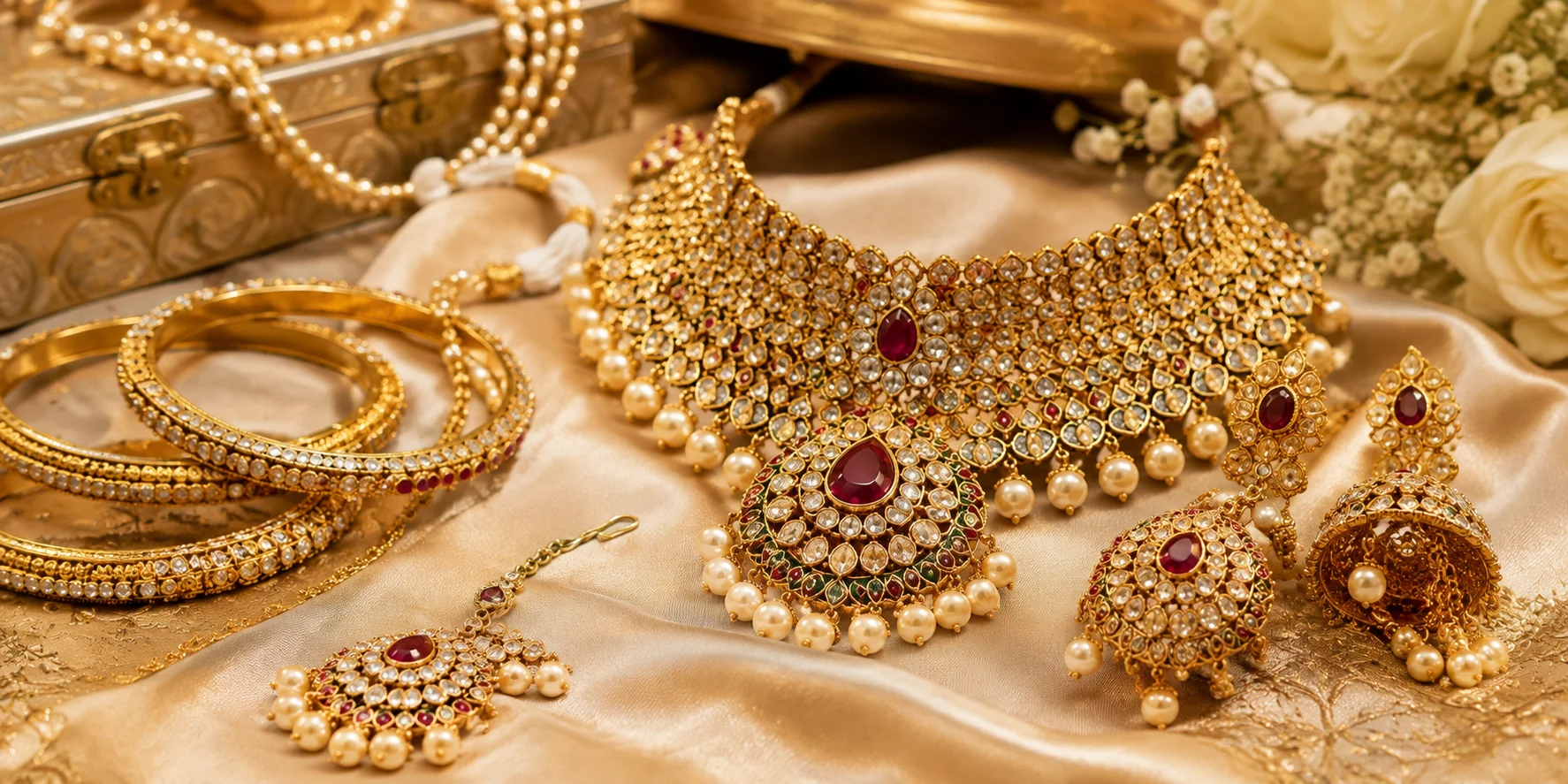
My khala called me from a shop in the sarafa bazaar last November, whispering, because the jewelry was standing about four feet away from her.The bill said Rs 1,400,000. Underneath, in the same blue pen, it said gold set.
That was the itemisation. No weight anywhere on it. No karat, no mention of mazdoori or kaat, just a total and a man repeating aaj ka rate hi laga hai baji as though the rate were the only number involved in what was happening.
She paid. Nikah was in eleven days.I want to spend most of this on that bill, because almost everything that goes wrong in wedding jewellery buying is sitting in the part of it nobody bothered to write down.
The rate is the smallest part of what you pay
Everyone checks the tola rate first, it’s basically a reflex now. Phone out, quick look, brace yourself. On 8 August 2026 the All Pakistan Sarafa Gems and Jewelry Association had 24K at Rs 456,536 a tola. Fourth straight day of increases, and two days before that the rate had jumped Rs 11,300 in one session.
Fine. But you’ll never pay that number, and the distance between it and what actually leaves your hand is where the whole conversation lives.
Two charges sit on top of the metal. Mazdoori is the labour, meaning the karigar’s hours plus whatever the shop puts on top of them. Kaat is wastage, gold that supposedly disappears while the piece is being made. Two separate charges. A lot of shops fold them into one figure and then wait to see whether you’ll ask about it.
Ranges are wide. Plain machine-made chains, roughly 5 to 10 percent. Rings and tops, somewhere in the 10 to 18 range. A heavy hand-worked bridal set can run 15 to 25 and I’ve heard worse than that in December.
None of it is regulated. There’s no authority anywhere deciding what a fair mazdoori looks like. Sounds like bad news, and it’s actually the opening, because an unregulated number is a soft number. The only reason people don’t push back on it is that it arrives buried inside one total, and a total reads like a fact instead of what it really is, an opening position.
So take it apart. Ask what the net gold weight is, and by net I mean after the stones come off, not the number showing when the whole piece goes on the scale. If there’s kundan or meena work in that necklace then a chunk of what you’re holding isn’t gold and you shouldn’t be paying gold rate on it. Ask whether mazdoori is a percentage of gold value or a flat rate per gram, because percentage charges rise every time the rate rises and this year that adds up fast.
Then ask the one that actually decides things. Kaat isi mein hai ya alag?Say it out loud, with whoever came along standing right there next to you. I’ve watched that single question change a quoted price twice.
And get all of it written on the receipt. Weight, karat, mazdoori percent, kaat percent, stone weight deducted. If a shop won’t put those on paper you’ve learned what you needed to know about that shop.
(One correction to myself. I said avoid percentage mazdoori, and that’s mostly right, but on a small light piece a flat per-gram rate can work out worse. Ask for both and compare. Half a minute.)
Purana gold exchange is where families really lose
If I could keep only one section it would be this one.Most families don’t buy a bridal set with fresh cash. They walk in carrying old jewelry dadi’s bangles, a set from some aunt’s wedding, odd pieces sitting in a locker since the nineties, and they exchange.It feels efficient and in some ways it is. But the way most people do it costs a lot more than they realise.
The counter routine goes roughly like this. He weighs the old pieces and starts deducting. Stones come off. Solder weight comes off, and solder is that lower-karat alloy holding the joins together, the same solder he charged you gold rate for on the day you originally bought the thing. Then he tests purity, usually on a touchstone, usually in about eleven seconds, and quotes you a rate a few percent under sarafa. Three tola goes in, maybe 2.6 or 2.7 comes back as credit, and none of the new purchase has even started yet.
Then you buy the new set and pay mazdoori and kaat again. On the full weight. Including the weight of the gold you just handed over, gold you already paid making charges on once, at whatever shop your grandmother walked into in 1994.
Nobody says this part out loud. The metal survives, the labour doesn’t, and every exchange buys the labour again.I’m not saying don’t exchange. Gold sitting untouched in a locker isn’t doing much either and a set nobody wears has its own cost. But if you’re putting 3 tola in to build a 4 tola set, be clear that you’re paying making charges on four, not on the one you added.
There’s a small thing that genuinely helps. Get the old pieces weighed and tested at a different shop before you take them to the one you’re buying from. Two opinions on the same lump of gold. If those numbers are more than a few percent apart, you’ve learned something about at least one of the two shops.
What it actually cost one family
A family I know bought a set in November 2024, back when gold was somewhere around Rs 270,000 a tola. Roughly 4 tola, 22K.Metal worked out at about Rs 990,000. Mazdoori at 18 percent added Rs 178,000 to it. Kaat at 8 percent put on another Rs 79,000. Call the whole thing Rs 1.25 million.
Today that same 4 tola of 22K is worth something like Rs 1.67 million on metal alone, and if they sold it back, after the usual deduction, they’d probably see around Rs 1.54 million.So they’re up. Comfortably up, and gold had a very good twenty months while they happened to be sitting in it.
But look at that Rs 257,000 of mazdoori and kaat, because it went the moment they stepped out of the shop. It bought the karigar’s hours and the karigar’s hours aren’t stored inside the necklace, they’re just spent, and there’s no jewelry anywhere buying them back off you.
Now compare it to the boring version. That same Rs 1.25 million put into plain 24K coins in November 2024 would be worth close to Rs 2.1 million now.
I’m not saying skip the set. Buy the set, it’s a Shaadi and not a portfolio review, nobody’s putting a gold coin on a bride’s forehead. Just don’t tell yourself you’re investing while you’re paying twenty-six percent over metal. Two different purchases, and you’ll be happier with the first one if you’re honest about which you’re actually making.That daughter wears exactly one piece from the set now, by the way. The tops. Rest of it has been in the locker since January.
Things that quietly add weight
A few practices that aren’t quite fraud but aren’t quite honest either.
Hollow pieces first. Big bangles and thick chains are often hollow, sometimes filled with lac to hold their shape, and if the shop is weighing gross then you’re paying gold rate for resin. Just ask whether the piece is hollow. Ordinary question, and an ordinary shop answers it without any drama.
Solder weight, as above. Every join has some, nobody itemises it, and it comes off your total on the day you sell.
Stone weight counted as gold is the most common one of all. On a kundan-heavy set that can be a serious portion of what you’re being charged for.
Then screws, clasps, hooks. Small on their own, less small across a full set of seven pieces.
None of this means jewelry are crooks. Most of the ones I’ve dealt with were perfectly straight with me when I asked straight questions. But if you ask nothing then the working assumption is that you don’t care, and people who don’t care get priced accordingly, that’s just how any counter anywhere works.
21K or 22K
One tola is 11.664 grams. So at the moment 24K is around Rs 39,100 a gram, 22K at 91.6 percent purity comes to about Rs 35,850, and 21K at 87.5 percent sits near Rs 34,250.
Call it Rs 1,600 a gram between those last two. On a 45-gram set, roughly Rs 72,000.
Same design, same karigar, same shop. And under mehndi lighting from three feet away I don’t think most people can tell, and honestly I don’t think most jewelry can either without testing it.
21K also holds up better to being worn. Keeps its shape, doesn’t deform when a bangle catches on a car door handle. There’s a reason it’s the everyday default in this country.
For anything she’ll actually wear again I’d take the 21K and put the difference somewhere it does more work.
Hallmarks, where the honest answer is unsatisfying
Look inside the piece for a stamp. On 22K it usually reads 916. You might see a PSQCA mark next to it, sometimes an assay centre mark, sometimes the jeweller’s own identification.
PSQCA oversees hallmarking on paper, and PGJDC has assaying centres set up in Karachi and Lahore. I spent a while trying to work out whether any of it gets meaningfully enforced in smaller cities and couldn’t get a straight answer from anybody, so that’s probably the answer. Plenty of long-established shops sell unhallmarked pieces on reputation and always have done.
Reputation is worth something. It isn’t worth 1.4 million rupees on its own. Big spend with no hallmark, get it independently assayed before you clear the balance.
While I’m here, gold-plated and gold-filled and gold-toned are not gold. They photograph beautifully and they’re worth nothing later.
Nobody checks the groom’s side, so that’s where the easy margin is
Everyone’s attention goes to the bridal set. The groom’s pieces get bought in twenty minutes on the way out, usually by someone who’s already exhausted.
Which is exactly why the margins there are quietly better for the shop. A heavy kada is very often hollow. A plain nikah band is about the lowest-labour piece in the entire shop, so paying 15 percent mazdoori on it makes no sense at all, and people pay it constantly because they’ve stopped reading numbers by that point in the afternoon.
Ask the same questions you asked an hour earlier. Hollow or solid. Net weight. Mazdoori flat or percentage.
And chandi is underrated for the groom’s side generally. A well-made silver kada looks better on most men than a thin gold one at the same spend, and nobody at the walima is doing purity checks on it. That’s a personal opinion and my chacha would fight me on it.
The jewelry committee scheme
Most decent-sized shops run monthly instalment plans now. Pay in for eleven months, get the twelfth contributed, or take a discount on making charges at the end of it. They push these hard around this time of year.
Read the terms and find out one specific thing. Is your gold priced at the rate on each deposit date, or at the rate on the delivery date?
If it’s the delivery date, you’re saving cash into a scheme while carrying all the price risk of a rising market without owning any actual metal. In a year that’s moved the way this one has, that’s a bad deal wearing a discount’s clothes.
You’re also tied to one shop, and that quietly removes your ability to walk out. Walking out is most of your leverage.
My own view, and plenty of people will disagree, is that buying a small coin yourself every month does the same job better. You own the metal from day one, you’re not locked to anybody, and you can still take it to whichever karigar you like at the end.
Instagram jewelry
There are good ones. There are also accounts with lovely photography, no physical address, no verifiable hallmark, no written buyback.
The filter I’d use is simple. Can you walk into a shop and put your hand on the counter, and will they put weight, karat, mazdoori and buyback in writing before you pay?
If both answers are no then price it as costume jewelry in your head, whatever the caption claims. Advance payment to an account number for a bridal set, eleven days before a nikah, is not a position I’d want to be in.
If someone’s buying it in Dubai
Happens often enough. A family trip, someone’s brother lives there, making charges tend to be lower in the souk and the work is good.
The customs side is murkier than people assume. Gulf News puts the duty-free allowance for a passenger entering Pakistan at around 10 grams with duty applying above that. Other sites say 50 grams with total confidence. One guide I read admitted the figures get revised periodically and are left substantially to the officer’s judgement on the day, and that lines up with everything I’ve heard from people who’ve actually done it.
So I’m not giving you a number to lean on. What I’d do is keep every original invoice, keep the purity certificate, declare rather than hope, and assume the officer’s reading is the one that counts. Ten grams isn’t much gold, a single decent bangle can be more than that, so a full bridal set is going to be a conversation whatever the rule technically says.
Worth it for the making charges? Sometimes, on plain heavy pieces. I wouldn’t build a trip around it.
Timing, which people always get wrong
The season runs October to February and it’s compressed this year, because Ramadan falls in early February 2027. Four months instead of five, more or less.
Karigars are three to six weeks backed up by the middle of November. So a December wedding needs the custom order in by early October, not “next weekend,” early October. Leave it later and you’re picking from whatever’s already sitting in the display case, and the display case is where the awkward pieces go to live out their years.
The better move, if the wedding is eight months out or more, is to buy the metal first. Coins or small bars, spread over a few months, almost no making charge on them. Then hand the gold across and pay mazdoori and kaat on the conversion only. You’ve stopped guessing where the rate lands in November because you already own the gold.
Hardly anybody does this and I’ve never fully worked out why. Something about coins not feeling like a wedding purchase, I think, whereas a set does.
Try this
Write down one exact spec. Say 40 grams, 22K, this particular style. Take that identical spec to three shops in a single afternoon and don’t tell any of them what the others quoted. Ask three things only: mazdoori percent, kaat percent, and whether stone weight comes off.
Write all three answers down.
The spread shows up fast, and by the fourth conversation you’ll know what a fair number sounds like. That’s all leverage really is.
The actual sentences, if it helps to have them ready:
Bhai, weight stones ke saath hai ya nikal ke? Mazdoori percent mein hai ya per gram flat? Kaat isi mein shamil hai? Cash de doon abhi to mazdoori pe kya Banta hai?
That last one works more often than it has any right to.
Go on a weekday morning as well. Tuesday, eleven o’clock, the shop is empty, the owner is on his second chai and is willing to actually talk to you. Sunday evening in December you’re customer fifty-something and you’ll be quoted like it.
Afterwards, which everyone skips
Photograph every piece before it goes anywhere. Flat on a plain background, with the receipt in the same frame so the weight and karat are legible next to the item.
Takes fifteen minutes for a full set and it’s the only version of proof you’ll have if something goes missing or if you’re arguing about weight with a shop three years from now.
On insurance, don’t assume. Standard home cover in Pakistan very often excludes jewelry or caps it at a figure that has nothing to do with what you actually paid, so read the policy before you rely on it rather than after. Bank locker fees are trivial next to what’s going in them, and honestly the bigger risk with a home safe isn’t theft, it’s that four people know the code and one of them is nine years old.
One opinion, take it or leave it
The full traditional set, the necklace and jhoomar and matha patti and jhumkas and haath phool and the bangles, is overrated as a purchase. The look isn’t overrated, the look is spectacular and I’d never argue about that. But the matha patti gets worn for four hours, photographed from six angles and then vanishes for thirty years.
Rent it. Borrow it off a cousin who married in 2023. The rental market here works perfectly well now whatever your phupho has to say on the subject.
Then take the difference and put it into fewer, better pieces. Tops she’ll reach for, bangles that actually fit, one necklace that works with more than a single outfit.
Gold’s been climbing for two years and none of this season’s numbers are going to feel good, and that part isn’t yours to fix.
The receipt is.