


A friend handed me a ring about two years ago and asked if I could do something about it. Oxidised band, the kind where the pattern only reads because the grooves are black.So I did the foil and baking soda thing. Everyone does it, it’s on every website.
Ninety seconds in hot water and it came out gleaming. Uniformly. Everywhere. Including all the parts that were supposed to stay dark.The pattern was still technically there. It just didn’t read anymore, the whole surface had gone one flat silver tone, like somebody had pulled the contrast slider down to zero. She was very nice about it. I felt terrible for about a week.That ring is why I think the first step in cleaning silver jewelry has nothing to do with cleaning.
Work out what you’re holding first
Three questions before anything touches water.Is it sterling or plated? Sterling is 92.5 percent silver and usually stamped 925 somewhere. Inside the band, on the clasp, on a small tag attached to the chain. Plated means a very thin skin of silver over brass or copper or nickel, and I mean thin, microns. Polish a plated piece hard a few times and you’ll go through it.
Are there stones, and are they porous? Turquoise, opal, pearl, coral, amber, lapis, emerald. Soft or porous or both. Heat is bad for them, alkaline solutions are bad for them, and pearls lose their surface permanently. Diamond, sapphire, ruby and cubic zirconia are tough and mostly fine with anything.
Is the black part supposed to be there? This is the one that got me. Oxidised silver, marcasite, a lot of tribal and Rajasthani and Balochi work, most things with deep filigree, the darkness in the recesses is the design and somebody put it there on purpose.
If you can’t tell whether the black is tarnish or intent, look at where it’s sitting. Tarnish spreads across raised surfaces and flat planes, it goes wherever the air goes. Intentional oxidation stays down in the low points and off the high points, because the high points were polished back afterwards.Answer those three and you’ve ruled out most of the ways to wreck something.
Is it actually silver
Worth ten seconds before you spend an afternoon on something. Particularly with market pieces or anything bought off Instagram.Silver isn’t magnetic. So a decent magnet, a neodymium one rather than the thing on your fridge, should feel almost nothing. If the piece jumps at it there’s steel or nickel in there.
There’s also the ice test. Silver conducts heat better than any other metal, so an ice cube on a flat silver surface melts noticeably faster than one on a coin. Hard to fake, that one.Neither works on plated pieces since the outside genuinely is silver. For that you need a jeweller with an acid kit. Costs nothing, takes a minute, and most shops will do it while you wait.
Most of the time it isn’t tarnish
People see a dull greyish chain and go straight for a tarnish treatment. But a lot of what’s on there is body oil, lotion, sunscreen, hairspray, dead skin, soap scum from months of showering with it on. Not a reaction with the metal. Just dirt.
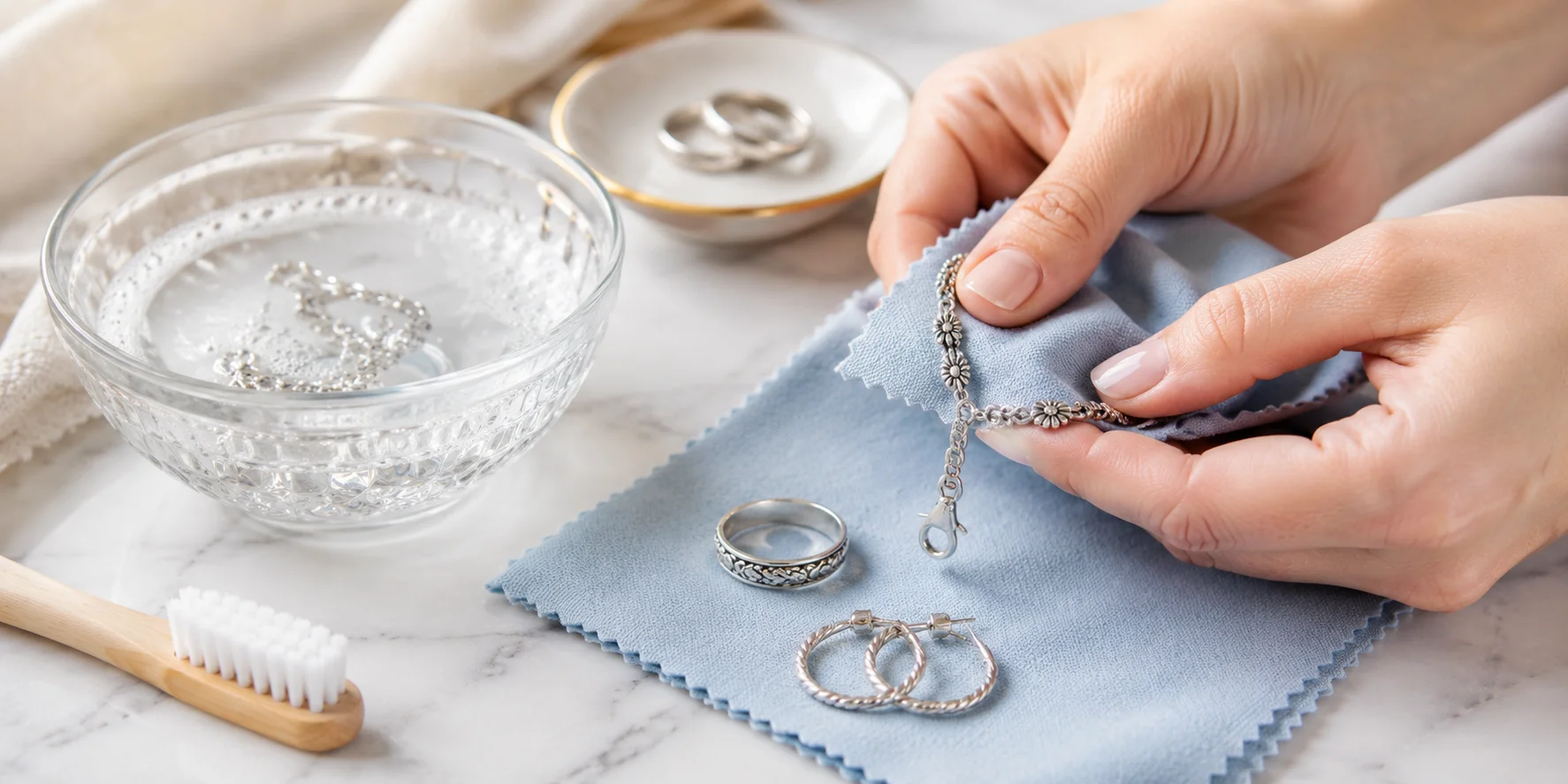
Dirt comes off with soap.Warm water, not hot. A drop of ordinary dish soap, nothing with bleach or added citrus. Ten minutes. Then a soft toothbrush, genuinely soft, a baby one is ideal, worked along the links and around the settings and into the gaps behind stones.
Rinse. Then dry properly, and this is the step everybody rushes.Microfibre cloth, then leave it out on a towel for an hour before it goes back in a box. Water sitting inside a setting or a hollow bangle will cause you grief later.
Don’t use paper towel or tissue for this.Half the pieces people bring me need nothing beyond this.
Chains
Chains tarnish faster than anything else you own. Huge surface area for their weight, and they sit against skin all day.
They’re also nearly impossible to polish, because the tarnish is inside the links where no cloth goes. You can work at a chain for twenty minutes and it’ll look better from across a room and still be grey up close.
So chains are the one category where I’d go to the foil bath first instead of last.Box chains and rope chains hold the worst of it. Snake chains are the most annoying to dry, water sits in them and shows up as a watermark days later.
If it’s knotted, sort that out before cleaning. Two pins, a drop of oil, good light. Cleaning it first just gets you a clean knot.
The foil method
The chemistry here is genuine, unlike most of what circulates. Tarnish is silver sulfide. Aluminium has a stronger affinity for sulfur than silver does, so in a hot alkaline electrolyte the sulfur migrates to the aluminium and the silver sulfide reduces back to metallic silver. It’s a galvanic reaction, the two metals need to be in contact for it to run, and the baking soda is there to make the water conductive.
Practically, no metal is lost. Polishing removes a small amount of silver every time, this removes none. Which is the reason I’d drop a chain in here rather than sit there working at it with a cloth.
- Line a bowl with aluminium foil, shiny side up. Ceramic or glass, not metal.
- Boil water, let it stand a minute so it’s very hot but off the boil.
- About a tablespoon of baking soda per cup. Some people add salt. I’ve never seen it make a difference.
- Pour it in. It fizzes.
- Piece goes in touching the foil. If it floats in the middle nothing happens at all.
- Thirty seconds to two minutes.
- Out, rinse cool, dry fully.
Faint sulfur smell while it runs, which is the reaction doing what it’s meant to.
Not for: oxidised or antiqued pieces, marcasite, pearls, opal, turquoise, amber, glued settings, or anything you’re unsure about.One thing that rarely gets mentioned anywhere. The piece often comes out slightly matte, a chalky white rather than a mirror, because tarnish has gone but nothing has been polished. Two minutes with a silver cloth afterwards fixes it.
Polishing cloths
I’ve bought a lot of silver-cleaning products over the years and the treated two-layer cloth is the one that earns its keep. Inner layer holds the compound, outer layer buffs.For light tarnish it beats everything. Two minutes, no water, nothing to spill, no risk to stones.Straight strokes, not circles. Circles leave a swirl pattern that shows up in sunlight.
The cloth turns black. Don’t wash it, washing takes the compound out.They’re cheap and they last a year or two. If you buy one thing off this list, buy one of these.
Things I’d skip
Toothpaste is the most overrated silver-cleaning advice on the internet, and I used it for years before ever thinking about why it works. It works because it’s abrasive. That’s the whole mechanism. Silver is around 2.5 to 3 on the Mohs scale, it’s soft, and you’re rubbing grit into it with your thumb. Whitening formulas are deliberately more abrasive so they’re worse. Does it take tarnish off? Yes. Does it leave a haze of micro-scratches you’ll notice in three years on a piece you can’t undo? Also yes.
Ketchup, lemon juice and vinegar are acids and they do work. But sterling is 92.5 percent silver and roughly 7.5 percent copper, and acid attacks the copper first, so you can end up with a faintly pink cast and a rougher surface over repeated use.
Baking soda rubbed on as a paste is a different thing entirely from baking soda dissolved in the foil bath, and it’s worth keeping those separate in your head. As a paste it’s just abrasive.Boiling water on stone-set pieces causes thermal shock. Opals crack, glue softens, stones work loose and you find out at a wedding.
Ultrasonic cleaners are excellent on plain silver. But the vibration loosens settings, it can shatter included stones, and it’s completely wrong for pearls.Commercial dips, the liquid ones you dunk into, are fast and harsh. They strip intentional oxidation on contact and repeated use dulls the metal. I keep a bottle. I use it maybe twice a year, seconds rather than minutes, and rinse thoroughly afterwards.
Plated, vermeil, rhodium
Plated: no polish at all. Soap, water, soft cloth. Same abrasion problem as the toothpaste above, just with far less material to lose before it matters. Every abrasive pass takes plating off and once the base metal shows at the edges it can’t be fixed short of replating.
The foil method is gentler on plated pieces than polishing is. Keep it brief anyway.Gold vermeil is gold over sterling. Never polish it. Soap, water, pat dry. A silver cloth will take the gold off, that’s what it’s for.
Rhodium plating is the one people don’t know about. A lot of modern sterling gets a thin rhodium coat for shine and tarnish resistance. If you own a piece that stubbornly stays bright while everything else in the same box goes grey, that’s why. Polish wears rhodium unevenly and you end up with a patchy two-tone thing that looks worse than the tarnish did.
Stones
I listed the porous ones at the top and I’m not going to type them out twice. Damp cloth around the metal, leave the stone itself alone, never soak.
Pearls are the strict one. The nacre is thin, alkaline solutions eat into it, and a pearl that’s lost its lustre doesn’t get it back. On last and off first, after perfume, before makeup remover. My nani used to say that and I assumed it was one of those things people just say, until I read the chemistry years later.Emeralds are usually oil-treated and heat drives the oil out. No hot water, no ultrasonic.
Heavy payal and thick tribal pieces
These behave differently to everything above so they get their own paragraph.I mentioned hollow bangles in passing further up, this is the longer version of that. Chunky anklets, big cuffs, heavy tribal work. A lot of it is hollow and filled inside with lac or resin, partly for weight and partly so it holds its shape. Hot water softens the filling and once it shifts it stays shifted.
Anything heavy that sounds hollow when you tap it, surface clean only. Damp cloth, soft brush, dry straight away.If it’s old and genuinely dirty, that’s a jeweller’s job. Some antique work carries a patina that took forty years to build and is part of what the piece is.
Storage
Cleaning silver jewelry is reactive. Not tarnishing it is the better game and it’s mostly about air and humidity.
Best thing you can buy is a pack of anti-tarnish strips. They pull sulfur compounds out of the air inside a sealed container. One strip in a ziplock bag with the air squeezed out and the piece stays bright for months. They cost almost nothing. Hardly anybody here uses them.
Silica gel does a related job on the humidity side (the packets that come in shoe boxes and medicine bottles work fine, no need to buy any). If you’ve kept silver through a Karachi monsoon you already know why that’s relevant. Same bracelet, Lahore in January versus July on the coast, completely different behaviour. I moved cities once and spent two weeks assuming a chain was faulty.
Things not to store silver in or near: wool and felt, both full of sulfur. Rubber bands. Newspaper and most cardboard. Velvet-lined wooden boxes are often worse than a plain plastic bag, which people find hard to believe because the box cost money and the bag didn’t.
And most of us store jewelry in exactly the wrong place anyway. Bathroom shelf, bedroom drawer next to a window, the dressing table where the steam from a hot shower reaches twice a day. Silver wants somewhere dry, dark and shut. A drawer in the coolest room you have, in sealed bags, is better than any box sitting out in the open no matter how nice the box is.
Off before swimming, chlorine attacks the alloy. Off before lotion and perfume and sunscreen and hair products. Off before the gym if you can be bothered.
On whether wearing silver keeps it shiny, I’ve heard the friction argument for years, and I’ve seen it hold true on some people and completely fail on others. Some people turn a chain grey inside a week. I don’t have a good explanation for it and I’d rather say so than make something up.
How often, and travelling
Daily-wear pieces, soap wash every few weeks, cloth polish when it starts looking tired. Over-cleaning is a real thing, especially with polish, since every session takes a little metal. (Not much. But it accumulates over decades, and it’s part of why old family pieces sometimes lose their crispness.)
Stored pieces, check twice a year. Mostly so you catch a green spot or a loose stone early.
Travel is worse for silver than people expect. Suitcases get hot, they get humid, everything rubs against everything else. Individual bags, air out, one strip in each. I found this out after opening a bag in a hotel room and finding a chain black after four days.
When to hand it over
Loose stones. A setting that rattles. Anything genuinely antique. Heavy black tarnish on a piece with fine oxidised detail. Or something from your family where getting it wrong isn’t really about money.
A professional clean isn’t expensive next to what people spend on the jewelry itself. And a decent jeweller will re-oxidise the recesses afterwards so the pattern still reads, which is worth asking for by name, because otherwise plenty of shops will polish the whole thing uniformly bright and hand it back looking wrong.
That ring, incidentally. She still wears it. It looks fine, it just doesn’t look like it used to.
Soap first, anyway. That’s usually the whole job.