


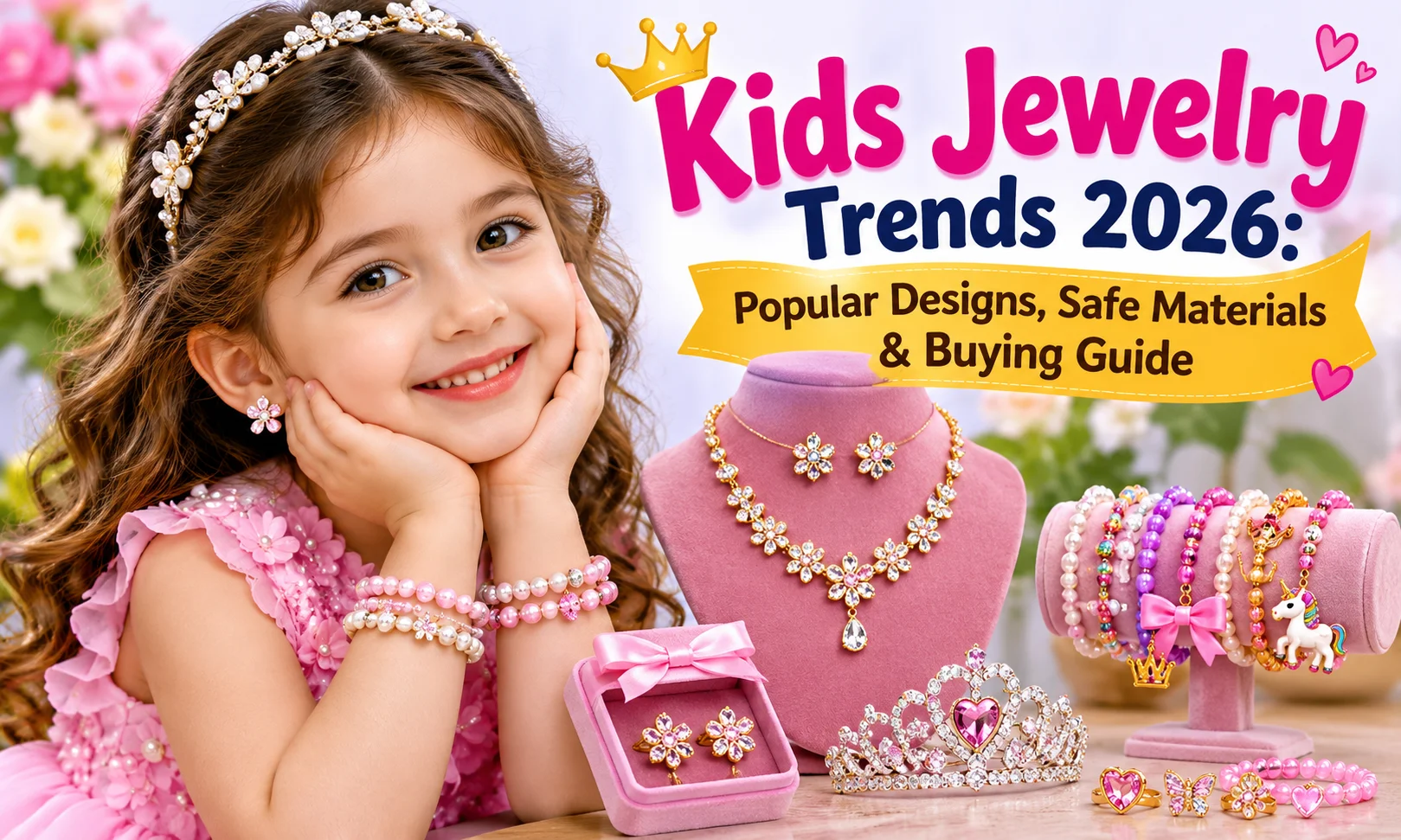
The earrings lasted about forty minutes.
I bought them that same morning. I was in a rush, it was one of those little gift shops near the station, and there they were — tiny gold-color stars, $9, pink box, ribbon on top. They were for a seventh birthday party. I felt quite pleased with myself, which should have been a warning sign on its own. By the time the cake came out, one star was gone. Somewhere in the grass. The birthday girl was crying, and I was down on my hands and knees in somebody else’s garden, moving tufts of grass about, while a dad I hardly knew stood there with a paper plate watching me like I was a nature program me.
We never did find it.
Anyway, that’s how a lot of us learn the first thing about jewelry for kids. Cute is the easy bit. Cuteness is everywhere. Cute also falls off. It snaps. It itches. It slides down the side of a car seat and that’s the last anyone sees of it. The hard bit is finding the piece a child will really wear, that won’t leave a green mark or a sore red patch, that stays on for a whole school day — and that doesn’t cost so much that you’re the one crying when it gets lost. Because it will get lost. That’s not being negative, that’s just how it goes.
So if someone has asked you to buy something small and sparkly for a small person, and you’re standing in a shop, or scrolling on your phone at midnight, and half the words mean nothing to you — 925 what? screw-back who? — then this is for you. We’ll go through what kids are wearing this year, what the pieces are made of, and how to not throw money away.
What’s actually in fashion this year
It used to be simple, kids’ jewelry. A cross on a chain for a christening. Studs when the ears got done. That was more or less it. It’s not like that now. And honestly? It’s more fun now.
Kids see what their big sisters and brothers wear. They see the stacking and the layering and the charm swapping, on screens and in the playground, and they want their version of it. So kids jewelry trends 2026 mostly look like grown-up jewelry made smaller and brighter. Names on things. Colour everywhere. Charms you can change. And one thing that is new, and it matters more than any of the styles: the people buying ask a lot more questions than they used to.
The first question used to be, isn’t that sweet? Now it’s, what’s it made of? Shop staff will tell you the same. Parents turn the box over. They read the small print. They ask about nickel. Which is all good. It can also feel like a lot, if you’re a grandparent who walked in just wanting a nice bracelet and walked into a chemistry lesson.
Don’t let it put you off. Most of what’s popular this year is easy to buy well once you know a few plain things. Fun stuff first. Sensible stuff after. I’ll try not to let the sensible stuff spoil the fun stuff.
Names, initials and stones on everything
This is the big trend. Nothing else is near it.
Name necklaces. Initial pendants. A little stone for the month they were born in. Words engraved inside a bangle. If a piece of children’s jewelry can have a name on it this year, somebody is putting a name on it. And I get why. A necklace that says Maya or Leo isn’t just a necklace to a kid. It says, this is mine. It’s got my name on it. Children go a bit mad for owning a thing with their name on it, in a way most of us grown-ups have forgotten.
The look this year is bubble letters. Big rounded letters, soft and puffy, not the thin swirly nameplates from years back. There’s a practical side to it too, which I like. Bubble letters are easy to read even when they’re small, and there are no thin bits to snap off. They look like they belong to a child, not like an adult’s necklace that shrunk in the wash.
If you’re buying, a few things I’ve picked up. An initial is the safer gift if you’re not sure. One letter is hard to get wrong. You don’t have to worry about spelling, and a single letter on a chain still works when the child is older — you just move it to a longer chain. Birthstones are the grandparent gift, and I mean that in a good way. A small stone for their birth month feels like you thought about it, and you don’t have to guess what a nine-year-old thinks is cool this week. That guess is one you will lose. Trust me.
Engraving is the quiet version of the same thing. A date inside a bracelet. A short message on the back of a pendant. Nobody else sees it. It’s just between you and them. Some kids like that more than the big name across the front, the shy ones especially.
One thing worth knowing before you pay. Real laser engraving lasts, because the words are cut into the metal. If a listing says personalized but the name is printed on, or stuck on, it can fade or rub off. Sometimes fast. Sometimes embarrassingly fast. Cut in is better than printed on. Every time.
Does it cost more? Sometimes a small fee. Sometimes it’s just included, mostly with the online makers. What it always costs is time. A piece with a name on it is made to order, so you can’t grab it off a shelf the day before the party — ask me how I know — so order early. And check the spelling three times. Then check it once more. There must be a drawer somewhere full of necklaces with one letter wrong.
Charm bracelets, and why kids keep swapping the charms
If you had a charm bracelet when you were young, heavy with a tiny shoe and a tiny tower, welcome back. They’re everywhere again. But they work differently now. The charms come off. They clip on, they loop on, they slide on, and the swapping is the whole point. A ballet shoe this month. A football next month. A little enamel strawberry because she saw one and that was that.
Kids swap them with each other too. And the shops know what that means. A charm bracelet isn’t one gift. It’s a gift that keeps giving you ideas for the next gift. Birthday coming? Add a charm. Good school report? Add a charm. You, the gift buyer, are sorted for years. On its own, that would nearly make the trend worth it.
The kits you make yourself
The other half of this is the DIY kits. A box with a bracelet or a cord, a heap of beads and charms, sometimes letter beads so they can spell their own name. These get bought for birthdays all the time, because making the thing is fun. Two kids and a charm kit at a kitchen table buys you about an hour of quiet. Any parent can tell you what an hour of quiet is worth.
The quality of the kits is all over the place, though. Most of them are dress-up stuff, and that’s fine, as long as you check the same things you’d check on anything else. Are the charms held on properly, with loops, or are they glued? Glued ones pop off. They end up in the carpet, and if there’s a little brother under three in the house who puts everything in his mouth, a loose charm is a real problem, not a small one. And does the box say what the metal bits are made of? If it just says “metal”, I’d keep that kit for older kids and short bits of wear. More on materials soon. It’s coming, I promise.
Colour, all over the place
Go and look at any kids’ jewelry stand this year and it looks like a sweet shop. Bright enamel charms shaped like fruit. Little animals. Sweets, flowers, all of it. Neon and soft pastel resin bits for dressing up. And metal in color’s you’d never see on grown-up jewelry, done with a hard coating that gives it a pink or rainbow shine and actually stays on.
Next to all that sugar, the natural bits are doing well too. Butterflies. Honeybees. Seashells. Daisies. The good ones aren’t flat. They’ve got a bit of shape to them — ridges on the wings, petals you can feel when you run a finger over them. Kids fiddle. Of course they do. A charm with something to touch gets touched, turned over, played with, worn. A flat one gets left in the box. Small thing, that. But if you’re standing at a counter choosing between two butterflies, pick the bumpy one.
One warning here, and I’ll say it again later because it matters. Cheap paint and cheap sparkle are exactly where you need to ask what a piece has been tested for. A painted charm on a very cheap import, with nothing written on the packet at all, is the risky corner of this whole market. The same butterfly from a maker who lists the materials and the testing is a different thing, even if it looks the same in a photo.
Beads and stacks, and the older kids taking over
Beaded bracelets are everywhere with the older ones. The stretchy, bright, friendship kind — make three, wear two, give one away. Kids from about nine to twelve stack them up one arm. Then they mix them in with a silver bangle and a charm bracelet, and they layer necklaces too: a short chain, a pendant, maybe one more chain if they’re feeling bold. They got all of it from grown-up jewelry. They’d hate to hear you say that. It’s still true.
Silver is having a real moment with this age group. Silver bangles. Silver pendants. Little hoops that click shut, the Heggie kind. Gold used to be the default nice metal for kids. For tweens right now, silver is the one they ask for. Partly it’s what they see everywhere. Partly, let’s be honest about money, a lost silver pendant doesn’t hurt the way a lost gold one does.
And then there’s the matching thing. Mum-and-mini sets. A necklace or bracelet for mum, and a smaller one, the same, for the child. They sell in silly numbers for birthdays, Mother’s Day, new baby gifts. Is it a bit soppy? Yes. Do kids love matching their mum? Completely. Here’s my small opinion on it, since I’m giving opinions: the sets are worth it for the photo and the grin alone. But buy the child’s half with the same care as anything else. The mini version of a cheap adult set is where the quality quietly drops off, and it’s the child’s half that sits on young skin all day.
The pieces that get kept in a box for years
Under all the colour and the swapping, there’s an older, quieter thing that hasn’t gone anywhere. First jewelry. Baby bangles. Christening bracelets. A tiny initial pendant in solid gold or silver, bought by a grandparent, worn for the photos, and then kept. In a box. For years and years. Half the adults reading this have a bent little silver bangle in a drawer that they wore at six months old and can’t bring themselves to throw out. That’s what these pieces are for. That’s their whole job.
And because they get kept, this is where solid metal earns its money. Solid gold doesn’t tarnish. Sterling silver polishes back up with a cloth. A cheap plated christening bracelet can look lovely in the photos and be peeling in a drawer by the child’s second birthday. Which rather spoils the point of a keepsake.
The other thing to know about is adjustability. Kids outgrow fixed sizes so fast it would be funny if you hadn’t paid for the thing. So you see a lot of extender chains now — a necklace with extra links, so it can be worn at 14 inches now and 16 inches later — and bangles that slide wider as the wrist grows. It’s not a trick. It’s the difference between a piece worn for five years and a piece worn for five months. Torn between two pendants that look much the same? Buy the one with the extender chain. In the future you say thanks.
Right. That’s the fun stuff. Now the bit I wish someone had told me before the star earring went missing in that garden.
Where the metal came from
A quick detour, because it’s part of the same story. Recycled silver and recycled gold are all over children’s jewelry this year. Little badges on the pages. “Made from 100% recycled sterling silver.” And parents really do ask about it in shops, which would not have happened five years ago. Part of it is the planet. Part of it, I think, is the same feeling behind all the material questions. People buying for a child want the thing to be clean, in every way you can mean that word.
Does recycled metal change anything on the skin? No. Recycled 925 silver is just 925 silver. The stamp matters the same as it always did. What changes is the mining behind it. If two pieces are much the same and one is recycled, I’d take the recycled one. But don’t let a green badge pull your eyes off the stamp, the clasp and the materials list. A recycled mystery metal is still a mystery metal.
What the stuff is made of, because that’s the bit that matters
Here’s what the pretty display cards don’t tell you. A child’s skin isn’t just small adult skin. It’s thinner. It’s often damp, or sweaty, or covered in sun cream. And the jewelry sits on it all day. The under-fives will chew on it, given half a chance. So the material is the whole game, really. The design is just what it looks like while the material does what it’s going to do.
The name to remember is nickel. Nickel is the most common cause of bad skin from jewelry — the itchy, red, sore patch under a clasp, or round a pierced ear. And it hides in cheap metal mixes. It can show up fast, or it can build up slowly over weeks, which is why a pair of earrings can seem fine in the shop and be a problem by the middle of term. When a parent says, she can’t wear earrings, they all set her ears off — nine times out of ten it’s not earrings she can’t wear. It’s nickel.
So what do you buy instead?
The metals I’d buy without worrying
Solid 14k gold is the classic. It lasts, it doesn’t tarnish, it’s kind to skin, and it’s the default for keepsakes. There is one catch. Some white gold is mixed with nickel to make it hard and pale. So for a child with sore, picky skin, yellow gold or rose gold is the safer bet — or white gold made with palladium in it instead of nickel. Worth asking one question about in the shop. That one question can save a lot of itching.
Then there’s 925 sterling silver. That little 925 stamp means the metal is 92.5% pure silver. The rest is other metal added to give it strength, because pure silver on its own is too soft to survive a child. Sterling silver suits most kids well, it costs far less than gold, and the worst it does is tarnish — it goes a bit dull and dark. That’s not damage. A soft cloth brings it back. For the money, it’s hard to beat, and it’s where I’d start for most families.
Surgical stainless steel, the 316L kind, is the workhorse. It’s tough, it’s cheap, it doesn’t tarnish, and you don’t have to baby it. It’s used a lot for kids’ studs and ID bracelets. For a school-age child who will put a piece of jewelry through PE, rain, mud and the bottom of a school bag, it just makes sense.
If ears react to everything — and some ears really do — the metals that end the argument are titanium and niobium. That’s what piercers reach for when nothing else works. Plain looking, not cheap for what it is, but if every earring ends in tears, this is where you end up, and it usually sorts the problem for good.
And then there’s food-grade silicone. That one is for teething jewelry, and people get it the wrong way round, so let me be clear. A silicone teething necklace is made for an adult to wear, so a baby can chew on it while being held. It’s BPA-free, it washes clean, it’s made to go in a mouth. It is a completely different thing from a necklace put on a baby. We’ll come back to that, because it matters a lot.
If you want the gold look without solid gold money, look for gold vermeil. That’s a thick layer of gold over sterling silver — the better end of plating. When it does wear, years later, what’s under it is silver. Silver is a good neighbor for skin. Mystery metal is not.
The stuff I’d leave on the shelf
Thin gold plating over a base metal that nobody names is the risky end of the market. Plating wears. It wears at the clasp first, and at the edges, anywhere it gets rubbed. And once it’s worn through, the base metal sits right on the skin, all day. And you don’t know what that metal is. Half the time the seller doesn’t know either.
Cheap costume jewelry with no materials listed at all is the thing to walk away from. I’m not saying that to be dramatic. Cheap imported children’s pieces have been recalled again and again in the US for having too much lead or cadmium in them. Those are metals you really don’t want in something a young child might chew on. It is all rules and tests on paper, and the rules are there. In the US, children’s products fall under the CPSIA, which sets strict limits on lead and says products for kids have to be tested by outside labs. There’s even a safety standard just for children’s jewelry, called ASTM F2923. In the EU and the UK, REACH rules hold back nickel getting out of jewelry onto skin, and they limit lead and cadmium too.
I’m not telling you that so you can quote rule names at the school gate. I’m telling you because it changes what you look for. A seller who follows the rules can normally show you something — a materials list, a note about testing, something on paper. A seller who just shrugs has told you plenty.
And that word, hypoallergenic? Nice word. It’s a marketing word. It isn’t a promise anyone checks. Anybody can print it on a box. The materials list is what counts. If a box says 316L stainless steel, that’s real information. If it says hypoallergenic fashion metal, that’s nothing. That’s just words arranged to make you stop asking questions.
A few more things to watch for. Charms and gems that are glued on fall off, and a charm on the floor is something a toddler can choke on. Magnetic clasps are a bad idea for little kids — if a child swallows two small magnets, that’s a real medical emergency, not a scare story, so keep magnets for much older children, or not at all. And the very cheap painted pieces and bargain crystals, with no testing behind them, belong in the same group in my head. Pretty in the photo. Question mark on the skin.
Amber teething necklaces: just skip them
These need their own few lines, because they’re still sold everywhere, and they worry me more than anything else in this article. Amber teething necklaces are strings of amber beads sold to be worn by teething babies. If I was telling a friend over a coffee, I’d just say: don’t buy one.
The US FDA warned back in December 2018 that teething necklaces and bracelets can strangle or choke babies. The American Academy of Pediatrics does not recommend jewelry for babies at all. And here’s the thing underneath all of that: there’s no solid proof that amber does anything for teething pain in the first place. So it’s a risk around a baby’s neck, worn to fix a thing it doesn’t fix.
If a baby near you is teething and miserable, there are better answers. A silicone teether they can hold in their own little fist. Or one of those silicone necklaces worn by you, the adult, for the baby to chew on while you hold them. Same idea. None of the danger.
The four checks I do before I pay
Okay. Here’s the bit to take with you into the shop. Everything above boils down to four checks, and you can do the lot in about ninety seconds, standing at a counter, with a child pulling at your sleeve. The four words are Material, Fastening, Fit and Finish. Say them once and they stick, which is the whole point.
First thing I do is the material. I look for the stamp. On silver I want to see 925. On gold I want a karat mark. On anything else I want a named metal in the listing — 316L steel, titanium, something real. If there’s no materials list anywhere, on the piece, on the box, on the page, that is my answer. I put it back. No stamp, no name, no sale.
Then I do the fastening. I open the clasp and close it, a few times, with my own hands. If it feels weak to me, it is weak. For little kids’ earrings I want screw backs or proper locking backs, the kind that have to be taken off on purpose. On a young child’s necklace I want a breakaway clasp, one that pops open if it gets a hard pull. A clasp is a small thing. It’s also the thing that decides whether the piece is still on the child at home time.
Fit is next. I hold the necklace up and think about where it will sit. A child’s necklace should sit short and flat, never hanging down loose. Somewhere around 14 to 16 inches is the right zone for older children, and small children shouldn’t have long chains at all. With a bangle, I check it can’t just slide off over the hand.
And last, the finish. I give every charm a firm tug. Not a polite tug. A real one. It shouldn’t move, and it certainly shouldn’t come off in my hand — if it comes off in my hand in the shop, it would have come off worse places later. Then I run a fingertip over the edges and the joins, all the way round. Anything sharp or rough or scratchy now will be worse after a week of wear.
That’s it. Stamp, clasp, length, edges. If a piece passes all four, it’s very likely a decent buy, whatever it cost. If it fails two of them, I put it back, however cute it is. The star earrings from the start of this? They’d have failed on the fastening in about four seconds. Loose butterfly backs. I know that now.
It depends on the age, a lot
Nearly every bad kids’ jewelry buy I’ve seen — or made, and I’ve made a few — comes down to one thing. Buying for the wrong age. So let’s do ages properly, because a two-year-old is not just a small ten-year-old.
Under three, the honest answer is: keepsakes and photos, basically. Babies and toddlers shouldn’t be wearing jewelry without an adult right there watching. Necklaces are a no, for the reasons in the amber bit above. Little earrings come out and go straight in mouths. Bracelets get chewed like they’re food. What you buy at this age is the christening bangle that goes on for the photo and goes back in its box. Or the piece that’s given, held up, admired, and put away. So buy it well. Being put away and kept is the job it’s actually for.
From three to five it’s soft, simple and supervised. Short bursts of wear. Parties, dressing up, feeling fancy for an hour. Soft beaded bracelets that an adult puts on and takes off. Studs, if the ears are pierced and fully healed. Nothing with small parts that come off. Nothing long. This is also the peak age for finding things and eating them, so the clip-on charm bracelets can wait a year or two. They’ll keep.
Six to eight is where it gets fun. This is the charm bracelet age. First real pendant age. Earrings they can nearly manage on their own. And responsibility starts here, in a small way — their own little jewelry box, a house rule about taking pieces off for swimming and PE. Wear time jumps up at this age, a lot, so this is where decent materials start paying you back.
Nine to twelve, the tweens, and their taste takes over. Stacking. Layering. Silver bangles and hoops that click. Friendship beads sitting right next to one good piece. They wear jewelry every day now — school, all day, all weather — and that’s exactly why good materials matter most for this group. Which is a shame, because they’re also the group most tempted by the cheap multipack at the till. A cheap alloy piece worn every single day is the one that ends as a rash and goes in the bin. In our house, the truce that works is one good silver piece, plus the fun cheap stuff for weekends. Nobody feels hard done by. Mostly.
What I actually priced for one seventh birthday
Let me put real money on this, because price ranges on a screen mean nothing until you fill a basket. While I was working on this piece, I priced a birthday gift for a seven-year-old. Pierced ears, all healed. Right in charm bracelet territory. The budget in my head was somewhere around $60 to $70, using what things cost in listings right now. And the way the money split is the lesson, more than the bits themselves.
I started with the fun layer. A set of bright beaded bracelets, the friendship stack kind, about $8. That’s play money spent on play jewelry, and it’s money well spent. She’ll stack them. She’ll swap them with friends. She’ll lose one and nobody will mind. At that price you’re buying fun. You’re not buying materials, and that’s fine, as long as they’re not being slept in or chewed by a toddler.
Then the main gift. A personalized charm bracelet with her initial and a little flower charm on it, about $28. Her letter, her bracelet, and charms can be added to it later — which means, sneaky bonus, her next two birthdays come with a small gift already sorted. At $28 you can fairly expect a named material and a clasp that works properly, and I checked both before it went in the basket. This is the one that lives in the jewelry box, not the toy box. Not solid gold. Not an heirloom. Just the proper piece.
And then, because those star earrings still sit in the back of my mind, a good pair of studs, about $28. At that price you can get small studs in sterling silver or surgical steel, with screw backs a seven-year-old can’t undo by accident in a garden. Fine for school. And here’s a detail I look for now: I bought them from a shop that sells single studs as replacements. Earrings live in pairs. They die alone.
What I didn’t buy tells the story just as well. There was a plated set — necklace, bracelet, earrings, all matching, gift box, the lot — for less than the studs cost. Very cute. And no materials listed anywhere. Not nickel-free, not a stamp, nothing. Just the words fashion jewelry. A year or two back I’d have bought it and felt clever about the bargain. This time it stayed on the shelf. That’s the four checks doing their quiet work. When a seller won’t tell you what a thing is made of, they’ve told you what it’s made of.
The whole basket came to roughly $64. One fun cheap thing. One personal piece. One properly made pair for every day. And those split across the market the way the shelves mostly do: dress-up and costume sets run about $5 to $15, decent sterling silver kids’ pieces sit around $20 to $60, and solid 14k gold children’s pieces start somewhere about $100 to $300 and climb from there. Personalization usually adds a small fee, or it’s already in the price. You don’t have to spend the gold money. But now you know what each shelf is, and knowing that is most of shopping.
Clasps, lengths and not losing the thing
Nobody writes songs about clasps. And yet they’re where it all goes wrong.
On earrings, for little kids, it’s screw backs or proper locking backs — backs that have to be taken off on purpose, not slid off by a jumper or a hug or a nap. Butterfly backs are the standard backs, and they’re fine for older kids, but they are the most losable thing in all of children’s jewelry, and the bare post behind them pokes into sleeping ears. For older kids, small Heggie hoops that click shut are the friendly option. Nothing to unscrew. Nothing hanging down. And the click tells you it’s shut.
On necklaces, short is the rule. Older children sit fine at roughly 14 to 16 inches. Anything long and swingy on a small child gets caught — on door handles, on playground stuff, on other children. For younger ones, that breakaway clasp again: it pops open under a hard pull, which sounds like a fault and is actually the safety feature doing its job. And for babies and toddlers, no necklaces. Not the cute ones. Not just for one photo that you’ll watch the whole time. Just no.
The standing rules in our house — borrowed, most of them, from jewellers who’ve fixed things for us for free, out of pity — are simple. Jewelry comes off for sleep, for swimming, for PE and for rough play. Pool water and sea water are hard on metals and even harder on anything glued. Clasps and charm joins get a quick look every few weeks, because a loose link today is a lost charm next month. Silver that goes dull gets a soft cloth, not a chemical dip. And keepsakes go back in their box.
Small habits, all of them. But they’re the difference between jewelry that lasts a childhood and jewelry that lasts half a term.
FAQs
What jewelry is safe for toddlers?
Short answer: almost none, worn. Toddlers put everything in their mouths, they pull at everything, and nothing should ever be looped round a toddler’s neck. So the safe list is a short one — a keepsake bangle that comes out for photos, and soft dress-up beads that an adult puts on and takes off in the same room. Save the real wearing for three and up. And even then, keep it short and keep an eye on it.
Which metal is best for sensitive ears?
Start with titanium or niobium. They’re what piercers use when ears kick off at everything else. After that, solid 14k gold suits most kids — yellow or rose, or white gold made with palladium rather than nickel — and 316L surgical steel is fine for a lot of children too. If every pair of earrings ends in itchy ears, stop buying multipacks with “hypoallergenic” on the front and hoping. The problem is nearly always nickel. Changing the metal fixes it. Another multipack won’t.
Are amber teething necklaces safe?
No. And that’s the clearest answer in this whole piece. The FDA warned in December 2018 that teething necklaces and bracelets can strangle or choke babies. The American Academy of Pediatrics doesn’t recommend jewelry for babies. And there’s no solid proof amber does anything for teething pain anyway. A silicone teether the baby can hold, or a silicone necklace worn by you for the baby to chew on, does the job without the risk hanging round a small neck.
What does 925 mean?
It’s a stamp, and a handy one. It means the piece is sterling silver — 92.5% pure silver, with the rest being other metals added for strength. Pure silver by itself is too soft; it wouldn’t last a week on a child. The stamp tells you two things at once. You know what metal is. And the maker bothered to stamp it, which the no-name costume pieces mostly don’t. Both good signs.
How long should a child’s necklace be?
Short. For older children, around 14 to 16 inches sits flat at the collarbone and stays out of trouble. Younger children shouldn’t wear long chains at all, and babies and toddlers shouldn’t wear necklaces, full stop. If you’re stuck between two sizes, take the one with the extender chain. Kids grow. A necklace that fits just right in March is tight by September. Ask me how I know that one, too.
Can kids wear jewelry to school or sports?
Depends on the school — a lot of them have rules, mostly about PE — but the sensible default is simple studs or nothing on school days, and everything off for sport, swimming and rough play. Things that dangle catch on things. That’s not being over-careful, that’s just how it works. Save the charm bracelet and the good pendant for the weekend, where losing them doesn’t involve a games field and a long search.
How do I stop earrings getting lost?
Buy the backs before you buy more earrings. Screw backs or locking backs for little kids, hoops that click shut for older ones, and a little dish or box by the bed that is the place earrings go. The whole system falls apart the first night a stud sleeps on a windowsill. Shops that sell single replacement studs help too. And when one does go out in a garden somewhere, try to take it well. Gardens keep their cut. That star was $9. The lesson cost more, worse luck.
Is gold or silver better for a christening or keepsake gift?
Both of them keep. It comes down to money and taste, really. Solid 14k gold never tarnishes and it reads as the classic family piece — expect roughly $100 to $300 and up for a small children’s piece. Sterling silver polishes back to new with a cloth, costs a small part of that, often somewhere in the $20 to $60 range, and it looks every bit as good in the photos. My own lean, for what it’s worth: silver for the piece a child will grow up actually wearing, gold for the tiny one that’s headed for the box and the story. Either one beats plated. Plating peels, and a peeled keepsake is just a sad little thing.
That’s about it, really. A name in round letters. A clasp that shuts properly. A stamp that tells the truth. Buy the piece she’ll reach for on an ordinary Tuesday, and it’ll still be in a drawer when she’s old enough to roll her eyes at it. Which is kind of the whole idea.