


So, twenty minutes before my cousin’s engagement party, I bought a pair of oversized gold hoops off a mall kiosk. Cost about $12, I think. My actual earrings were sitting in a drawer three cities away, so those hoops were basically an emergency buy. The guy at the kiosk promised they’d “go with everything.” Put them on in the car. Sun visor mirror.
Something was off.Not bad, exactly. Just off, in that way where you can’t name the problem but you know one exists.It wasn’t the earrings. It was my face. I’ve got a round-ish face, and those big round hoops just sat there next to it, echoing the shape instead of doing anything for it. Round next to round is just… more round. Nobody at the party said a word about it, obviously, because nobody studies your earrings that closely. But I noticed. There’s a photo from that night I still can’t fully look at. And once you notice a thing like that about your own face, there’s no real going back to not knowing it.
Which is, basically, how this whole rabbit hole started. Not because I’m a stylist. Not a jeweler either. I just got tired of buying earrings I loved in the store that did absolutely nothing for me in real life.
Turns out there’s a pretty simple logic behind how to match earrings with different face shapes, once someone explains it instead of assuming you already know it. That’s really just proportion, the kind of thing a tailor thinks about when deciding where a jacket seam should sit. Stylists and photographers lean on this all the time. They just don’t usually say so out loud, for whatever reason. And here’s a thing you’ve probably noticed without clocking it: the exact same earrings can look completely different on two people standing right next to each other. That’s the entire idea, really, packed into one dumb little observation.
Figure Out Your Face Shape First
Quick question: do you know your own face shape? If your answer’s “no idea,” you’re not alone. I didn’t either, for years. Nobody sits you down in school and teaches this, so most of us just guess, or never think about it at all.
I ended up figuring mine out with a dry-erase marker, standing in front of my bathroom mirror like an idiot. Pulled my hair back, held the marker up, and traced the outline of my face right onto the glass. A swipe of lipstick works just as well if that’s what you’ve actually got nearby. Stepped back, looked at what I’d drawn. That’s basically it: hair back, trace, step back, done.
Here’s the part that trips people up, though: hair quietly does most of the framing work on your face, and it makes almost everyone look rounder and softer than they actually are. Push it back properly first. Otherwise you’re just tracing your haircut, not your bone structure.
There’s a more precise version too, if you’re the type who wants numbers instead of a mirror trick. Measure forehead width, cheekbone width, jaw width, and overall face length, with a tape measure or even a bit of string held up and marked off. Line the four up next to each other and the shape kind of announces itself.
Here’s roughly how the categories break down:
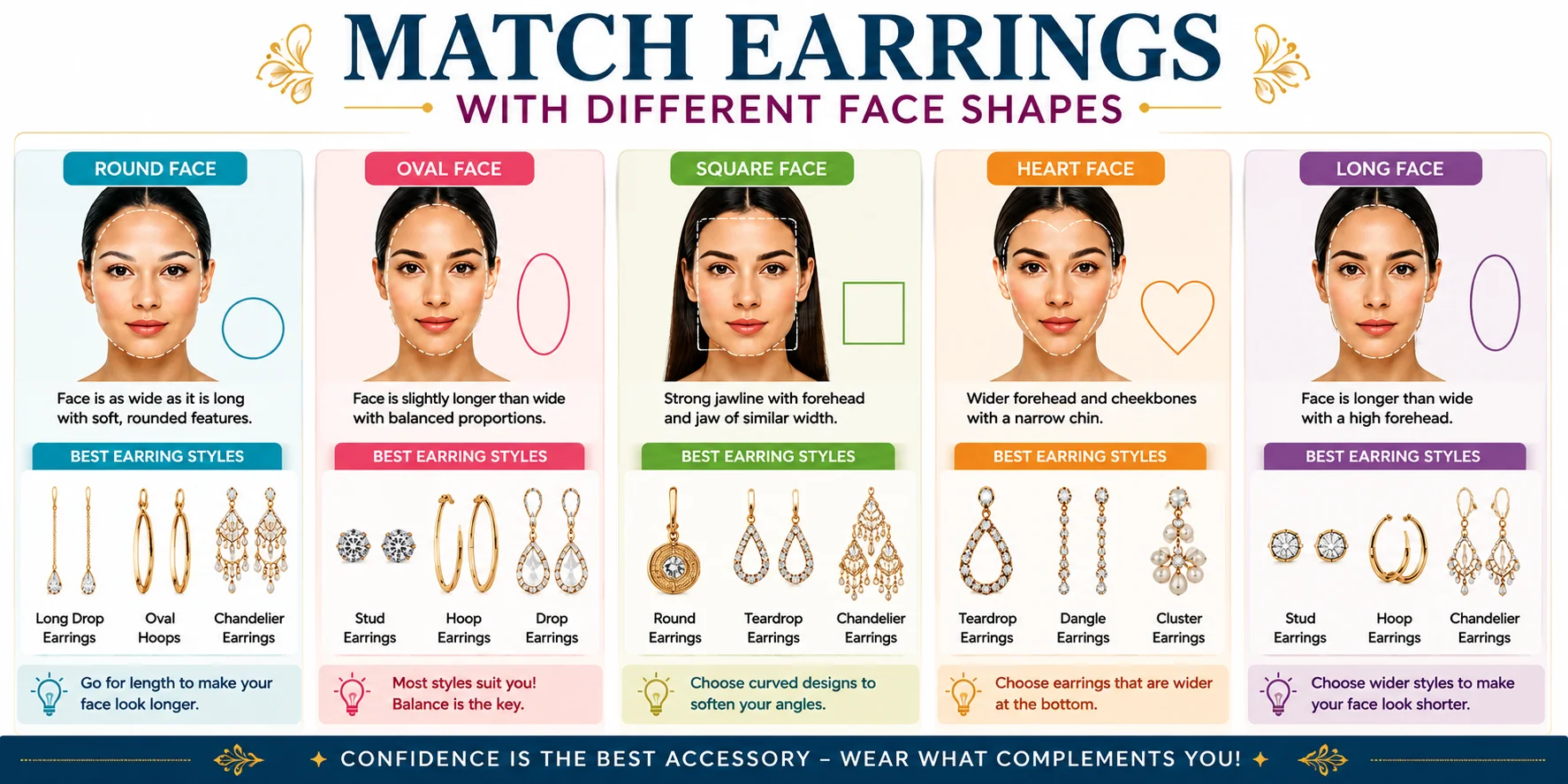
- Round: about as wide as it is long, with soft curves and no real angle at the jaw
- Oval: a bit longer than it is wide, jaw curving gently, forehead slightly broader than the chin
- Square: forehead, cheeks, and jaw all close in width, with a strong, angular jawline
- Heart: broad across the forehead and cheekbones, tapering down to a small, pointed chin
- Long (oblong): clearly more length than width, with fairly straight sides running down
- Diamond: cheekbones mark the widest point, narrowing sharply at both the forehead and chin
- Triangle (pear): jaw wider than the forehead, basically heart-shaped flipped upside down
Seven shapes, for something you were literally born with and never chose. It’s a lot. The two that get mixed up constantly are square and round, and the tell is always the jaw. Feel a distinct corner where it turns? That’s square. Curves smoothly with nothing you’d call an edge? Round. Most people land on theirs somewhere in that list before they’ve even gotten to the end of it.
Best Earrings for Every Face Shape
Okay. Actual point of the article, finally. My bad for the whole “quick” promise up there, followed immediately by three paragraphs about drawing on your face with a marker.
Round Face
The goal is length and angles, since your face already has plenty of soft curve going on. Long dangle earrings work well here. So do drop earrings with clean, straighter lines. Think rectangles, elongated teardrops, anything that pulls the eye down instead of sideways. Threader earrings and long linear drops do this well too, since they’re basically just a straight line pulling everything downward.
Honestly? I think giant round hoops are a little overrated for round faces. Everyone calls them “universal,” but a big circle next to a round face is just more circle. A hoop can still work here. Just reach for a slightly oval-shaped one instead of a perfectly round one, and it reads completely differently.
Oval Face
Every single earring guide calls this one “the most versatile,” and okay, fine, it’s mostly true. The proportions are already doing the balancing act on their own. Studs, hoops, chandeliers, drop earrings, an oval face will carry basically all of it without complaint. Which, if I’m being honest, makes it the least interesting shape to write advice for. There’s nothing to fix.
That said, “anything goes” isn’t quite right either. Scale still trips people up more than they’d expect. A tiny stud can go missing on a larger face, and a big chandelier earring can completely take over a small, delicate oval face. So: carry on, mostly, just don’t ignore proportion entirely.
Square Face
Square faces have the kind of strong jawline people pay good money for at a clinic, and that’s a good problem to have once you know what to reach for: curves. Hoops, teardrops, soft rounded drops. Anything curved softens the jaw instead of echoing it. Sharp geometric studs sitting right at jaw level do the opposite. They just underline what’s already there instead of balancing it out.
My friend Sana has this really sharp jawline. Like, model-sharp. It’s just how her face is, no filter, no contouring, nothing. For years she stuck to small geometric studs because she figured delicate meant safe. Then she borrowed a pair of my everyday gold hoops for a dinner (nothing fancy, I think I paid around $9 for them years ago), and three separate people told her she looked different that night. Not different in a vague way. Softer, somehow, even though nothing about her face had actually changed. That’s the entire square-face rule, in one small story.
Heart-Shaped Face
The whole game here is balance: earrings that widen toward the bottom offset a forehead that already draws more attention than any other feature. Teardrop shapes work well. So do chandelier earrings that flare out at the base. Skip anything that sits heaviest right up near the ear, since that only adds to a part of the face that’s already the widest.
Once the logic clicks, this one’s actually simpler to shop for than its reputation suggests.
Long or Rectangular Face
Here the goal flips completely: width, not length. Button earrings, chunky studs, and earrings that sit close to the lobe all work in your favor, since none of them add extra drop. Wider hoops help too, as long as they’re not so long that they drag the eye downward again. What you want to avoid is exactly what round faces should chase: long, thin, dangly earrings. On a face that’s already long, they just keep stretching things further.
It’s probably the one shape where “boring” earrings are doing you the biggest favor of the bunch.
Diamond Face
Cheekbones do all the heavy lifting on a diamond face, narrower at the forehead and chin on either side of them. The trick is adding a little width up top and down at the jaw, while staying away from anything that sits right at cheekbone level and draws even more attention there.
Cluster earrings, or earrings with some detail near the earlobe and a touch below it, tend to do this well. Think “presence,” not one single wide shape parked in one single spot. Why does adding width in just two small places change the whole face like that? No idea, honestly. But it does, pretty much every time.
Triangle (Pear) Face
Think of this as heart-shaped in reverse: width sits at the jaw instead of the forehead, so the earring fix flips too. You want interest and width up near the ear, not down at the jaw. A chandelier style with extra width up top does a lot of the work here, and so does a statement stud with a bit of sparkle to it. Anything that flares out wide at the bottom works against you, though, since the jawline’s already carrying most of the width without extra help.
Of all seven shapes, this one gets the least attention in most guides, which is a shame, since getting the direction right here makes a bigger visible difference than it does for almost any other shape on this list.
Common Mistakes People Make Buying Earrings
A few things nobody really tells you, that have nothing to do with face-shape charts and everything to do with real life.
Store lighting lies, for one. I’ve fallen for it myself: that warm, golden, flattering light almost every counter uses makes everything look better than it will the second you’re back outside. Step toward a window before you commit to anything, or just walk outside the shop for a moment. Fluorescent light versus actual daylight is a bigger gap than you’d think.
Take my cousin, who wears these thick square frames every single day. I used to think the obvious fix was matching frame with earring: more of one, more of the other. Turned out to be the opposite. The simpler and lighter her earrings got, the more the glasses could do their own framing job, instead of competing with something else on her face.
Copying a friend’s exact earrings falls into a similar trap. If a pair looked incredible on her, that’s about her face, not yours, same reasoning as this entire article, just easy to forget when something looks so good sitting on a shelf. Online shopping doesn’t help either. Product photos rarely show real scale, and a delicate-looking pair in a model shot can turn out to be nearly two inches long once it arrives. (This one bit me once too. A pair I loved in photos was nearly the size of a small bangle once it showed up.) Check the measurements listed, not just the picture, especially for dangle or chandelier styles.
Nobody warns you about weight, either. Wear heavy earrings every single day and your earlobe will slowly give a little over the years, nothing dramatic, just a slow stretch in the piercing hole that you won’t even notice happening. I love big dramatic drops as much as anyone. I just don’t wear them on a random Tuesday at my desk anymore. Save those for when you’re going somewhere that matters.
Getting bangs cut in, or chopping your hair short, or doing an updo for a wedding, will mess with all of this more than you’d think, and your bone structure hasn’t moved an inch the whole time. It’s worth a second look before anything big, instead of grabbing whatever’s already sitting in your jewelry box out of habit. The same goes for selfies. Don’t diagnose your face shape from one, since front-facing phone cameras distort proportions and usually widen whatever’s closest to the lens. A plain mirror works better, or a photo someone else takes of you from a few feet away.
The Two-Second Cheat Sheet
If you remember nothing else from this whole thing, keep this part:
- Round face → long, angular dangles, skip the perfectly round hoops
- Oval face → almost anything, just watch the scale
- Square face → curves, hoops, and soft drops
- Heart face → wider at the bottom, like teardrops
- Long face → studs and button earrings, close to the lobe
- Diamond face → width at the top and bottom, not the middle
- Triangle face → wider or heavier near the top
Most days, honestly, I don’t even glance at the list above. I just run through three questions in my head instead. Widest part of my face: forehead, cheekbones, or jaw? Am I trying to soften that, or even it out? Is this particular earring doing the opposite of what my face already does? That third one usually does most of the work.
One more habit worth stealing: hold the earring up next to your face instead of only checking it in that tiny display mirror at the counter. That single habit will save you from more bad purchases than any list, mine included, ever will.
FAQs
How do I find my face shape without a measuring tape?
Covered this above, but the short version: hair back, marker on the mirror, trace, then step back and look. Takes about ten seconds once you know what you’re looking for. Not scientific, but it beats guessing in your head.
Do small stud earrings work for every face shape?
Pretty much, yes, mainly because studs barely add any shape of their own. But they also don’t really do anything special. A good dangle or hoop can flatter your face shape a lot more. Studs mostly just sit there.
What’s the best earring style for a round face?
Long dangles with straight edges, no contest. Vertical lines just do more for a round face than pretty much anything else you could put in your ear.
I have a heart-shaped face. Are hoops okay?
Yes, especially medium-to-large hoops, since the roundness balances out a pointed chin nicely. Just go easy on tiny hoops sitting high and close to the ear, since those tend to add width in the wrong spot.
Are hoop earrings a safe choice for square faces?
Usually, yes, and they might be the single best choice out there. Pick rounder, softer hoops instead of anything geometric or sharp. The idea is to smooth the jaw out, not match its angles.
What if my face doesn’t match any of these shapes exactly?
That’s most people, honestly, myself included. Real faces are rarely a perfect textbook shape. Go with whichever two categories feel closest and borrow ideas from both. This whole system is a starting point, not a strict box.
Should I match earrings to my hairstyle or my face shape?
Kind of both, but they’re not really competing. Face shape barely changes; it’s the baseline. Hairstyle is just whatever’s layered on top of it that day. If your hair’s pulled back and off your face, lean harder into your face-shape pick. If it’s down and framing things, you’ve already got some natural softening or structure working in your favor, so you can bend the rules a little.
Does earring size matter more than earring shape?
Both matter, but size gets ignored way more often. A technically “correct” shape in the wrong size for your face can still look off, so treat size as step two, right after you’ve settled on shape.
Does metal color matter as much as face shape?
Not quite the same conversation. Metal tone is mostly about your skin’s undertone, while shape is about your bone structure, two separate decisions that just happen to get made at the same jewelry counter. This piece only covers the shape half.
Can I just ignore all of this and wear whatever I like?
Also yes. It’s a guide, not a rulebook. Feeling good about what you’re wearing beats any face-shape chart, mine included, every single time.
Anyway. Next time you’re stuck between two pairs at a jewelry counter, just picture your face shape for half a second. That’s the whole trick, not some elaborate formula. If you still end up buying the “wrong” ones because they made you smile in the mirror, buy them anyway. I still wear those $12 hoops sometimes. They’ve just learned their place now: hair down, never pulled back. Small fix. Huge difference.