


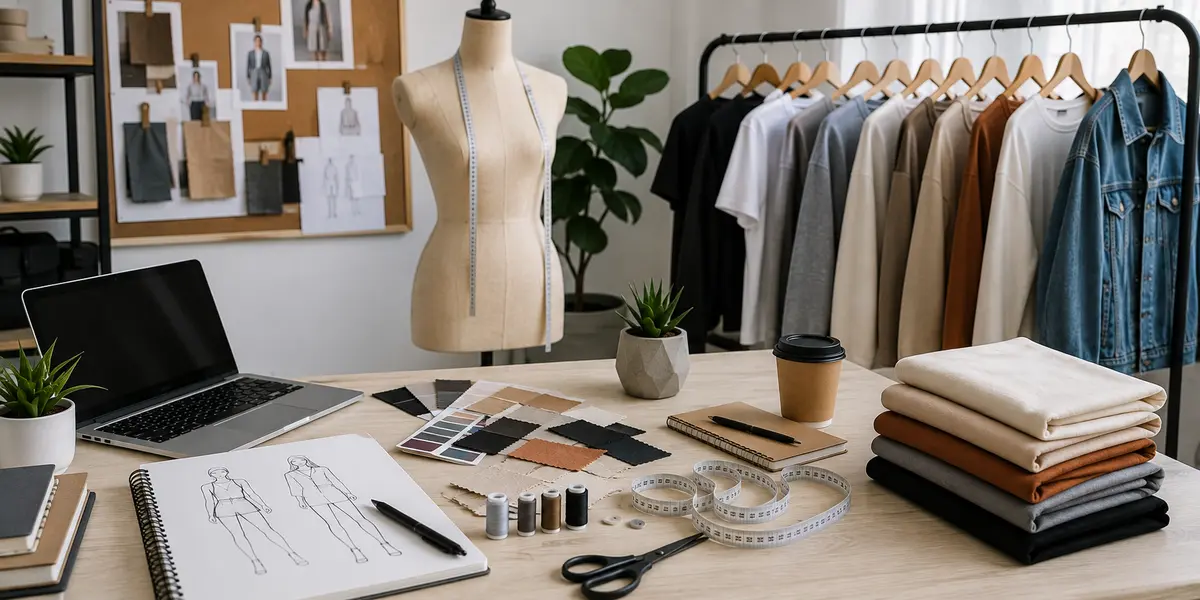
I was in that little print shop on East 6th in Austin, the one that always smelled like hot plastic and yesterday’s coffee. The guy behind the counter handed me the sample and just said, “You sure about fifty?” I laughed like it was no big deal. Inside I was already doing the math on how long it would take to move them if nobody cared. Logo sat a little high on the left chest. Not dramatically wrong. Just enough that my eye went straight to it every time. Still have that shirt. Folded under some winter stuff in the back of the closet. Crooked logo and all.
That’s usually how it starts when you’re trying to figure out how to start a clothing brand. Not some clean business plan. Just you, a slightly imperfect sample, and the quiet hope that someone else will want it too.
You’ve got an idea stuck in your head. Maybe a fit you can’t find in regular stores, or a graphic that feels personal, or just this feeling that most clothes right now are either trying too hard or completely boring. And you’re sitting there wondering if starting a clothing brand is actually possible without a mountain of money or some uncle in the industry. It is. It’s just slower and messier than the highlight reels make it look. A lot messier.
I’m going to talk through it the way I’d explain it to someone sitting across from me at a coffee shop. No big frameworks. No “ten steps to success.” Just the order of things that tends to work when you’re starting from zero and don’t want to lose your shirt (pun intended).
First thing that matters more than most people admit is knowing who the clothes are actually for. Not “young people who like streetwear.” That’s everyone and no one at the same time. Something tighter. The guy who lifts but still has to look presentable at a regular job. The woman who’s tired of shirts that feel like tissue paper after two washes. The person who wants something that doesn’t scream “I bought this because it was on sale.” Whatever it is, write it down in one plain sentence. Keep it somewhere you can see it. You’ll drift otherwise. Everyone does.
I watched a friend push angry slogan hoodies for a while. Black, heavy, lots of attitude. They moved okay for a couple months. Then the algorithm moved on and he was stuck with boxes of stuff that already felt dated. Another person I know made simple, slightly oversized work shirts for women who actually work outside. Nothing flashy. No big graphics. Still going years later. The difference wasn’t the designs. It was how specific the reason to buy felt. People could look at it and think, “That’s for me.”
Honestly? A lot of new brands skip this part and go straight to making cool-looking stuff. Then they sit there confused when the sales don’t come. Cool is everywhere. Specific is rarer.
Write that sentence. Something like “heavyweight, slightly oversized tees for people who hate how stiff most ‘premium’ basics feel after a few washes.” Or whatever your version is. You’ll need it later when you’re tempted to add a tenth product just because something is trending on TikTok.
Money is the part everyone dances around. You can start stupidly small. Or you can start with a real budget. Both paths work. They just feel different day to day.
If you’re broke or just testing the waters, print-on-demand is still the lowest-risk way in. You upload the designs, they print and ship when someone orders. No inventory sitting in your apartment. No minimums that matter. The margins suck though. Sometimes five or six bucks profit on a thirty-dollar shirt after all the fees. But you learn what people actually respond to without eating instant noodles for six months straight.
I know a woman who started exactly that way. Two designs. One sold decent. The other completely flopped. She killed the dud, made three more variations of the winner, and after about eight months she had enough data and cash to move to a small cut-and-sew run. That’s the useful version of print-on-demand for most people. It’s research with a checkout button attached.
If you’ve got two to five thousand dollars you can actually risk without panicking, you can go further. Sample a few styles. Feel the fabric after you’ve washed it a couple times. Then order a small batch. Fifty to a hundred pieces per style is pretty common at the beginning. Better margins. Better control over quality. Higher stress when the box arrives and half the collars sit weird.
Here’s a rough starter budget if you’re doing a small physical run of your own:
Samples and the shipping back and forth can easily eat three to six hundred bucks.
A first production order of three styles around seventy-five units each usually lands somewhere between eighteen hundred and thirty-five hundred depending on the blanks and how you’re decorating them.
Basic packaging, labels, hang tags another couple hundred.
Website and domain for a year is cheap, maybe one-fifty to three hundred.
A little ad spend to get the first real eyes on it, another three to five hundred if you want to test.
That’s not glamorous. It’s enough to find out if anyone actually cares.
One honest preference of mine: I think spending your first real money on better blanks is smarter than spending it on fancy packaging. A twelve-dollar blank that feels good will outsell a seven-dollar blank in a four-dollar box every single time once people start trying things on. Packaging is theater. The fabric is the product. People notice how something sits on their shoulders. They forget the tissue paper five minutes later.
Finding people to actually make the clothes is the part that freezes a lot of folks. Or gets them scammed.
For print-on-demand the big platforms are fine starting points. You already know the names. Test a few. Order samples from each. Feel the fabric. See how the print holds up after three washes in your own machine. One platform’s “premium” is another’s regular. Don’t trust the product photos. They lie constantly.
If you’re going custom, start with blank manufacturers who already make good basics, then add decoration. Or find a cut-and-sew shop if you need original patterns. Google is noisy and full of middlemen. Better routes: trade shows if you can get to one, or just ask other small brands who they use. A surprising number will tell you if you ask nicely and aren’t competing directly with them.
When you email a factory, be specific. “I need a hundred units of a 220gsm oversized tee in two colors, screen print on the front only, delivered to Texas.” Vague emails get vague replies or get ignored completely. Ask for their minimum order quantity, realistic lead times, and whether they can do a sample first. Always pay for the sample. Never skip it. I’ve seen too many people skip the sample and then cry later.
Red flags I’ve seen more than once: factories that won’t send real photos of previous work, ones that demand a huge deposit before you’ve seen anything physical, or ones that suddenly change the price after you’ve already mentally committed. Trust moves slow at first. That’s fine. Better slow than screwed.
Quick real example. My friend Marcus started a small brand of heavyweight crewnecks. He found his factory in Los Angeles because another brand casually mentioned them in an Instagram story. Ordered samples. One came back with the wrong weight fabric. He sent it back with detailed notes. Second sample was right. First real production run of a hundred twenty pieces had three that failed his own quality check. He ate the cost, fixed the process with the factory, and now just reorders every four months or so. Not sexy. Just how it usually goes when you’re starting a clothing brand for real.
The brand side, the name and the look and the photos, gets overthought constantly. Name first. Check if the domain is available and if the Instagram handle is free or close enough. Don’t fall in love with a name you can’t own online. Simple is better than clever most of the time. Clever names are hard to remember and harder to spell when someone is trying to find you later.
Visual identity doesn’t need a five-thousand-dollar designer. It needs consistency. One or two fonts max. A color palette that doesn’t look like every other new brand launching this month. Take photos that feel like the world your customer already lives in. Natural light. Real people. Actual streets or messy rooms. Overly styled studio shoots often make the clothes feel less wearable, like costumes instead of something you’d actually put on a Tuesday.
I actually think a lot of new brands overdo the mood-board phase. You can spend weeks collecting aesthetic images on Pinterest and still have zero product to sell. Set a hard deadline. Two weeks for the name, rough logo direction, and first three product concepts. Then stop collecting and start making something physical.
Website-wise, Shopify is still the easiest for most people starting out. It’s not the cheapest long-term if you scale hard, but for the beginning it’s fine. Get a clean theme. Write short product descriptions that sound like a human wrote them, not a catalog. Make the buy button obvious. And please don’t hide the shipping costs until the very last step. People hate that. It feels like a trick.
Getting the first sales is the part that makes most creators uncomfortable. You have to tell actual humans that the thing exists.
Organic first. Post the process. Show the samples arriving. Show the ones that came out wrong. Show yourself wearing the thing around town. People buy from people they feel like they know a little bit. A polished brand account with perfect photos and zero personality gets scrolled past. A slightly messy account that shows the work and the mistakes often doesn’t.
Collaborations help more than people expect, but not the way most beginners do them. Not sending free product to accounts with fifty thousand followers who never post it. Real small ones. Local shops, other micro-brands, creators whose audience actually overlaps with yours. Offer something useful, not just “feature me please.”
Paid ads can work early, but they’re very easy to waste money on. Start tiny. Ten or twenty dollars a day testing two or three creative angles. Look at what the algorithm actually pushes. Kill the losers fast. One brand I know got their first eighty sales almost entirely from one simple video of the fabric stretch test. No model. No music. Just hands pulling the hem of the shirt. Weirdly effective. People could see how the material moved.
Email list from day one, even if it’s only five people at the start. The people who buy once are the ones most likely to buy again. Treat them better than the algorithm does. A simple “hey, new color just dropped” email to people who already trust you will outperform a lot of cold traffic.
If you want something concrete to do in the next thirty days instead of just reading and thinking about it, try this:
Write your one-sentence customer and problem statement and put it where you’ll see it.
Order three different blank tees or hoodies in the weight and fit you’re thinking about. Wash them. Wear them for a full day. Decide which one feels right.
Design one graphic or choose one simple treatment like embroidery or a clean print.
Get a single sample made. Print-on-demand or local print shop, doesn’t matter.
Take five decent photos of it on a real person or on yourself. Natural light only.
Set up a basic Shopify or similar store with just that one product.
Tell ten specific people who might actually care. Not “everyone on your story.” Ten real humans.
Post the story of getting the sample, including the part that went wrong.
That’s it. Do those eight things and you’ll know more about whether this is for you than another month of researching manufacturers and watching YouTube videos.
Things that quietly kill more brands than bad designs: cash flow problems when you sell out, reorder, and the factory is late so you have no stock while ads are still running. Or you order too much of something that only looked good in your head. Quality consistency is another quiet killer. First batch great. Second batch the fabric feels slightly different or the print placement shifts. Customers notice. Reviews suffer.
And burnout. Making clothes is fun until you’re packing orders at midnight for the third week in a row while your day job still exists. Build even tiny systems early. A simple packing checklist on a sticky note. A cardboard box where returns go. Something so the whole operation doesn’t live only inside your head.
I knew a couple who started a small kids’ brand. Beautiful stuff, really thoughtful. They did everything themselves for two full years. Then one of them got sick for three weeks and the whole thing stalled. Orders backed up. Emails went unanswered. They eventually hired part-time help just for packing and never looked back. The lesson wasn’t “hire early no matter what.” It was “don’t build something that collapses the second you’re not operating at a hundred percent.”
If the first products sell and you want to keep going, the next decisions get heavier. More styles? Better fabrics? Wholesale into shops? Your own manufacturing setup?
Most people move too fast into new categories. The brands that last usually deepen what already works before they widen. One great tee becomes three colors, then a long-sleeve version, then maybe a matching short. That’s boring on paper. It’s also how you build a real customer who buys from you more than once.
Wholesale can feel exciting. Getting into actual shops. But the margins shrink and the payment terms can stretch out for months. A lot of small brands do better staying direct-to-consumer longer than they expected.
And the brand itself will try to drift. Trends will pull at you. Other brands will copy what you’re doing. You’ll see something blowing up on TikTok and think “we should do a version of that.” Sometimes yes. Mostly no. Go back to that one sentence you wrote at the beginning. If the new idea doesn’t serve that specific person, let it go. It’s harder than it sounds when the shiny new thing is getting all the attention.
FAQs
How much money do I really need to start a clothing brand?
Honestly? You can test the waters with under five hundred dollars if you stick to print-on-demand and do the photos yourself. A proper small batch with samples and a basic site usually lands between two thousand and five thousand. Anything less and you’re mostly just playing around. Anything more and you better already have some signal that people want what you’re making.
Is print-on-demand worth it or just a trap?
It’s worth it if you treat it like market research instead of the final version of the business. Margins are thin and the quality can be hit-or-miss depending on the platform, but you learn what sells without a garage full of unsold hoodies. Most people who stay stuck on it forever are the ones who never move to better blanks once they have real proof of demand.
Do I need a trademark right away?
No. File when you have a name you’re keeping and some actual sales under your belt. Early on just make sure nobody big already owns the exact name in clothing. A quick search on the USPTO site and a domain check is enough for the first six months. Don’t let trademark anxiety stop you from making the first sample.
How do I find a manufacturer that won’t ghost me?
Ask other small brands directly. A lot of them will share if you’re not competing head-on. Start with samples only and pay for them. If the factory pushes for a big deposit before you’ve seen anything physical, walk away. Lead times that sound too good to be true usually are. And always get everything in writing, even if it’s just email.
What if my first designs don’t sell at all?
Kill them fast. That’s completely normal. The brands that make it are the ones that treat the first few products like experiments, not sacred art. Look at whatever little data you have, talk to the few people who did buy, and make the next version better. Most of my early stuff that I personally loved sat in boxes. The ones I almost didn’t release were the ones that moved.
Should I quit my regular job to do this full time?
Not until the brand is covering your real bills for at least three or four months straight and you can see a clear path to keep that going. The romantic version of quitting and “going all in” leaves a lot of people broke and bitter. Keep the day job until the numbers make the decision for you. It’s less dramatic that way, but it keeps the lights on.
Starting a clothing brand is less about fashion and more about making decisions while you’re still unsure. You will order the wrong size run at least once. You will have a design you love that nobody else does. You will pack an order wrong and have to email a stranger to apologize and fix it. All of that is normal. It happens to almost everyone.
The people who stick around are usually the ones who treat it like a long conversation with a specific group of people instead of a performance for the algorithm. They fix the small things. They listen when someone says the collar is itchy. They don’t quit the first time a shipment is late or a design flops.
You don’t need permission from anyone. You need a sample that feels right in your hands, a clear idea of who it’s for, and the willingness to look a little ridiculous while you figure out the rest.
That’s really most of the game. The rest is just details you only learn by getting a few things wrong first.