


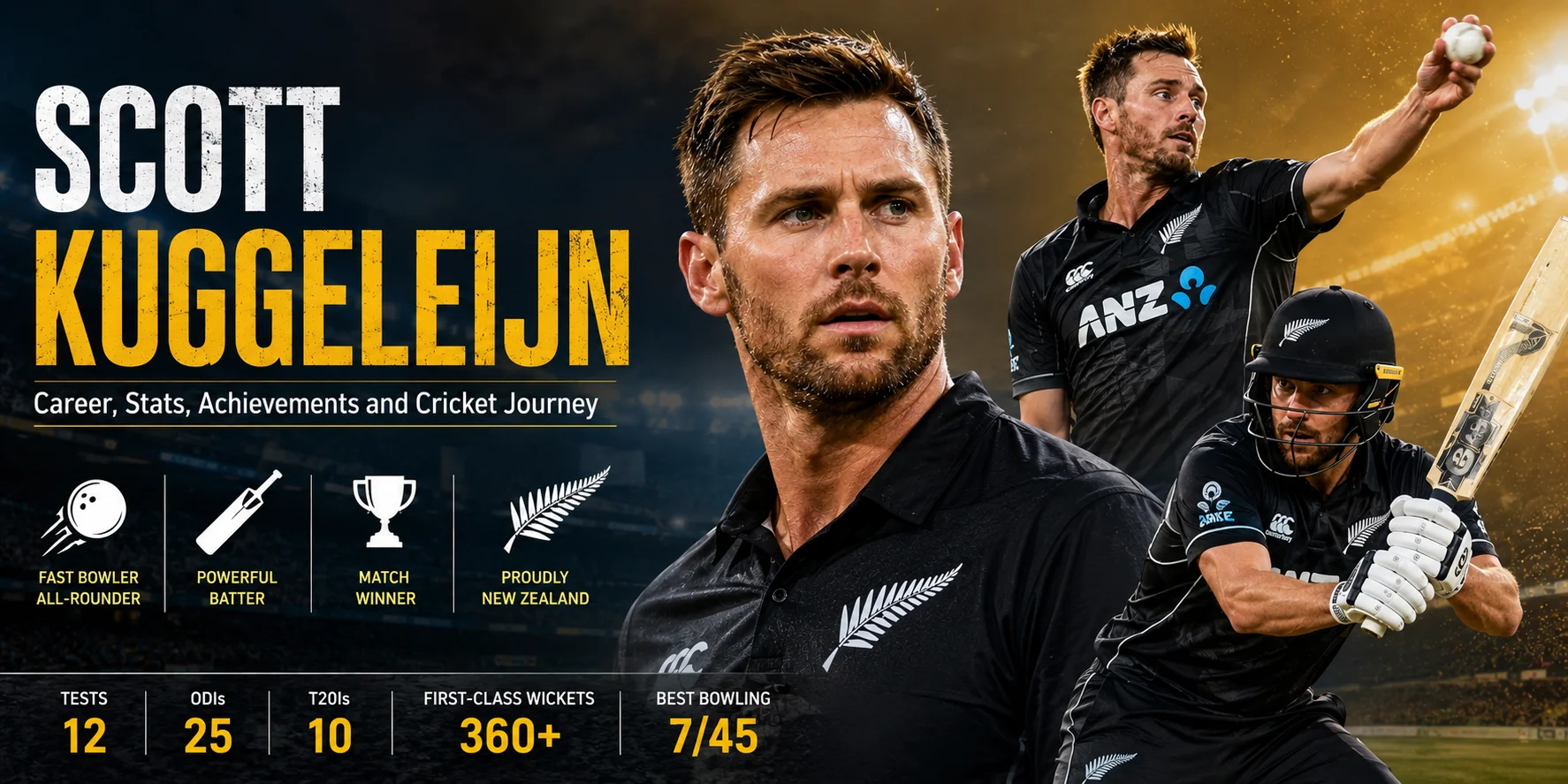
Dunedin, March 2025. Plunket Shield, final round. Northern Districts are chasing a declaration and need runs fast. Their fast bowler Scott Kuggeleijn walks out to open. First time in his life he has batted at the top of the order in first-class cricket. The fourth ball he faces, he hits it for six. Does not slow down after that. Fifty comes off 19 balls. He eventually walks off on 71 from 26 deliveries. Somewhere in that innings, a record Andre Adams had owned since 1997 quietly disappeared.
A bowler did that. Opening the batting. For the first time ever. That is probably the cleanest way to explain what kind of cricketer Kuggeleijn is. He does not follow the expected script. Never quite has.
Who Is Scott Kuggeleijn?
Born January 3, 1992, in Hamilton. Right-arm fast-medium. Bowling all-rounder. That is the short version. The longer version is that he has played Test cricket, ODI cricket, and T20 cricket for New Zealand all three formats while never quite becoming the kind of name that gets mentioned first when people talk about New Zealand pace bowling. He has been useful, often very useful, in ways that do not always show up loudly in the record books but that his teams have clearly valued for a long time.
He has also played for Chennai Super Kings in the IPL, St Lucia Zouks and St Lucia Kings in the CPL, and Dubai Capitals in the ILT20. For a seam bowler who came through the Northern Districts system in Waikato, that is a reasonable spread of the world.
Scott Kuggeleijn’s Early Life and Cricket Background
Hamilton is not a glamour city. It is a working city in the Waikato, and the cricket it produces tends to reflect that hardworking, patient, not much interest in doing things the flashy way. Scott Kuggeleijn is a product of that place in the most straightforward sense.
His dad is Chris Kuggeleijn. Two Tests against India in 1988–89. Sixteen ODIs for New Zealand. After finishing as a player, Chris went into coaching with Northern Districts, which is the region where Scott eventually built his whole career. So you have a father who played international cricket and then spent years on the coaching side of the game, both in the same place his son was developing. That is a genuinely rare setup. Not just having a cricketing father having one who then understands player development professionally, in the same system, at the same time.
Uncle Jason and cousin Tim were also in and around domestic cricket. The cricket conversation in that family was not something that happened on weekends while watching TV. It was specific. Technical. People who had played were part of it. Scott went through the Northern Districts age-group pathway, started with Wellington in 2011–12, played two seasons, then moved to Northern Districts in 2013–14. Has been there since. The Wellington chapter, looking back, feels like a short detour that was always going to end with him coming home.
Scott Kuggeleijn’s Domestic Cricket Career
His international caps get the attention. The domestic career is where the real story is. First-class debut was November 2011. Wellington versus Central Districts in Napier. He was 19. The Wellington stint gave him a base some experience, some exposure to first-class cricket but the serious career started once he joined Northern Districts. That is when everything started building properly.
Three years in, the 2016–17 Ford Trophy happened. He finished the tournament as the leading wicket-taker. Seventeen wickets in nine matches. And not in the way where two freak games pump the number he was genuinely the most threatening pace bowler in the whole competition, week after week, from the first match to the last. The New Zealand ODI squad for the Ireland tour was named not long after. His name was in it.
What he built from there at Northern Districts is, honestly, more impressive than most people outside that region realise. Three hundred and sixty-two first-class wickets. Average of 30.16. Best of 7 for 45. Fourteen five-wicket hauls. Over 18,000 balls bowled in first-class cricket alone.
That Canterbury game is worth its own mention. Northern Districts were in a match where Canterbury had posted 445 in the first innings. At 445 you are not really thinking about winning. You are thinking about getting through the next two days with some dignity. Kuggeleijn took six wickets in Canterbury’s second innings. Nine for the match. Northern Districts won by five wickets. The game should not have ended that way. He made it end that way. The 2025–26 Super Smash leading wicket-taker again. Seventeen wickets. He was 33 years old. Northern Brave took the title, their fifth. His bowling was not a small part of that.
Scott Kuggeleijn’s Franchise Cricket Career
Not every franchise cricketer actually gets used. Some get picked, sit in the dugout for most of the tournament, play one or two games if someone is injured, and go home. It happens more than the glamour around franchise cricket suggests.
Kuggeleijn’s time with Chennai Super Kings in the 2019 IPL was not that. Chennai do not carry players for the sake of it. Their squad selection across the years has been ruthlessly practical if you are there, there is a clear reason why. Fast-medium bowlers who hit good areas, bowl the hard overs, and do not go for twenty in their last two that is the profile they value. He fitted it.
The CPL stints with St Lucia were spread across multiple seasons. Different challenge entirely. West Indian pitches, shorter boundaries at certain venues, batters who like pace and who specifically look to hit through the line against seamers. You cannot rely on the same plan you use in New Zealand. You have to figure out what works in those conditions specifically, against those batters specifically. He kept getting recalled to the Caribbean circuit, which tells you he figured it out well enough.
Dubai with the ILT20 added another layer. Night cricket, slower surfaces, the ball behaving differently in dry heat than it does in the humidity of the Caribbean or the cold of a New Zealand spring. Each franchise stint IPL, CPL, ILT20 taught him something his domestic career alone could not have. The fact that he kept getting picked up across all three is the real point. Franchise teams have no loyalty. If a player is not delivering, he does not come back. Kuggeleijn kept coming back.
The Weight of a Cricket Family
There is something that can happen to sons of former international cricketers that does not get talked about enough. The expectation shows up before the ability does. People in the system already know the father’s name. Coaches who work with the son once worked alongside the father. The comparison is always there, even when nobody says it directly. Some players buckle under that. They either try to be their father and cannot, or they spend so much energy distancing themselves from the comparison that they lose sight of their own game.
Kuggeleijn clearly did not go either way. But the weight was real. His father Chris coached with Northern Districts after finishing as a player. The people who coached Scott had worked with Chris. The name carried meaning in that environment before Scott had played a single first-class ball. Whether that was more useful or more difficult probably shifted depending on the season and the situation. When the Ford Trophy went well, it added nicely to the story. When things were harder when international calls did not come or when the career hit the serious difficulties of 2016 carrying that name in the same region where his father worked must have been its own thing to manage.
What is clear is that the numbers he put up came from work, not from the name. Three hundred and sixty-two first-class wickets. You do not get those because your father coached in the same system. You get them by bowling, season after season, on pitches that are not always friendly, against batters who have figured you out and need to be beaten in a different way.
Chris represented New Zealand. Scott represented New Zealand in three formats. That is two generations of the same family in the Black Caps. It is a good story. It is also, if you sit with it, a story about doing a hard thing twice in the same family not just inheriting a name, but actually earning it separately.
What Domestic Grind Actually Looks Like
The phrase gets used a lot. “Domestic grind.” It tends to sit as a vague idea less glamour, smaller crowds, long seasons. What it actually involves in practice is worth being specific about, because the specifics are what make Kuggeleijn’s career numbers mean something.
The Plunket Shield runs from October through to March. Four-day cricket. Rotating venues across regions on two different islands, which means a lot of travel between matches. The squads are relatively small, so you play most games. You play with and against the same people over and over across years. There are no massive crowds. A Thursday afternoon Plunket Shield match in Hamilton might have a few dozen people watching mostly family of the players, a couple of local club members, maybe a dog wandering near the boundary. You take your wicket, you walk back to your mark, you come back to bowl the next over.
Fourteen five-wicket hauls means fourteen separate occasions where Kuggeleijn took five or more wickets in an innings of a four-day match. Each one of those required sustained, quality bowling not just one good spell, but enough good deliveries over enough time to get through a batting lineup properly. Fourteen times, across different seasons and conditions and opposition lineups.
The 18,000-plus balls is the number I keep coming back to. That is an enormous amount of running in. That is years of early mornings and long days in the field and training sessions that nobody was watching. It is also the foundation under everything that happened at the visible level the international caps, the franchise cricket, the batting record in Dunedin. The Test cap at 31 and the fifty at 33 were the moments people saw. The 18,000 balls were what made them possible.
Scott Kuggeleijn’s International Cricket Career
Three formats. Three different time windows. None of them a long, clean run.ODIs came first. May 14, 2017, at Malahide in Dublin Ireland versus New Zealand. New Zealand did not take their strongest possible squad. They were using the tour to assess players they had not had a proper look at yet at that level. Kuggeleijn got two games, took five wickets, went at a decent rate. Best figures 3 for 41. Enough to justify the selection. The ODI door did not stay open after that, but it had opened once.
T20Is gave him more time. January 11, 2019, Auckland, New Zealand versus Sri Lanka. Over the next couple of years he earned eighteen caps. Sixteen wickets at 29.44, economy of 8.75, best of 3 for 27. He was in the squad for the 2019 home series against India New Zealand won that convincingly and he toured Bangladesh in 2021. Last T20I came in Mirpur, September 2021. Then that format went quiet for him too. The Test cap arrived in February 2023. Nearly six years after the ODI debut in Dublin. New Zealand versus England, Bay Oval, Mount Maunganui. Cap 284. He was 31.
A lot of cricketers get their Test caps at 22 or 23 and do not fully understand what is being handed to them. Kuggeleijn had spent over a decade working in domestic cricket, gone through some genuinely difficult years personally, and waited. Three Tests in total the England series and then one against Australia in Christchurch in February 2024. Six wickets, 92 runs, highest score of 44. The numbers are not the story. The story is that he played Test cricket for New Zealand in all three formats after everything that came before it.
Scott Kuggeleijn’s Bowling Style and Strengths
Fast-medium. That is the label. Does not tell you much on its own. What he actually does is something that sounds simple and is genuinely not: he puts the ball in the right area, ball after ball, without drifting. Good length, outside off stump or right on it, seam upright. Every delivery creates a problem for the batter drive and risk the outside edge, leave and let the pressure keep building. That is not a complicated plan. It is an effective one when it is executed consistently, which is the hard part.
New Zealand pitches tend to reward this kind of bowling when the seam is moving. Hamilton in the morning, Wellington on a fresh pitch, Dunedin when there is something in the surface these are conditions where a disciplined seam bowler who hits the right areas can be very difficult to face. Kuggeleijn has played on those grounds across fifteen years. He knows what they offer and what adjustments to make. No coaching manual gives you that. Bowling 18,000 balls over fifteen seasons does.
In T20 cricket, what keeps a pace bowler relevant is meaningful pace variation. Not just bowling slightly slower sometimes actually disrupting a batter’s timing by changing speed in a way they cannot easily read. He can do that. The 8.75 economy across 18 T20Is is the evidence.
The Canterbury game 7 for 45 in an innings, nine for the match, Canterbury had 445 on the board is the single clearest exhibit of what he can do when everything is working. On that day, it did not matter what Canterbury had scored. He just took wickets until the game was done.
Scott Kuggeleijn’s Batting Contributions
This section gets skipped. It should not. Career high score of 142 not out. Against Central Districts at Karori Park, his Wellington years. That is a real innings — not a slog at the end of a day when the bowlers are tired, but an actual first-class century-plus, built properly. A meaningful number of recognised batsmen in domestic cricket have not reached 142 not out. Kuggeleijn got there as a bowler.
The pattern at Northern Districts over many seasons has been steady. He comes in at seven or eight. The recognised batters are back in the pavilion. The team needs either quick runs or some extra time at the crease to push the total to somewhere competitive. He provides it often enough that it became something his teams counted on, without it ever becoming a headline. Innings like that do not trend. They win games though.
Dunedin in March 2025 was different.
First innings he scored 53 not out off 32 balls. Three fours, eight sixes. Went from the first ball, no slow start, just hit. That alone was worth writing about. Then in the second innings Northern Districts needed a declaration and needed it fast. They put Kuggeleijn in to open something he had never done once in over a decade of first-class cricket. He hit the fourth ball for six. He finished on 71 from 26 balls. Strike rate of 273. The fifty came off 19 balls. Andre Adams had held that record since 1997. Gone.
Three fours. Eight sixes. Twenty-six balls. Had never opened before.
Lower-order batting from pace bowlers gets seriously undervalued in how cricket is analysed and talked about. The focus stays on economy rates and wicket tallies. But a bowler who can genuinely bat hold an end in a Test, or accelerate properly in a T20 death phase gives the captain options that change how a whole match is managed. Kuggeleijn has been that option at Northern Districts for a long time.
Scott Kuggeleijn’s Career Stats and Records
International Career
| Format | Matches | Wickets | Best Bowling | Batting Runs | Highest Score |
|---|---|---|---|---|---|
| Tests | 3 | 6 | — | 92 | 44 |
| ODIs | 2 | 5 | 3/41 | — | — |
| T20Is | 18 | 16 | 3/27 | — | — |
Domestic Career Highlights
- First-class wickets for Northern Districts: 362 at average 30.16
- Best first-class bowling: 7 for 45
- Five-wicket hauls in first-class cricket: 14
- First-class career high score: 142 not out
- Fastest fifty in New Zealand first-class history: 19 balls vs Otago, March 2025
- 2016–17 Ford Trophy: Leading wicket-taker — 17 wickets in 9 matches
- 2025–26 Super Smash: Leading wicket-taker — 17 wickets; Northern Brave won the title
Scott Kuggeleijn’s Major Cricket Achievements
Written out in one place, it is a more substantial list than most people expect:
- Played Tests, ODIs, and T20Is for New Zealand all three international formats
- Led the 2016–17 Ford Trophy wicket charts with 17 wickets in 9 matches, which earned the first national call-up
- Received Test cap 284 in February 2023 at age 31, after more than a decade in domestic cricket
- Played franchise cricket for Chennai Super Kings in the IPL, St Lucia Zouks and St Lucia Kings in the CPL, and Dubai Capitals in the ILT20
- Broke the New Zealand first-class record for the fastest fifty 19 balls against Otago in March 2025
- Led the 2025–26 Super Smash wicket charts with 17 wickets as Northern Brave won the title
The Test debut came at 31. The batting record came at 33. Nothing about the international career ran in a straight line. The career is real regardless.
What Makes Scott Kuggeleijn Stand Out?
The combination. That is the honest answer.
Fast-medium bowlers with a first-class century-plus are not common. Players who wait ten years for a Test cap and receive it at 31 are not common. Domestic cricketers who also play IPL, CPL, and ILT20 across their career are not common. Bowlers who break 27-year-old batting records while opening for the first time in their career are well, there is basically no comparison for that one.
None of those things typically belong in the same player profile. They are all him. His father played Test cricket for New Zealand. He played Test cricket for New Zealand and two other formats on top. Two generations of Black Caps from the same family. The name means something in New Zealand cricket history and he went out and added to it separately, not by leaning on it.
There were real difficulties in 2016 legal proceedings that went through two trials without conviction. That period hung over things for a while. The career kept moving. The 2017 call-up came. The T20Is came. The Test cap came eventually. The batting record came after that. He did not stop. Still the leading wicket-taker in the Super Smash at 33. Still contracted with Northern Districts for 2026–27. Still showing up.
Scott Kuggeleijn’s Recent Cricket Journey
By normal expectations a fast bowler at 33 is winding toward the exit. Kuggeleijn has not read that memo. Last Test was February 2024 in Christchurch against Australia. New Zealand have gone toward younger pace options since then, and the international chapter looks finished from the outside though nothing official has been said. Last T20I was Mirpur, September 2021. Domestically it is a completely different picture.
The 2024–25 Plunket Shield ended with that Dunedin innings two half-centuries in one match, the fastest fifty in New Zealand first-class history, Northern Districts winning the Shield. The 2025–26 Super Smash came next and he topped the wicket charts across the whole competition. Seventeen wickets. Northern Brave won their fifth title.
Contracted into 2026–27. The domestic career is still going. And for someone who made his Test debut at 31 and broke a batting record at 33, the safer assumption is probably that you do not know how this ends yet.
FAQs About Scott Kuggeleijn
Who is Scott Kuggeleijn?
Scott Kuggeleijn is a New Zealand cricketer born January 3, 1992, in Hamilton. He is a right-arm fast-medium bowling all-rounder who has played Tests, ODIs, and T20Is for New Zealand. At domestic level he has been a consistent presence for Northern Districts for over a decade. His father Chris Kuggeleijn played two Tests and 16 ODIs for the Black Caps in the late 1980s before moving into coaching.
What country does Scott Kuggeleijn represent?
New Zealand. He has 3 Test caps, 2 ODI caps, and 18 T20I caps for the Black Caps. Domestically he plays for Northern Districts across the Plunket Shield, Ford Trophy, and Super Smash.
What is Scott Kuggeleijn known for?
Several things depending on when you started following him. Earlier in his career it was the 2016–17 Ford Trophy — 17 wickets in 9 matches, leading the tournament, earning his first national call-up. Then the T20I appearances including the 2019 home series against India. Then the Test debut in 2023 at age 31. And most recently the 19-ball fifty against Otago in March 2025, which broke a 27-year-old New Zealand first-class record while he was opening the batting for the first time in his career.
What is Scott Kuggeleijn’s bowling style?
Right-arm fast-medium. Good length, off stump corridor, upright seam. He does not try to do too much — he puts the ball in areas where the batter has to make a decision and lets the conditions do the rest. Varies pace usefully in T20 cricket. Best first-class figures are 7 for 45, and 14 five-wicket hauls in first-class cricket show he can work through a lineup when he is on.
What are Scott Kuggeleijn career statistics?
Internationally 3 Tests, 92 runs and 6 wickets. 2 ODIs, 5 wickets, best 3 for 41. 18 T20Is, 16 wickets at 29.44 average and 8.75 economy, best 3 for 27. First-class — 362 wickets at 30.16, best 7 for 45, 14 five-wicket hauls, career high score 142 not out. Leading wicket-taker in the 2025–26 Super Smash with 17 wickets. Holds the New Zealand first-class record for the fastest fifty 19 balls against Otago, March 2025.
Professional cricket does not hand out long careers to people who do not deserve them. Fifteen years in the game, all three international formats, franchise cricket across three different leagues, a batting record broken at 33. Kuggeleijn has not had the loudest career in New Zealand cricket. He has had one of the more interesting ones.