


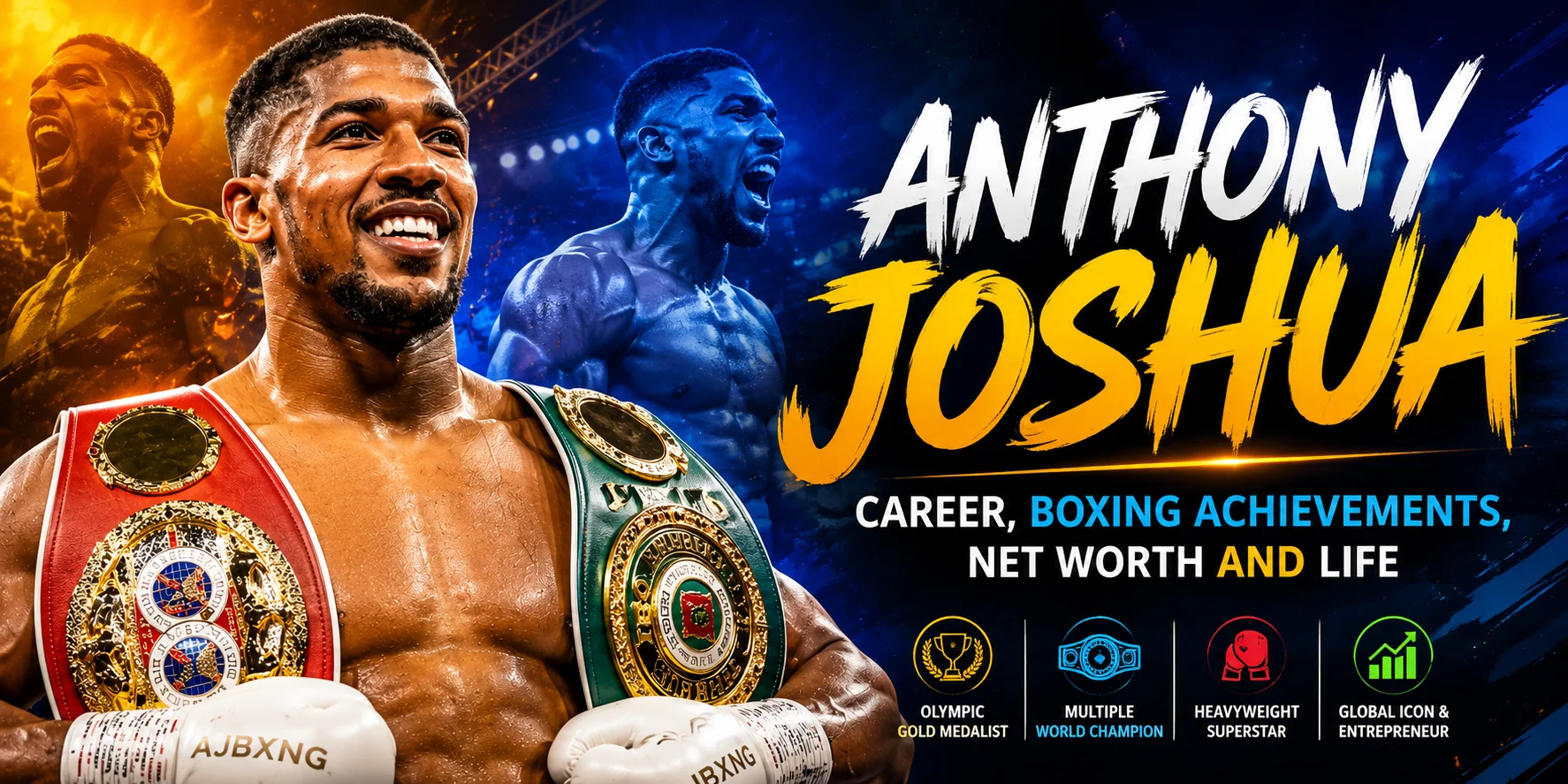
I remember watching Anthony Joshua’s comeback fight against Andy Ruiz Jr. in Saudi Arabia back in 2019. The man was hungry. You could see it in how he moved — calculated, sharp, nothing wasted. He’d lost his titles just months before in one of the biggest upsets boxing had seen in years, and everyone was watching to find out if he’d fall apart or come back harder. He came back harder. That’s kind of Joshua’s whole thing, actually. But I’m getting ahead of myself.
Who Is Anthony Joshua, Really?
Anthony Joshua is a British heavyweight boxer who’s spent the last decade being one of the biggest names in the sport. If you’ve followed boxing at all since 2013, you know the name. Olympic gold medalist, multiple world champion, the kind of fighter who fills stadiums just by showing up.
What makes him interesting isn’t the belts or the knockout power it’s the arc. He had his moment at the top, lost everything, and had to rebuild from scratch. Not everyone pulls that off in professional boxing. A lot of fighters fold under that kind of pressure. Joshua didn’t fold.
He’s British-Nigerian, born in Watford in 1989, and by any measure he’s become one of the highest-grossing boxers in recent memory. Hundreds of millions in career earnings. But that part comes later.
Early Life and How Boxing Found Him
Joshua wasn’t always heading somewhere meaningful. He grew up in Watford just northwest of London, not rough, not posh with a working-class background and Nigerian heritage from his dad’s side. By his own account, he was just a regular kid going nowhere in particular. School wasn’t clicking. He wasn’t getting into serious trouble or anything like that, just drifting through days without much of a plan. No real direction, no real passion for anything specific.
Then, around 2007, he walked into a boxing gym. He was about 18 at the time.
It wasn’t some cinematic “this is destiny” moment you’d see in a film. He literally just wanted something to do, somewhere to put his energy. But something clicked almost immediately. His coach, Rob Frazier, saw what was sitting in front of him raw athleticism, a 6’6″ frame, reach that went on forever, and maybe most importantly, someone who could actually listen when told to do something. That last quality matters more than people realize. You can have every physical gift imaginable, but if you tune out your coach, you’ll plateau fast and stay there.
From 2007 to 2012, amateur boxing was basically his entire life. Not casually completely seriously. Wake up, train, work on technique, just about manage to show up to school, train again, sleep, then repeat the whole thing. He competed internationally, built a quiet reputation, and slowly stopped being a raw prospect and started becoming someone the sport actually needed to pay attention to. Not flashy about any of it. Just relentless.
The 2012 London Olympics. His home country. Super-heavyweight division. Joshua won gold. That’s not luck finding you that’s five years of grinding, unglamorous work landing exactly when it needed to. He was 22 years old. Olympic champion.
When he turned professional in 2013, the boxing world was already watching closely. Expectations were building faster than most young fighters have to deal with. But expectations are strange things they can crush you completely or fuel you beyond what you thought possible. For Joshua, they seemed to fuel him. He wanted the pressure. Or at least, he handled it convincingly enough that nobody could tell the difference.
Professional Career Takes Off And Then Gets Complicated
His early professional fights followed the standard path for promising prospects opponents who were there to lose, give the rising star some rounds of experience, and move on. Joshua was devastating in these matchups. Fight after fight ended early. Sometimes really early. His opponents would absorb a few clean shots and that was generally that.
Between 2013 and 2015 he put together 16 straight wins, the majority by knockout. The boxing world was genuinely paying attention now. This wasn’t just a well-marketed prospect with a good story the guy was finishing fights, and finishing fights is what fans actually show up to watch.
In 2016 he got his first real title shot, against Charles Martin for the IBF heavyweight belt. He won. Then he kept winning, kept collecting. By 2017, he was holding the IBF, WBA, and IBO titles simultaneously. He was, by any honest measure, the top heavyweight on the planet.
Here’s where a lot of fighters’ stories start to get genuinely strange.
Imagine being 27 years old and having basically achieved everything you set out to do since your teenage years. You’re the best in the world at your sport. Your fights are worth millions of pounds. You’re becoming famous well beyond boxing itself. The pressure doesn’t disappear when you reach the top, though if anything, it gets heavier with every month that passes.
Joshua fought Wladimir Klitschko in April 2017 in front of nearly 90,000 people at Wembley Stadium. The biggest heavyweight fight in years by most measures. Joshua won, and the legend kept growing. He looked genuinely untouchable.
Then June 2019 happened.
Andy Ruiz Jr. overweight, a massive underdog, someone the majority of people weren’t taking seriously at all knocked Joshua down multiple times and walked away with every belt he owned. It was shocking in a way that’s difficult to describe properly if you weren’t watching it live. People simply couldn’t process what they were seeing. Joshua had been dominant for years, and then this. That’s boxing sometimes. Doesn’t matter how good you are the sport will find a way to humble you eventually.
The Comeback and What It Meant
That loss broke something in Joshua. Not permanently but for a real stretch of time, it genuinely broke him. He had to sit with it properly. Actually work out what went wrong, not just tell himself whatever comfortable story made it easier. Then he had to decide whether he wanted to fight his way back for real or just take the easier road that was absolutely available to him.
He chose the harder one.
The rematch with Ruiz Jr. in Saudi Arabia, six months later, showed a completely different fighter. More patient, less explosive, far more methodical in everything he did. He’d worked with trainer Rob Garcia on rebuilding his whole approach from the ground up. More jab, fewer big single shots, smarter pace control throughout twelve rounds. He won decisively Ruiz came in even heavier this time and never seriously threatened him.
What stuck with me about that win was how different Joshua looked even in victory. Less like someone trying to prove something to the entire world, more like someone just trying to be better at their job than they were six months ago. That’s real growth. That’s also probably why people still carry genuine respect for him even through the defeats that followed.
His Major Fights The Ones That Actually Mattered
Wladimir Klitschko (April 2017) — This was the fight that gave Joshua’s reputation actual substance behind it. Klitschko was a legitimate legend who’d dominated the heavyweight division for over a decade technically brilliant, impossibly experienced, the exact kind of opponent who exposes young champions who aren’t quite ready yet. People genuinely weren’t certain Joshua was ready. He was. He came in at 250 pounds, controlled the fight with his jab from early on, landed the cleaner right hands consistently, and stopped Klitschko in the 11th round. Not always the prettiest performance, but it didn’t need to be. He’d beaten a genuine all-time great. The hype finally had something real standing behind it.
Andy Ruiz Jr. I (June 2019) — The upset that people still bring up. Ruiz Jr. came in overweight. Visibly soft. He was +600 in the betting markets, which basically means you needed to be paid just to consider him a genuine threat. Then the bell rang and Ruiz’s hand speed which is honestly extraordinary for a heavyweight caught Joshua completely off guard. Joshua went down in the third round. Then again in the seventh. By the time it was finished, Ruiz was holding every belt and Joshua was standing there with nothing. Twenty thousand people in Madison Square Garden watched it happen in real time. It’s still one of the strangest results the heavyweight division has produced in recent years.
Andy Ruiz Jr. II (December 2019) — Six months later, same two fighters, completely different fight. Joshua boxed smart moved constantly, used his jab throughout, controlled the distance carefully, made Ruiz come to him rather than walking forward into danger the way he had the first time. Ruiz came in even heavier. Joshua won every round on all three scorecards. The comeback was complete, though he looked noticeably changed more careful, more calculating, less willing to just trade punches. Some fans weren’t happy with it. I thought it showed he’d actually absorbed a genuine lesson, which is honestly rarer than it sounds in this sport.
Oleksandr Usyk I (September 2021) — Usyk is genuinely something different. He came up from cruiserweight, where he’d been undisputed champion, and his footwork is simply beautiful to watch always at the right angle, never quite where you expect him to be when the punch arrives. Joshua had spent two years carefully climbing back after Ruiz and then walked straight into this. Usyk put him down twice and won clearly on every scorecard. It wasn’t close, it wasn’t controversial, nobody was robbed of anything. Usyk was just the better boxer on the night. He moved and Joshua hit empty air. That’s as clean an explanation as boxing ever offers.
Usyk II (August 2022) — Joshua trained specifically for this rematch. Worked on his defensive movement, his angles, everything Usyk had picked apart the first time around. And he genuinely improved that was obvious to anyone watching. But Usyk had improved as well. He dropped Joshua in the eighth round and won the decision again. At that point the conclusion was hard to avoid Usyk is simply the superior technical boxer, and Joshua couldn’t find a way around that reality across two complete fights. That’s not disrespect to Joshua. That’s just the truth of what happened.
Francis Ngannou (March 2024) — Ngannou is a UFC heavyweight with some of the most frightening striking power in any combat sport. On paper it’s an interesting crossover matchup, but not really a competitive one at the professional boxing level. Joshua won by decision. It was entertaining, showed he can still perform well against elite strikers from other disciplines, but it wasn’t a title fight and Ngannou isn’t a professional boxer. Different category entirely from what Joshua’s been measured against.
His Boxing Style What Actually Makes Him Dangerous
Joshua isn’t a brawler. He’s a technical heavyweight who uses his size intelligently as one tool among several, not as a substitute for actual skill. His jab is the foundation of everything he does well inside the ring. Textbook in technique, quick enough to surprise people at his size, sets up everything that comes after it. Watch any fight where he’s in genuine control and his jab is landing consistently. Watch any fight where he’s struggling and you’ll see immediately that it’s stopped working.
He’s at his best when closing distance and landing in combination. Four, five, six punches in sequence with the majority of them connecting cleanly. His right hand is probably his single best weapon when it lands clean on a heavyweight, the fight usually ends shortly after. His hook is solid. His footwork cuts off the ring in a methodical way, moving laterally, making retreat genuinely uncomfortable for opponents who’d rather run and reset.
Where he gets exposed and the Usyk fights demonstrated this as clearly as anything could is against truly elite technical boxers who can dictate the pace entirely on their own terms. Usyk made him look flat-footed at moments. Literally throwing punches at empty space because Usyk had already moved by the time they arrived. Ruiz Jr. exploited something similar in their first fight Joshua was waiting for the perfect moment to land his right hand, Ruiz was throwing constant combinations and never giving him the breathing room he needed.
The honest take: Joshua’s a really good heavyweight. Top five on most nights, maybe top three when everything is working. But he’s not Mike Tyson or Lennox Lewis. He sits just below that tier. There’s genuinely nothing wrong with that most great champions do. Some get remembered for generations, some gradually fade. Joshua probably gets remembered, and I think for the right reasons when it’s all said and done.
The Titles What They Actually Mean
Joshua has held the IBF, WBA, IBO, and WBO heavyweight titles at various points throughout his career. The IBF and WBA carry the most genuine credibility within the sport. The IBO is… let’s call it a working title and leave it at that. So when someone says he held “four world titles,” that’s technically accurate and also requires a bit of honest context to mean anything real.
The credentials stand up though. He beat legitimate top-tier opponents consistently. He fought the best competition that was actually available to him. By any reasonable standard, he’s a genuine multiple-time world heavyweight champion. The debate about all-time rankings is a separate conversation entirely.
His Net Worth Where the Money Comes From
Estimates put his net worth somewhere between $50 and $70 million, though like all celebrity wealth figures that get reported, it’s really an educated guess at best. His biggest individual paydays came from the Klitschko fight, both Ruiz rematches, and the two Usyk fights somewhere in the $30–50 million range per fight at his absolute peak.
Beyond the fight purses themselves: sponsorships with brands including Beats by Dre and Puma, endorsement deals of various kinds, appearance fees, social media revenue. He’s been genuinely marketable at the top level for well over a decade now, and that kind of sustained marketability compounds significantly over time.
Worth being honest about though fighters don’t actually pocket the full number you see reported in headlines. After taxes, management fees, training camp costs, corner costs, and promotional splits, what lands in the bank is a noticeably smaller figure. But Joshua’s been operating at elite level long enough that even after everything gets taken out, the wealth that’s accumulated is genuinely significant.
The Mental Side What People Don’t Talk About Enough
Nobody really asks what it actually does to a person to lose to an underdog in front of 20,000 people, on camera, with the replay running on every platform for weeks afterward. Joshua had to sit with all of that. He’s spoken about it publicly the paranoia that crept in, the constant second-guessing, the anxiety that followed the first Ruiz fight around for months. That’s not vague awareness-raising language. That’s specific, that’s real, and that’s genuinely difficult to climb back from.
After the Usyk losses, he faced a completely different kind of problem. There’s a guy out there who is simply better at boxing than he is. You can’t train your way around that reality. You can’t outwork a technical gap through sheer effort and desire. You have to accept it honestly and figure out what comes next from there. That’s actually harder than booking another training camp, and most fighters in his position would never admit it publicly.
What people genuinely respect about Joshua and I think this is a significant part of why he maintains real popularity even through defeats is that he doesn’t manufacture excuses afterward. He loses and says “that guy was better than me” or “I made mistakes I couldn’t correct.” No blaming the referee, no going after opponents after the fact, no putting a different version of events out there. He just owns what happened. That’s genuinely rare in a sport that produces some of the largest egos you’ll find anywhere.
Outside the Ring Who He Is as a Person
He’s been in high-profile relationships over the years, has kids he speaks openly about, and has talked about how fatherhood genuinely changes what stepping through those ropes actually means to him. When someone is depending on you in a real way, the stakes shift in ways that are hard to explain. You’re not just fighting for your own ego or building your own legacy anymore.
He’s into fashion photographed at London Fashion Week, involved with designer brands, works in that world in a genuine way. It doesn’t come across as performative at all. He actually seems interested in design, in how clothes are constructed and why certain things work the way they do. That tells you something real about who he is beyond the sport.
His social media is genuinely unusual for an athlete operating at his level. Not a wall of gym selfies and thinly veiled sponsored content he puts up training footage alongside family moments alongside things he’s actually been thinking about. It reads like someone using a platform to communicate rather than simply broadcast a carefully managed image of themselves.
His charitable work doesn’t attract loud headlines, which is usually the clearest sign that it’s actually genuine. Youth boxing programs, community work back in Watford. He doesn’t make a point of announcing any of it. He just quietly does it.
Why He’s Still Popular
Some of it is pure skill. When you compete at the very highest level for that long and win the majority of it, people keep paying attention regardless of what else is happening.
Some of it is the honesty. He talks about his losses in a way that doesn’t feel managed or shaped for public consumption actually reflecting on what went wrong, actually admitting the anxiety, actually saying out loud when he simply couldn’t figure out an opponent. That resonates with people, especially coming from someone at that level of global fame.
Some of it is what he represents within British sporting culture. He’s British success operating on a genuinely global stage, and there’s a particular tradition in boxing around exactly that. He fits into a lineage people genuinely care about.
And honestly, some of it is just presence. When Joshua walks toward that ring and the crowd reacts the way it does you feel it even through a screen. That’s not something you manufacture through media training or careful brand management. Either it’s there naturally or it isn’t.
What’s Next
As of 2024, Joshua is still fighting. No longer the undisputed champion, but competing at a real and meaningful level. The heavyweight division is genuinely open right now Usyk is the clear number one and after that it gets complicated and interesting very quickly.
The significant thing is that he doesn’t actually need to fight anymore. He’s made enough money that walking away tomorrow would be perfectly fine for the rest of his life financially. So the fact that he keeps coming back and stepping through those ropes means the desire is completely real. He’s fighting because he genuinely wants to, not because he has no other reasonable option. That distinction matters more than people give it credit for.
A third fight with Usyk isn’t impossible boxing has a long tradition of trilogy fights, and that’s legitimately unfinished business between them. Younger heavyweights like Daniel Dubois would line up immediately for a Joshua fight just for what it would mean for their own profile and career. There’s also the media side of things commentary, analysis, maybe eventually working with fighters as a trainer. A lot of fighters eventually end up there, and someone with Joshua’s experience and intelligence at the sport has obvious value in that world.
What I’d guess is going on in his head right now: he wants one more significant win. Something against a genuine top-five heavyweight that puts him back into the real conversation on his own terms. If he gets that, retiring feels like a genuinely satisfying place to land. If he doesn’t, he’ll keep working toward it until something changes. But he’s not desperate about any of it, and at 35 with a nine-figure career behind him, he doesn’t need to be.
Why He Matters Beyond Boxing
Joshua came into the sport at exactly the right moment for what it needed. The heavyweight division had been steadily losing casual fans during the Mayweather-Pacquiao era — everyone’s attention was on smaller weight classes, and heavyweight felt slow and old-fashioned by comparison. The division genuinely needed someone electric who could bring people back. Joshua filled that space completely and then some.
He made heavyweights interesting again for people who weren’t already deeply committed fans of the sport. Part of that is skill, part of it is natural marketability, and honestly part of it is that he simply looks the part in a way few fighters ever have he’s enormous and built like someone designed him specifically to be a heavyweight champion. That matters more than most people want to publicly admit when it comes to how sports get sold to casual audiences.
He also showed definitively that a British boxer could headline at the scale Joshua has consistently operated. Wembley Stadium, 90,000 people, pay-per-view on both sides of the Atlantic simultaneously. That opened real doors for other fighters. It proved boxing could be genuinely international in a way the sport hadn’t quite achieved before.
And the Ruiz Jr. upset, painful as it obviously was for Joshua personally, was genuinely good for boxing as a whole. It reminded everyone watching that results aren’t predetermined, that anything can actually happen on a given night. That’s what keeps people watching sport in the first place. If Joshua had beaten everyone cleanly and retired with a perfect record, his career would essentially be a highlight reel. Instead he has a genuine story with real weight to it. That’s worth something for him personally and for the sport he’s given so much to.
FAQs
Who is Anthony Joshua?
A British-Nigerian heavyweight boxer born in Watford in 1989. He won Olympic gold at the 2012 London Games, turned professional in 2013, and went on to become one of the most recognizable heavyweight champions of his generation. He’s fought at the absolute top level for over a decade and is known just as much for how he’s handled defeats as for the wins.
How many world titles has Anthony Joshua won?
He’s held the IBF, WBA, IBO, and WBO heavyweight titles at various points throughout his career. The IBF and WBA are the most widely recognized. Depending on how you count it, he’s been a world champion multiple times over though it’s worth knowing that different organizations sanction different belts, so the numbers require a little context.
What is Anthony Joshua famous for?
His knockout power, his 2012 Olympic gold medal, his massive fights against Klitschko and Usyk, and his comeback story after losing to Ruiz Jr. He’s also one of the highest-paid boxers of his era and is known for being unusually honest about his defeats in a sport where most fighters would rather make excuses.
What is Anthony Joshua’s professional boxing record?
As of early 2024, he has around 26 wins against 3 losses. His defeats came against Andy Ruiz Jr. in their first fight and Oleksandr Usyk twice. His knockout percentage throughout his career is high he’s finished a significant number of his opponents inside the distance.
How much is Anthony Joshua worth?
Estimates generally put his net worth between $50 and $70 million, though celebrity wealth figures are always educated guesses rather than confirmed numbers. His fight purses at championship level have been among the largest in the sport, and he’s built additional income through sponsorships, endorsements, and brand deals over many years.
Is Anthony Joshua still boxing?
Yes, as of 2024 he’s still actively competing. He’s no longer the undisputed heavyweight champion but continues to fight at a high level and remains one of the most bankable names in the sport.
What boxing style does Anthony Joshua use?
He’s a technical heavyweight who relies on a clean jab, good combination punching, and his physical size to control fights. He’s not a pure brawler he’s more precise and methodical than that. He’s at his best against fighters who come forward, and he’s shown vulnerability against elite technical boxers who can dictate pace and movement on their own terms.
Did Anthony Joshua win an Olympic gold medal?
Yes. He won the super-heavyweight gold medal at the 2012 London Olympics, which was held in his home country. That result put him firmly on the radar before he’d thrown a single professional punch.
Why did Anthony Joshua lose to Andy Ruiz Jr.?
Ruiz Jr.’s hand speed was faster than Joshua anticipated, and Joshua got caught trying to time the perfect shot rather than staying busy. Ruiz threw constant combinations and Joshua couldn’t find the rhythm he needed. It was a genuine upset not a fluke exactly, but one of those nights where everything went wrong at once and the underdog made the most of every single opening.
What happened after Joshua lost to Usyk twice?
He kept fighting. He beat Francis Ngannou in March 2024 and has continued to look for meaningful matchups at heavyweight. He hasn’t made excuses about the Usyk losses publicly — he’s acknowledged that Usyk was simply the better boxer across both fights, which is an unusually honest thing for a fighter in his position to say.
The Real Story
Joshua isn’t a simple narrative and never really has been. He’s not the unstoppable force people imagined he’d become back in 2017. He’s also not the finished article some people were ready to write him off as after the Usyk losses came in back to back. He’s a genuinely skilled heavyweight who had the particular bad luck of sharing an era with Oleksandr Usyk, and who ran into an underdog who simply had his number on one specific night in New York.
What sticks with me about him is how he’s handled losing publicly. On camera. With replays running across every platform for anyone who wanted to watch. Losing his undefeated record to someone the entire boxing world had dismissed. Losing twice to someone he couldn’t solve across two complete fights and two full training camps dedicated to solving him. And still being here. Still showing up to the gym every morning. Still taking fights that matter.
A lot of people with his money and his options would have quietly faded into endorsements and paid appearances years ago without anyone really blaming them for it. Joshua had every reasonable opportunity to do exactly that. Instead he fought Ngannou. He’s out there looking for the next one. That tells you something genuinely real about who he is.
Is he the greatest heavyweight who ever lived? No. Top five all-time? Probably not honestly. But he’ll be remembered and not because he never lost, but because he lost and kept showing up anyway. Because he was honest about what it cost him when most people in his exact position wouldn’t have been. Because he didn’t reach for easy excuses when they were sitting right there available to him.