


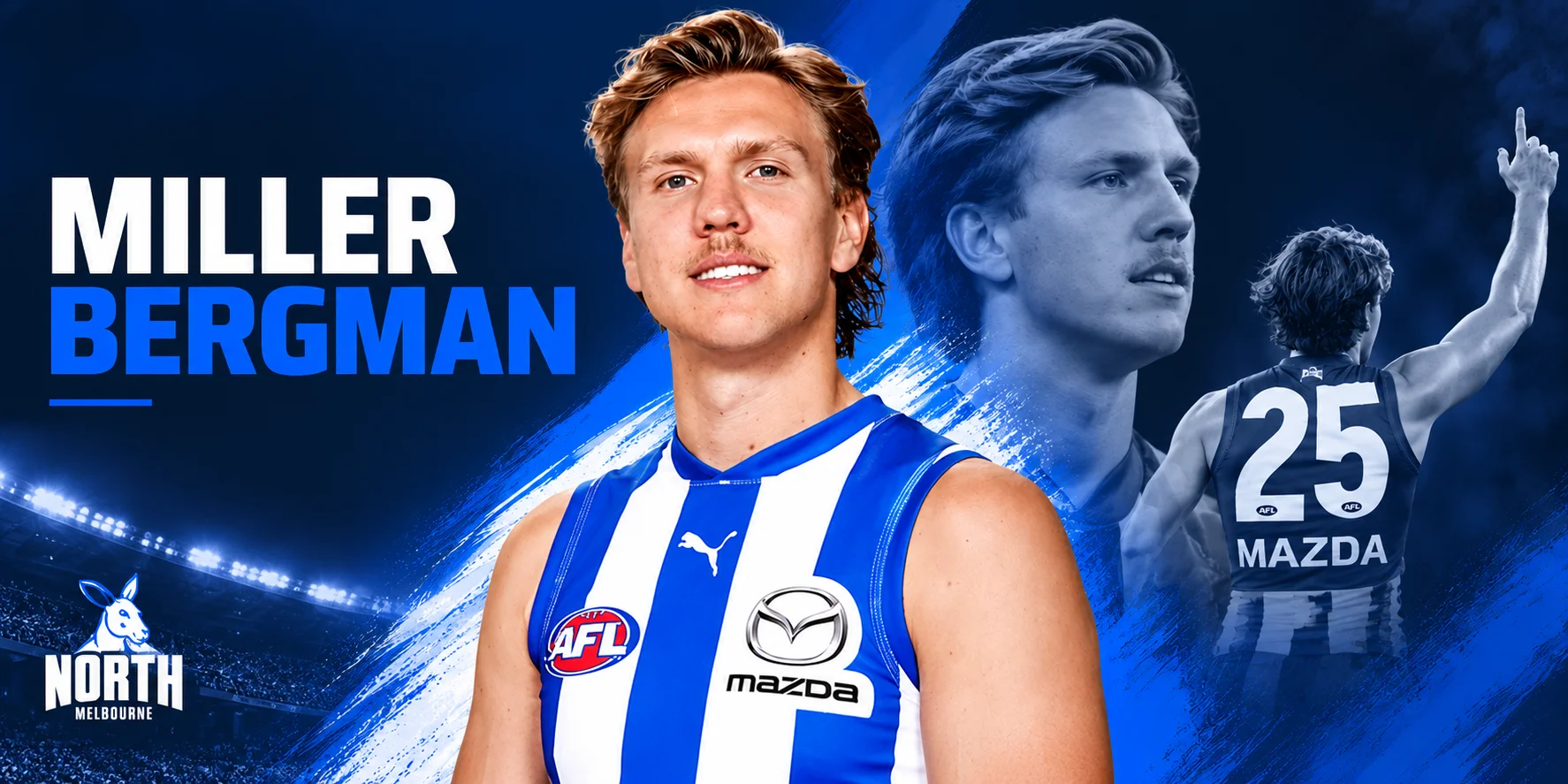
Round 7, 2022. North Melbourne are already down big to Carlton the final margin will read 50 points when a nineteen-year-old wins a clearance out of defense, gets it away cleanly, and takes a tackle that lands him awkwardly on his right shoulder. He doesn’t finish the game. Nobody watching that moment could have known it, but it would end up telling you more about Miller Bergman’s career than any highlight reel ever could.
That’s not really how comeback stories usually get told. Most start with the good part the goal, the medal, the viral clip and work backward to the hard stretch that came before it. Bergman’s story runs the other way around. The hard part came first, early and unglamorous, and what he did with it is basically the whole point.
Here’s the thing about football careers built this way: they don’t photograph well. There’s no viral clip to point people toward, no single passage of play you can hold up and say “there, that’s when it all clicked.” What you get instead is a slower story one told in contract extensions, VFL box scores, and a stubborn refusal to disappear after bad luck kept finding him. It’s worth telling properly, because it’s a far more common shape for a professional sporting career than the version that usually gets the airtime.
Who Is Miller Bergman?
Miller Bergman is an Australian rules footballer, and if you haven’t heard the name, that’s fair he was never built to be a headline guy. What makes him worth writing about isn’t fame. It’s the shape of the career itself: a modest draft pick, a serious injury almost immediately, and a story judged less by highlights than by how he handled getting back up, more than once. He was born on January 25, 2003, in Melbourne, and footy wasn’t exactly optional growing up. His father, Shannon, had been drafted by North Melbourne back in 1989, though he never played a senior game for the club. The connection stuck anyway plenty of kids grow up around a club without it meaning much, but for Miller it clearly did. By the time he was old enough to have a favorite team, he’d already picked one, and for a while, it’s exactly where his career played out.
He wasn’t drafted as some can’t-miss prospect, either. North Melbourne took him at pick 38 in the 2021 National Draft a solid selection, not a headline one. Picks in that range rarely come with much fanfare. Nobody’s writing breathless scouting profiles about a player taken in the late thirties; the expectation, if there is one, is usually just “make a list, and see what happens from there.” Recruiters liked his footy brain and his disposal, by hand and by foot, more than any raw athletic ceiling. Watch him play as a rebounding half-back flanker and the first thing you’d notice is how early he reads the play, not how fast he covers ground.
That’s a specific kind of prospect, and it’s worth spending a moment on why it matters. A half-back flanker’s job, broadly, is to intercept the opposition’s forward thrusts and turn defense into attack in the same motion win the ball deep in your own defensive 50, and use it well enough that the other team doesn’t get a second crack at it. It’s a role that rewards anticipation over pure athletic gifts. You can’t teach a player to run a faster 20-meter sprint overnight, but you can develop their reading of the game, their patience with ball in hand, their willingness to take the simple option instead of the heroic one. Bergman was drafted on the promise that those things could be built on. It usually means a player has to think his way onto an AFL list rather than jump his way onto one and it tends to produce careers that are steadier than they are spectacular, at least when things go to plan.
Building Toward the Draft
Nobody just falls into AFL football. It’s years of underage competitions, representative squads, and a lot of talented kids who don’t quite make the cut for every one who does. The system is genuinely brutal in its filtering thousands of teenagers play serious junior football across Australia each year, and only a small fraction of them ever hear their name read out on draft night. Bergman came up through Mazenod College and then the Dandenong Stingrays’ under-18 program, one of the more established talent pathways in Victorian junior football, where his decision-making first started catching the eye of recruiters watching from the boundary.
Then COVID hit, and it scrambled his under-18 season the same way it scrambled development for young athletes everywhere, in every sport, all over the world. Games got postponed. Whole competitions got shortened or scrapped outright. For a footballer in his draft year specifically, that’s about as bad as timing gets under-18 seasons exist largely so recruiters can compile enough vision and form to make an informed decision, and a shortened or cancelled season means less evidence to go on. Plenty of players lost momentum in that stretch that they never fully got back; some almost certainly went undrafted purely because clubs simply hadn’t seen enough of them.
Bergman’s response, at least looking back on it, was fairly simple: instead of just waiting around for footy to resume, he used the dead time to build his running capacity and general conditioning. It’s an easy detail to skip past in a career summary, but it’s also exactly the kind of small, boring, unphotographed decision that separates players still on an AFL list five years later from the ones who quietly vanish from the pathway system. Nobody hands out awards for “did fitness work during a competition shutdown.” It doesn’t show up on a highlight reel or a scouting report headline. But recruiters do notice which players turn up to testing in good shape when competition resumes, and which ones don’t.
By draft night in 2021, he wasn’t a lottery-ticket name and nobody pretended otherwise. He was a considered pick the sort of selection clubs make because the tape shows good habits and sound instincts, not because there’s a jaw-dropping highlight package attached to it. Pick 38 doesn’t come with the pressure of a top-five selection, and in some ways that’s a gift. Nobody expects a mid-range pick to be best-and-fairest by year two. What they expect, if anything, is exactly what Bergman set out to prove: steady development, a bit of patience, and a player who earns his spot rather than having it handed to him.
The VFL Years: Learning the Speed of the Real Thing
Here’s something that doesn’t get talked about enough when people discuss young AFL prospects: getting drafted solves almost none of the actual problem. It gets a player a locker and a training program. It doesn’t automatically make them good enough to play senior football, and for most drafted teenagers, there’s a real chance they never will be not through lack of effort, but because the gap between underage football and the AFL is enormous, and not every talented junior closes it.
The VFL exists as the buffer between those two worlds. It’s a genuinely tough competition in its own right, full of experienced senior-level players, delisted AFL footballers trying to find their way back, and a wave of hopeful teenagers all trying to prove they belong at the level above. For a nineteen- or twenty-year-old, that’s a brutal environment to be thrown into bigger bodies, faster decisions, less forgiveness for a lazy disposal or a slow read of the play. Some players go there and realize, fairly quickly, that AFL football isn’t going to happen for them. Others use it exactly the way it’s designed to be used: as a place to fail safely, adjust, and get better without a full stadium and a television broadcast watching every mistake.
Bergman spent 2021 and into 2022 doing that work, mostly out of the spotlight which is usually the healthiest way for a teenager to develop anyway. Less noise, fewer expectations, more room to actually get better without every training-track rumor turning into a headline. There’s a pattern worth noticing among AFL players who go on to have solid, durable careers: an awful lot of them had quiet, unremarkable first couple of years in the system. The ones who arrive with enormous hype often face a different kind of pressure entirely — expectation outpacing development, media attention outpacing form. Bergman never had that problem. He had the simpler, in some ways more useful problem of just needing to get better, on a timeline nobody outside the club was watching too closely.
The Debut, and the Injury That Followed
Then came Round 7, 2022. He was a late inclusion that week, not a locked-in starter, and he made the most of the chance early that clearance out of defense was exactly the kind of read-and-react play recruiters had banked on when they drafted him. For a few minutes, it must have felt like everything was clicking into place at once: the years of junior footy, the COVID-disrupted season he’d fought through anyway, the VFL grind, all of it converging into an actual AFL debut against Carlton, wearing the colors his own father had once worn on a rookie list decades earlier. Then the tackle came, and it put him down hard on his right shoulder. He knew straight away something was wrong the kind of injury where the body tells you before a trainer or a scan confirms it. He was subbed out and didn’t play again for the rest of the season.
Losing the back half of your debut year to injury at nineteen is about as tough as it gets for a young footballer, and it’s worth sitting with exactly why that’s true rather than just stating it. Momentum matters enormously at that age. Game time, confidence, a coach’s trust in selection meetings, a spot in the senior team’s rotation all of it builds slowly, week by week, and all of it can disappear within a single missed month, let alone an entire missed season. Shoulder injuries specifically can be unforgiving for footballers, because so much of the sport depends on contested one-on-one contact, and a shoulder that isn’t fully trusted changes how a player attacks the ball in a tackle. Recovery isn’t just physical. There’s a psychological rebuild that has to happen too trusting the joint again in exactly the situations that damaged it in the first place.
A long layoff doesn’t always end a career outright, but it quietly ends plenty of them, one missed opportunity at a time, unless a player finds a way back in. Clubs move on. Draft classes behind you keep arriving. It would have been entirely understandable, and not even unusual, if Bergman’s AFL story had effectively ended in that tackle a single-game career, footnoted rather than remembered.
It didn’t. He returned in Round 1, 2023, and played well enough across that season that North Melbourne handed him a two-year contract extension, locking him in through the end of 2025. If you’re looking for the actual turning point in this story, that’s it. Not a signature goal, not a highlight-reel mark. Just a football club putting it in writing, in a contract, that they still believed in him after watching him prove over an entire pre-season and a chunk of a season that the injury hadn’t taken anything essential away from his game.
What the Work Actually Looks Like
It’s worth being honest about what a young AFL defender’s day-to-day work actually involves, because it’s almost never what people outside the game picture. It isn’t press conferences or sponsorship shoots those are the exception, not the rule, for a player like Bergman. It’s training sessions that start early and run through detailed positional drills. It’s hours spent breaking down opposition vision with the coaching staff, learning tendencies, working out where a specific opponent likes to run when the ball’s in dispute. It’s a strength and conditioning program built around a season-long calendar, with load managed carefully enough that a player doesn’t arrive at Round 20 running on empty. None of that is thrilling to describe, and that’s rather the point.
After the shoulder injury specifically, the work took on a different shape for a while one built around rehabilitation rather than pure improvement. That typically means a staged return: isolated strength work on the affected joint long before contact is reintroduced, non-contact training drills before full-intensity ones, and closely monitored VFL minutes before a player is trusted with a senior recall. It’s slow, deliberately so, and it can be mentally taxing in a way that’s easy to underestimate from the outside. A player has to sit and watch teammates play senior football while doing rehab in a gym, which is its own kind of discipline patience under a very specific, very public kind of frustration.
That distinction between playing more and healing properly matters more than it sounds. Plenty of players return from injury too early, whether through their own impatience or external pressure, break down again within a few weeks, and never quite recapture the timing and confidence they had before the initial setback. Bergman’s comeback held, at least for a couple of seasons, and that says something concrete about how the recovery itself was managed by the medical staff, by the coaching group, and by Bergman’s own willingness not to rush it.
From 2023 onward he settled into life as a defender for North Melbourne — not a star, not a captain, just a reliable option the coaches kept turning back to, week after week. That word, reliable, does a lot of quiet work in professional sport. It’s not the kind of thing that gets a player a magazine profile, but it’s exactly the reputation that keeps a name on a list when a club is deciding who to keep and who to let go.
Then 2024 threw a fresh run of setbacks at him, almost back to back: a fractured jaw early in the VFL season, a hamstring injury not long after that, and then a concussion in Round 23 that closed out his year entirely. Read that sequence back and it’s a genuinely brutal twelve months for one player three separate, unrelated injuries, each requiring its own recovery timeline, its own rehab program, its own mental reset. Plenty of guys would’ve had every excuse to fade quietly after a run like that, to lose form, to lose the trust of selectors, to start looking like a player whose body simply couldn’t hold up. Whether Bergman fully avoided that fate is, honestly, part of what made the years that followed complicated for him but the fact that he kept showing up through all three injuries, rather than walking away, tells you something about the kind of competitor he is.
Why AFL Clubs Delist Players Like Him
To understand what happened to Bergman heading into 2026, it helps to understand a bit about how AFL list management actually works, because it’s rarely as simple as “the player wasn’t good enough.” Every AFL club operates under a hard cap on both list size and salary spend. That means every single list spot is a genuine trade-off keeping one player on the books, particularly a player carrying an injury history, means not being able to draft or recruit somebody else. Clubs run this calculation on every player, every off-season, weighing form, age, injury history, positional need, and what’s coming through the draft pipeline behind that player. It’s a genuinely cold process by design, because it has to be. A club that lets sentiment drive list decisions tends to end up with an ageing, underperforming list within a few years.
Injury history plays an outsized role in that calculation, and it’s not always fair to the player involved. A footballer who’s missed significant chunks of multiple seasons even for entirely unrelated injuries, as was the case across Bergman’s jaw, hamstring, and concussion setbacks in 2024 starts to look, from a list manager’s spreadsheet, like a risk. Not necessarily a poor player. A risk. Clubs have to project forward, and a player who’s shown he can be genuinely good when fit, but hasn’t strung together a full, uninterrupted season, is a harder bet to make than a similarly talented player with a clean injury record.
None of that makes the decision easy to sit with if you’re the player on the other end of it. It’s worth saying plainly: being delisted or not offered a new contract isn’t the same thing as being told you’re not good enough to play AFL football. Plenty of delisted players go on to be picked up by other clubs, sometimes within the same off-season, once a list manager elsewhere runs the same calculation and reaches a different answer because their specific needs are different. Others spend a season in the VFL rebuilding form and fitness before getting another shot through the mid-season or rookie draft. It’s a much messier, much more human process than the phrase “wasn’t offered a contract” tends to suggest.
Where His Recognition Actually Comes From
Here’s the thing about Bergman’s recognition it was never going to arrive as a viral moment. There’s no signature goal, no iconic mark taken in front of a packed stadium, nothing that gets replayed on highlight shows a decade later, the way a genuinely famous passage of play does. If you went looking for that kind of career-defining clip in his story, you simply wouldn’t find one, and it’s a bit pointless to go searching for it.
What he got instead was quieter, and honestly more meaningful in professional sport terms: a club that kept choosing him anyway, more than once, even after setbacks that would have given them a perfectly reasonable excuse not to. The 2023 contract extension is the clearest piece of evidence for that list managers don’t hand out multi-year deals as a courtesy or a pat on the back for effort. They do it because someone’s gone through the tape, assessed the medical reports, weighed the risk, and decided the player is genuinely worth the investment, injuries and all. That’s a considered, deliberate vote of confidence, not a sentimental one.
Beyond that one big signal, his recognition lived where most professional athletes’ recognition actually lives day to day injury updates on club websites, VFL team-sheet mentions, the occasional line in a match preview when he got named in a senior side, a mention in a “player watch” column from a journalist who follows the club closely. Not headlines. Just the slow accumulation of a football community knowing your name because you keep turning up, week after week, whether or not anyone outside the club is paying close attention.
That’s the reality for the overwhelming majority of professional athletes, whatever the highlight-reel version of sporting fame might suggest to people who only follow the biggest names. Most players never go viral in their careers, never land a shoe deal, never trend on social media after a big performance. They get respected by the people who watch the sport closely teammates, coaches, dedicated fans who track VFL form guides and for a lot of them, that respect is the actual prize, the thing that makes years of unglamorous work feel worthwhile.
What He Actually Has to Show for It
Ask for a trophy case and Bergman’s career comes up short on paper no Brownlow votes, no All-Australian selection, no premiership medal, nothing flashy sitting on a stat sheet that would catch a casual fan’s eye. But that’s probably the wrong way to measure a career shaped like his, built as it was around interruption and recovery rather than a smooth upward line. What he does have:
- An AFL debut — further than the huge majority of drafted players ever manage to get. Plenty of talented juniors are drafted and never play a single senior game; simply running out in Round 7, 2022, put him ahead of a meaningful chunk of his own draft class.
- A real comeback from a serious shoulder injury, finishing with a contract extension on the other side of it proof, in the club’s own words and its own money, that the injury hadn’t diminished what he offered.
- A brutal 2024 — a fractured jaw, a hamstring injury, then a season-ending concussion that he kept working through rather than walking away from, even as the setbacks piled up one after another.
- A club that re-signed him, which in football terms is about as close as it gets to a vote of confidence backed by actual money, rather than a comforting quote in a press release.
- A genuine role within a senior AFL list, even without star billing the kind of steady, dependable presence that coaches build a defensive structure around, even if it rarely gets celebrated publicly.
None of that photographs particularly well. All of it is real, and in professional sport, real tends to matter more in the long run than photogenic.
A Quiet Kind of Influence
Bergman was never going to be a mainstream name outside the sport no talk-show circuit, no international press coverage, no profile piece in a general-interest magazine. But inside North Melbourne and the wider AFL community, his path carries some genuine weight, the kind that doesn’t need a big audience to matter. Younger players at the club have, in him, a concrete example of what a serious injury comeback can look like when it’s handled without drama or shortcuts not a dramatic redemption arc set to music, just a fairly ordinary process of rehab, patience, and gradually earning trust back. That’s arguably more useful for a teammate to watch than a flashier story would be, because it’s the version of recovery they’re actually likely to face themselves at some point in a contact sport. Coaches, for their part, tend to point to his reading of the game as exactly the kind of skill that never shows up in a highlight reel but ends up winning a player a career, or at least extending one, when the flashier tools aren’t there.
His public profile grew the same unglamorous way his football did: a mention here when he played well, an injury update there, a line added to a player database somewhere, a brief note in a form guide before a VFL round. He’s got a Wikipedia page now, and his numbers are tracked across the usual AFL statistics sites the kind of databases dedicated fans and fantasy footy players check obsessively. For a player only a handful of seasons into senior football, that’s genuine traction even if it never made him a household name outside football circles. It’s the athlete’s version of a public profile, built almost entirely on performance and persistence rather than managed through a publicist or a carefully curated highlight account.
Lessons in Bergman’s Career, for Anyone Paying Attention
You don’t need to follow AFL closely to get something out of a career shaped like Bergman’s, and it’s worth pulling a few threads out explicitly rather than leaving them buried in the timeline. The first is fairly obvious once you say it out loud: setbacks aren’t always disqualifying, even when they feel like it at the time. A season-ending shoulder injury in your debut year is about as discouraging a start as professional sport can hand a nineteen-year-old. It would have been entirely reasonable for Bergman to read that injury as the end of the story. Instead, it became chapter two of a longer one.
The second is less about talent and more about temperament. Nothing in Bergman’s story suggests he was the most gifted player in his draft class, and the club that picked him never pretended otherwise. What separated his path from a lot of talented players who quietly disappear from the system was a consistent willingness to do the unglamorous part properly building fitness during a cancelled season, rehabbing a shoulder patiently instead of rushing back, grinding through VFL football without much outside attention. None of that is exciting to read about. All of it is, apparently, what actually builds a career.
And the third is a slightly uncomfortable one, but worth saying honestly: doing everything right doesn’t guarantee a happy ending. Bergman did the rehab properly. He earned a contract extension. He kept fronting up through a genuinely rough run of injuries in 2024. And he still wasn’t offered a new deal for 2026. That’s not a contradiction of the lesson above it’s a reminder that professional sport, like a lot of professional life, rewards good process without always guaranteeing a good outcome. Sometimes the honest ending to a hard-working career chapter is simply an uncertain one, and that’s worth respecting rather than smoothing over with a tidier story than the facts actually support.
What Comes Next
This is where the story gets complicated, because professional sport rarely wraps up in a neat bow, and Bergman’s situation heading into 2026 doesn’t come with a tidy resolution attached. As of mid-2026, North Melbourne didn’t offer him a contract for the season ahead. After the string of injuries and the stop-start game time that came with them, the club made a call to move in a different direction, for reasons that likely blend form, age profile, injury risk, and the usual list-management arithmetic described above.
He’s 23. That’s young by most standards plenty of AFL careers genuinely get going in a player’s mid-twenties, once a body settles and experience catches up to instinct. Plenty of players have found new clubs, or rediscovered form entirely, after being let go by the team that drafted them; the league’s history is full of players who had their best football at a second or even third club, sometimes years after an initial delisting looked like the end. Others use a break from a primary list to play a full, healthy VFL season and get picked up through a mid-season or rookie draft once they’ve proven their body can hold up over a longer stretch. And for some players, that stage of a career becomes the natural point to step back from full-time football altogether the AFL Players’ Association runs development and transition support specifically because this juncture is common enough to need structure, not rare enough to treat as an afterthought.
Whether one of those paths is ahead for Bergman, or whether his next chapter sits outside football altogether, isn’t public yet, and there’s no real value in guessing at it here. Either way, he’s already got a chapter of his own that nobody can take back: he made it to AFL level from a modest draft position, he competed there, and he fought through more bad luck across a handful of seasons than most players see across an entire career, let alone the first few years of one.
Whatever comes next, it’s a fair bet the traits that got him this far travel with him regardless of which jumper he’s wearing, or whether he’s wearing one at all sound decisions under pressure, a willingness to grind through the boring, invisible parts of the job, and an apparent refusal to let injury be the last word on his career. A contract not being renewed doesn’t undo any of that. It just means the next chapter hasn’t been written yet.
FAQs
Who is Miller Bergman?
An Australian rules footballer born January 25, 2003, who played as a defender for North Melbourne after being drafted with pick 38 in 2021. Best known for his footy IQ and for coming back from a serious shoulder injury suffered in his debut season.
What is he actually known for, given he doesn’t have highlight-reel moments?
Mostly his decision-making as a rebounding defender, and the way he handled a long injury layoff early in his career without it derailing everything that came after at least for a couple of seasons.
How did his career start?
Junior football at Mazenod College, then the Dandenong Stingrays’ under-18 program, where his game reading first got noticed. COVID disrupted that development window, and he used the downtime to build fitness rather than waste it. He was drafted in 2021 and made his AFL debut in Round 7, 2022.
What happened with the injury, exactly?
He landed awkwardly on his shoulder after a tackle during his Round 7, 2022 debut and missed the rest of that season as a result. He returned to senior football in Round 1, 2023.
Why did North Melbourne extend his contract?
Because his form on return from injury was strong enough to convince the club he was worth investing in further the resulting extension ran through the end of 2025.
What position did he actually play?
Primarily as a defender, having come through the system as a rebounding half-back flanker a role built around intercepting the ball in defense and using it constructively rather than just clearing it under pressure.
Why wasn’t he offered a new contract for 2026?
It wasn’t publicly explained in detail, but it follows a run of significant injuries across 2024 a fractured jaw, a hamstring issue, and a season-ending concussion that likely factored into North Melbourne’s broader list-management decisions heading into the new season.
What’s next for him?
North Melbourne didn’t offer him a new deal for 2026. What comes after that a move to another club, time in the VFL to rebuild form, or a path outside football hasn’t been made public yet.