


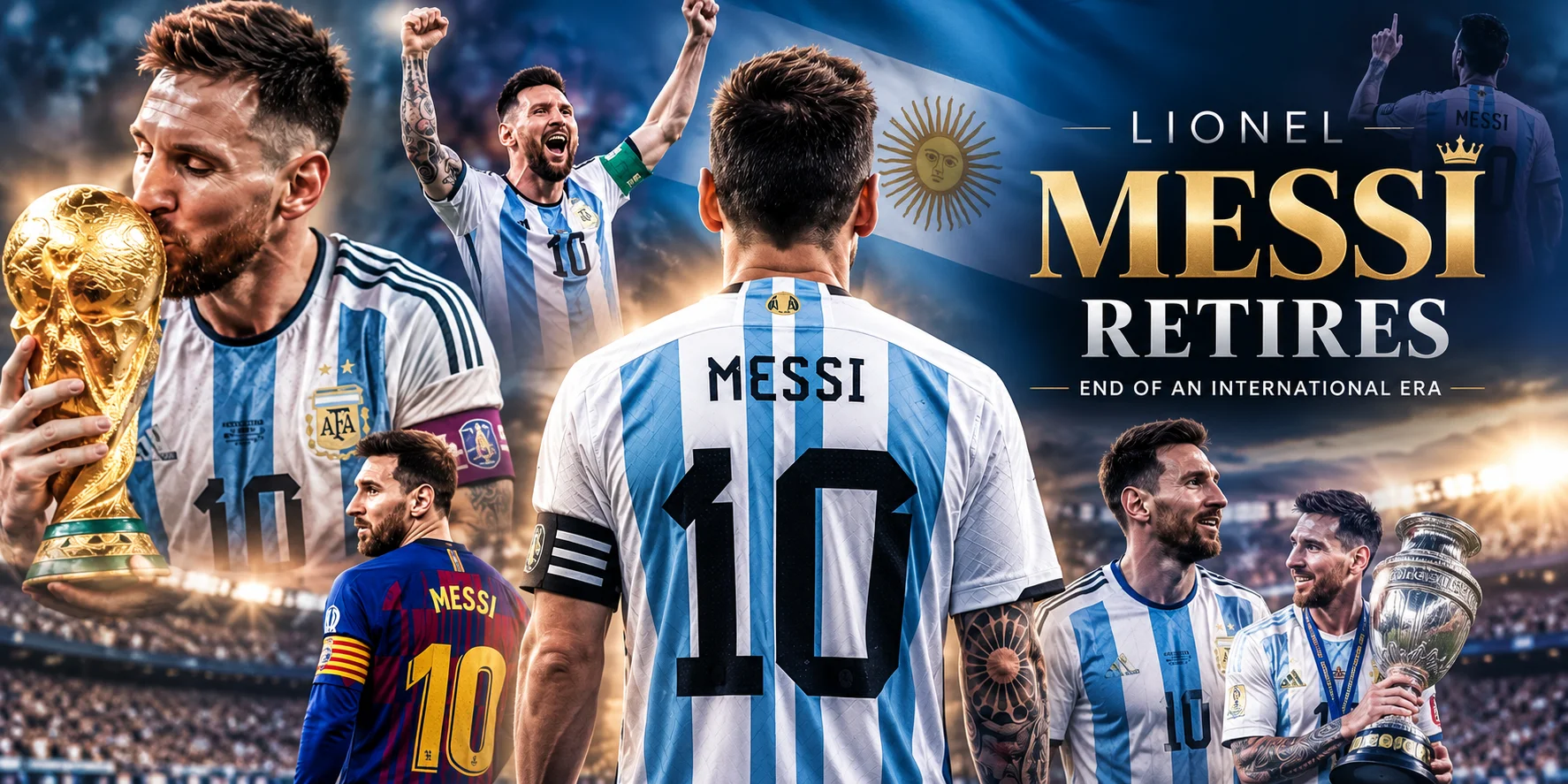
I’ve read that Instagram post like four times now. Still hasn’t fully landed. No press conference. No farewell tour. Nobody choreographed this, it was just him, a photo, and a long paragraph in Spanish confirming what everyone half suspected already: Lionel Messi retires from Argentina, done with international football for good, marking the end of an international era nobody thought they’d actually see arrive.
A friend texted me the second it dropped. Just “he’s actually done.” That’s it. And it still hit weird, even though everyone kind of saw this coming since summer if they were honest with themselves.
Why He Waited So Long to Post It
Okay so here’s the part that actually got me once I dug in a bit. Turns out he didn’t write that Monday morning at all. That letter goes back to July 21st, a couple days after they lost the World Cup final to Spain, 1-0, extra time, out at that stadium in New Jersey. He had it finished and then just… sat on it. Didn’t post. His dad Jorge passed away on August 8th, apparently he’d been sick a while, and somehow Messi kept sitting on that letter through all of that on top of everything else, only putting it up weeks after.
He didn’t even type it, from what I can tell. The photo he shared was of handwritten notebook pages, actual pen on paper, which feels almost old fashioned for someone with that kind of following. Not a clean story either way. A final loss, then his father dying, then this long quiet stretch where he’s just holding onto a goodbye he’d already written. If you were making this up you’d probably tie it up neater than that. Real life doesn’t really work that way.
Fits his personality too, honestly, if you think about it. He’s never really been someone who does big statements or press conferences well, always seemed happier letting the football speak instead of him standing at a podium explaining himself. Even his goodbye ended up basically silent, no interview, no questions taken, just a photo of his own handwriting and however many hundred million people scrolling past it that morning.
Two Decades of Carrying Something Heavy
Before any of that, there’s the part of the story people tend to forget once someone gets this famous. He was a scrawny kid from Rosario with a growth hormone deficiency, and his own club back home couldn’t really afford the treatment for it. Barcelona ended up being the club willing to pay, on the condition his whole family moved to Spain, which is how a thirteen year old ended up at La Masia, betting his entire physical development on a club continents away that he’d never actually played a match for yet. Strange thing to have happen to you that young, your own body being the reason you leave home.
Debut for the senior national team goes back to 2005 though, he was eighteen at the time. Fast forward to this year and it’s 207 appearances for the country, 125 goals stacked up along the way. Both Argentine records. Not particularly close ones either. He leaves as the highest scoring player in South American international football history too, which is its own kind of number to sit with. I’ve seen his tenure described as 19 seasons in one place and 21 years since debut in another, depends how you’re counting I guess, doesn’t really matter, it’s a long time either way.
On top of the international side, there’s eight Ballon d’Ors sitting in his cabinet too, more than any player in the history of the award, the most recent one coming in 2023 off the back of the World Cup win. Individually, by the time this retirement even became a real conversation, there wasn’t much left in the sport for him to actually collect.
But honestly the numbers were never really the point with him and this team. It was more about the weight of the thing.
At Barcelona he got to be brilliant kind of on his own terms. That was a choice, in a way. With Argentina it wasn’t a choice at all, it just got handed to him, the whole country’s expectations, whether he wanted that or not. And for years it went the same way over and over. Lose, and somehow that’s proof he can’t do it when it counts. Win, and people still manage to find the angle where it wasn’t quite enough.
2014 final, lost to Germany. Oddly enough he still walked away with the tournament’s Golden Ball that year, best player of the whole World Cup, despite his own team losing the final. Plenty of people thought that was a strange call in the moment, plenty argued it should’ve gone to a German player instead, but FIFA handed it to him regardless. Never felt like much of a consolation prize to anyone actually watching from Argentina that summer, from what I remember.
Then back to back Copa finals in 2015 and 2016, both losses, missed his own penalty in the second one against Chile. After that 2016 one he actually quit. Said right there in the moment he was done with the national team. You could tell he meant it too, from the footage anyway, he looked completely wrecked. Didn’t last long though, few weeks maybe. Came back saying he’d rather try fixing things from inside than sit outside and complain. Fair enough, I guess.
Then 2018 happened, which honestly might’ve been the low point of the whole thing. France knocked them out in the round of 16, a wild 4-3 game where a teenage Mbappé basically announced himself to the world at Argentina’s expense. Messi came home from that tournament pretty disillusioned by all accounts, and the federation ended up handing the job to a guy named Lionel Scaloni who’d never even coached a professional club before, hired more or less as a stopgap while they figured out something better. Funny how that worked out.
Finally Winning Something, Then Winning Everything
Scaloni’s Argentina took a while to click, but by 2021 something had shifted. Final against Brazil, at the Maracaná of all places, in Brazil’s own house, and up to that point Messi had gone sixteen years with the senior team without winning a single thing. Di María got the only goal, 22nd minute, chipped it over the keeper off a long ball from Rodrigo De Paul. Argentina defended the lead the rest of the way. 1-0 final. First title in 28 years for the country, first ever for Messi with this team.
That result mattered more than people probably remember now, given everything that came after. It’s the one that actually broke the pattern. Everything from Qatar onward, you could argue, only happened because that Maracaná night proved to the group it was possible.
Then 2022.
He was 35 by then. People had been writing him off for years at that point, too old, window’s closed, the usual stuff. Then he goes and plays what’s probably the best individual World Cup anyone’s ever had. Two goals in the final, an assist tacked on too, and by the time it got to penalties he was still completely locked in, no sign of cracking. When they actually won it, the look on his face wasn’t triumph exactly, more like relief, like some weight he’d been hauling around for seventeen years had finally been set down.
There was also that whole moment with the robe. When the Emir of Qatar handed him the trophy, he draped this black and gold bisht over Messi’s shoulders first, a traditional garment of honor over there, and it ended up covering the Argentina jersey completely in most of the photos from that night. Kicked off a weirdly large debate online afterward, people arguing over whether it was disrespectful to cover the shirt like that or just a cultural gesture that got misread outside the region. Messi never really addressed it directly, near as I can tell. Just wore it and lifted the trophy anyway.
The homecoming might’ve been even wilder than the final itself, honestly. Millions flooded into Buenos Aires the next day, so many people that the team had to ditch the open-top bus partway through the route and finish by helicopter instead, flying low over a city that was basically wall to wall blue and white as far as you could see. Local estimates put the crowd somewhere around four million, in a country of roughly 46 million total, which is a genuinely strange ratio to actually sit with. Some fans up in the crowd had banners with Messi and Diego Maradona side by side, which felt significant somehow, the two guys Argentina loves most sharing a frame finally. Thirty-six years removed from the last time the country had won it, back in ’86.
Somewhere in the middle of all that was his wife Antonela Roccuzzo and their three sons, Thiago, Mateo, and Ciro, who’d been in the stands through the whole tournament and ended up in some of the most shared photos to come out of Qatar, his boys draped in the medal and climbing over the trophy like it was just another Tuesday at home.
Worth remembering the club side of his career was in flux this whole stretch too. He left Barcelona in tears back in 2021, the only club he’d known since he was thirteen, pushed out mostly by La Liga’s salary cap rules rather than any real desire to leave on his part. Two seasons at PSG after that never quite fit right by most accounts, some visible friction with fans there despite winning plenty individually during his time in Paris. Then Inter Miami in the summer of 2023, and his debut for them was almost cartoonish, a stoppage time free kick winner in his very first match for the club, like he was just casually reminding everyone how easy this could still be for him even at that age.
Copa América 2024 came with its own strange chapter. Final against Colombia in Miami, kickoff delayed over an hour because fans without tickets breached the gates, and then Messi went down with a non-contact leg injury in the 64th minute, no one even touched him. Sat on the bench with his foot swollen, visibly in tears, cleat and captain’s armband both removed. Di Maria took the armband for what turned out to be his own last match in the shirt, stayed on the field until Lautaro Martínez came off the bench and buried the winner in the 112th minute. 1-0. Argentina’s 16th Copa América title, more than any other country’s won, third major trophy in three years for this group. Messi didn’t get back out there. Watched it happen from the sideline.
By the time this year’s World Cup rolled around, going off everything already listed there, he really didn’t have much left to prove. Not to anyone, not at that stage. He’d already answered every question people spent two decades throwing at him.
One More Run, and a Final That Didn’t Go His Way
Which is honestly what makes this year different from the usual one-last-shot storyline. He didn’t need Argentina to win in 2026. Already had his fairy tale from Qatar. Went anyway. Sixth World Cup, tied the appearance record, and for a stretch that summer he was actually the all time leading World Cup scorer, 21 goals, before Mbappé got to 22 and passed him.
The final itself was rough to sit through if you were pulling for Argentina. Spain had basically all the ball the entire match, something like twenty shots to Argentina’s two, and Argentina spent the last stretch of it down a man after Enzo Fernández picked up a second yellow card deep in second half stoppage time. Emi Martínez basically kept them alive on his own for a while, something around eleven saves, a record for a World Cup final apparently, but even that couldn’t hold forever. Ferran Torres got it, actually, just a sub at that point, found the winner in the 106th minute, right at the start of the second period of extra time. Said afterward that it didn’t feel like his goal alone, more like the whole country had put it in the net with him, something like forty-something million people riding on that one moment.
No shootout redemption story this time. Just a tight, kind of brutal 1-0 loss on the biggest stage there is.His legacy, honestly, was already set in stone before this game even kicked off. He didn’t owe it anything. Played it like he owed it everything anyway, which tells you something.
Why Walking Away Now Makes Sense
Some players hang on too long. You know the type, one more tournament, one more medal, trying to wring out whatever’s left even after the body’s clearly said it’s done. Messi didn’t really do that. At 39, World Cup already won, two Copa América titles, a runner up medal from this year, he looked at all of it and just decided that was enough.
Funny thing is this isn’t even the first time he’s called a tournament his last. He said something pretty similar heading into Qatar back in 2022, and then obviously kept going after they won it. So yeah, probably a small part of everyone half expecting another reversal, some kind of 2016 repeat where he’s back in a month. Doesn’t really seem like that’s where this one’s headed, at least not so far.
Not disappearing from football completely either. Still playing club level for Inter Miami, MLS, where the travel’s way easier and honestly the stakes aren’t close to a World Cup qualifier at altitude in La Paz. But the international part, the thing that took everything out of him for twenty plus years, that’s done.
Worth sitting with that for a second. Didn’t wait for his body to force the call. Didn’t tack on one more redemption arc for the narrative. Just looked at what he’d built, what it cost him, what was left, and made the call on his own terms.
The Reaction
His wife Antonella Roccio posted something too, the kind of thing you write about someone you’ve watched chase this for basically your whole life together and finally seen land. Argentina’s president Javier Miley thanked him. FIFA’s Gianni Infantino put a statement out, something about his career reshaping the sport. Argentina’s football federation posted a short thank you as well.
Teammates flooded the comments underneath his post. Angel Di Maria reposted it captioned “Thank you, Eternal Captain.” Cristian Romero and Leandro Paredes both wrote longer paragraphs about what playing next to him actually meant to them, gratitude mostly, the kind of thing you don’t usually see teammates say publicly. Nicolás Tagliani kept his down to basically two words, just glad, grateful, something like that. Honestly the short one might’ve hit harder than the long ones.
None of it felt like obligation, any of it. Felt more like people who, even knowing this day was coming, still weren’t quite ready when it actually showed up.
What Argentina Loses Now
Argentina’s probably fine long term. Football regenerates. New names come through, someone else wears the armband eventually, that part’s not really in question. Scaleni’s still around too as of this year, still the same guy who inherited a wrecked dressing room back in 2018 and somehow turned it into the best stretch in the country’s football history. That continuity helps.
There’s also just the number itself. Argentina’s number 10 has carried outsized weight ever since Maradona wore it, and Messi took it on early, not really by his own choice, more just because that’s what happens when you’re clearly the best player in whatever group you’re standing in. Whoever gets handed that shirt next inherits decades of comparison already baked into the fabric before they’ve even played a match in it. Not an enviable spot, being the guy after the guy after Maradona.
But there’s a specific thing that disappears when a guy like this leaves and it’s not really about goals scored. It’s more that feeling, present basically every match for two decades, that something impossible was still on the table as long as he had the ball near his feet. Changes how a team plays around that presence. Changes how the other side sets up too. Kind of pressure you can’t really coach into a squad, and once the guy creating it walks away, it’s just gone.
What He Leaves Behind
Take away the trophies and the record book and what’s left is harder to put a number on. Small, technical guy who proved you didn’t need to be built like a linebacker to run the biggest stage in the sport. Treated a throwaway qualifier about as seriously as a World Cup final. Quit once, in the middle of a genuinely bad loss, and came back anyway.
None of the club stuff really overlapped with how people felt about this international retirement, which says something about how separate those two halves of his career always were in people’s heads. Club Messi was brilliant and mostly happy. Argentina Messi carried something heavier basically the whole time. Both true, both him, just different depending which shirt he had on.And now, someone who got to write his own ending, on notebook paper of all things. Grief in it. A loss in his last match too. Not really a fairy tale. Just his own version of one.
FAQs
When did Messi actually retire from international football?
Put it up on Instagram Monday, August 31, 2026. Written weeks earlier though, right around late July, not long after the World Cup final wrapped up.
Is he retiring from football completely?
No, just the national team. Still playing for Inter Miami in MLS.
What was his last major tournament?
This year’s World Cup. Argentina made the final, came up short though, 1-0 to Spain in extra time. Ferran Torres got the winner off the bench in the 106th minute.
Had he tried to retire before this?
Once, yeah. After the 2016 Copa América final loss to Chile on penalties he said in the moment he was done. Came back a few weeks later though.
What are his actual numbers for Argentina?
207 caps, 125 goals, both records. Also briefly the all time leading World Cup scorer this past summer before Mbappé passed him, and he leaves as the top scorer in South American international football history.
What did he actually win with the national team?
2022 World Cup. Copa América twice, 2021 and 2024. Also made finals in 2014, 2015, 2016, and this year, just didn’t come out on top in any of those.
How old was he when he stepped away?
39. People had been calling him washed since about 2018, for what it’s worth.
Will Argentina be okay without him?
Probably, teams always adjust eventually after losing someone like that. But that specific feeling, that anything was possible as long as he had the ball, that part doesn’t really get replaced.