


My cousin turned sixteen this June. I got her a necklace a simple gold pendant, delicate chain, the exact kind of thing that would’ve made my whole month at that age. She said thanks. Sweet about it, even.
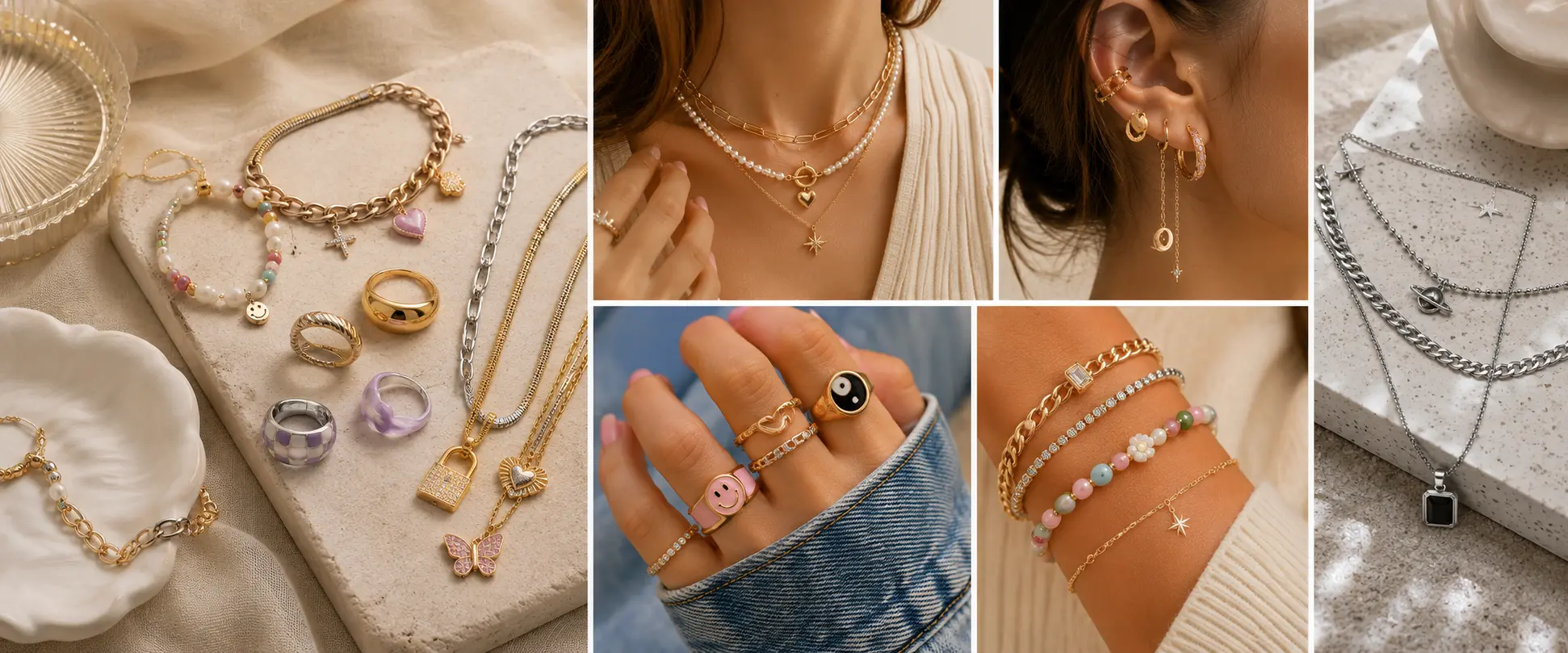
She wore it for maybe an hour.By the time we sat down for cake, she was back in her actual look: four rings stacked across two fingers, a chunky silver chain layered under two thinner gold ones, and earrings that flat-out didn’t match each other. Not by accident, either. I asked.
“That’s the point,” she said, like I’d asked why the sky was blue. felt about ninety years old. Genuinely.
So I did what any confused older cousin does I went down a rabbit hole, way later into the night than I meant to. There’s a real logic behind it, apparently. Didn’t get all of it in one sitting, but enough to understand why my cousin’s ears currently look like a hardware store display.
Anyway. Wrists, ears, necks here’s the stuff I kept running into, over and over, digging into jewelry trends for Gen Z in 2026. Not the padded-out trend-report version.
Everything Has a Charm on It Now
Necklaces, bracelets, bag straps, phone cases if it can hold a charm, someone’s clipped one onto it in 2026. Zodiac signs, initials, birthstones, tiny padlocks, an enamel charm shaped like whatever your personality quiz said you were that week. Half of this has nothing to do with the charm itself and everything to do with what it’s supposed to say about you, which sounds like a lot until you remember teenagers have always done exactly this, just with different objects each decade.
Gen Z grew up watching everyone online build a “brand” out of themselves, so I guess the jewelry followed the same script a highlight reel, just wearable. A single letter charm for your name. A birthstone for your little brother. One weird little charm shaped like a taco because you and your best friend have an inside joke nobody else gets, and nobody’s really supposed to.
I picked up a $9 charm off a mall kiosk last month for no real reason it had a tiny moon on it, I liked it, done and that’s more or less this trend, condensed into one purchase. Cheap, small, meaningless to anyone but you, and somehow exactly what you wanted.
The shift from a few years back is obvious once you notice it. Matching jewelry sets used to be the goal you bought the set, you wore the set. These days a matched set almost looks like you gave up halfway through building an actual collection. Or just didn’t bother trying.
Gold and Silver Are Finally Getting Along
For pretty much forever, jewelry had one rule: pick a metal and stick with it. Gold person or silver person. Pick a lane.
That rule’s dead now. Good riddance.In 2026 the idea is combining them on purpose a gold chain next to a silver charm, a silver ring stacked beside two gold ones on the same hand, mismatched stud earrings where one side’s a hoop and the other’s some tiny star shape. Looks intentional because it is. There’s actually a bit of skill involved, even though the point is looking like you didn’t try.
I’ll admit I used to think mismatched earrings meant you’d lost one and gave up looking for the match. Nope. That’s just how it’s done now, and mine not that I’m biased look better than the matched pair I’ve had sitting in a drawer since 2019.
Quiet Luxury Had a Good Run
For a few years, the vibe was: look expensive, but never actually let on that you know it. Barely-there gold chains. One tasteful stud. Nothing loud, nothing you could pin to a specific trend just quiet, tasteful, kind of forgettable money.
2026 got tired of forgettable.Statement pieces are loud again oversized cuffs, chunky link chains, sculptural stuff you’d actually clock from across a room. I don’t know exactly when this flipped, but search data picked it up before most people consciously noticed, with interest in bold, maximalist styles climbing fast heading into the year.
Why the sudden swing back to loud? Hard to say for certain, but my guess is people got tired of looking expensive instead of looking like themselves. Quiet luxury was never really a Gen Z thing to start with it got borrowed from an older, more corporate crowd that actually wanted to hide their money. Left alone, Gen Z jewelry has always run louder than that.
And a lot of it isn’t split by gender anymore, either. Chunky chain bracelets and signet rings used to sit in the “men’s” section of a store, unofficially. Now they’re just jewelry, and whoever wants one wears one. Works the other way too thin gold chains and small hoops show up on guys just as often as anyone else. The “his and hers” jewelry counter is turning into a bit of a relic, if it isn’t already.
Okay, But How Do You Actually Wear All This?
If you want the layered look without it turning into a mess, there’s a formula I’ve landed on that actually holds up mostly from messing it up a bunch of times first and paying attention to what worked.
- One anchor piece. A chain, a pendant, or a charm necklace that actually means something to you, not just whatever was on the shelf.
- One delicate piece. A thin chain, a small pearl, something that doesn’t fight for attention.
- One textured or chunky piece. A bold link chain, a bead necklace, something with actual presence.
- Stop at three, roughly. Go past that and it stops looking curated and starts looking like you emptied a drawer.
- Mix metals on purpose, not by accident. One warm piece, one cool piece, and let whatever third material you’ve got a stone, a cord, a charm tie the two together.
Same rough logic works for rings and ear stacks. Anchor, filler, texture. Done, more or less.
It Has to Survive Actual Life
Nobody really wants jewelry anymore that only works for special occasions. If you can’t shower in it, sweat in it, and sleep in it without it tarnishing or snapping in half, a lot of people just won’t bother buying it doesn’t matter how good it looks in a photo.
Which is a big part of why solid gold, gold vermeil, and stainless steel have mostly pushed out the cheap gold-plated stuff, the kind that turns your finger green if you so much as wash your hands twice in a row. Nobody wants to explain that on a first date.
Makes sense once you think about how jewelry actually gets used day to day now. It’s not saved for weddings and job interviews anymore. It’s on for class, on for the gym, on for a grocery run you didn’t plan on making, and still on when you fall asleep scrolling at 2 a.m. and forget to take it off, which happens more than anyone admits. If something’s annoying or high-maintenance, it comes off and mostly stays off. Doesn’t matter what it cost or how good it looked in the ad.
Your Ears Are a Whole Project Now
Piercings aren’t something you get once and forget about anymore. They’re curated. Planned, even. A small hoop in the lobe, a stud above it, something delicate on the helix or the tragus, maybe a second lobe piercing doing a completely different thing than the first one. Nobody’s really going for symmetry. Half the point seems to be that your left ear and your right ear could belong to two different people with two different budgets.
If you don’t have the piercings for it, ear cuffs have gotten good enough now that most people can’t tell the difference anyway. No needle, no six-week healing wait just clip it on, and you’ve got the look without actually committing to anything.
Pearls, But Make Them Weird
Not your grandmother’s pearls. Well actually, maybe her exact pearls. Just not styled anything like the way she wore them.
The big shift is toward baroque pearls lumpy, irregular, asymmetrical ones instead of a perfectly round classic strand. Every single one looks a little different, and that inconsistency is most of the appeal. A strand that looks like it rolled off a factory line just isn’t really the goal anymore.
The styling matters more than the pearl itself. You’ll see one baroque pearl hanging off a chain that’s honestly too chunky for it to make any traditional sense, or a single pearl stud paired with something completely unrelated on the other ear. Sometimes a cluster of pearls gets shoved up against something heavy and industrial-looking instead of floating politely on a thin gold chain, which is supposedly how pearls are meant to behave. Odd combination on paper. Works anyway, somehow.
Color Is Back On the Table
For a long stretch, “fine jewelry” basically meant colorless. White diamonds. White gold. Silver everything. Color got parked in the costume jewelry aisle, treated like it wasn’t serious enough for the real stuff.
That’s fading fast.
Enamel rings in actual colors cherry red, cobalt, that specific green you only see on old candy wrappers are showing up right next to fine gold pieces like it’s completely normal now. Colored gemstones are having a moment too, and not just the obvious ones. Sapphires that aren’t blue. Fancy-colored diamonds that used to be a rich-person-only category. Even cheaper stones like citrine and garnet are landing in nicer settings instead of getting waved off as “not a real gem.”
Part of this ties into something else: Gen Z seems to want a bigger, more varied collection built out of decent materials rather than one or two “important” pieces saved for later. A gold-vermeil ring with a citrine, a lab-grown pendant, an enamel bracelet arguably a more interesting jewelry box than three matching diamond studs bought over ten years.
I think this one’s less about any single gemstone and more about a mood shift, if I had to guess. Neutral, safe, matches-everything jewelry had a good run. Now people want the opposite something a little loud, a little specific, something that clashes on purpose instead of blending in.
One small tip if you try this: pick one loud colored piece and let everything else stay quiet. A single enamel ring or a colored gemstone pendant reads as intentional. Three of them at once, and you start looking like you raided a gumball machine on the way out the door.
I ended up with a cobalt enamel band from a random Etsy seller for about $22, and it’s somehow become the piece people comment on most more than anything that actually cost real money.
The Friendship Bracelet Thing Actually Means Something
Here’s a real example, not a hypothetical. Back in 2023 and 2024, fans at Taylor Swift’s Eras Tour started making and trading beaded friendship bracelets in the stadium lines nothing fancy, just letter beads spelling out lyrics or inside jokes, handed off between strangers while everyone waited for doors to open. No brand invented this. Nobody in the jewelry industry planned it. It was just a few thousand fans doing something sweet, at a massive scale.
Fast forward to 2026 and that moment never really ended, it just grew up. Beaded letter bracelets are still around, but the format’s expanded chain versions, stacking bangles, even “permanent” bracelets that get welded onto your wrist at a jeweler so they can’t be lost or accidentally unclasped. It’s become one of the fastest-growing corners of the bracelet market.
Says something about the strongest Gen Z jewelry trends. The real ones rarely start in a boardroom. This one started with a stadium full of bored people and a bag of plastic beads.
Lab-Grown Diamonds Are Just… Normal Now
A few years ago, “lab-grown” sounded like a downgrade the diamond version of a knockoff bag. That’s completely flipped. For a lot of Gen Z shoppers, lab-grown isn’t the backup option anymore. It’s the first choice, full stop.
Price is the biggest reason, probably. A lab-grown stone costs a fraction of what a mined one does at the same size, so instead of settling for something smaller because that’s what fits the budget, you can just get closer to the size you actually wanted. A lot of buyers like the ethics side of it too no mining, no supply-chain question marks hanging over the ring.
Small opinion, and I’ll die on this hill: for anything that isn’t a forever piece an everyday ring you might lose at the gym, studs you’ll wear daily and probably scratch up lab-grown is the smarter buy. Not even close.
One honest caveat, though. The “sustainable” label gets thrown around more than it’s really earned. Growing a diamond in a lab still takes serious energy, and a lot of producers aren’t exactly forthcoming about where that energy comes from — could be solar, could be a coal-heavy grid, depends entirely on the factory. It’s usually cheaper, and it usually sidesteps the ugly supply-chain stuff around mining. But automatically green? Not really. That part takes actual digging, more than most people bother doing before they check out.
Thrifted and Hand-Me-Down Jewelry Isn’t a Backup Plan Anymore
Secondhand jewelry used to be what people settled for when new wasn’t in the budget. These days plenty of people pick it on purpose, budget aside. Depop, thrift stores, estate sales, grandma’s old jewelry box all of it’s fair game, and a lot of Gen Z shoppers are hunting there first, not last.
And here’s the part that actually surprised me. It’s not mainly about the planet, or at least not as much as everyone assumes. That’s the story people default to, and sure, it’s in there somewhere. But when you look at why people actually buy secondhand, the bigger reasons are value, quality, and the simple fact that a 1970s gold chain from an estate sale doesn’t look like anything currently sitting on a mall shelf. Sustainability’s more of a nice bonus than the main event.
There’s something else going on too, and it’s less about shopping and more about family. An actual grandmother’s brooch, restrung, re-clasped, worn with a hoodie instead of Sunday best that hits different than anything bought new. It’s just sentimental, and it happens to line up with what’s on-trend for 2026 almost by accident.
Real talk, since we’re here: some of this is worth chasing, some of it isn’t. A $150 “build-your-own” charm kit from a mall counter? Skip it you can build the same thing yourself for a third of the price with a trip to a bead shop and an hour of patience. An actual pre-loved gold piece from an estate sale for the same money? Worth every penny.
FAQs
Quick answers to the stuff people keep asking me about this.
What’s the single biggest jewelry trend for Gen Z in 2026?
Personalization, if you forced me to pick just one. Charms, initials, zodiac pieces, birthstones and a lot of the other stuff on this list, mixed metals, layering, ear stacks, is kind of just that same idea wearing a different outfit.
Do Gen Z shoppers prefer gold or silver?
Neither, really, or both, depending how you want to look at it. Mixing gold and silver together, sometimes on the same hand, is one of the clearer jewelry trends of the year. That old “pick one metal and commit” rule doesn’t really apply anymore.
Are lab-grown diamonds a big deal, or just marketing?
A genuinely big deal, not just marketing spin. Price and ethics both play into it a lab-grown stone gets you a bigger, cleaner-looking diamond for a lot less money, and plenty of Gen Z buyers like not having to think too hard about where a mined stone came from. One thing though: don’t assume “lab-grown” automatically means “eco-friendly.” That part’s murkier than most of the marketing lets on.
Is layering jewelry still in style, or is it played out?
Still very much in, and if anything it’s gotten more specific. There’s an actual formula to doing it well now anchor piece, delicate piece, textured piece instead of just piling everything on and hoping for the best.
Are friendship bracelets still trending in 2026?
Yes, but they’ve grown up. What started as beaded letter bracelets, the kind traded at Taylor Swift’s Eras Tour, has expanded into chain versions, stacking bangles, and even permanent welded bracelets. The sentiment stuck around even after the format changed.
Where is Gen Z actually buying jewelry in 2026?
All over, really. Depop and thrift stores for vintage and estate finds, small direct-to-consumer brands discovered on TikTok or Instagram for anything personalized, and traditional jewelers for bigger pieces, like an actual lab-grown ring. Less about one store, more about piecing a collection together from wherever the right piece turns up.
Is colorful jewelry actually trending, or is that a niche thing?
Pretty mainstream at this point, not some niche corner. Enamel pieces and colored gemstones are showing up in regular jewelry collections next to classic gold and diamonds, not tucked away in a separate “fun” section. Safest approach: pick one colorful piece and let the rest stay quiet.
Do Cuban link and chunky chain bracelets still count as a Gen Z jewelry trend?
Yes, and they’ve mostly stopped being a “men’s jewelry” thing. Chunky link bracelets and chains get worn by anyone now, often mixed with something more delicate on the same wrist instead of worn alone. That contrast, heavy chain against thin chain, is a big part of why the stacking trend works in the first place.
What’s one Gen Z jewelry trend that’s actually fading out?
Perfectly matched three-piece sets, the kind that come boxed together and are obviously meant to be worn exactly as sold. Not gone completely, but a look that clearly came from one matching set tends to read as a bit dated next to a collection assembled slowly, over time.
My cousin, for what it’s worth, has already added a fifth ring to the stack. I asked if it was too much.
She just looked at me.
I think I already know the answer to that one.