


A grey sleeve was hanging out of the gap like a tongue, and I did what everybody does — leaned in with my hip, shoved, heard the runner grind, gave up, left it open about two inches. Walked off. Came back an hour later and it was still sitting there, half-open, sleeve out, looking smug.
Then I actually counted what was inside. Nine t-shirts.
Nine. A drawer wide enough to lie a laptop across, and it had reached capacity at nine t-shirts — and the weekend before that, I’d been scrolling through dressers online, seriously considering spending real money to store nine shirts.
That’s the moment it landed. My clothes weren’t the problem. The furniture wasn’t the problem. I was folding the way somebody showed me when I was about nine years old — sleeves in, fold in half, drop it on the pile — and that method throws away a genuinely stupid amount of space.
So here’s the thing I wish someone had told me earlier, without the twelve-minute video intro.
Folding isn’t magic — here’s what actually saves the space
I’ll be straight with you, because a lot of articles about this oversell it.
A folded shirt takes up roughly the same volume whether it’s lying flat in a stack or standing on its edge. Physics doesn’t care about your organizing habits. If somebody tells you a particular fold “doubles your drawer space” out of thin air, they’re rounding up hard.
The space you actually gain comes from four unglamorous things:
- Squeezing out air. Loose folds trap pockets of nothing. A firm fold with the fabric pulled flat can be 30–40% thinner than a lazy one on the exact same shirt.
- Folding to fit the container instead of folding to a shape. This is the big one. More on it in a second.
- Not disturbing the stack. A flat pile is fine on day one. By day four you’ve dug through it three times, it’s bowed in the middle, and it’s now twice as tall as it needs to be.
- Using the top 5 cm of the drawer. Nobody fills a drawer to the brim with a flat stack, because the stack topples. So you leave a band of empty air across the top of every drawer in the house. Add that up across five drawers and it’s basically a sixth drawer you paid for and never used.
That’s it. That’s the whole trick. Everything below is just the mechanics.
Honestly? Once I understood point two, the rest fell into place on its own.
The one formula worth writing on a sticky note
Grab a measuring tape. Open your drawer, measure the inside height — floor of the drawer to the underside of whatever’s above it — and subtract two or three centimetres.
That number is how tall every folded item in that drawer should be. Not “fold it in thirds.” Not “fold it into a square.” Fold it to that number.
Mine came out to 15 cm, so I fold every t-shirt into a rough 15 × 25 cm rectangle and stand it up. Yours might be 11 cm or 22 cm. Doesn’t matter. What matters is that a shirt folded 2 cm too tall means the drawer catches when you close it, which means you’ll be annoyed by it, which means in three weeks you’ll go back to dumping things in a pile. Systems fail on friction, not on effort.
Same logic for shelves. Same logic for a suitcase — measure the depth of the case with the lid down, subtract a couple of centimetres, fold to that.
Write the number down. Stick it inside the drawer if you’re the kind of person who forgets. I am that person.
The three folds that cover almost everything you own
There are dozens of folding methods floating around. You need three.
1. The file fold (t-shirts, tees, polos, light tops)
You fold the shirt into a small firm rectangle and then stand it on its edge in the drawer, like a book on a shelf, so you’re looking at the spine of the shirt rather than the top of a pile.
This is the one that changed my drawers, and not mainly because of volume. It’s because you can see everything. Every single shirt, front row to back, at a glance. No excavation. Which means the third-favourite shirt buried at the bottom of the stack actually gets worn again instead of quietly rotting there for a year.
And nothing collapses. You pull one out, the gap stays, the neighbours hold their shape. That’s the real win.
2. The tight roll (soft, unstructured stuff)
Anything with no shape to protect — pyjamas, gym shorts, cotton leggings, underwear, thin summer tops, swim gear. You lay it flat, fold it long and narrow, then roll it firmly from one end, tucking as you go.
Rolling is brilliant for soft fabric and wildly overrated for everything else. I’ll die on this hill. Rolled jeans are a lumpy nightmare that eat drawer depth and come out with creases in places creases don’t belong. Rolled dress shirts are a cry for help. Roll the floppy things, fold the structured things.
3. The flat stack (knits, sweaters, heavy things that crease)
Fold in half, sleeves back, keep it flat, and stack no more than four or five deep.
Some clothes just shouldn’t be squeezed or stood on end. Chunky knits lose their loft, get a permanent horizontal crease across the chest, and heavy wool stretches out of shape if you hang it. So they get folded flat and stacked low, on a shelf where you’re not fighting gravity.
Three folds. That’s genuinely all of it.
How to fold a t-shirt to save space in about five seconds
Fine, six seconds. Here’s the version I use every single time, and it works on a bed, a table, or the floor.
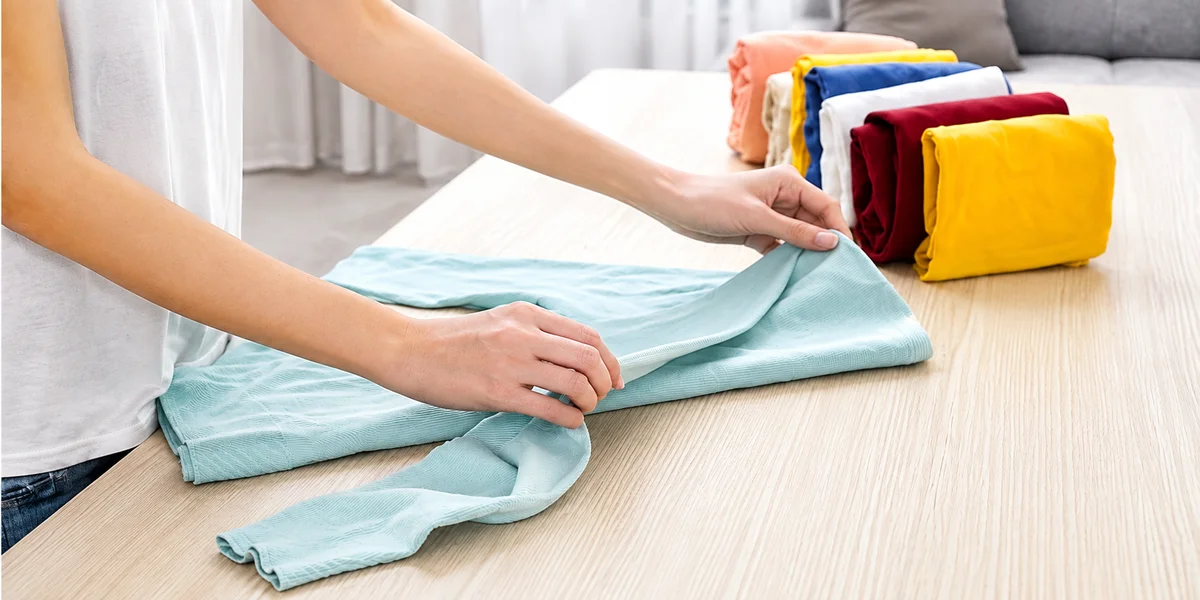
- Lay the shirt face down, back facing up. Smooth it flat with your palm — actually do this, it’s not decorative, it’s what removes the air.
- Fold one side inward about a third of the way, bringing the sleeve with it. Fold the sleeve back on itself so it lies inside the panel you just made.
- Same on the other side. You now have a long vertical strip roughly the width of your hand plus a bit.
- Check the strip’s width against your sticky-note number. Too wide? Fold each side in a little more. This is the step everyone skips and it’s the whole point.
- Fold the bottom hem up to just under the collar, then fold once more in half. Press down firmly.
- Stand it up in the drawer, folded edge facing you.
The fold-face-down part matters more than it sounds. Printed graphics end up on the inside of the rectangle, so they don’t rub against each other and crack. Learned that after ruining a shirt I liked.
If your shirt comes out too tall, fold the bottom up in thirds instead of halves. Too short and floppy to stand up on its own? Fold it in half instead of thirds so it’s chunkier. You’re tuning it to the drawer, not following a recipe.
Give it a week. The first few days it feels fussy and slow. Then your hands learn it and you stop thinking about it entirely — you’ll fold a shirt while talking to somebody and not notice you did it.
Jeans, hoodies, socks, and the other awkward ones
T-shirts are easy. Every folding video starts with a t-shirt because t-shirts are flat and cooperative. Real drawers aren’t full of t-shirts.
Jeans and trousers
Fold them in half lengthways first — leg on leg, so the natural curve of the seat is on the outside. There’s a lumpy bit at the hip that sticks out; fold that back in flat so you get a clean straight rectangle instead of a rectangle with a hip.
Then fold in thirds, or in half if your drawer is shallow. Stand them on edge, same as the shirts. Six or seven pairs of jeans standing upright take up about the space three pairs stacked flat used to, because a flat stack of denim bows in the middle and wastes everything above it.
Chinos and anything with a crease you care about? Fold along the existing crease and leave it at that. Don’t fight the crease, use it.
Hoodies and sweatshirts
The bulkiest thing most of us own, and the fold everybody does wrong.
Lay it face down. Fold the sides in, sleeves tucked back, like the t-shirt. Then — this is the bit — fold the hood down over the body rather than leaving it flapping at the top. The hood is a big soft pocket of air, and if you fold it flat and trap it inside the parcel, the whole thing loses a solid chunk of thickness. Then fold in half, press hard with both hands, and stand it up.
Two hoodies in a stack sit at about the height of four folded this way. I’ve measured it, on my own drawer, because I was mildly obsessed at the time.
Socks — please stop balling them
The sock ball is comfortable, familiar, and it’s a crime against space.
When you stretch the cuff of one sock over the pair, you’re building a hollow ball with air inside and you’re wrecking the elastic at the same time. Socks stored that way stop staying up in about a year.
Instead: lay one sock on the other, fold in half or thirds, done. Flat little parcels. Line them up in rows in a shoebox or a divider so they stand together. My sock drawer went from full to about half full and I own the same socks.
Underwear and basics
Roll them. Tight little cigars, stood up in rows in a small open box. Sounds excessive. Takes four minutes for the whole drawer and it’s the single most satisfying part of this entire process, which probably says something about me.
Bras and delicates
Don’t fold cups flat and don’t stack heavy things on top of them. Nest them front-to-back in a row, cups inside each other, and give them their own strip of the drawer with a divider so nothing crushes them. This is the one category where saving space is not the priority — the thing costs money and loses its shape permanently if you squash it.
Same folds, different box: drawers, shelves and suitcases
The fold doesn’t change much. The geometry of what you’re filling does.
Drawers
One drawer, one category. T-shirts here, trousers there, and don’t let them mix — mixed drawers are where organisation goes to die, because you can’t scan them and you stop trying.
Dividers are worth it. I bought four fabric ones for about 1,400 rupees and they’ve earned it several times over, purely because they stop rows from slumping sideways every time you take something out. If you don’t want to spend anything: cut cereal boxes down to the height of your fold, or use shoeboxes with the lids off. Works identically. Looks worse. Nobody’s opening your drawer.
Fill drawers front to back, not left to right. You want a row you can read like a filing cabinet when you pull the drawer out — that’s the whole reason for standing things up.
Shelves and open closets
Shelves have a different enemy: height. A tall stack looks tidy and then you pull something from the middle and the top half slides off.
Cap your stacks at about 20 cm, or four to five items, and start a second stack beside it. Two short stacks side by side beat one tall one every single time — quicker to use, doesn’t collapse, and honestly it looks better.
Heavy things low, light things high. Standard stuff, but people put sweaters on the top shelf and then wonder why the shelf sags.
Suitcases
A luggage shop off the main bazaar, a Tuesday, me asking for something bigger than my 55 cm carry-on. The owner looked at the bag I’d brought in, looked at me, and said: “The bag isn’t your problem.”
Slightly rude. Completely correct.
Here’s how I pack now. Structured, foldable things — jeans, shirts, a jacket — get folded flat and laid in the bottom in one layer, the way you’d stack books. Soft things get rolled tight and used as filler: rolls go along the edges, into the gaps beside the shoes, inside the shoes, into the space around the toiletry bag. Shoes go sole-to-sole at the hinge end, in a cloth bag, stuffed with socks.
The perimeter matters more than the middle. Most half-packed suitcases have a soft empty ring running all the way around the inside edge, and that’s where the extra four days of clothes live.
Packing cubes: worth it. Compression bags with the roll-out valves: mostly not, in my opinion. They do genuinely shrink a pile, but weight doesn’t compress, so if you’re flying with a limit you’ll just hit 23 kg with a smaller, denser bag and feel cheated. Compression bags solve a volume problem. Airlines charge for a weight problem.
The weekend that fixed my cousin’s hostel room
My cousin Hamza moved into a hostel room in February with a three-drawer dresser, a narrow hanging rail, and — we counted — forty-four t-shirts. He’s a t-shirt guy. Two drawers wouldn’t shut, the third had become a general dumping ground for chargers, a belt, and one shoe, and he was sleeping with roughly a week’s worth of laundry stacked on the chair beside his bed.
We spent a Saturday afternoon on it. Maybe three hours, most of that spent talking rather than folding.
First we emptied all three drawers onto the bed, which is horrifying and necessary. Then he made two piles: wear regularly, and everything else. Eleven shirts went into a bag for his younger brother without much argument — they were the free promotional ones from university events, and he admitted he hadn’t touched any of them since the events themselves.
Then we measured. Drawer one had 16 cm of inside clearance, so we folded to about 14. Twenty-two t-shirts standing on edge, front to back, with a divider a third of the way in holding the row tight. Drawer two: eight pairs of jeans and shorts, folded lengthways and stood up. Drawer three: two shoeboxes side by side, one for rolled underwear, one for flat-folded socks, plus the leftover strip for the chargers and belt he refused to throw away.
All three drawers closed. First time since he’d moved in.
The part he actually noticed, though, wasn’t the space. Three weeks later he mentioned he’d basically stopped ironing t-shirts, because the shirts at the bottom of a pile were the ones that came out with deep creases across them, and now there was no bottom of a pile. He also stopped wearing the same four shirts on rotation, because he could finally see all twenty-two.
That’s the thing nobody puts in the headline. Folding clothes to save space quietly fixes a bunch of small problems that don’t look related.
Try this: the 45-minute drawer reset
Don’t do your whole wardrobe. You’ll get bored around minute twenty, abandon it half-finished, and be worse off than when you started. I’ve done exactly that.
Pick one drawer. Set a timer if that helps.
- Minutes 0–5: Empty it completely onto the bed. All of it. Wipe the drawer out, because there’s dust and probably a receipt in there.
- Minutes 5–10: Measure the inside height. Subtract 2–3 cm. Say the number out loud so you remember it.
- Minutes 10–15: Two piles — actually wear, and don’t. Be quick and slightly ruthless. Anything you haven’t worn in a year and don’t have a specific reason to keep goes in a bag by the door.
- Minutes 15–35: Fold the “wear” pile to your number. File fold for structured items, roll for soft ones. Press each one flat with your hand before the final fold.
- Minutes 35–40: Load it front to back, standing up. Add a divider, a cut-down box, whatever you’ve got.
- Minutes 40–45: Close the drawer. Open it again. Look at it for a second, because that’s the bit that makes you want to do the next one.
Then stop. Do drawer two next weekend. Slow is fine. Slow finishes.
Mistakes I made, so you can skip them
I over-compressed everything. Went through a phase of folding aggressively tight, including the wool sweaters, and gave two of them a permanent crease across the chest that never came out. Not everything wants to be small.
I built a system I couldn’t maintain. My first attempt had shirts folded to a beautiful precise size that took about forty seconds each. Looked incredible. Lasted nine days. If a fold takes longer than roughly five to eight seconds, you won’t keep doing it on a Wednesday night when you’re tired, and a system you don’t maintain isn’t a system, it’s a photograph.
I folded damp clothes. They came out of the machine feeling almost dry, so I stacked them, and the drawer smelled faintly of pond for a week. Bone dry, or don’t fold.
I kept hanging things that don’t need hanging. T-shirts, jeans, knitwear — all of them do better folded, and every one you take off the rail gives you back space you didn’t know was on the table. Hang the things that actually need it: shirts, blazers, dresses, anything structured or made of fabric that creases if you look at it wrong. Fold the rest.
And I ignored the real issue for a long time. Which is that folding well makes an over-full wardrobe manageable, not fixed. If your drawers still won’t close after all this, the answer isn’t a cleverer fold. You know what it is.
A couple of small things that add up
Turn drawer-fold direction with the seasons. Heavy winter items down low in the deep drawer, light summer things up top, and swap them twice a year while you’re already in there. Takes ten minutes and stops the deep drawer from becoming an archaeological site.
Keep one shelf or drawer at about 80% full on purpose. Sounds wasteful. It’s the buffer that absorbs a laundry day, a gift, a sale you couldn’t resist. Without slack somewhere, the whole thing tips back into chaos the first busy week you have.
And fold as you take things off the drying rack, standing right there, straight into the drawer. Not into a basket first. The basket is where good intentions go to sit for four days.