


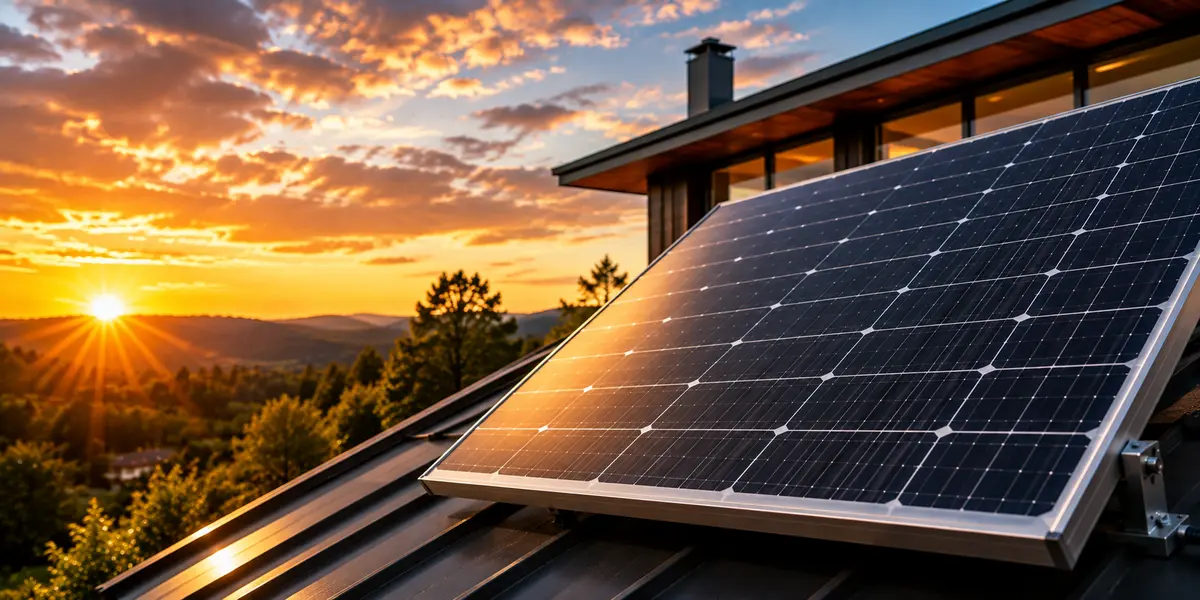
So my neighbor ambushes me in his driveway last spring, right after his install finished. Coffee in one hand, other hand pointing up at the roof like he’d personally invented electricity. “Ninety percent of these panels are the same junk,” he goes. “This one’s not.” Meant the REC Alpha Pure-R. I just kind of nodded, said something noncommittal, and drove off thinking, sure buddy, they’re all basically the same. Took me three months of digging through spec sheets and one genuinely long call with an installer to admit — okay, fine, he had a point.
Here’s the thing about shopping for solar panels. Every brand’s website says the exact same stuff. Maximum efficiency. Industry-leading warranty. Cutting-edge technology. It all blurs together after the third tab you open. So instead of another generic buyer’s guide, I want to just talk through one specific panel — what’s actually good about it, where it disappoints, what it costs, and who should skip it entirely.
What Exactly Is the REC Alpha Pure-R?
It’s REC Group’s flagship residential panel, manufactured in Singapore. Built around heterojunction (HJT) cell tech, paired with what REC calls a “true busbar” design — meaning no visible busbars running across the cell surface. Mouthful, I know. What it actually means for you: better sunlight capture than older panel designs, less heat-related energy loss, and — this is the detail people skip over — it’s completely lead-free.
That lead-free bit gets glossed over in a lot of reviews I read, which is weird because it’s not nothing. Most panels still have small traces of lead in the soldering — nobody talks about it much. REC just… took it out. Makes recycling less of a headache down the road, and if sustainability’s even part of why you’re doing this whole solar thing, it’s a genuinely nice touch, not just a checkbox on a spec sheet.
Key Specs at a Glance
Quick numbers, for the skimmers:
- Power output: 380W to 470W, depending on which model in the range
- Efficiency: up to 22.3% — near the top of what’s available for residential right now
- Temperature coefficient: -0.24%/°C — basically, panels lose output as they heat up, and this one loses less than most (more on why that matters in a second)
- Warranty: 25 years product, 25 years performance, 92% output still guaranteed at year 25
- Cell tech: heterojunction, half-cut cells, no visible busbars
- Dimensions: roughly 71.5 x 41.7 inches, weighing around 42 lbs per panel
Pay attention to that temperature coefficient number. Seriously. Everyone fixates on the peak efficiency percentage and forgets panels don’t sit at a nice cool 77°F all day. They bake. A panel that looks amazing on a cool spring morning spec sheet might sag hard once it’s July and the roof’s hitting 140 degrees.
Why Heterojunction Tech Actually Matters
I’ll keep the physics short, promise.
Standard solar cells — the PERC type, which is most of the market — rely on a single layer of silicon doing all the heavy lifting. Heterojunction cells basically sandwich that silicon between thin layers of amorphous silicon. Sounds fancy, does two practical things: loses less energy to heat, and holds output steadier across more lighting conditions — cloudy afternoons, that weak early-morning sun most panels kind of shrug at.
So does that mean HJT is automatically “the better panel,” full stop? Nah, not really. They cost more to manufacture, full stop, and if you’ve got a modest roof with modest energy needs, a cheaper PERC panel does the job just fine. But if roof space is tight and you want max output per square foot, this is exactly where HJT earns its premium.
My Actual Experience Comparing Panels
Full disclosure — I’m not an electrician. Didn’t install anything myself. What I did do was spend about a month talking to three installers, squinting at spec sheets until my eyes hurt, and pulling quotes for a 6.5kW residential setup. Two installers pitched me standard monocrystalline panels from budget brands. One quoted the Alpha Pure-R.
Price gap wasn’t small, either. The REC system landed around 18% higher than the cheapest quote I got. That’s real money, not a rounding error. But when I actually ran the 25-year output projections — factoring in better heat performance and the higher efficiency — that payback gap shrank down to roughly three extra years. Combine that with the stronger warranty and slower degradation curve, and the math started making a lot more sense than it did on paper alone.
Would I say buy it, no questions asked? Nah. If money’s tight and you just want that electric bill down, cheaper panels get you there too, no shame in that. But if you’re not moving anytime soon and you actually care about getting the most out of every watt your roof can produce, this one’s worth what it costs. Not just marketing talk.
What It Actually Costs (And What Changes the Number)
Pricing pages always feel vague on purpose, so here are real numbers, with the caveat that they shift by region and installer.
For a typical 6-8kW setup, expect $3.20 to $3.80 per watt installed, before incentives. A 6.5kW system lands around $20,800 to $24,700 before rebates. A budget PERC system doing the same job usually comes in cheaper, closer to $2.60 to $3.00 per watt. So yeah, there’s a gap.
Few things that swing that number more than people expect, in my experience asking around:
- Roof complexity. Steep pitch, multiple angles, or tricky access adds labor cost fast.
- Electrical panel upgrades. Got an older home? You might need your breaker panel upgraded to handle the new system — and that cost almost never shows up in the first quote you get.
- Local incentive programs. Federal tax credits, state rebates, whatever your utility’s offering — these can knock 20-30% off the final number, sometimes more, depending where you live.
- Installer overhead. Smaller local installers are sometimes cheaper than big national brands, though warranty support can vary.
My advice, and I mean this — get itemized quotes. Not just a lump sum. Ask exactly what’s panel cost, what’s labor, what’s the inverter, what’s permitting. Installers who won’t break it down are usually the ones padding something.
Where This Panel Falls Short
No product’s perfect and I don’t trust any review that pretends otherwise.
Cost. The big one. HJT tech is pricier to produce, and that cost lands on you. If budget’s the deciding factor, this probably isn’t your panel.
Availability. Not every installer stocks REC. Depending on where you live, finding someone certified to install and service them could take extra legwork.
Overkill for small setups. Small roof, no shading issues, modest needs? A standard panel will likely do fine for meaningfully less cash.
Longer break-even, sometimes. Cheap electricity rates or a roof that already gets perfect sun all day? Then honestly, that efficiency premium isn’t buying you much. You’d just be paying extra for headroom you never actually use.
A Quick Real-World Scenario
Picture a house with a partially shaded roof — say, a big oak tree throwing shadow across part of it every afternoon. This is honestly where higher-efficiency panels like the Alpha Pure-R shine (yes, pun intended, sorry). HJT cells handle partial shading and weaker light noticeably better than standard panels, so you lose less total output when part of the array’s sitting in shadow.
Now compare that to a neighbor with a fully open, south-facing roof, zero obstructions. In that case the efficiency edge matters less, since a standard panel’s already running close to ideal conditions most of the day. The premium panel still wins — it just won’t feel as dramatic on your monthly bill.
Nobody brings this up enough during the sales pitch, honestly. Your specific roof should decide which panel makes sense. Not whatever’s trending on some forum, and definitely not whatever the salesperson happens to be pushing that particular quarter.
How It Stacks Up Against Competitors
Numbers side by side, since that’s easier than me describing it in paragraphs:
| Feature | REC Alpha Pure-R | Standard PERC Panel | Premium Competitor (e.g. SunPower) |
|---|---|---|---|
| Efficiency | Up to 22.3% | Typically 18–20% | Up to 22.8% |
| Temp coefficient | -0.24%/°C | Around -0.35%/°C | -0.29%/°C |
| Lead-free | Yes | Usually no | No |
| Warranty | 25 years, full | Often 10–25 years, prorated | 25 years, full |
| Price | Higher | Lower | Higher |
That warranty row deserves its own mention. A lot of panel warranties are prorated — the guaranteed output percentage quietly drops year over year, and the fine print gets murky by year fifteen if you actually read it. REC’s flat 25-year full warranty is one of the stronger guarantees going right now. Every installer I talked to brought it up before I even asked.
Worth noting too — REC sits in a weird sweet spot between budget brands and ultra-premium ones like SunPower. Slightly cheaper than the top-tier competitor, comparable performance, similar warranty terms. If you were choosing between just those two, it’d come down to installer availability in your area more than anything else.
Maintenance and Upkeep: What to Actually Expect
Solar panels get marketed as “install and forget,” which, mostly, is true. Not entirely though.
Rain does most of the cleaning work on its own, honestly. Live somewhere dusty, or near farmland? A quick rinse with a garden hose every so often keeps output steady — skip the pressure washer, it’s overkill and can mess with the glass coating over time. Beyond that, a once-a-year look-over for cracked glass, loose mounting, or debris piling up is plenty for most people. You don’t need to be up on that roof every month checking things.
Most systems ship with an app showing daily output too, and it’s worth glancing at monthly. A sudden unexplained dip is usually worth investigating — could be a tree that’s grown enough to start shading part of the array, could be a wiring issue, could be nothing. Either way, better to catch it early.
Snow’s a common worry in colder climates, but panels are angled enough that it mostly slides off on its own. I wouldn’t recommend climbing up there to manually clear it — risky if you’re not used to roof work, and rarely necessary anyway.
None of this is dramatic. I think people overestimate how much babysitting these things need. Set it up right, check the app occasionally, and mostly just let it do its job.
Is It Worth Buying?
Honest answer: depends what you actually value.
Cheapest system possible, don’t care about squeezing extra watts? Skip it. Plenty of solid budget panels will serve you well for a decade-plus.
Tight roof space, hot climate, partial shading, or you just want the strongest long-term warranty out there? This one earns its price tag. It’s not hype — the engineering’s real and the numbers back it up.
My neighbor, by the way — eight months in now, his system’s outproducing his provider’s original estimate by a small but steady margin, even through a brutal August heatwave. Still won’t stop talking about it. I get it now though. Genuinely.
A Simple Buyer’s Checklist Before You Sign Anything
- Get at least three itemized quotes, not just bottom-line numbers
- Ask about degradation rate, not just the headline efficiency percentage
- Confirm whether the warranty is full or prorated — read the actual document, not the sales page
- Check if your roof orientation and shading situation actually justifies a premium panel
- Ask what happens if the installer goes out of business — is the manufacturer warranty separate?
- Look into local and federal incentives before comparing final prices between quotes
What the Actual Installation Process Looks Like
People underestimate how much of the “solar experience” is just paperwork and waiting, honestly. Here’s roughly how it played out for the quotes I got, and what installers told me to expect timeline-wise.
Site assessment. An installer comes out, checks your roof’s condition, angle, shading, and structural capacity. This usually takes an hour or two. If your roof’s older or needs repairs, they’ll flag it now — better to fix that before panels go up, not after.
Design and permitting. This is the slow part. Your installer draws up a system design, submits it to your local utility and permitting office, and then you wait. Depending on where you live, this can take anywhere from two weeks to a couple months. Nobody warns you about this stage enough, and it’s usually the most frustrating part of the whole process.
Installation day. The actual mounting and wiring typically takes one to three days for a residential system, depending on size and roof complexity. Panels go up, inverter gets installed, wiring gets run.
Inspection and activation. Once installed, a local inspector checks the work, and your utility company has to approve the interconnection before you’re actually allowed to switch the system on. This final step alone can add another few weeks.
All in, from signing a contract to actually flipping the switch, most homeowners are looking at two to four months. Longer in areas with backed-up permitting offices. If an installer promises a one-week turnaround for the whole thing, be a little skeptical.
Alpha Pure vs. Alpha Pure-R: Don’t Mix Them Up
Quick thing that trips people up while shopping — REC has both the “Alpha Pure” and “Alpha Pure-R” lines, and they’re not identical.
The Alpha Pure-R is the newer, higher-efficiency version, with the improvements to heat performance and output I’ve been talking about this whole article. The original Alpha Pure line is still a solid panel, still lead-free, still heterojunction-based, but sits a notch below in peak efficiency and temperature performance.
If an installer quotes you “REC Alpha panels” without specifying which line, ask directly. The price difference between the two isn’t huge, but it’s enough to matter, and you want to know exactly which spec sheet you’re actually buying against.
Common Myths About High-Efficiency Panels
A few things I kept hearing during my research that turned out to be flat-out wrong, or at least seriously oversimplified.
“Higher efficiency always means faster payback.” Not necessarily. Efficiency matters more when roof space is limited. On a large, unobstructed roof, a cheaper panel array can sometimes produce comparable total output for less money, just by using more square footage.
“Panels stop working after the warranty period.” No — the warranty is a guarantee on minimum performance, not an expiration date. Panels keep producing beyond 25 years, typically at somewhat reduced output.
“All heterojunction panels perform the same.” Definitely not true. Manufacturing quality, cell binning, and design details vary a lot between brands even within the same general technology category.
“You need direct sun all day for solar to be worth it.” Partial shading and cloudy regions still generate meaningful output, especially with panels designed to handle lower-light conditions better, like the ones we’ve been discussing here.
Environmental Side of Things (Beyond the Marketing Line)
Every solar brand claims to be the “green choice,” which, sure, they all technically are compared to fossil fuels. But there are real differences worth mentioning here.
The lead-free construction I mentioned earlier isn’t just a nice footnote — it genuinely simplifies recycling at end-of-life, since lead contamination is one of the trickier issues in panel disposal. REC also publishes third-party verified environmental product declarations, which, if you care about the manufacturing footprint and not just the panel’s output once installed, is worth actually reading rather than taking on faith.
Manufacturing solar panels does have a carbon cost, and HJT production is slightly more energy-intensive than standard PERC manufacturing, at least currently. But the payback period — meaning how long a panel needs to run before it’s offset the emissions from making it — is typically under two years for most modern panels, this one included. Compared to a 25+ year lifespan, that’s a small fraction of the total.
If sustainability is a genuine priority for you and not just a talking point, it’s worth asking installers directly about a panel’s carbon payback period and recycling program, not just its efficiency rating. Not every brand will have a good answer ready.
FAQs
How long do REC Alpha Pure-R panels actually last? Rated for 25 years, with 92% output guaranteed at that mark. Realistically, well-maintained panels often keep producing usable power past their warranty window, just at gradually reduced output.
Are heterojunction panels more fragile than standard panels? Not really — durability’s comparable to standard monocrystalline panels. The tech difference is in how cells convert and hold onto energy, not in how sturdy they are.
Do I need a special inverter for these? Nope. Works with standard string inverters and most microinverter setups. You’re not locked into some proprietary ecosystem.
Is the higher cost worth it for an average-sized home? For an average system with decent roof conditions, payback takes a bit longer than cheaper panels — but not dramatically so. Comes down to your budget and how long you’re planning to stay put.
Can these handle extreme heat well? Yes, actually one of the strongest selling points here. Lower temperature coefficient means less output loss as things heat up, which matters a lot if you’re somewhere with brutal summers.
Where are these manufactured? REC’s facility in Singapore, where quality testing also happens before panels ship out.
Should I get multiple installer quotes before deciding? Always, regardless of which panel you end up picking. Installation cost and quality swing more between companies than people expect — sometimes more than the panel brand itself affects your final number.
What happens to output on cloudy or rainy days? It drops, no getting around that, but heterojunction panels like this one hold up noticeably better in low-light conditions than standard PERC panels.
There’s no single “best” solar panel for everybody, and anyone telling you otherwise is probably selling something. Your roof, your climate, your budget, how long you’re staying — all of it shapes the right answer for you specifically. The Alpha Pure-R isn’t magic. It’s just solid engineering with a price tag to match. Whether that trade-off’s worth it is your call to make, ideally with a few real quotes in hand and a healthy dose of skepticism toward anyone insisting theirs is the only panel worth considering.