


Four bites. Through my pants. That’s how I found out clothes don’t work the way I thought they did.
It was my cousin’s engagement party, two summers back. Hot night, thin cotton pyjama pants because I couldn’t be bothered picking a real outfit, and by the time the samosas came out I was scratching my thigh like something was wrong with me. My aunt glanced over. “You know they can bite through that, right?” Flat tone. No sympathy at all.
I did not know that.
I’d genuinely gone years assuming a shirt or a pair of pants was basically Armor. Turns out no. Not even close, in some cases.
So, short version: yes, mosquitoes can bite through clothes. Long version’s more interesting, though, and once you get why, you’ll probably never look at a pair of leggings the same way again.
Why Mosquitoes Can Bite Through Clothes in the First Place
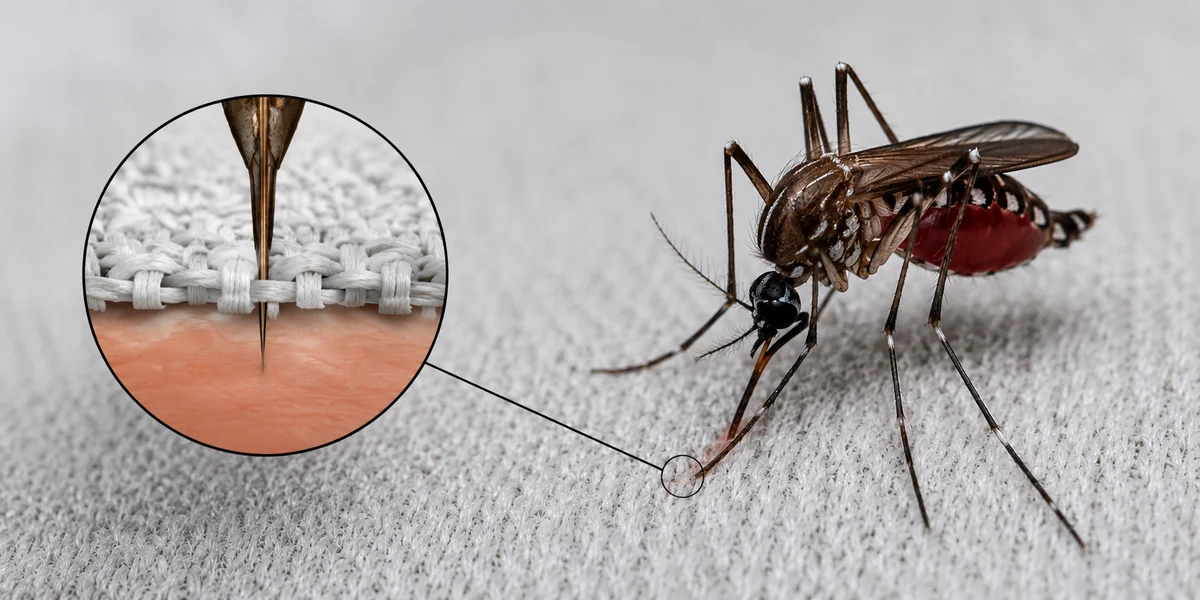
Nobody really tells you this part. A mosquito doesn’t have one needle. It’s got six, all bundled into one mouthpart called a proboscis, and honestly, it’s less like a straw and more like a tiny surgical kit. Four pieces are stiff, serrated, built for sawing in. Two are tubes — one drops saliva in (that’s your itch, right there), the other pulls blood out.
And it’s thin. Thinner than you’d guess. Somewhere between 40 and 100 microns across, depending on species. A human hair runs about 100 microns. So, in a lot of cases, the thing biting you is finer than your own hair.
Which is really the whole story with fabric. Every piece of clothing is riddled with tiny gaps between threads — has to be, or it wouldn’t breathe, wouldn’t stretch, would feel like wearing a trash bag. Those gaps are usually plenty wide enough for something needle-thin to get through.
Tight fabric makes it worse. Picture leggings, you’re sitting cross-legged on the grass, fabric’s pressed flat against your leg already. No air gap. No buffer. At that point the mosquito’s not even hunting for a hole. Contact is basically all it needs.
Same logic explains mosquito nets, actually. A net’s mostly empty space — it’s not blocking anything by being solid, because it isn’t solid. It works because the holes are small enough that a mosquito’s whole body can’t fit through, so the proboscis never even becomes relevant. Your t-shirt’s doing the identical job. Just badly, and by accident.
The Real Study on Mosquitoes Biting Through Fabric
Not something a pest control blog invented for content. Researchers at North Carolina State actually ran the numbers on this.
They built a mathematical model for how Aedes aegypti — dengue, Zika, yellow fever, that mosquito — bites through different textiles, based on how thick the material was and how tight the weave sat. Then they tested it. Live mosquitoes. A cage built specifically for this.
Results: a base-layer undergarment and a combat shirt, both military-designed originally, blocked every single bite across trials with 200 live mosquitoes. Not “mostly.” Not “significantly reduced.” Zero got through.
Here’s the part that actually got me, though. A follow-up round of testing found something almost backwards — tight compression gear, the kind of athletic shirt you’d grab at a sporting goods store, didn’t just fail to block bites. It resulted in more bites than bare skin. Because once fabric’s snug enough, you stop feeling the mosquito land. No early warning. No reflex swat. It just stays and finishes eating.
Clothes that felt protective, working against the person wearing them. Wild.
More recent work has taken this even further — dozens of fabrics tested across three separate disease-carrying mosquito genera, narrowed down to a handful that hold up no matter which species you’re dealing with. This is nowhere near settled science from a decade ago. It’s active, right now.
Which Fabrics Actually Stop Mosquito Bites (and Which Don’t)
Weave and thickness. That’s basically the entire equation. Not brand, not price.
Easy for mosquitoes to get through:
- Thin cotton — any t-shirt, any pair of pyjama pants
- Spandex, most stretchy athletic fabric once it’s snug
- Loosely knit sweaters
- Sheer or gauzy stuff, obviously
- Wet fabric. Doesn’t matter what it started as.
Actually, holds up:
- Denim
- Canvas
- Tightly woven nylon (rain jacket material)
- Thick wool, unstretched
- Layering. Two thin shirts frequently beat one thick one.
Standing in a store trying to decide? Check denier or thread count on the tag. Higher number, generally fewer gaps. Not foolproof, since weave pattern counts for just as much as raw thickness, but it’s a decent tiebreaker.
I’ll say it plainly: a lot of “mosquito-repellent” clothing lines feel like marketing dressed up as fabric science. Jeans plus a $9 bottle of permethrin spray will beat a $70 “technical” shirt more often than not. Not always — a few brands really do use tighter, purpose-built weaves — but check the actual fabric before paying extra for a logo.
One more thing. Color doesn’t change whether a mosquito can bite through fabric. It changes whether one lands on you at all. Mosquitoes track heat, and dark colours — black, navy, deep red — hold and radiate more of it. A black shirt won’t get bitten through any easier than an identical white one. It’ll just draw more company first.
The Loose, Thick, Treated Rule
Three words, if you forget everything else: loose, thick, treated.
Loose first. Fabric touching skin might as well be nothing at all. Even half an inch of gap between material and leg is often enough, even through fairly thin stuff.
Thick, next, for an obvious reason — more threads in the weave, fewer and smaller gaps. It’s why denim beats a t-shirt even though, technically, they’re both just cotton.
And then treated. Most people skip this step because it’s extra work. Understandable. But fit and fabric only go so far alone, and this is where permethrin does its part.
Quick test, no lab required: hold your fabric up to a window or a lamp. Light passes through easily, you can make out gaps between threads? A mosquito probably can too. Not scientific. Genuinely useful before you sit outside at dusk, though.
Mistakes That Quietly Get You Bitten Anyway
A handful of things trip people up even when they think they’ve done everything right.
Sitting cross-legged. Kneeling in the garden. Sitting low in a lawn chair. All of it stretches fabric tight against skin exactly where mosquitoes are aiming. You can own genuinely good, protective pants and still get hit purely from how you’re sitting.
Then the gap problem. Ankles, wrists. Long sleeves and pants cover most of you, sure, but there’s nearly always a strip of skin exposed where a sock ends or a cuff slides up. Ankles getting wrecked even on nights you’re fully covered? That’s usually why.
Wet clothes might as well not exist, as far as a mosquito’s concerned. Rain, sweat, straight out of a pool — wet fabric clings, thins out, and loses whatever protection it had dry.
And the big one: workout gear feels protective because it’s snug and “technical.” Based on everything above, that’s backwards more often than not. Snug means contact everywhere. Contact’s the one thing a mosquito actually needs.
When Clothes Alone Aren’t Enough
Loose, thick, well-chosen fabric was never going to solve this completely on its own. It shrinks your exposed area. That’s it. Here’s what stacks on top.
Permethrin’s where I’d point almost anyone first. EPA-registered, sprayed on or built in at the factory. Not even a new idea, honestly — military researchers were testing skin repellent against treated uniforms back in the 1960s, in actual mosquito-infested swamps, chasing this exact same question.
DIY spray runs $10 to $15 a bottle, usually. Sawyer’s the brand you’ll see most at outdoor stores. Lasts about 6 washes or 6 weeks, whichever comes first. Professional treatment (Insect Shield’s the name that comes up most) lasts way longer — up to 70 washes, basically the garment’s whole lifespan.
My honest take: DIY spray’s the better deal for most people. Unless you’re somewhere with serious disease risk, or outside constantly, a $12 bottle covering a few outfits handles what you actually need.
One safety note if there’s a cat in the house: permethrin’s genuinely toxic to cats, even in tiny amounts. Let treated clothing dry completely before it ends up anywhere your cat sleeps, and don’t spray near their bedding. Dogs are fine with it. Cats aren’t.
Skin repellent still matters for whatever fabric doesn’t cover — DEET or picaridin, ankles, wrists, neck, hands.
Timing helps more than people give it credit for, too, though it depends which mosquito’s around. Aedes aegypti — dengue, Zika — bites mostly during daylight, especially right after sunrise and right before sunset. Culex and Anopheles, tied to West Nile and malaria, lean toward dusk and night instead. So “avoid dawn and dusk” isn’t quite universal advice. Depends what’s actually flying where you live.
My aunt was right, for what it’s worth. I checked. Ditched the thin pyjama pants for real outdoor evenings, started spraying my hiking pants with permethrin instead of dousing every inch of exposed skin. Small change. Noticeably fewer bites.
Clothes were never a force field. Just one more layer of odds in your Favor, same as everything else here.