


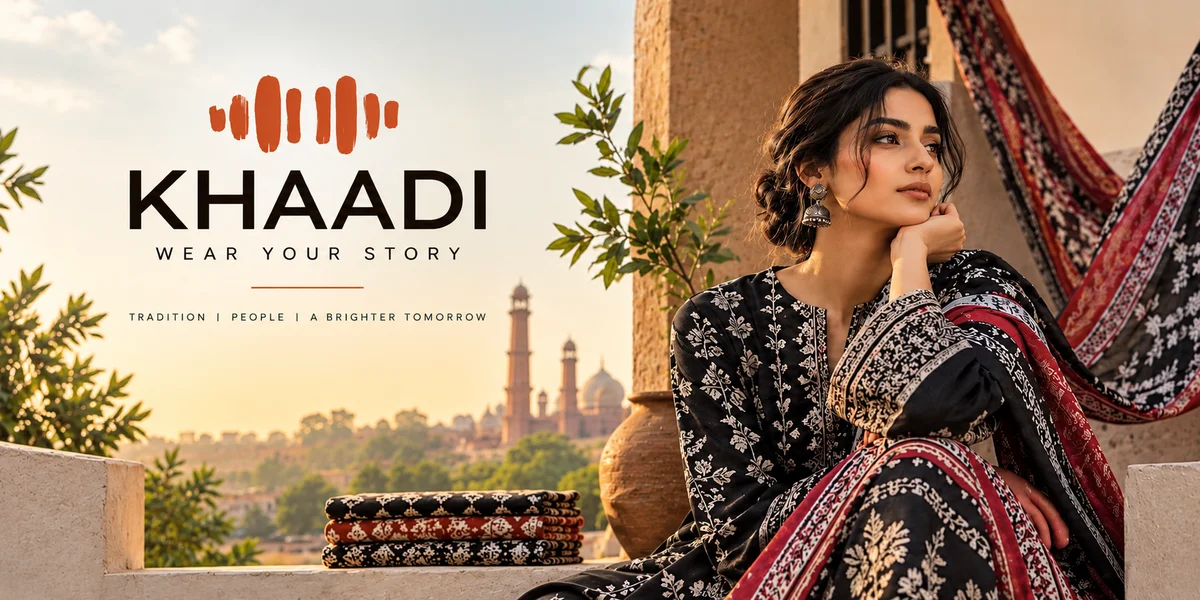
Khaadi: The Story Behind Pakistan’s Most Recognisable Clothing Brand
The last time I went to Khaadi for one shirt, I came out with three.
Not even nice ones necessarily. Two prints that, if I’m honest with myself, were the same print in different colourways, and a plain kurta I bought because I felt guilty about the first two.
This happens to everybody. There is always another rack. And the lighting in those stores does something to colour that I have never fully forgiven, because a teal that looks incredible under those lights becomes a slightly sad blue-green the moment you get it home and hold it up near a window.
Anyway. That’s the shopping experience. The brand itself has a longer history than most people realise, and it doesn’t start with lawn campaigns or billboards on Shahrah-e-Faisal. It starts with a small shop in Karachi, and cloth.
Khaadi Pakistan today sells stitched clothing, unstitched fabric, accessories, home goods, fragrances. Stores across the country and a few abroad. But in 1998 it was one guy and a fabric idea.
So What Is Khaadi, Exactly?
A Pakistani fashion and lifestyle brand, founded by Shamoon Sultan in 1998, first store in Zamzama, Karachi.
For a while, fabric was the entire business. That was it. No stitched section, no accessories wall, nothing to browse except cloth.
The name is the giveaway. Khaadi refers to handwoven cloth, the kind made on a handloom, and Sultan built the whole thing around it. What he did differently, and this is the bit that actually mattered, was refuse to treat handloom as a museum piece. Traditional textile usually gets sold to you with a heritage speech attached. He put it into clothes people would wear on an ordinary Wednesday.
Everything the brand became later grew out of that one decision.
Khaadi History: Starting From One Shop
1998, Karachi. By today’s standards the launch was almost nothing.
No retail chain. No website, obviously. No twelve categories. One store in Zamzama built around fabric, run by a man who’d become seriously interested in handloom weaving and decided to do something about it.
Small was useful, though. You walked in and understood the brand in about half a minute, because there was only one thing to understand. The cloth did the talking. No brand story needed on a wall somewhere.
Which gave Khaadi something a lot of newer labels never quite get: an actual material identity. A reason to exist that isn’t a logo and a lookbook.
Then Came the Clothes (2002)
Women’s ready-to-wear launched in 2002 and it changed the shape of the company completely.
Before that you bought fabric and the rest was your problem. Find a darzi, explain what you want, come back twice for fittings, get told it’ll be ready Thursday, collect it the following Tuesday. We all know the routine. After 2002 you could just buy the finished shirt and go home.
For Khaadi it meant becoming a fashion retailer instead of a fabric shop.
And the timing was right, because Pakistani shoppers buy both. Stitched for convenience, unstitched when they want it their way, frequently in the same month. Now the brand could catch you either way instead of losing half its customers to whoever sold what it didn’t.
How Khaadi Clothing Became the Main Event
Ask most people what Khaadi sells and they’ll say clothes. The fabric story is still underneath everything but the printed shirt is what lives in people’s heads.
The range widened over the years. Everyday pieces, heavier festive stuff, all of it. What kept it recognisable was colour. Khaadi prints have this habit of being much louder than they should be and somehow getting away with it. Some collections are quiet. Others are aggressively not.
That spread is the reason one brand covers a student picking up a plain kurta for university, someone looking for something that won’t get comments at the office, and a family doing their Eid shopping in the last ten days of Ramzan when every shop in the city has turned into a battlefield. Three very different customers. One label.
Khaadi Khaas
In 2008 the company launched Khaadi Khaas, which pushed into premium and festive.
Two things came out of that. It picked up customers who wanted more than an everyday shirt, and it made clear the brand wasn’t going to sit inside its original handwoven-fabric definition forever. The identity was stretching. It just didn’t snap.
Khaadi Fabrics and the Unstitched Habit
Plenty of people still don’t want ready-made clothes and that isn’t changing any time soon. Unstitched is a genuinely big part of how Pakistan dresses, especially if you’ve got a tailor who actually understands what you want.
Khaadi widened its fabrics range in 2012.
The appeal is control. Instead of accepting whatever shirt the brand decided to make, you decide. Length. Sleeves. Neckline. Whether the dupatta gets used as a dupatta or gets quietly repurposed into something else. Your darzi becomes part of the design and the thing you end up with is not on anybody else.
You’re not buying an outfit. You’re buying the starting point for one.
(The catch, and every woman in Pakistan already knows this: after the 20th of Ramzan your tailor stops picking up the phone. Buy unstitched early or don’t buy it at all.)
Home, Bags, Perfume
Khaadi Home launched in 2013. Accessories in 2016. Fragrances in 2019.
Which quietly changed what a Khaadi trip means. You might be going in for a bag. Or cushion covers. Or a wedding gift for a cousin you don’t know well enough to buy clothes for.
Every fashion retailer does this eventually. The difference here is the textile background gave the lifestyle range something to hang off, so it didn’t feel random.
Khaadi Online Shopping
The online store went live in 2014.
For anyone not living near a flagship, this was the whole game. Smaller cities. And the huge number of Pakistanis abroad who can’t exactly drive down to Dolmen on a Sunday.
But online is not the same and pretending otherwise is silly. You can’t feel the weight of the fabric. You can’t hold it against yourself. You can’t check what a colour does in daylight, which is the thing that catches people out constantly.
So the unglamorous details carry all the weight online: honest photographs, colour that matches reality, real measurements instead of S/M/L, and a returns process that doesn’t require three emails.
Going Abroad
The first store outside Pakistan opened in the UAE in 2010. The UK came later. In 2024 Khaadi opened its first store in the United States.
That’s a long way from one shop in Zamzama.
International is harder than it looks, though. Sizing expectations shift. So do price comparisons, styling habits, and what people assume about fit and fabric. A Pakistani customer reads a print instantly. She knows the season it belongs to, roughly what it should cost, and how she’d wear it. Someone seeing the brand for the first time in Manchester has none of that and is comparing it, fairly or not, to whatever else is on that high street.
Staying yourself while making sense to that second customer is genuinely difficult. Plenty of Pakistani brands have tried it and not managed.
Why Khaadi Is So Popular Here
No single reason, which is normally how it goes with brands people actually like.
Some of it is visual. The prints are identifiable from across a room and that’s worth more in fashion than most people admit. Some of it is coverage: stitched and unstitched, everyday and formal, physical stores and online, so the brand fits into more situations than its competitors do.
And a lot of it is just time. Twenty-something years is long enough to become part of people’s lives in a way you can’t buy. Your mother has a Khaadi print she has been refusing to give away since roughly 2015. You probably remember the first thing you bought there with your own money. Somebody in your family has definitely told you to go check the new collection.
That isn’t advertising. That’s just years of showing up.
What Actually Makes It Different
It kept its roots without getting trapped in them, which sounds like a line from a brand deck but is more or less accurate.
Khaadi didn’t preserve handloom exactly as it found it. Colours changed, patterns changed, cuts changed, store formats changed, whole categories appeared that didn’t exist before. The connection to cloth stayed underneath all of it, like a spine.
The result is a brand that reads modern without pretending it isn’t Pakistani. That’s rarer than it should be.
Buying Khaadi for Everyday Wear
Versatility is quietly the strongest thing about the clothing. The same printed shirt goes to class, to a friend’s lunch, and to a relaxed office, depending entirely on what you put with it.
The trick is picking the right piece, not the prettiest one.
Actually, let me push that further, because I think most people get this backwards. The dramatic statement outfit gets attention once. Maybe twice, if you’re at two events. Then it lives in the cupboard being lovely. Meanwhile a well-cut plain shirt becomes the thing you reach for every second week for three years running. Only one of those was worth the money and it wasn’t the exciting one.
Four Checks Before You Pay
Don’t walk in asking what’s nicest in the store. That question has never once saved anybody money.
Fabric first.
Match it to when you’ll actually wear it. Something beautiful in December is unwearable in a Karachi June and no amount of loving the print will fix that in the moment.
Then the fit.
Your usual size does not behave the same across every cut. Look for garment measurements, especially online, and take them seriously.
Then frequency.
Once? Three times? Twenty? Answer honestly rather than optimistically. It changes what the piece is worth.
Then styling.
Picture three separate outfits built around it before you pay. If three comes easily, buy it. If you’re stuck after one, put it back on the rack.
Quick Checklist
Before you commit:
- Do you like the fabric or just the print? Not the same question.
- Right season?
- Does the cut work on you, or only on the mannequin?
- Do you already own something suspiciously similar (be honest)
- Can you dress it up and down?
- More than two wears, realistically?
- Sensible for your budget this month specifically?
- Have you checked the care instructions?
Last one gets skipped constantly. Don’t. A gorgeous outfit that needs dry cleaning you will never actually get around to is an outfit that lives permanently in your almari.
Stitched or Unstitched?
Depends less on the clothes and more on what kind of shopper you are.
Go stitched if you want it sorted today, you can’t be bothered with tailoring, or the design is already exactly what you’d have asked for.
Go unstitched if you like customising, you’ve got a darzi who understands you, or you’re particular about length and cut.
Neither one wins. Stitched buys time, unstitched buys control, pick whichever you’re currently short of.
Styling: Less Is Usually More
Khaadi designs arrive with a lot going on already, so restraint gets you further than addition.
Busy print on top? Keep the bottom plain. Four colours in the outfit already? Let the jewellery stay quiet. It’s the plain outfits that can carry a heavy statement earring or a properly printed dupatta, because there’s actually space for it.
One thing to remember: one loud piece, everything else supporting. When every part of an outfit is competing you end up with noise.
Is Khaadi Expensive?
Depends what you’re picking up, honestly. The brand runs across several price levels and categories, so calling all of it cheap or expensive tells you nothing useful. Judge the specific thing in your hand.
Cost per wear is the more useful number:
price ÷ number of wears
Buy a shirt at Rs. 5,000. Wear it twice, it cost you Rs. 2,500 a wear. Wear it twenty times, Rs. 250.
Same shirt. Completely different answer. This is why the pricier piece that turns into a favourite is often better value than the bargain you wore once to a mehndi and never again.
Eid Shopping
Come Ramzan, Khaadi is on almost everyone’s list, and festive shopping runs on different rules.
People want something more than their usual clothes. Deeper colours, more work on it, richer fabric. Fine. The mistake is buying the most elaborate thing available for every single event of the week, which is how people spend a fortune and still have nothing to wear in July.
One strong outfit plus simpler pieces around it stretches much further and you’ll actually keep wearing the simpler pieces afterwards.
Also, and this genuinely needs saying more often: repeating an outfit is allowed. Nobody is coming for you.
The Stores Themselves
Physical retail still matters to this brand. Khaadi has moved into experience-led formats, including its Experience Stores, built around design and art and culture rather than just rails and shelves.
Which reflects where clothing retail has gone in general. A store isn’t a stockroom with better lighting anymore. Lighting decides how a colour reads. Displays decide what you see in the first ten seconds. Layout decides how long you stay. Even the gap between racks changes whether a place feels premium or like a sale.
If you’ve ever left a shop holding something you had no intention of buying, that wasn’t an accident. Somebody designed it.
The Business Lesson Hiding In All This
Here’s the part that’s interesting even if you don’t care about clothes.
Khaadi expanded enormously and never lost the thread. Clothing came out of textiles. Fabric connected back to clothing. Accessories extended fashion, home extended lifestyle, e-commerce extended reach, international stores took the lot somewhere new.
Now picture the other version, where the company started selling unrelated products in year two because the money looked good. The brand blurs. Nobody can tell you what Khaadi is for anymore.
For anyone running something smaller, the lesson is fairly blunt. Give people one clear reason to remember you. Build outward from that reason. Trying to sell everything to everyone on day one is the fastest way to be memorable to nobody.
Kreate Your Mark
In 2022 Khaadi launched Kreate Your Mark, a non-profit initiative for women entrepreneurs, offering exposure, learning, collaboration and access to space at the experience-led locations.
Worth mentioning because it shifts the relationship slightly. A brand whose customers are overwhelmingly women putting something back into women running businesses. For a fashion company that’s a sensible extension rather than a press release.
Still Relevant?
Yes, and specifically because it didn’t stay the same.
Fashion moves. Customers move. Retail and technology move faster than both. A business built around fabric in 1998 has had to learn stitched clothing, e-commerce, international retail, lifestyle categories, and a customer who now reads reviews on her phone before she gets to the store.
Khaadi didn’t protect its original shape. It protected enough of its identity to stay recognisable and let almost everything else change around it.
Why People Keep Going Back
Sometimes the answer is boring: they know what they’re getting.
Familiar aesthetic, sizing that behaves, previous experiences that went fine, and enough variety that the new collection isn’t just last season in a different colour.
Customers want familiarity and novelty at the same time, which is an unreasonable thing to want. Too much familiarity, brand gets boring. Too much reinvention, brand stops being itself. Khaadi has spent two decades balanced between those two, and the balance is harder than the annual results make it look.
Khaadi Timeline
- 1998 — first store, Zamzama, Karachi
- 2002 — women’s ready-to-wear
- 2008 — Khaadi Khaas
- 2010 — first international store, UAE
- 2012 — fabrics expand into a full category
- 2013 — Khaadi Home
- 2014 — online store
- 2016 — accessories
- 2019 — fragrances
- 2021 — first Experience Store
- 2022 — Kreate Your Mark
- 2024 — first US store
Not bad for something that started with one fabric shop.
FAQs
What is Khaadi? A Pakistani fashion and lifestyle brand founded by Shamoon Sultan in 1998. Started with handwoven textiles, now sells stitched clothing, unstitched fabric, home products, accessories and fragrances.
When was Khaadi founded? 1998. First store was in Zamzama, Karachi.
Who started Khaadi? Shamoon Sultan, who built it around handloom textiles and modern fashion.
What does Khaadi mean? Khaadi refers to cloth, and is tied to traditional handloom weaving.
Is Khaadi available outside Pakistan? Yes. UAE in 2010, the UK later, and the first US store in 2024. The online store also ships to customers outside Pakistan.