


So this happened a few months ago. My gold chain started turning this weird bronze color. Right where it sits against my neck. Not tarnished. Just… off, somehow. I never take that chain off, by the way. Not even in the shower.First thing I thought of was toothpaste. That’s what every “life hack” account on Instagram tells you to use. For basically everything. Good thing I texted a jeweler friend before actually doing it.
Toothpaste is one of the worst things you can rub on gold. Turns out. Nearly wrecked a chain I’ve had for six years. Six years! All because of some fifteen-second reel. Had close to two million likes on it too. I kid you not.
Anyway.
You’ve got gold jewelry that’s lost its shine somewhere, right? A ring. Your grandmother’s bangles. Whatever’s in the back of a drawer. Doesn’t matter what. This covers what actually works for cleaning gold jewelry. It also covers what quietly ruins it, while you’re not paying attention. Not the baking soda volcano thing. Not whatever that reel told you.
Why Gold Gets Dull in the First Place
Gold doesn’t rust. Doesn’t tarnish the way silver does, either. So why’s it get grimy and dull after a while?Mostly it’s just life, honestly. Lotion, perfume, sweat, hand sanitizer. Soap residue that never quite rinses off. Builds up in the tiny crevices of a ring. Or between the links of a chain. Everyone uses way more hand sanitizer now than they did five years ago too. Doesn’t help. Cook with turmeric even semi-regularly? You already know what I mean. That stuff stains everything it touches. Rings included. Doesn’t come off easy either.
Gym rats, take note. Rings on while lifting does something similar. Chalk. Metal-on-metal contact. Wearing at the surface bit by bit. Small stuff. Adds up though.
Pure gold is basically never worn by itself, by the way. Gets alloyed with other metals. Copper or silver usually. Makes it sturdy enough for daily wear. That alloy reacts a little with the oils and pH your own skin puts out. Some people’s skin does this more than others. Nobody’s ever fully explained why to me. Pull a ring off after a hot day. Sometimes there’s a faint dark smudge underneath. That’s not the gold failing you. Just skin oil and metal doing their thing.Hard water plays a small role too. Mineral-heavy tap water leaves a chalky film after you rinse. Makes jewelry look duller than it actually is.
The Easy Way to Clean Gold Jewelry at Home
Okay, the actual method. Most solid gold cleans up fine with stuff already under your sink. Jewelers will tell you the same thing, more or less. Covers maybe 90% of what’s in your jewelry box right now.
Steps, roughly:
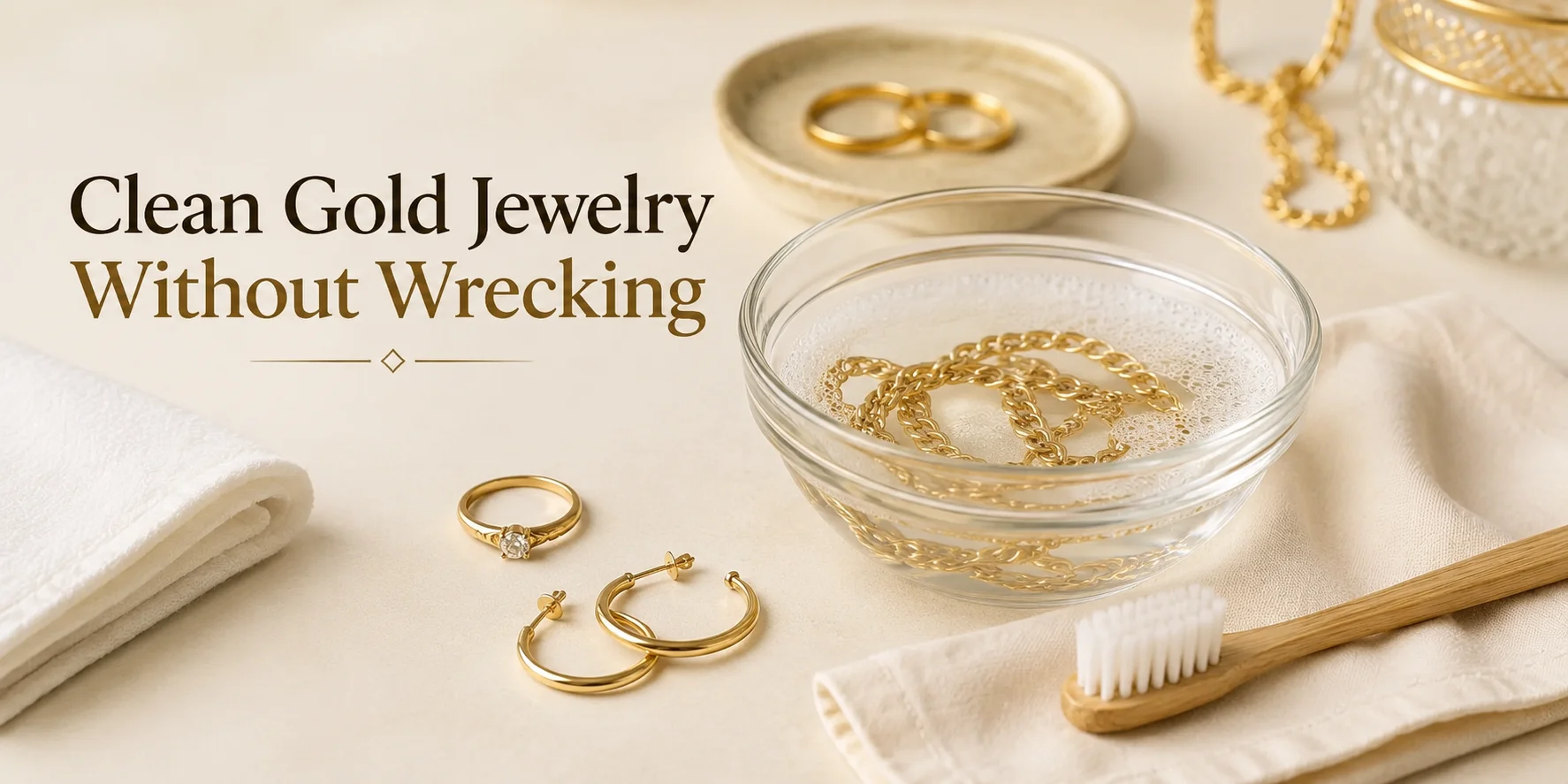
- Warm water in a small bowl. Not hot. No real need for it. Heat can mess with certain glued-in stones.
- A few drops of mild, unscented dish soap. Skip the ones with added moisturizer or degreaser. Not doing you any favors here.
- Drop the piece in. Let it sit 15, 20 minutes.
- Soft-bristled brush. An old toothbrush is perfect, honestly. Gently work into the crevices, settings, chain links. Wherever grime hides.
- Rinse under running water. Plug the drain first, or do it over a bowl. Someone I know lost an earring straight down a sink doing this exact thing. Don’t be that person.
- Pat it dry with something soft and lint-free. Microfiber, old cotton shirt, whatever. Just not paper towel. Leaves these tiny scratches over time you won’t notice till later.
Hard water at home? Splash of filtered or bottled water at the end. Stops that cloudy film from setting in. Do this whole thing over a towel too, not bare counter. A wet gold ring skittering toward the edge of a counter is its own special kind of panic.
That’s the whole thing, really. Six steps. Nothing that requires a special trip anywhere except maybe the brush, and even then you’ve probably got an old one lying around. A polishing cloth after gets you extra shine in under a minute. If that’s what you’re after. Couple bucks near any jewelry counter.
Bigger grime problem, one soap alone won’t budge? Ammonia, diluted. One part to six parts water, somewhere with airflow. Quick dip, a minute or two, then rinse well. It’s a lot stronger than soap. Don’t lean on it every week. Once in a while, tops.
The “Hacks” That Quietly Wreck It
This is the part everyone skips. Honestly the half that actually matters more.
Toothpaste, first and worst. Most brands have mild abrasives in them. Great for tooth enamel. Way too much for a metal as soft as gold. A few rounds of that and you’ll start seeing tiny scratches that just don’t go away. Ever. Worse if you’re dealing with 21k or 22k gold too. That’s most South Asian jewelry, if you’re wondering. Higher karat means less alloy mixed in. Less alloy means softer metal. Softer metal scratches if you so much as breathe on it wrong. Not exaggerating by much.
Baking soda’s the same story people tell for silver. Works great there, actually. Gold, not so much. Scrubbing hard enough for the paste to actually work? You’re already scratching the surface. Vinegar and lemon juice come up a lot too. “Natural” acids and all that. Sure, they’ll technically clean plain gold with no stones. But the acid’s harsh enough to mess with certain gemstones. Can damage a pearl faster than you’d think too. Like, sandwich-making speed. Soap and water does the exact same job without any of the risk. I genuinely don’t get the appeal.
Coca-Cola gets brought up sometimes too. Something about the acid cutting through grime. Might do something for a grimy old penny, sure. No reason to dunk actual jewelry in sticky soda though. Not when soap does the same job without leaving your ring smelling like a vending machine.
Chlorine’s the one that actually worries me most. This isn’t just a shine problem. It reacts with the metals alloyed into the gold. Can weaken the whole structure over time. Especially right at the solder joint. That’s just the spot where the ring band got joined in the first place. Jewelers see rings that have snapped clean through at that exact point. Years of pool time or hot tubs will do that. So take the ring off before you swim. Every single time. Not just the times you remember to.
Ultrasonic cleaners are great, meanwhile. But only for plain solid gold with nothing set into it. Pearl, opal, emerald, anything glued on? That vibration alone can crack it, loosen it, or knock it clean out. I’ve heard of stones just popping out mid-clean before. Not fun to explain to whoever the ring belongs to.
Oh, and if your piece has that brushed, matte look that’s everywhere right now? Don’t polish it. You’ll wear the finish down unevenly. Ends up looking patchy instead of clean. Soft cloth wipe only on that stuff. No polishing cloth, ever.
Store-bought wipes and dip solutions are usually fine too. Just actually read the label first. Some carry solvents too harsh for plated jewelry or anything with a pearl. Rarely printed anywhere obvious on the box either.
My grandfather swore by rubbing gold with a splash of flat beer, if you can believe it. No idea where that came from. None whatsoever. Won’t hurt solid gold with no stones though. So if that’s a family thing in your house too, keep at it. Just doesn’t do anything soap and water isn’t already handling better.
Solid Gold or Plated? It Changes Everything
Quick gut check before you clean anything. Is this even solid gold? A lot of gold-colored jewelry isn’t, actually. Worth knowing which one you’ve got. Look for a stamp somewhere on the piece. Usually inside the band, or near the clasp. Something like 14k, 18k, 21k, 22k. Says GP or GF or “gold plated” instead? Different animal entirely. Thin gold layer over a base metal. Changes basically everything about how you should treat it.
No stamp at all, and you need a quick answer? Try a magnet. Gold and its usual alloys don’t stick to magnets. So if something clings hard to one, it’s probably not solid gold. Not foolproof. Some fakes use non-magnetic metal too. But it catches the obvious ones fast enough.
Plated stuff wants a much gentler hand across the board. No soaking, ever. A soft, barely-damp cloth wipe does the job. Push it too hard, or too often. That thin gold layer wears through faster than you’d expect. Then you’re left with whatever’s underneath showing in patches. Usually some dull gray or coppery color. Honestly looks worse than the tarnish did. Vermeil’s a step up. Sterling silver with a noticeably thicker gold coat. Still not solid gold though. Don’t treat it like it is.
Cheap and plated? I’ll be honest, I don’t really bother deep-cleaning it much. Wipe it, keep it dry, wear it out before it fades on its own. Some things aren’t meant to last forever. That’s fine, really.
What About White Gold and Rose Gold?
White gold’s worth its own mention. Gold on its own is yellow. Always has been. To get that bright white look, jewelers alloy it with metals like palladium or nickel. Then coat the whole piece in a thin layer of rhodium. That rhodium is what actually gives white gold its shine. Not the gold underneath. And it wears off eventually. Usually somewhere between one and two years, depending on how much you wear the thing. Could be longer if it barely leaves the box. Could be a lot sooner if you’re rough on your hands. Once it wears through, you’ll notice a warmer, slightly yellow tint creeping in from underneath. That’s not tarnish. No amount of soap fixes it. Just means the piece needs re-plating. That’s strictly a jeweler job, not something you handle at home.
Until then, the same soap-and-water method works fine. Just skip the diluted ammonia trick from earlier. Ammonia’s a bit harder on that thin rhodium coating than it is on plain yellow gold. No reason to wear through it faster than you have to. Re-plating itself isn’t too expensive either. Somewhere in the range of a decent pair of shoes, usually. Most jewelers turn it around in a day or two. Rings worn daily, engagement rings especially, often need it about once a year. Something you wear occasionally could go three or four years before anyone but you would even notice.
Rose gold’s got more copper mixed into the alloy than yellow gold does. That’s what gives it the pinkish color. Cleaning-wise, nothing changes. Same rules apply. But copper reacting with skin sometimes leaves a faint green or dark smudge on your finger. Especially in humid weather. Or if you sweat a lot. Happened to me with a rose gold ring once. Panicked a little, honestly. Thought something was wrong with it. It’s not. Just copper doing what copper does. Wash it off. Totally harmless.
Stones and Pearls Play by Different Rules
Pearls, never soak. Full stop, no exceptions. They’re organic, porous little things. Water weakens whatever they’re strung on. Can dull the surface too, with enough exposure. Same deal with opal, turquoise, coral. Soft, delicate stones that just want a wipe with a cloth. Nothing more. Opals especially hate sudden temperature swings and dry heat too, not only water. So don’t leave them baking in a sunny window for hours either.
Harder stones, diamond, sapphire, ruby, usually take the soap-and-water thing fine. As long as the setting’s actually solid. Wiggle it gently with a fingernail first. Feels loose at all? Skip the home method. Straight to a jeweler.
Older and Inherited Pieces Need Even More Care
Different rules again for anything older. A wedding set that’s been in the family a while. Or kundan and polki-style stones, which show up constantly in South Asian bridal jewelry. Here, water’s the actual enemy. Those stones sit on a foil backing, this thin reflective layer that gives them their particular sparkle. Water gets trapped behind it sometimes. The cloudiness that follows almost never comes back out. Professional cleaning won’t fix that after the fact either. So why risk it?
Dry only, for pieces like that. Soft dry brush for dust. Soft cloth to wipe. Done. Needs more than that? Find a jeweler who actually specializes in kundan or antique work, not just whoever’s closest. The whole restoration process is different from regular gold cleaning.
When to Just Call a Professional
A friend of mine, I’ll call her Amina, not her real name. She took her engagement ring in for what she figured was a quick clean. The jeweler quoted her something like 1,500 rupees. Might’ve been a bit more actually. Just to buff out scratches that turned out to be months of toothpaste damage. She hadn’t even realized she was doing it that often. That’s kind of the problem with small habits like that. They pile up quietly. You only really notice once someone else points it out.
Worth seeing a professional if:
- A stone feels loose, or there’s a faint rattle when you shake the piece
- It’s an antique, or actually means something to you, sentimentally or otherwise
- Home cleaning didn’t touch the dark buildup stuck in tight settings
- The metal itself looks bent, thin, or worn through somewhere
Jewelers have steam cleaners and tools that get into places a toothbrush just can’t. Most will check the prongs under a loupe for free while you’re there too. Might as well ask. Takes thirty seconds. Catches problems way before a stone actually falls out and vanishes into a couch somewhere. For anything genuinely valuable, a professional clean is worth it. Usually doesn’t cost much, maybe the price of a decent meal out. Worth not gambling on it yourself.
How Often You Should Actually Clean Gold Jewelry
Stuff you wear daily, rings, a chain that never comes off, does well with that soap soak roughly every couple weeks. Occasional pieces just need a clean before and after they’re worn. Then back into storage till next time.
Climate plays into this more than people think, too. Somewhere hot and humid, sweat speeds up how fast grime builds. That every-couple-weeks routine might actually need to turn into weekly through the middle of summer. What you do with your hands all day matters as well. Someone doing manual work, gardening, cooking, cleaning, sees buildup a lot faster than someone sitting at a desk all day does. No single right answer here. Just pay attention to how your own jewelry looks and adjust from there.
And on storage. Don’t just dump gold loose into a drawer with everything else. It’s soft enough to scratch itself, or get scratched by whatever’s next to it. A soft pouch, or a box with actual separate compartments, does more for keeping things looking good over the years than any cleaning method ever will. Humid climate? Toss a silica packet in there too, the free kind that comes in shoeboxes. Keeps tarnish and moisture down. Pieces that just sit unworn for years tarnish differently too, by the way. Less from skin oils. More from the air itself reacting slowly with the alloy. A gentle wipe before wearing something you haven’t touched in ages isn’t a bad habit to pick up.
Chain’s fine now, by the way. Fifteen minutes in soapy water, soft cloth, nothing dramatic. Turns out most of those flashy internet hacks are just noise. Soap and a little patience gets you further than people ever give it credit for.