

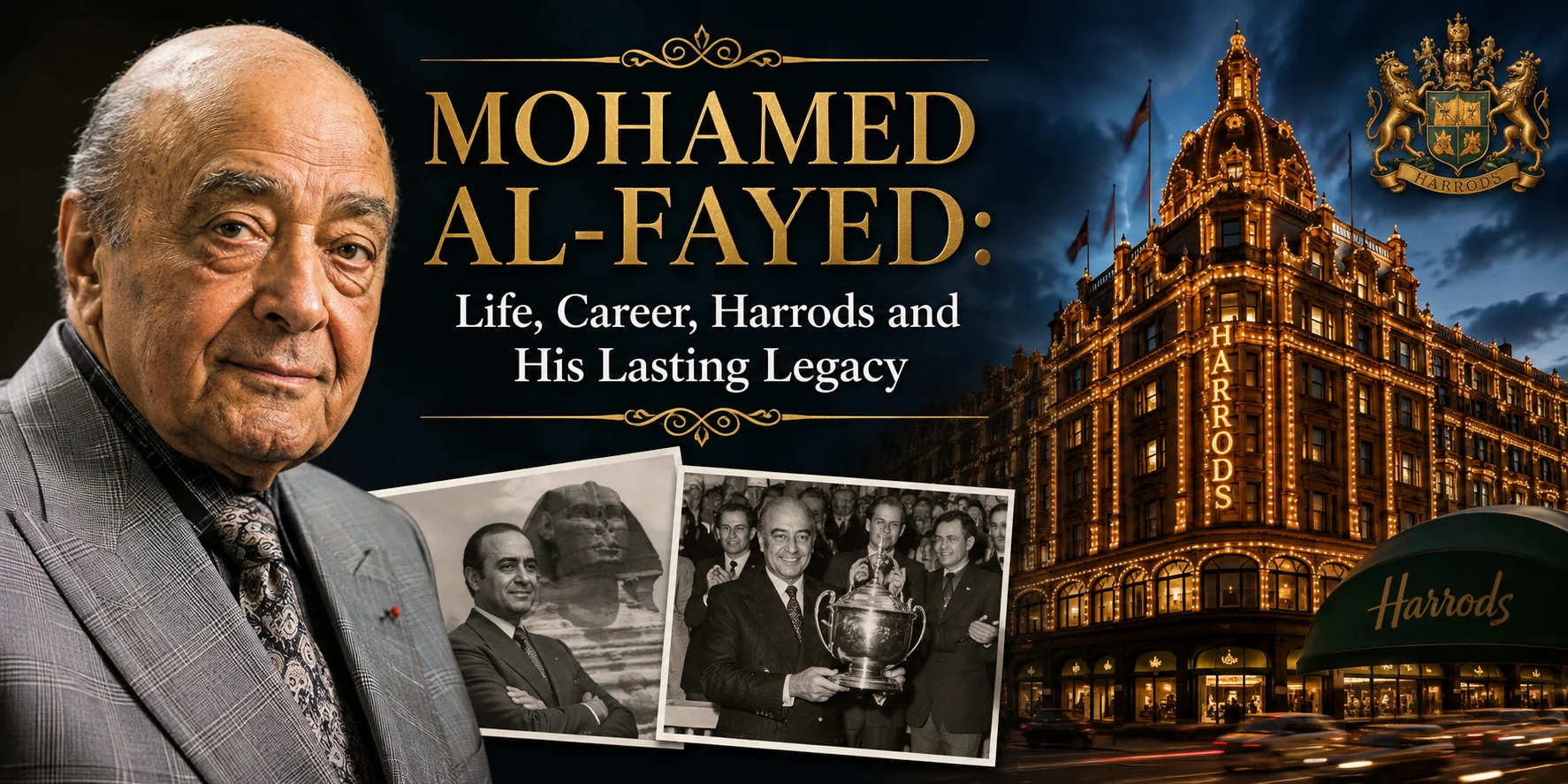
January 2018 and Harrods is moving furniture around on the lower ground floor. A bronze statue comes off its plinth Diana and Dodi dancing under a bird’s wings and gets loaded into a van headed to Surrey. The man who commissioned it eight years before, who’d promised it would stand there forever, isn’t even in the country anymore. He’d sold the place in 2010 to Qatar’s money. So in 2018 what you’re looking at is really just a landlord clearing out a dead man’s personal effects from the building. Which is blunt, but that’s what it was. That image holds the whole thing, really. A man who walked into the most Establishment building in London and put his grief in the middle of it, in glass and bronze, and a corporation that eventually decided his ghosts were bad for business.
Anyway, here’s who he was.
Who Was Mohamed Al-Fayed?
Start with the facts and then the actual story, because they’re not quite the same thing.
Born in Alexandria in January 1929. Died in London on 30 August 2023, aged 94. Spent most of his adult life in Britain from the 1970s onwards despite the country refusing to have him as an official citizen, which he brought up constantly and which genuinely ate at him.
So why does any of this matter? Twenty-five years. 1985 to 2010. He had Harrods for a quarter of a century. Bought the Ritz in Paris in 1979 and then just… held it. Never sold it, not even when things got bad, not even when the building had become so toxic to his name that the royals wouldn’t go near it. Fulham FC belonged to him from 1997 until 2013. Forbes had him at about $2 billion at the end, which is either accurate or a wild guess depending on how private money was moving around those figures don’t actually mean much with people like this.
His son Dodi died with Diana in a car crash in Paris on 31 August 1997. That was the hinge point everything after that, for twenty-six years, came out of that one night. And then, separately, or maybe not separately at all, more than 150 people ended up at the police with allegations of sexual misconduct against him by the time he died in 2023. He died in August 2023 without ever being charged. He denied the accusations his entire life. So none of it could be tested in court, and now it never will be. You need to know that going in.
Mohamed Al-Fayed Early Life in Egypt
Rushdy, Alexandria. His father was a primary school teacher. That’s it no cotton fortune, no shipping dynasty, no family firm waiting for him to step into.Which matters because for about three decades he told a very different story about where he came from, and Britain believed him, or at least believed him enough. His first businesses were small. Fizzy drinks. Then sewing machines, door to door, in a city where plenty of families still made their own clothes and a Singer was a serious household purchase. He had five siblings; two of them, Ali and Salah, would end up standing with him when he bought Harrods.
Even his birth year is loose. He’d claim 1933 sometimes. British officials went through the paperwork in the 1980s and came back with 27 January 1929. Four years, just gone. Nothing on its own, but then you see it happen over and over with him and it stops being nothing.Sometime in the early seventies he started calling himself “Al-Fayed” instead of plain Fayed, and his critics had an absolute field day with that because the “Al” implies an aristocratic pedigree the family didn’t have. His critics loved it. He’d hear about it constantly and just shrug it off.
How Mohamed Al-Fayed Built His Business Career
Everything turns on one marriage that fell apart.
In 1954 he married Samira Khashoggi. Her brother was Adnan Khashoggi, who would become one of the most famous arms dealers alive we’re talking about a man whose name came up in every scandal in the Middle East and beyond. The marriage lasted about two years, but Dodi was born in 1955, and professionally it lasted much longer because Al-Fayed went to work for his ex-brother-in-law, starting in a furniture export business in Saudi Arabia.
After that, shipping. He and his brothers built a shipping business in Egypt and moved the head office to Genoa, kept a London office on the side. The sixties were genuinely odd for him. Around 1964 he was circling François Duvalier in Haiti with a scheme for an oil refinery it went nowhere. Then he shows up as an adviser to the Sultan of Brunei. Then advising Sheikh Rashid in Dubai right as the place began pouring money into ports, roads and hotels at a scale it had never seen before, and he picked up a large stake in the British contractor Costain, so he’s advising on a construction boom while holding an interest in who gets hired to build things.By 1979 he had enough to buy the Ritz in Paris. Trophy asset, base in the city he loved most, and though nobody could’ve known it the hotel where his son would have his last dinner.
Now: does all of that account for the money he produced in 1985 when he bought Harrods? British government inspectors spent years on that exact question. And before anyone says that’s easy with hindsight: it’s roughly what they did in the late eighties, working from the paperwork rather than the version of himself Al-Fayed was selling.
Five questions worth asking about any rags-to-riches story
This is the bit of his early career you can actually use. Next time you read a self-made-billionaire profile, run it through these:
- Where did the first real block of capital come from? Not the vibe, the number.
- Who made the introductions, and what did they get back?
- Write the years out in a column. Does the sequence hold?
- Has any regulator, court, auditor or inquiry ever looked at the origin story?
- Which claims rest on nobody but the man himself?
Put Al-Fayed against those five questions and he fails one, four, and five. Hard.
Mohamed Al-Fayed and His Rise in the Middle East
The Gulf is where the money and the address book stopped being two separate things. Advising the ruler of a city being drawn from nothing put him near decisions worth sums that are hard to picture, and he collected relationships there the way other men collect property. Charming when charm worked, openly rude when it didn’t.
So by the early eighties he had the Ritz, real cash flow, two brothers operating as one unit with him, and an appetite for something in Britain that would make people take him seriously. Harrods came up for sale.
How Al-Fayed Became the Owner of Harrods
This is the chapter that fixed, in the minds of Britain, exactly who he was. And it’s a mess.
Harrods was inside House of Fraser. Roland “Tiny” Rowland ran the conglomerate Lonrho, wanted Harrods badly, got blocked by a competition referral, so in November 1984 he parked his stake of about 30% with the Fayed brothers. He thought he was lending it to a friendly party.
By March 1985 they’d bought the remaining 70% for £615 million in cash. Harrods was theirs. Rowland went to war. For years he argued that the Fayed had misrepresented who they were and where the money came from, and he pushed until the Department of Trade and Industry opened a formal inquiry.
The inspectors reported in March 1990 and it’s brutal. They found the family had presented itself as heir to an old, wealthy Egyptian cotton and shipping house when Mohamed was in fact the firstborn son of an Alexandrian schoolteacher, and they pressed hard on whether family money could’ve funded a £615 million cash bid. The report’s closing line is still quoted: that the lies had been told so successfully, for so long, that they’d set into accepted fact.
And then nothing happened. Prosecutors concluded there was no case to bring. He kept the store for another twenty years. He floated House of Fraser in 1994 and held Harrods privately, which tells you what the place was to him. Not an asset. The whole point of everything. In 2000 the store lost its royal warrants, in the sour years after Diana and Dodi died and after what he started saying about the royal family. Ten years later, in May 2010, he sold Harrods to Qatar Holding for a reported £1.5 billion.
Mohamed Al-Fayed’s Other Major Business Interests
Harrods takes all the attention, but there was more than that:
- Hôtel Ritz Paris. Bought in 1979, held until he died, and he spent heavily on restoration for decades.
- Fulham FC, 1997 to 2013. More on that below, because it earns its own section.
- Punch. He relaunched the old satirical magazine in 1996. The magazine lost money steadily and he pulled the plug in 2002.
- Turnbull & Asser, the Jermyn Street shirtmaker.
- Balnagown Castle, and the Highland estate wrapped around it. Going by the way he talked about the place, I think he loved it more than anything he owned in London.
- Harrods Estates, plus a scatter of aviation and retail interests underneath all of it.
The Fulham years, which nobody writes about properly
This is my favorite part of the story and it gets about two lines in most obituaries.He buys Fulham for £6.25 million. Six and a quarter, for a third-tier club with modest crowds and a ground by the Thames that had seen better decades. He announced they’d be in the Premier League within five years, which sounded like the usual noise from a new rich owner.
Promoted in 2001. Four years, a season to spare. That’s not nothing.Sixteen seasons, roughly £200 million of his own money going in, and then in 2013 he converted the loans into equity, which wiped out the club’s debt at a stroke. They held a top-flight place for over a decade and reached a European final in 2010, which for Fulham is somewhere near science fiction. Shahid Khan bought them that July. The fee was never confirmed; press reports said between £150 million and £200 million.
So: in at £6m, spent £200m, out below what he’d spent. As an investment, a loss. As an owner? Ask a Fulham fan over thirty-five and a lot of them will still tell you he was the best they’ve had, and looking at where the club started and where he left it, they’re right.
And then he ruined it slightly by installing a statue. In 2011 a large bronze Michael Jackson appeared outside Craven Cottage. Jackson had been a friend and had attended exactly one game there, in 1999. Supporters mocked it without mercy, he told them that if they didn’t appreciate the gift they could go to hell, and the new owner had it taken away in 2013. It went to the National Football Museum and then into storage.Bad statue. Very him.
Al-Fayed, Dodi Fayed and Princess Diana
Dodi Fayed was born in 1955, his only child with Samira. He grew up between three continents. He grew up between Egypt, Europe and Britain, worked as a film producer, and has a credit on Chariots of Fire.
By the summer of 1997 he and Diana were together, partly aboard his father’s yacht in the Mediterranean, and the paparazzi lost every shred of proportion about it. On the night of 30 August they were in Paris at the Ritz, his father’s hotel. Just after midnight the Mercedes taking them away crashed in the Pont de l’Alma tunnel with photographers in pursuit. Both of them died. So did the driver, Henri Paul, who was on the Ritz payroll and who turned out to have been well over the drink-drive limit that night.
One version of Mohamed Al-Fayed’s life ended that night.What replaced it was a campaign that never stopped. He would not accept the crash as an accident, and he said publicly that his son and Diana had been killed on the orders of the royal family, naming the Duke of Edinburgh, with the security services carrying it out. He put his own investigators on it, and in 2011 he paid for a film, Unlawful Killing, which never got a UK release on legal advice.
Two serious investigations went through the claims. Operation Paget, the Met inquiry under Lord Stevens, reported in 2006 and found nothing to support him. The 2008 inquest jury returned a verdict of unlawful killing, blaming the grossly negligent driving of Henri Paul together with the vehicles chasing the car.
Twenty-six years, and he never moved. Not once.Grief, or something he needed to be true because the alternative pointed at his hotel, his employee, his car? I think both, and I don’t have much patience for readings that make it purely cynical. Grief isn’t required to be logical to be real.The memorials inside Harrods came out of that same refusal to let it go, which is where this piece opened.
Why Mohamed Al-Fayed Remained a Controversial Figure
Set the abuse allegations aside for a moment and he was still, easily, the most divisive rich man the country had.
The citizenship refusals sat at the center of it. Turned down in 1994, turned down again in 1999, with the DTI report’s findings on his character sitting in the file. Decades of residence, the most famous shop in the country in his hands, no passport. He treated it as a personal insult and made sure everyone knew France had given him the Legion of Honor.
Then cash for questions. In 1994 he revealed he’d been paying MPs to table parliamentary questions for him. Tim Smith resigned. Neil Hamilton fought, sued for libel, and lost in 1999. The scandal fed into a new framework for standards in public life, and his stated motive was simple: he’d paid, he’d felt used, then he’d been dropped.
Beyond that, the conduct. Feuds, briefings against enemies, surveillance of staff, litigation, tax threats about leaving the country, an office culture former employees now describe in terms that are hard to read. He ran his companies like a court. He could also be generous, funny in an interview, loyal to anyone loyal to him, and properly beloved at Craven Cottage. All true at once.
The Allegations and Investigations Surrounding Al-Fayed
I’m holding this section to what’s on the record, and the record is grim enough without any help from me.
Allegations of sexual misconduct followed him for years while he was alive. And here’s the part that matters: the Met’s own numbers show you how long we’re talking about. 21 women went to police between 2005 and 2023. In 2008 detectives questioned him over the alleged abuse of a 15-year-old. Files reached the Crown Prosecution Service twice once in 2008, again in 2015 — and then prosecutors were asked for early advice three more times after that. But nothing was ever charged. He denied it all. He died with none of it tested against him in a courtroom.
19 September 2024. That’s when the BBC broadcast Al Fayed: Predator at Harrods, with its World of Secrets podcast running alongside it. More than twenty women who’d worked for him described sexual assault on camera, and five said he raped them. He’d been dead a year by then, so there was nobody left to say anything back, to deny it, to fight it in any way.
Harrods, Qatari-owned since 2010, went public saying it was appalled. It apologized. It accepted, publicly, that the business had failed its own employees who were his victims. It had actually started settling claims quietly in 2023, before any of this aired. Within weeks of the broadcast the store said more than 250 people were in its claims process, and by 2026 lawyers for survivors were describing something like 400 women, spread across the UK, the US, Japan, Denmark, Malaysia, Canada and Spain.
November 2024 is when the Met opened a second investigation, this one into people who may have facilitated the alleged offending, covering claims running from 1977 to 2014. It remains open, and the force calls it one of its largest and most complex investigations. Seven suspects have been interviewed under caution on suspicion of offences including aiding and abetting rape, assisting the commission of sexual offences, and human trafficking for sexual exploitation. In August 2026 the Met confirmed a file on a man in his 80s had gone to the CPS for a charging decision over two alleged indecent assaults. As of late August 2026 no decision has been announced and nobody has been convicted of anything connected to this.
The Met has also referred itself to the police watchdog over its handling of complaints made in 2008, with the IOPC directing that investigation, and there are separate allegations that officers took bribes. His surviving brother, Ali Fayed, has been accused by three former Harrods employees and unequivocally denies all wrongdoing.
Survivors, backed by an all-party parliamentary group co-chaired by MPs Dave Robertson and Wendy Chamberlain, want a statutory public inquiry and want the trafficking element treated as a network rather than a pile of separate incidents. The Home Office has recognised at least one case as modern slavery.
What Happened After Mohamed Al-Fayed’s Death?
He died on 30 August 2023, a day short of the twenty-sixth anniversary of the crash. Funeral after Friday prayers at the Central Mosque in Regent’s Park, then burial in the grounds of his Surrey home, next to Dodi.
That week’s obituaries were about Harrods, the Ritz, Fulham and Diana, and that version of him held for almost exactly twelve months.
Since the documentary it’s been lawyers and police. Harrods opened a redress scheme on 31 March 2025 with an independent survivor advocate attached, set aside £62.3 million, and offered awards reaching £200,000 or more per person. It closed to new applications on 31 March 2026, around 180 people registered, more than 80 claims settled by then, and anything filed before the cut-off is still being processed.
Not everyone used it. Some went to court instead, several suing his estate rather than the store. And in 2026 Harrods itself asked the High Court to replace that estate’s executors, arguing there are real questions about whether it’s solvent and how slowly claimants are being paid. That hearing is listed for November 2026.
Mohamed Al-Fayed’s Legacy
Two legacies, and they don’t sit together.
The commercial one is real and shouldn’t be waved away. He saved the Ritz. He ran Harrods for twenty-five years and made it somewhere people flew to London to see. He funded a small west London club into the Premier League from his own pocket, restored a Highland estate that was falling apart, and forced a closed establishment to deal with an outsider who refused to behave like one. And the scandal he set off in 1994 changed how Parliament polices itself.
The other legacy is now the first thing most people learn about him. Well over a hundred women have gone to the police. Harrods has apologised and is paying. There’s a parliamentary group named after his survivors.
And the store keeps editing him out. The memorials went in 2018. There were reports in 2025 that the Egyptian escalator itself, that slightly deranged piece of design he commissioned, is being pulled out and modernised.
Odd thing to sit with, if you ever stood at the bottom of it and looked at the wine glass.
FAQs About Mohamed Al-Fayed
Who was Mohamed Al-Fayed?
An Egyptian businessman, born in Alexandria in 1929, living in Britain from the 1970s until his death in London in August 2023. He owned Harrods, the Hôtel Ritz Paris and Fulham FC, and was the father of Dodi Fayed, who died with Princess Diana in 1997.
How did Mohamed Al-Fayed become wealthy?
He started out selling drinks and sewing machines in Alexandria, then worked for his then brother-in-law Adnan Khashoggi, moved into shipping, and built connections across Haiti, Brunei and the Gulf. Advisory work in Dubai during its construction boom and a large stake in the contractor Costain were the significant ones. A 1990 government report rejected his account of his origins and questioned whether family money could have funded his £615 million bid for House of Fraser.
When did Mohamed Al-Fayed buy Harrods?
The Fayed brothers took a stake of roughly 30% in Harrods’ parent company, House of Fraser, in November 1984, then bought the rest in March 1985 for £615 million. He sold Harrods to Qatar Holding in May 2010 for a reported £1.5 billion.
What businesses did Mohamed Al-Fayed own?
Harrods and House of Fraser, the Hôtel Ritz Paris, Fulham Football Club, the shirtmaker Turnbull & Asser, Punch magazine, Harrods Estates, a stake in Costain, and the Balnagown estate in Scotland.
Who was Dodi Fayed?
His only son with his first wife, Samira Khashoggi. Born in 1955, Dodi worked as a film producer and has a credit on Chariots of Fire. He was in a relationship with Diana, Princess of Wales, in the summer of 1997, and both died after a car crash in a Paris tunnel in the early hours of 31 August 1997.
What happened to Mohamed Al-Fayed?
He died in London on 30 August 2023, aged 94, and was buried beside Dodi at his Surrey home. A year later a BBC documentary aired allegations of rape and sexual assault from more than twenty former employees, triggering a large police investigation, a Harrods compensation scheme and continuing legal action over his estate.
What is Mohamed Al-Fayed known for?
Twenty-five years as owner of Harrods, the Ritz Paris and Fulham FC, the cash-for-questions scandal, his decades-long refusal to accept that Dodi and Diana died in an accident, and, since 2024, the allegations of sexual abuse made against him after his death.