


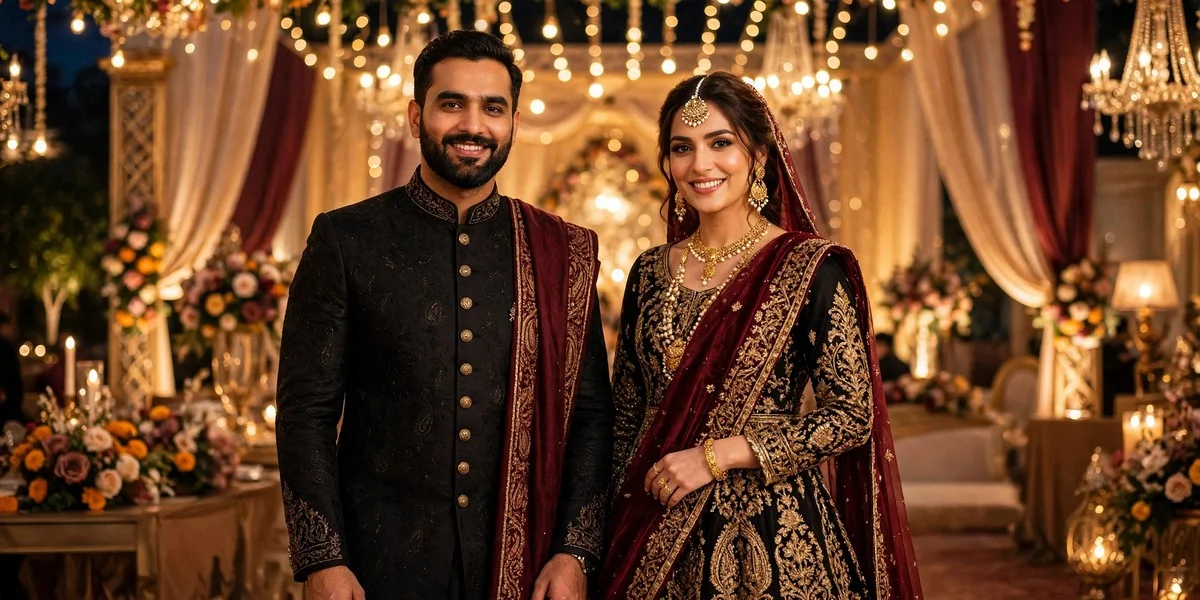
Ten years ago, if you had walked into a Pakistani wedding wearing black, at least three aunties would have exchanged looks. One of them would definitely have whispered something. Black was the colour of mourning, of funerals, of “beta, shaadi par kala pehenna achi baat nahi hoti.” It simply wasn’t done.
Cut to this wedding season. Scroll through any photographer’s Instagram page right now and count the black outfits. Black lehengas with gold kaam. Black velvet suits. Black sherwanis on grooms — grooms, the one person who traditionally had exactly two colour options, cream and maroon. Brides in black and gold at their own walimas. Guests in black sarees stealing the show in the group photos.
Something has shifted, properly shifted, and if you’re planning a wedding outfit this season — yours or someone else’s — black is suddenly one of the smartest choices you can make. This article is about why it’s trending, how to wear it without looking like you’re attending a different kind of event, what it costs in Pakistan right now, and the few rules that separate “stunning in black” from “wait, is she okay?”
Why Is Black Suddenly Everywhere at Weddings?
Trends usually have three or four parents, and this one is no different.
The celebrities did it first, like they always do. A few big weddings, a few award shows, and suddenly there it was — a celebrity bride at one of her own functions in black and gold, looking like she’d invented weddings. You know what happens next in Pakistan. The photos land on Instagram at night, and by morning every boutique in Lahore has had at least one customer walk in holding her phone at arm’s length saying “bilkul aisa chahiye.” Black lehengas, black embroidered suits, even black-on-black sherwanis on men who would normally never experiment. The outfits were so good that nobody even had the “but black at a shaadi?” debate out loud. The pictures just ended it.
Instagram and winter are co-conspirators. Our wedding season is basically November to February, and almost every function that matters — baraat dinner, walima — happens after dark, under those warm yellow marquee lights. Ask any wedding photographer which colour he trusts in that light and watch him smile before he answers. Pastels go pale. Light pinks basically surrender. But black? Black sits in that golden light and does something unfair — the gold kaam on it starts glowing, the jewellery catches fire, and the person wearing it looks like the best-lit human in the hall. I have seen side-by-side photos from the same wedding, same camera, where the girl in black looks like a magazine cover and the girl in powder blue looks like she attended a different, dimmer event. These days a wedding is half celebration, half photoshoot. The colour that wins the camera was always going to win the season.
Velvet came back, and velvet loves black. Winter wedding fashion in Pakistan runs on velvet — velvet shawls, velvet suits, velvet lehengas. And no fabric on earth wears black better than velvet. The colour goes deep, almost liquid, and the fabric’s sheen gives it dimension so it never looks flat. Half the black outfits you’ll see this season are velvet, and that’s not a coincidence.
And honestly? People got bored. Red brides, maroon brides, mehndi yellows and greens — beautiful, classic, and after decades of the same palette, a generation of brides and guests wanted one event, just one, where they could look different. Black is the rebellion that photographs well.
There’s one more reason, the most practical one of all: black is re-wearable. That Rs. 60,000 maroon bridal-style outfit will be recognised every single time you wear it. A black outfit can go to five weddings with different jewellery and dupatta styling and nobody clocks it as a repeat. In this economy, that matters.
The Auntie Question: Is Black at a Wedding Actually Acceptable Now?
Let’s address the real obstacle, because it isn’t fashion — it’s family politics.
The honest answer: it depends on your family, your city, and which function it is. In Karachi and Lahore’s urban circles, black at weddings is now completely normal, especially at walimas and receptions. In more traditional families, a guest wearing black at a mehndi might still raise eyebrows — mehndi is the colour festival, and honestly, black at a mehndi is also a styling waste, like wearing sunglasses indoors.
The practical middle path most families have landed on:
- Walima / reception: Black is fully safe now. This is its home ground.
- Barat: Black works beautifully for guests; for the bride’s own barat, red still rules in most families, though black-and-gold bridal looks are appearing in fashion-forward families.
- Mehndi / dholki: Skip black here, yaar. The mehndi is the one night the yellows, greens and oranges get to run the whole show — the decor, the flowers, the rasams, everything is colour. Show up in black and you’ll look like a guest at the wrong function, and frankly, like you didn’t get the memo everyone else got.
- Nikah: This one is genuinely family-dependent, so I’ll give you the honest version instead of the fashionable one. The nikah is a soft, daytime, emotional occasion, and plenty of families still picture it in whites and pastels. A guest in a festive black outfit with gold on it will pass in most urban families now. In a traditional one, you may spend the whole event feeling slightly like a question mark. My rule: family ko pehle parho, fashion ko baad mein. Know your people first. Yes, that includes ignoring this blog when your grandmother is involved.
And if you’re the bride or the groom and black is the dream — do not, I repeat, do not make it a surprise. This is a conversation you have in the drawing room, weeks early, ideally with a photo of the outfit open on your phone so people react to how good it looks instead of reacting to the word “black.” Choose the walima for it if there’s any resistance at all. I have yet to hear of a single family fight over a black walima outfit. A black baraat entrance sprung on a traditional family as a surprise, though? That story I have heard. Twice. It did not go the way the couple rehearsed in their heads.
Black Wedding Outfits for Women: What Actually Works
The Black Lehenga With Gold Work — the Queen of This Trend
If one outfit is carrying this entire trend on its back, it’s this one. A black lehenga with antique gold zardozi, tilla or sequin work is the single most photographed wedding look in Pakistan right now, and once you’ve seen one in person you understand why. The gold doesn’t sit on the black, it glows off it.
Styling notes from watching many women get this right (and a few get it wrong): keep the gold antique rather than yellow-bright — it looks richer and more expensive. And here’s a move I love, because it’s half fashion and half diplomacy: put a coloured dupatta on it. Deep maroon, bottle green, classic red — draped over all that black and gold, it does two jobs at once. It gives the outfit its festive pop (black genuinely looks better with one colour standing next to it), and it takes the temperature down at home. Ammi and Daadi see the red dupatta and relax. I’ve watched this exact negotiation succeed at a family dinner. The dupatta is not an accessory; it’s a peace treaty.
The Black Saree — Elegance That Never Fails
For walimas and receptions, a black saree in chiffon, net or silk with a worked border is the safest possible way to join this trend. My khala has worn the same black saree, styled three different ways, to what I count as at least six family weddings — and she’s in her sixties, which tells you the other thing about this outfit: it does not care about your age. Twenty-five or seventy-five, it behaves. It also has the highest “borrow rate” of any outfit in a family; the day you buy one, every woman in your khandan mentally books it. On the blouse, you pick your drama level: heavy kaam wala blouse if the saree is plain, simple blouse and big jewellery if the border is already doing the talking. Both work. Doing both at full volume is where it starts to shout.
Black Velvet Suits — the Winter Wedding Workhorse
Not every wedding needs a lehenga. For guests attending their fourth shaadi of the season (we’ve all had that December), a black velvet kameez with a worked neckline, paired with a contrasting izaar or trousers and a net or organza dupatta, is warm, formal, and endlessly re-styleable. Velvet also hides the December wedding diet’s failures kindly, which is not a small thing.
Black Gowns and Fusion Looks
For receptions and corporate-adjacent weddings, black gowns and Indo-western fusion pieces — capes over lehengas, draped silhouettes, black anarkalis — are where the younger crowd is playing. These photograph like fashion editorials. Just check the family’s temperature before going full fusion at a conservative event; there’s a line between “fashionable” and “the topic of the family WhatsApp group,” and you want to enjoy the wedding, not headline it.
Black Wedding Outfits for Men: Quietly, the Bigger Revolution
Women in black at weddings grab the attention, but the men’s shift is arguably bigger, because men’s wedding fashion in Pakistan barely changed for thirty years.
The Black Sherwani
A black sherwani with subtle self-embroidery or antique gold buttons is now a legitimate groom outfit, especially for walimas. It looks regal in a way that surprises people the first time they see it — sharper than cream, less expected than maroon. Grooms styling it right are pairing it with a contrasting shawl (maroon or deep green, again, saves the family peace) and a classic turban in a lighter tone so the whole look doesn’t go too dark in photographs.
The Black Suit, Done Properly
For guests and for grooms at receptions, a well-fitted black suit with a crisp white or ivory shirt is bulletproof. Two upgrades that take it out of “office party” territory: a textured or subtly patterned tie/pocket square in a wedding colour (burgundy, emerald), and proper formal shoes that are actually polished. The difference between a wedding black suit and a work black suit is entirely in these details — oh, and fit. Fit is doing most of the work, as always.
Black Kurta With a Waistcoat — the Guest’s Smart Play
If a full sherwani or suit feels like too much, a black kurta pajama with a rich waistcoat — velvet, jamawar, or a deep contrasting colour — is the sharpest low-effort wedding look a male guest can wear. It’s comfortable through a five-hour event, it photographs well, and the waistcoat does the “I made an effort” talking for you. Every man should own this combination; it will rescue him at three weddings a year for a decade.
Best Black Couple Combinations: Matching Without Looking Like Twins
Now for the question couples actually argue about in the boutique: if we’re both wearing black, how do we match without looking like we planned a uniform?
The rule underneath all of this is simple — share two things, never everything. Share the accent colour and the metal. Differ in outfit, texture and where the colour sits. Couples who get this right look like a matched set in photographs. Couples who copy each other completely look like they’re attending in matching uniforms, and the family group chat will say so, lovingly, by midnight.
Combination 1: The Royal Gold Pair (the walima favourite)
Him: black sherwani, antique gold buttons, no shawl or a plain black one.
Her: black lehenga with heavy antique gold kaam, gold jewellery, dupatta in the same black-gold family.
This is the combination in half the trending walima photos right now, and it’s the safest black couple look there is. The link between the two outfits is the gold — his buttons quietly repeat her embroidery. Nothing matches exactly, everything belongs together. If your families need one drop of tradition, let her carry a maroon dupatta and him a maroon pocket square or shawl border in the same maroon. Same colour, two small appearances, done.
Combination 2: The Velvet Pair (built for December)
Him: black sherwani or black suit with a black velvet shawl.
Her: black velvet lehenga or velvet suit with worked borders.
If December had a uniform, this would be it. Both of you in velvet, in black, under warm wedding lights — nothing about that photograph can go wrong, the fabric is doing eighty percent of the work before either of you even smiles. It’s also the kindest combination to shop for if you’re short on time (and couples are always short on time), because you don’t have to colour-match anything complicated. Velvet talks to velvet. One small division of labour though: the gold goes on her side — jewellery, kaam, borders. His side stays clean. Velvet plus gold plus embroidery on both of you and the photo starts looking like a furniture showroom. Restraint, on the groom, is the styling.
Combination 3: Black With Emerald — for Couples Who Are Done With Maroon
Him: a black sherwani if it’s a big function, a black kurta with a waistcoat if it isn’t — and somewhere on him, emerald. A green shawl over the shoulder, or just the pocket square.
Her: her black outfit, with the emerald living in her jewellery. Or flip the whole arrangement — her dupatta carries the green, his waistcoat picks it up. Either direction works; both of you wearing green everywhere does not.
Maroon is the classic partner for black, everyone knows it, which is exactly why emerald is having its moment. It reads richer in photographs — deeper, a little unexpected — and three different stylists have mentioned it to me this season unprompted, which in fashion usually means it’s already happening. One genuine, painful warning before you fall in love with it: “emerald” is not one colour in Pakistani bazaars. It is about forty colours wearing a trench coat. The green from one shop and the green from another will fight in your wedding photos like they have a personal history. So buy his green and her green together, same shop, same day, holding them side by side. Learn from other people’s albums, not your own.
Combination 4: No Sherwani, No Lehenga — the City Couple Version
Him: a black suit that actually fits — this combination has nowhere to hide, the fit IS the outfit — white shirt, and one wedding-colour detail, a burgundy tie or pocket square.
Her: black saree, gold border, proper jewellery. Or the gown-style black outfits the boutiques are full of right now.
Some couples read the first three combinations and think, lovely, but that’s not us. This one is for them — the hotel-wedding, reception-only, we-own-half-of-this-already couples. It’s the cheapest combination on this list to put together and somehow the one that looks most like a magazine editorial when it lands. The catch is that with this little going on — no heavy kaam, no big silhouettes — every detail gets examined. His shoes, her jewellery, the fit of that suit. Get those right and minimal beats maximal. Get them wrong and there’s no embroidery to save you.
3 Matching Rules Every Black Couple Should Steal
- One shared accent, worn in two places. His shawl border and her dupatta. His pocket square and her clutch. Small-small, in the same shade, and the photograph suddenly looks designed.
- Same metal family. If her jewellery is antique gold, his buttons and cufflinks should be gold-toned too. Her in gold, him in silver buttons — tiny detail, but the camera notices what the eye forgives.
- Same formality level. He cannot be in a casual black kurta while she’s in a full bridal lehenga, or the other way around. Black hides many sins; a formality mismatch is not one of them. Decide together: full formal, mid-formal, or smart — then both dress to that level.
And one photograph tip specifically for couples in black: ask your photographer for a few shots against a light or decorated backdrop, not only the dark stage corners. Two people in black against a bright, festive background is one of the most striking wedding photographs there is. Two people in black melted into a dark background is a puzzle for your relatives.
How to Style Black at a Wedding Without Looking Somber
This is the heart of it. Black at a wedding succeeds or fails on styling, because the colour itself is neutral — everything depends on what you put with it.
Gold is black’s best friend. Gold jewellery, gold kaam, gold clutch, gold khussay. Antique gold especially. This pairing is the entire trend in one sentence, and it works on every skin tone in this country.
Add ONE colour, not four. A black outfit with a maroon dupatta: stunning. A black outfit with a maroon dupatta, green jewellery, red lipstick and gold shoes all fighting at once: confusion. Pick your one accent and let it be the accent.
Jewellery should go bigger than usual. Black absorbs light, so delicate jewellery disappears against it. This is the occasion for the jhumkay with presence, the layered necklace, the statement ring. If you’re wearing black, your jewellery budget (or your mother’s jewellery box raid) should go up a level.
Makeup needs warmth. Against black, very pale or washed-out makeup can make you look tired in person and ghostly in photos. Warm blush, a proper lip colour — deep rose, berry, classic red — and defined eyes bring the face back into the outfit. The makeup artist at my cousin’s walima said it to the bride in the chair, in exactly these words, while pointing at her black outfit with the brush: “Kala pehna hai to moo par rang lao, warna photo mein sirf kapra nazar aayega, tum nahi.” If you’re wearing black, bring the colour on your face — otherwise in the photo only the dress will be visible, not you. She was right. She usually is, about everything, which is annoying.
And the fabric quietly decides everything. Here’s the whole secret, and it took me an embarrassingly long time to see it: black itself is neither festive nor dull. The fabric makes that decision. A flat, matte, slightly tired black — the kind that looks a bit grey at the edges — reads as plain, everyday, almost mournful no matter what you sew from it. The same black in velvet goes deep and rich. In raw silk it holds a soft shine. In chiffon it moves and catches light with every step. So in the shop, ignore the colour for a second (it’s black, you know it’s black) and do this test instead: hold the fabric up, move it under the light, watch what it does. If it plays with the light, it’ll play beautifully at a wedding. If it just sits there absorbing everything like a black hole in a dupatta, put it back.
Prices in Pakistan: What Black Wedding Wear Costs (PKR)
Realistic 2026 ranges, because “trending” shouldn’t mean “bankrupt”:
|
Item |
Local / Mid-Range (PKR) |
Designer / Bridal (PKR) |
|---|---|---|
|
Black lehenga (guest, semi-formal) |
15,000 – 35,000 |
60,000 – 2,50,000+ |
|
Black bridal lehenga (heavy gold work) |
55,000 – 1,20,000 |
2,50,000 – 8,00,000+ |
|
Black saree with worked blouse |
8,000 – 25,000 |
40,000 – 1,50,000 |
|
Black velvet suit (women, 3-pc) |
6,500 – 15,000 |
25,000 – 75,000 |
|
Black gown / fusion outfit |
12,000 – 30,000 |
50,000 – 2,00,000 |
|
Black sherwani (groom) |
25,000 – 60,000 |
90,000 – 3,50,000 |
|
Black suit (stitched, good fabric) |
18,000 – 40,000 |
60,000 – 1,50,000 |
|
Black kurta + waistcoat set |
6,000 – 14,000 |
20,000 – 45,000 |
Where to look: for bridal and heavy formals, the usual designer studios and bridal markets of Lahore (MM Alam Road, Liberty) and Karachi (Zamzama, Tariq Road) all have black collections this season because the trend is impossible to ignore. For guest outfits, brands like Ideas, Khaadi’s festive lines, Alkaram, Maria B and Sana Safinaz all release black festive pieces every winter — and the smart money checks their end-of-season sales in January and February, when this season’s black formals quietly drop 30 to 50 percent and next December suddenly looks very affordable.
One buying tip worth its own line: check black fabric under bright light before paying. Cheap black dye jobs reveal themselves in daylight — some go slightly brown, some slightly grey-green. Hold the outfit near the shop door. Real, deep black stays black.
5 Mistakes That Ruin a Black Wedding Look
- Plain black, no work, no jewellery, no accent. This is the one that looks like a different kind of gathering. Black at a wedding must be decorated — embroidery, jewellery, a contrasting dupatta, something that says celebration.
- Black at the mehndi. Covered above, worth repeating. Wrong function. The mehndi belongs to colour.
- Ignoring the photographs. All-black with a dark background and dark hair can flatten you into a floating face in group photos. A gold neckline, a coloured dupatta edge, or lighter jewellery near the face fixes this — give the camera something to hold on to.
- Cheap black fabric. Black is unforgiving about quality. A faded, greyish black looks older and sadder than any other faded colour. This is the one outfit where fabric quality is worth paying for.
- Matching your partner head-to-toe in black. One of you in black is a statement; both of you in full black with no accents reads as a themed couple costume. Coordinate, don’t clone — if he’s in a black sherwani, her outfit can carry the gold and the colour.
FAQs
Is it okay to wear black at a Pakistani wedding?
In 2026, yes — especially at walimas and receptions, where black is now a mainstream, fashionable choice for guests and increasingly for grooms and brides. For mehndis, colour is still expected, and for traditional families it’s wise to check the mood for barat and nikah functions.
What colour dupatta goes best with a black lehenga?
Maroon, deep red, bottle green and antique gold are the classic winning combinations. Maroon and red keep traditional families happy; gold-on-gold keeps it regal; bottle green is the fashion-forward pick of this season.
Can a groom wear a black sherwani?
Absolutely, and many now do — particularly for the walima. Style it with gold or antique buttons, a contrasting shawl, and a lighter turban so the look stays festive and photographs well.
Which fabric looks best in black for weddings?
Velvet is the season’s champion — black velvet has depth and sheen that photographs beautifully in evening light. Raw silk, silk and chiffon with embroidery are also excellent. Avoid dull, flat fabrics that make black look faded.
How much does a black bridal lehenga cost in Pakistan?
A mid-range black bridal lehenga with gold work typically costs between Rs. 55,000 and Rs. 1,20,000, while designer bridal pieces start around Rs. 2,50,000 and go far higher depending on the handwork.