


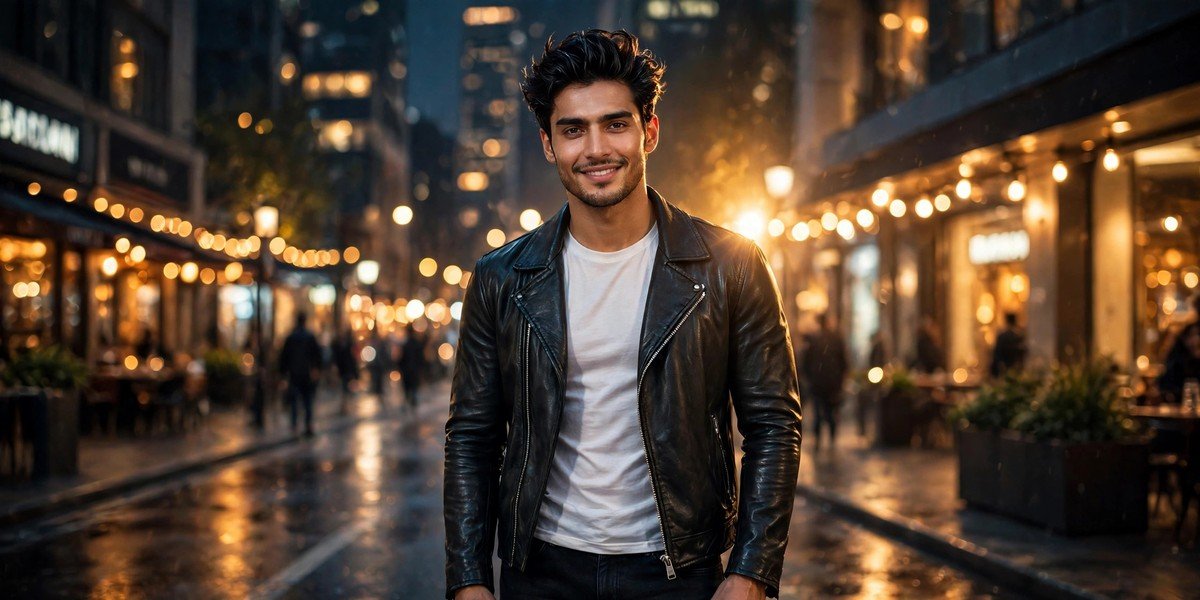
Let me tell you about a photo from when I was nineteen.
It’s a group picture from a university trip. Everyone’s standing in a line, and there I am in the middle — in a black t-shirt two sizes too big for me, because somewhere in my teenage brain, I’d decided that lose clothes would hide the fact that I was skinny. Reader, they did not hide it. I looked like a kid wearing his older brother’s shirt. The sleeves were eating my arms. In that photo I somehow looked thinner than I actually was, and I was already pretty thin.
If you’re a skinny guy reading this, you already know the two traps. Trap one: wear baggy clothes to “cover it up” and end up looking like the clothes are wearing you. Trap two: wear tight clothes thinking they’ll show your shape, and end up looking like the shape is the problem. Most skinny guys spend years bouncing between these two traps. I know I did.
Here’s the good news, and I mean this genuinely: dressing to look more muscular is not about your body. It’s about geometry. Shoulders, lines, layers, where the eye goes when someone looks at you. Actors who look huge on screen are often surprisingly lean in real life — their stylists understand this game. And unlike the gym, which takes a year to change how you look, the right clothes change it this Saturday.
This guide is everything I wish someone had explained to me before that university trip photo. No fake promises — clothes won’t give you muscles. But they will absolutely change how much muscle people think you have. Let’s get into it.
First, Understand What Actually Makes a Guy Look Muscular
When people look at a man and think “built”, they’re not measuring his biceps with their eyes. They’re reading three signals:
Wide shoulders compared to the waist.
This is the big one. The shoulder-to-waist ratio is basically the whole game. A guy with broad-looking shoulders and a clean, fitted waist reads as muscular even if he’s lean everywhere else.
Structure in the upper body.
Chest, shoulders and upper back that have some visual “frame” to them — seams in the right places, fabric with some body to it, nothing collapsing or hanging.
Nothing drowning, nothing squeezing.
Fabric that pools, droops or flaps tells the brain “Small body inside big clothes”. Fabric that’s sprayed on tells the brain “Small body, look how small”. The sweet spot in the middle — clothes that follow your frame with a little room to breathe — is where “athletic” lives.
Everything after this point is basically tricks to fake these three signals. And once you see it, you can’t unsee it — you’ll catch yourself in a trial room going, oh, that’s why this shirt looks off. Which is a much better place to be than just standing there annoyed at the mirror, trusting nothing. That was my method for years. It produced the photo.
Tip 1: Fit Is Not a Detail. Fit Is the Entire Thing.
I need to say this first because everything else is decoration on top of it.
I’ll put it the way my tailor once put it to me, holding up a shirt I’d brought him: “Sahab, ye aap ki shirt hai, ya aap is mein rehte hain?” Is this your shirt, or do you live in it? One size is all it takes to cross that line. A shirt that fits reads as lean and sharp. A shirt one size too big reads as borrowed. What you’re after is fabric that sits close and moves with you — when you raise an arm or sit down, there shouldn’t be a second, independent shirt flapping around on top of your body.
Three fit checkpoints, learn them once and use them forever:
Shoulders: The shoulder seam of any shirt, t-shirt or jacket should sit right at the edge of your shoulder bone — not drooping down your arm, not pulling in towards your neck. If a skinny guy fixes nothing else in his wardrobe, fix this. That seam is a line, and the world reads it as “shoulder ends here.” When it slides halfway down your arm, well. The world reads that too.
Sleeves: Aim for sleeves that stop somewhere around the middle of your upper arm and sit close — you should be able to slide one finger in, not a whole hand. I got this from my gym trainer, of all people, a man whose arms deserve their own postal code. He pointed at my loose t-shirt sleeve one morning and told me the sleeve was making my arm look half its size, like a small ring rattling around on a dinner plate. Annoying advice to hear at 7 AM. Completely correct advice, though.
Length: Shirts and t-shirts should end around the middle of your fly, roughly. Too long and the shirt becomes a dress that swallows your legs and makes your whole frame look shorter and thinner. Too short and you’ll spend the day pulling it down.
And here’s the advantage skinny guys in Pakistan have that almost nobody talks about: we have tailors. A darzi will take in a shirt’s sides, fix a sleeve, adjust a shoulder for a few hundred rupees — work that costs a fortune in the West. Some of my best-fitting shirts started life as totally average ready-made pieces that my tailor spent twenty minutes on. So if this article leaves you with one habit, let it be the one he gave me: jab bhi shirt lo, shoulders par lo — baaki sab hum theek kar dein ge. Buy it for the shoulders. Almost everything else on a shirt can be fixed.
Tip 2: Your Shoulders Need Help. Give It to Them.
Since shoulders are signal number one, treat them like it.
Clothes with built-in structure — a blazer with a proper shoulder, a structured jacket, a denim or leather jacket with some stiffness — literally draw a wider, squarer frame on top of your body. Even a simple unlined blazer over a t-shirt makes a lean guy look noticeably broader in photos. There’s a reason every red carpet stylist reaches for one.
Details that add shoulder width:
- Epaulettes and shoulder details on jackets and shirts (there’s a reason military uniforms have them — they were designed to make men look broader and more imposing)
- Raglan sleeves, and shirts with a contrasting shoulder panel. Sounds like a tiny design detail. It really isn’t — that line running across your shoulders is exactly where people’s eyes go to measure width, and these styles cheat the measurement.
- Fabric with some backbone. Do this test in the shop: pick up two t-shirts, one thin, one heavy cotton or twill, and hold them both up by the shoulders. The thin one droops like it’s tired. The heavy one keeps a shape. On your body, that shape becomes your shape, and that’s the whole trick.
And the thieves, because there are thieves: a soft cardigan worn completely on its own, thin fabrics that start the morning fine and have collapsed by lunch, and the worst repeat offender — a shoulder seam that has slid down your arm and is just hanging there, defeated, telling everyone the shirt is in charge here.
Tip 3: Layers — the Oldest Trick in the Book, Because It Works
Layering is the skinny guy’s oldest trick, and it works for a stupidly simple reason: each layer adds a few millimetres of visual bulk, and three layers add up to a different silhouette.
But layering has rules, because random layers just look like you got dressed in the dark:
Thin first, heavy last. Whatever touches your skin should be the lightest thing you’re wearing — a fitted tee or a shirt. Then build outwards: overshirt over it, jacket over everything. Try it backwards exactly once and you’ll understand the warning in your bones. I did it backwards once, thick sweater under a thin jacket, and spent the whole evening looking like I was smuggling a pillow under there.
Each layer should be visible. A collar showing above a sweater, cuffs peeking out of a jacket sleeve, the hem of a t-shirt below an open overshirt — these little edges are what make layering look deliberate instead of accidental.
Two or three layers is plenty for most days. Now the obvious objection, because I can hear it from here: bhai, Lahore, June, 44 degrees — layers?? Fair point. In proper Pakistani summer, layering dies, and it should. The summer move is different: one single piece, but a substantial one — a heavy-fabric tee, or a short-sleeved shirt with an actual collar and some structure in it. Full layering season runs October to March, plus any office where some unidentified colleague has set the AC to “Arctic” in July.
A combination that has never failed me: fitted white t-shirt, open flannel or denim overshirt with sleeves rolled to the forearm, dark jeans. The rolled sleeves matter more than you’d think — forearms are one place where lean guys actually look good, and showing them while adding bulk on top is playing to your strengths.
Tip 4: Choose Necklines That Widen, Not Narrow
This sounds like a tiny detail. It isn’t.
A deep V-neck on a skinny guy creates a long vertical line down the chest and visually narrows the whole upper body — it’s basically drawing an arrow pointing at how lean you are. Save deep V-necks for guys with big chests who want to show them.
Your necklines are:
- Crew necks — the classic round neckline frames the shoulders and keeps the eye up at face and shoulder level. The default choice, and the right one.
- Henleys — a crew neck with a few buttons. Somehow this small detail reads as rugged and athletic. Unbutton one button, not three.
- Collared shirts and polos — a collar adds width and structure right at the top of your frame, next to your face, where everyone looks first.
- Boat necks and wider necklines, if you ever actually find one in a men’s section here. They’re rare in Pakistan — I think I’ve spotted them twice in five years of shopping — but a wider neckline stretches the shoulder line sideways in a way a crew neck simply can’t. Both times, I bought the shirt on the spot. Zero regrets so far.
Tip 5: Patterns and Texture Do the Heavy Lifting. Literally.
Here’s the problem with a plain, thin, solid-coloured shirt: there is nothing on it to look at except you. Every rib, every angle — faithfully reported, no filter. Now put a check, or a stripe, or a chunky knit on that exact same body. The eye gets busy. It’s travelling over the pattern, catching on the texture, and somewhere in the middle of all that activity the man underneath quietly registers as… bigger. Nobody can fully explain why it works. It just does, and tailors have been exploiting it since before either of us was born.
Your friends:
- Horizontal stripes, especially across the chest. Yes, the oldest advice in the book, and yes, it works — horizontal lines stretch the eye sideways. A Breton-style striped t-shirt is almost unfairly effective on a lean frame.
- Checks and plaid on shirts. The grid pattern adds visual mass in every direction, and a flannel check shirt is basically the skinny guy’s national dress in winter.
- Chunky knits, cable-knit sweaters, ribbed fabrics. Texture is literal, physical bulk. A cable-knit sweater doesn’t just look heavier than you — on your shoulders, it is heavier, and the silhouette shows it.
- Pockets and panels on the chest. A chest pocket, a double-pocket shirt, a t-shirt with a chest stripe or panel — all of these put visual furniture on the widest part of your torso.
And the flip side: very fine vertical pinstripes on a shirt will make a lean man look like a ruler. Vertical lines lengthen and slim. That’s wonderful if that’s your goal. It’s not ours today.
Tip 6: Colour — Light on Top Is Your Friend
Simple rule that stylists use constantly: light colours advance and look bigger, dark colours recede and look smaller. Black is slimming. Magazines have told women this for fifty years, and the physics applies to us too.
So if you want to look more muscular:
- Light colours up top. White, light grey, sky blue, beige — the whole pale family. I resisted this for years because white felt “too simple”, too plain, like I wasn’t trying. Then a friend showed me two photos of me from the same week. Black tee in one, white tee in the other. The guy in white looked like he’d been eating properly and sleeping well. Same body. Same week. I have worn a lot of white since that day.
- Dark colours down below. Dark jeans, dark chinos, that end of the wardrobe. They anchor everything and, more importantly, they stop competing — all the width the light colour is creating up top gets to stay up top.
- Head-to-toe black: retire it. Said with love, by a recovering all-black dresser. It was basically my entire personality at twenty, and the whole time it was quietly making me look thinner — one long dark column with a face stuck on top. Black’s entire job in fashion is making people look slimmer. Women have used it for exactly that for decades. Why were we volunteering for it?
And no, this is not me banning black from your life, relax. A black shirt that fits like it was made for you is still a sharp thing to own, and some evenings slim-and-sharp is exactly the assignment. The point is to stop dressing on autopilot. On the days when looking bigger is the goal — and if you’re this far into this article, let’s be honest, that’s most days — you know the order now. Light on top. Dark at the bottom. Finished.
Tip 7: the Humble T-Shirt, Taken Seriously at Last
Let’s be realistic about the t-shirt’s position in your life. If you’re a guy in Pakistan, it isn’t one item in your wardrobe — it basically is the wardrobe, nine months of the year. Which makes it strange that most of us give it about ninety seconds of thought in the shop and then wear the consequences for two years.
Fabric weight beats the logo on the chest. Every single time. A thin t-shirt is a traitor: it clings where you don’t want it to, sags where you don’t want it to, and the first decent gust of wind presses it against your ribs like a live X-ray. Now compare the heavy cotton one. Hold it up by the shoulders in the shop and watch — it keeps its own shape instead of dangling there sadly. It does the same thing on your body. It lends you its shape. So if this year you upgrade exactly one thing you own, make it this swap: thin tees out, heavy tees in. It’s the cheapest transformation in this entire article and it isn’t close.
Sleeve length: mid-bicep, as covered earlier. There’s also a small tailor trick here — a sleeve hemmed slightly shorter and fitted makes arms look bigger than the same arm in a long loose sleeve. Same arm. Different frame around it.
Fit through the body: fitted, not tight. You should be able to pinch about an inch of fabric at the sides. If you can pinch a handful, it’s too big. If you can’t pinch anything and breathing is a decision, it’s too small — and compression-tight clothes on a lean frame mostly advertise the leanness.
Tip 8: Shirts — Your Secret Weapon
If t-shirts are the daily driver, shirts are where skinny guys quietly win, because a good shirt has structure built into it — collar, placket, cuffs, seams — and structure is our whole strategy.
Wear them with the sleeves rolled to just below or above the elbow. Rolled sleeves do three things at once: they show your forearms (a lean guy’s best feature, seriously — lean forearms with visible veins and tendons read as athletic, not skinny), they add a band of folded fabric bulk around your arms, and they make any shirt look more relaxed and confident.
Fit rules are the same as t-shirts, with one addition: a shirt should never balloon at the waist. If there’s extra fabric pooling around your belt when you tuck it in, that’s a tailor job, two hundred rupees, ten minutes. That little balloon of fabric is the single most common reason a decent shirt looks sloppy on a slim guy.
For patterns, medium checks and small prints are your range. Very large loud prints can overwhelm a small frame — the print starts wearing you. And for formal shirts, a slightly wider collar spread frames the face and neck better than a tiny narrow one.
Tip 9: Fix the Bottom Half — the Skinny Jeans Trap
Now we need to talk about your jeans, because there’s a paradox here that catches everyone.
Skinny jeans on skinny legs make your legs look… skinnier. I know, the name suggests they belong together, but what actually happens is the jeans announce the exact circumference of your legs to the world, and if the top half has any bulk at all, you end up with the classic lollipop look — big on top, sticks below.
The fits that work for you:
- Slim fit (not skinny) — follows the leg with a little room. This is the default answer for most lean guys.
- Straight fit — a consistent width down the leg adds visual weight to the whole lower body. With the current fashion swing back towards relaxed fits, straight and even slightly relaxed trousers are genuinely a gift to skinny guys. Take the gift.
- Tapered chinos — room in the thigh, narrower at the ankle. Clean, modern, and they make legs look athletic rather than thin.
Small practical things now, most of them learned by ruining good jeans myself. First: don’t let the legs bunch up at your ankle in folds. That concertina effect at the bottom somehow makes your whole leg read shorter and thinner, and getting jeans hemmed costs almost nothing, so there’s no excuse. One cuff or a pin-roll is a different story — actually helpful. A folded band of fabric at the ankle is a bit of extra weight in exactly the place your leg is thinnest. And those very pale, washed-out jeans that look so nice folded in the shop window? Unkind on skinny legs, friend. Mid-blue and dark washes simply carry more presence.
Shorts, quickly, because grown men keep getting this wrong in public: above the knee, and fitted like they were made for a human leg. The long baggy ones that finish halfway down the shin — you know exactly the ones I mean — turn your legs into two drinking straws poking out of a tent. Nobody has ever looked athletic in those. Not once, in recorded history.
Tip 10: Jackets — the Closest Thing Clothing Has to a Cheat Code
Notice that everything so far has been about working with the lines your body already has. A jacket doesn’t bother with any of that. A jacket cheats. It shows up carrying its own shoulders — structured, squared-off, wider than yours — and simply installs them on top of you like furniture. I have genuinely never watched a well-cut blazer fail to make a lean guy look broader. Not once, in years of paying attention. It’s the closest thing clothing has to a guaranteed result.
If I could hand you only three, it would be these three:
- A navy blazer. (Charcoal, if navy bores you.) Single-breasted, two buttons, and shoulders that are actually present and accounted for. Mine has been worn over t-shirts, over formal shirts, and to at least two dinners it had no business attending, and it has never once let me down. Of every purchase mentioned on this page, this one changes the most.
- A denim jacket in a classic fit — structured, hits at the waist, layers over a hoodie or sweater in winter for real bulk.
- A bomber or Harrington jacket — the ribbed waistband sits at your belt and the body of the jacket has room through the chest and shoulders. Bombers were designed for pilots and somehow make every wearer look like they have an upper body worth writing home about.
What to be careful with: very long coats on a slim frame can look like the coat is escorting you somewhere. Long coats work when they fit close and you have the height for them; when in doubt, jackets that end at the waist or mid-thigh are safer and widen rather than lengthen you.
Tip 11: Grooming and Posture — the Free Upgrades
Not clothes, I know, but I’d be lying if I left these out, because they change how your clothes sit on you.
Posture first. Rounded, slumped shoulders can steal what looks like two inches of width from your frame. Chest up, shoulders back and down — it costs nothing, it’s instant, and every single outfit in this guide looks 30 percent better on a guy standing properly. Half of “he looks athletic” is just “he stands like it”.
Hair and beard play a supporting role. Very long, flat hair plastered down can make a slim face look narrower; a bit of volume on top and shorter sides balances the face. A well-kept short beard adds width and maturity to a thin face and jaw. None of this is mandatory — it’s seasoning, not the meal — but it’s free seasoning.
Tip 12: The Gym Conversation (Brief, I Promise)
This is a style guide, not a fitness lecture, and clothes genuinely can do most of the work in this article. But since the goal in the title is “look more muscular”, honesty requires thirty seconds on the obvious: even a small amount of muscle in the right places changes everything your clothes do.
You don’t need to become a bodybuilder. Shoulders, upper back, chest and arms respond fastest visually, and even a few months of basic training — push-ups, pull-ups or rows, overhead pressing, and eating properly, which for most skinny guys is the actual hard part — will put a frame under your clothes that makes every tip here work twice as well. Clothes frame the picture. A little muscle gives them a better picture to frame. End of lecture.
Tip 13: Know What to Avoid — the Skinny Guy “Don’t” List
Sometimes the fastest improvement is subtraction. The repeat offenders:
- Oversized everything. The 2019 photo at the start of this article. Enough said.
- Deep V-necks and scoop necks — narrow arrows down your chest.
- Very thin, clingy fabrics that outline every rib in the wind.
- All black, head to toe, every day — the slimming uniform.
- Skinny jeans with a bulky top — the lollipop.
- Long shirts and kurtas hanging past mid-thigh on a lean frame (a kurta that fits close with the right length, though, looks excellent on slim guys — shalwar kameez done properly is genuinely one of the most flattering outfits for a lean Pakistani man, because the cut adds clean lines without drowning you).
- Tiny patterns and huge patterns — stay in the middle lane.
- Carrying yourself like you’re apologising. Not a clothing item, but it shows more than clothing does.
5 Ready-Made Outfits That Always Work
Theory is fine. Here is what to actually wear on Saturday:
- The everyday winner: White heavy-cotton crew neck t-shirt (fitted), dark navy slim jeans, white sneakers, sleeves ending mid-bicep. Simple, clean, broader than it has any right to look.
- The smart one: Light blue Oxford shirt, sleeves rolled, tucked into beige tapered chinos, brown belt and loafers. The light-top-dark-bottom contrast doing quiet work.
- Winter bulk special: Grey cable-knit sweater over a collared shirt (collar out), dark straight jeans, boots. Texture, layers, structure — all three signals at once.
- The jacket trick: Plain t-shirt, open denim jacket or overshirt, black slim jeans. Effortless, and the jacket’s shoulders do the heavy lifting.
- Desi formal, done right: Well-fitted kurta in a mid-tone colour (not shapeless, not skin-tight), waistcoat in a contrasting shade, straight shalwar or fitted pyjama, Peshawari chappal. Proof that you don’t need western clothes to look built — you need fit.
Shopping Tips Specifically for Skinny Guys in Pakistan
A few local, practical things before you spend money:
Try the smaller size than your instinct says. Most skinny guys have been buying a size up “to look bigger” for years. In the trial room, honestly compare both. Nine times out of ten, the smaller size is the one that makes you look bigger. Yes, it’s backwards. Yes, it’s true.
Budget for the tailor, not just the clothes. Keep 500 to 1,000 rupees of any shopping budget aside for alterations. A 2,500-rupee shirt plus 300 rupees of tailoring beats a 4,000-rupee shirt that almost fits.
Shop the structured sections. Blazers, denim jackets, overshirts, knits — these categories are your home ground in any store, from Outfitters and Breakout to the racks in Zainab Market or Ichihara. The thin t-shirts and deep-V section is not your home ground. Walk past it with confidence.
Build slowly. You do not need a new wardrobe this month. One heavy white t-shirt that fits. One shirt tailored properly. One jacket with real shoulders. Those three purchases will quietly fix most of your daily outfits, and you can build from there.
FAQs
Can skinny guys wear slim-fit clothes?
Yes — slim fit is your best friend. The rule is slim, not tight. Clothes should follow your frame with a small amount of room. Slim fit adds shape; skin-tight subtracts size by advertising exactly how lean you are.
What colours make skinny guys look bigger?
Light and bright colours on the upper body — white, light grey, sky blue, beige — paired with darker trousers. Light colours visually expand, dark colours slim down, so put each one where it helps you.
Should skinny guys wear stripes?
Horizontal stripes, especially across the chest: absolutely yes, they widen your torso visually. Fine vertical pinstripes do the opposite and are best avoided when looking bigger is the goal.
Do baggy clothes make skinny guys look bigger?
No — this is the most common mistake. Oversized clothes make the body inside them look smaller by comparison and give a sloppy, borrowed-clothes look. Fitted clothes with structure are what actually add visual size.
What is the single best clothing item for a skinny guy?
A well-fitted blazer or structured jacket. It brings its own shoulders, works over almost anything, and changes your silhouette more in two seconds than any other item you can buy.
Can shalwar kameez look good on skinny guys?
Very good, when it’s fitted properly — clean lines, correct length, and a waistcoat for occasions. A loose, oversized kurta is the desi version of the baggy t-shirt mistake, so fit matters here just as much.