


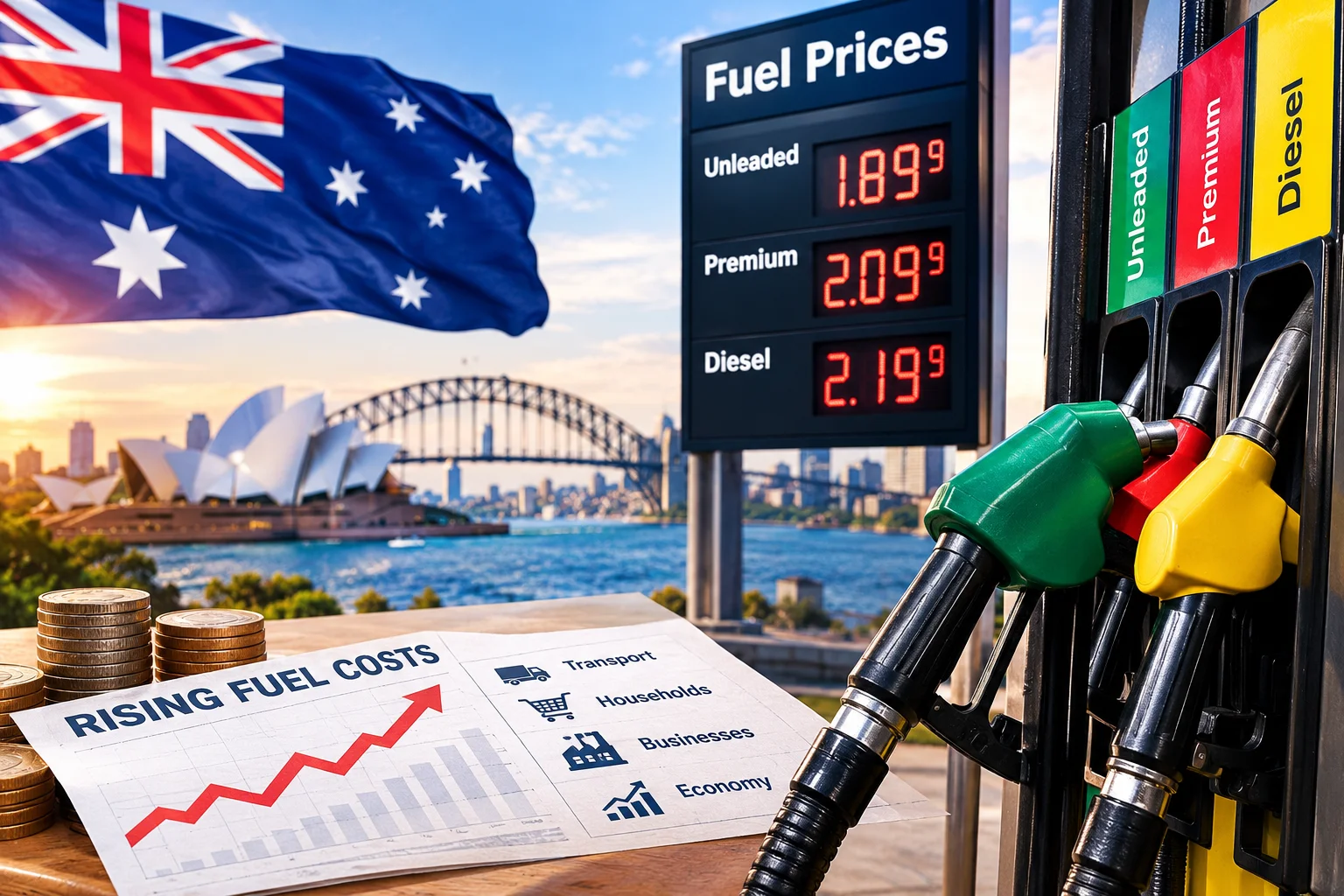
I put forty dollars in, like I always do, and the needle barely moved. Forty bucks. That used to be a decent top-up, enough to stop thinking about fuel for a few days. This time, at a servo on Church Street in Parramatta on a Tuesday night, I watched the liters crawl 16, 17, just under 17 liters and then I did the thing we’ve all started doing. I took a photo of the bowser. Not to post anywhere. Just to send to my brother with the caption: “Is this real??”He sent back a photo of his own bowser, out near Penrith, eight cents a liter dearer than mine. Eight cents. Same city, same fuel, same night.
That’s Australia fuel prices in 2026 in one dumb little exchange. The numbers are big and strange, they change by the suburb, and nobody not the bloke behind the counter, not the experts on the morning shows, not your mate who’s suddenly an oil analyst nobody can tell you with a straight face what you’ll pay next Tuesday. But here’s what we can do. We can look at what’s actually driving it, because a lot of it isn’t mystery at all once someone explains it in plain words. We can do the math’s on what it’s costing a normal household, in dollars, not percentages. And we can talk honestly about the bits you can control (a few) and the bits you can’t (most of it, sorry).
Let’s start with the number that matters, then work backwards.On 21 October 2026, the average petrol price across Australia’s five biggest cities Sydney, Melbourne, Brisbane, Adelaide and Perth was about 236 cents a liter, according to the ACCC, the competition watchdog that tracks this stuff every week. Diesel was worse. About 277 cents a liter.Back on 20 February, before the conflict in the Middle East blew up, petrol in those same cities averaged around 171 cents. Diesel sat near 177.
So petrol is up roughly 65 cents a liter in eight months. Diesel is up about a dollar a liter. A dollar. Read that again if you need to. If you fill a 50-litre tank, that 65-cent petrol rise is an extra $32.50 every single fill compared with February. And if you peaked at the worst moment late March, when the five-city petrol average hit about 257 cents you were paying even more.That’s the headline. The rest of this is me trying to answer the question my brother actually asked under his photo, which was: “How did it get this bad this fast?”
First, a quick honesty check about these numbers
Fuel prices move every day. Sometimes every hour, at the same servo, which is a sentence that should be illegal to type but is just true here. So when I give you a price in this piece, it’s an average, on a date, from the ACCC’s weekly monitoring or a price-tracking service. Your servo might be ten cents under it today and twelve cents over it on Friday. That’s not me being sloppy. That’s the market. Sydney’s daily average on 20 February was 165.2 cents. Melbourne was 176.1. Brisbane was 188.8 Brisbane started the year dearer and stayed cranky about it for months. Same country. Three very different starting lines.
Averages are still useful, though. They tell you the direction and the size of the hit. And the direction in 2026 has been brutally simple: up a lot, down a bit, up again, never back to where it started. Right. Now the why.
The big one: a war on the other side of the world, and a narrow bit of water
On 28 February 2026, the conflict between the United States, Israel and Iran escalated sharply. Within weeks, the thing every energy nerd had warned about for years stopped being theory: shipping through the Strait of Hormuz was disrupted, tankers were attacked or diverted, the Red Sea route stayed dangerous, and the oil market did what it always does when it’s frightened. It panicked upward. Why should a strait most Australians couldn’t find on a map decide what you pay in Parramatta?
Because roughly a fifth of the world’s petroleum normally moves through that water. A fifth. When it slows, or when insurers start charging war-risk money to sail through it, or when refineries in Asia can’t get the crude they were counting on, the price of everything downstream jumps crude first, then the refined stuff, petrol and diesel, that Australia actually buys.
Brent crude, the global benchmark you’ll hear on the news, has been trading around US105toUS110 a barrel in late October. It spiked higher in March. Those aren’t numbers I need you to memories. Just know this: every time Brent jumps ten dollars, your bowser price follows it up a hill a week or two later, like a dog on a lead. Slow to come down, too, but we’ll get to that lovely topic later.
Here’s my honest opinion, and some people in the industry would argue with me: we spent years treating cheap, reliable fuel shipping as a law of nature. It wasn’t. It was a lucky arrangement. 2026 is what it looks like when the arrangement breaks.
Australia doesn’t buy crude and make petrol. It mostly buys the finished thing.
This is the part most people get wrong, and I got it wrong for years too. I’d always pictured it like this: big ships bring crude oil to Australia, Australian refineries turn it into petrol, petrol goes to servos, done. There’s still a bit of that. But only a bit.
Australia now gets roughly 81 percent of its refined petroleum from imports, according to government figures you’ll see quoted in the ACCC’s orbit and in energy reporting this year. Read that slowly. The petrol in your tank most likely arrived in this country already refined made in Singapore, South Korea, Malaysia, Japan or somewhere else in Asia not made here from crude.
And the country that once had a row of refineries up and down the coast now has two: Geelong in Victoria and Lytton in Brisbane. Two. The others Altona, Kwinana, the rest of the names your dad would know closed over the last decade or so, turned into import terminals, or both. There were good commercial reasons given at the time. Cheap imports, old plants, all of that. I’m not going to pretend those decisions were made by villains in a boardroom twirling moustaches. But the result is the result: when Asia’s refining system gets squeezed, Australia feels it in days, not months. There’s no big local buffer to hide behind.
The government pays the two remaining refineries a support payment to keep them running, basically admitting they’re strategic assets, not just businesses. And the country’s emergency stocks, as of late October, sat at around 39 to 43 days of petrol and about 31 days of diesel. That’s the cushion. It’s not nothing. It’s also not the kind of cushion that lets a country shrug off a long shipping crisis.
Now add the benchmark bit, because this is the bit that actually sets your price. Australian petrol prices don’t follow crude directly. They follow a refined-petrol benchmark priced in Singapore, called Mogas 95. Diesel follows a Singapore benchmark too, Gasoil 10ppm, if you want the name to impress nobody at a barbecue. Those Singapore prices are in US dollars, which brings in the next villain.
The Aussie dollar: the quiet multiplier nobody puts on a poster
If the Australian dollar falls against the US dollar, everything Australia buys in US dollars gets dearer, even if the world price hasn’t moved a cent. Fuel is bought in US dollars. So a weaker Aussie dollar is like a second, invisible price rise stacked on top of the first one.
Late October, the dollar has been sitting around 70 US cents, give or take the day’s mood. It has been weaker than that during the worst of this year. I’ll spare you the graph, but the logic is dead simple and worth keeping in your head:
Singapore benchmark up + Aussie dollar down = you cop it twice.
Singapore benchmark up + Aussie dollar steady = you cop it once, and it still hurts.
That’s why you’ll sometimes hear “oil prices eased overnight” on the news and then watch your local price go up anyway. The oil bit eased. The currency bit, or the refining bit, didn’t. It’s three or four dials, not one, and they don’t all turn the same way on the same day. Annoying? Deeply. But at least now when it happens, you’ll know it’s not just your servo having a lend of you.
Well. Not only your servo. We’ll get to them too.
Diesel is the real story, and almost nobody talks about it at the barbecue
Petrol gets the headlines because petrol is what most of us buy. Fair enough.But diesel went up more about a dollar a liter from February to late October in the big cities, against petrol’s 65 cents and diesel is the fuel the country actually runs on. Trucks run on it. Every truck, basically. Farm machinery runs on it: tractors, harvesters, the Ute the farmer uses to check the fences. Mines run on it. Remote towns generate power with it. Fishing boats, delivery vans, the courier who brought your parcel this morning and will pretend he didn’t throw it at the door diesel, diesel, diesel.
So when diesel sits near 277 cents a liter in the capitals and around 289 cents across regional areas, as the ACCC recorded in September, that cost doesn’t stay at the servo. It walks.
It walks into the freight bill for getting food from a farm or a warehouse to your supermarket. It walks into the price of the concrete for a house slab, the steel, the tiles. It walks into your grocery shop in little five and ten cent steps that no single person can point at and prove, which is exactly why it drives people mad. Your lettuce costs more and nobody handed you a receipt that says “lettuce: +40c, blame Hormuz.”
A truckle I spoke to well, cornered, at a roadhouse west of Dubbo in August, he was not thrilled to be my research project and told me his fuel bill for the same Sydney run had gone up “somewhere north of four hundred bucks a trip” compared with the start of the year. He didn’t show me invoices. I didn’t ask. But do the rough maths on a truck burning a few hundred liters a run, with diesel up around a dollar, and his number isn’t hard to believe. He said, and I’ve thought about this line a lot since: “Mate, I don’t set the price of anything. I just deliver the bad news with the freight.”
That’s the economic impact in one roadhouse sentence, honestly. Multiply him by every truck, tractor and delivery van in the country.
Inflation works the same sneaky way. Fuel is in the official inflation numbers directly you buy it, it’s counted and then it’s in there a second time, indirectly, inside the price of almost everything that travelled on a truck. Which is almost everything. That’s why the Reserve Bank watches oil like a hawk, and why a fuel shock makes their interest rate job miserable: cut rates to help households, and you risk feeding the inflation the fuel started; keep rates up, and households cop the fuel and the mortgage at the same time. There’s no clean move. There’s just the least bad one, chosen in a room in Martin Place while the rest of us refresh fuel apps.
The tax that came back
Here’s the local twist, and it made a real difference to the timing of your pain this year.
Fuel excise the federal tax built into every liter was halved in late March, when prices were at their screaming peak. With the states handing back some extra GST on top, the total cut came to about 32 cents a liter from 1 April to 30 June. Then a smaller cut, about 16 cents, ran through July. On 2 August, it ended. Gone.
Excise is now back at its full rate: 53.7 cents a liter, after its regular August indexation bump. Add GST, which is charged on top of everything including the excise (yes, a tax on a tax, welcome to Australia, we’ve always done it this way), and roughly a third of what you pay for a $2.40 liter is tax about 75 cents of it, based on the breakdowns published off AIP and tax office figures in October.
I have mixed feelings about the excise cut, and I’ll say them plainly because a friend would. While it lasted, it genuinely helped 32 cents off is 32 cents off, that’s sixteen dollars on a 50-litre tank, you’d have to be rich or lying to shrug at that. But a temporary cut has a cruel second act. The day it ends, prices jump by exactly the amount everyone forgot they’d been saved, and it feels like a brand new rise. August felt awful at the bowser partly because nothing in the world got worse that week. The discount just left.
Should they bring it back? People will argue about that in the comments under this article, they always do, and both sides have a point worth hearing. It costs the budget billions, and most of it goes to people who’d have bought the fuel anyway, including me, including the well-off. It also lands fastest in the pockets of the people with the least slack the outer-suburban commuter, the regional worker with a 60-kilometre drive and no train station — in a way that a payment in six weeks doesn’t. My view, for what it’s worth: if a government does it, it should say the end date out loud, in the announcement, in the biggest font it’s got. The surprise ending did more damage to people’s trust than the money did good. Probably. I think. Anyway.
The price cycle: yes, your city really does that, no, you’re not imagining it
If you live in Sydney, Melbourne, Brisbane, Adelaide or Perth, petrol prices in your city move in a cycle. Up like a rocket over a day or two, then a slow, lazy drift down over a week or two, then — bang — up again.
The ACCC has studied this for years and says the quiet part out loud: the cycle is driven by retailers’ pricing decisions, not by wholesale costs changing that fast. Wholesale prices do not leap 30 cents on a Thursday and melt slowly for a fortnight. Retail prices in the big five cities do.
Perth is the tidy exception that proves you can, in fact, run this differently — its cycle is a regular weekly one, cheap day and dear day in a pattern you can set your watch by, because Western Australia has its Fuel Watch system publishing tomorrow’s prices today. The east coast cycles are longer, messier, and (my opinion again) much harder for a normal person with a job and a life to game.
Diesel, by the way, doesn’t cycle. Diesel just sits there, high and steady, like it pays rent. Regional prices don’t really cycle either. They sit at a premium — in September the ACCC had regional petrol averaging about 243 cents and diesel about 289 cents — because there’s less competition, longer freight distances, and one servo in a small town does not have to impress you. It knows. You know. The next servo is 90 kilometers away and you both know that too.
And then there’s the pattern every driver learns in their bones: prices mysteriously firm up right before a long weekend, a school holiday, a big drive-everywhere event. I’m not going to accuse anyone of anything I can’t prove. I’ll just say my family group chat now has a standing rule, written by my mum, in capitals: FILL UP WEDNESDAY BEFORE A LONG WEEKEND. Mum has never read an ACCC report in her life. Mum has also never been wrong about this.
The city-by-city bit, because “national average” is a lie your wallet doesn’t believe
Nobody buys the national average. You buy fuel in a suburb, on a day, and petrol prices in Australia can differ by more than 30 cents a liter between two servos the same week — and by a noticeable whack between capitals in the same month.
October’s run sheet, from the price trackers watching the capitals, had Adelaide and Perth at the cheaper end for regular unleaded, around 234 to 235 cents a liter on average across the month so far, Brisbane and Melbourne in the middle around 237 to 238, Sydney a touch higher, and Canberra, Darwin and Hobart up the top, with Hobart flirting with 248. Small cities, fewer servos, longer supply lines, thinner competition. Same story as the regional numbers, just with better coffee nearby.
And spare a thought — a genuine one, not the polite kind — for anyone filling up a long way from a capital. Regional drivers paid about 243 cents for petrol and 289 for diesel back in September while city people were complaining, loudly and fairly, about 237. Regional drivers also drive further, on average, for work, for school, for a doctor. Further, at a higher price, in an older car, usually. If there’s a group this year has hit hardest and helped least, it’s them, and it isn’t particularly close. I don’t have a neat fix to offer in this paragraph. Sometimes a section just has to say the thing.
A real case study: one Sydney tank, three dates, no made-up numbers
Let’s pin this to something real instead of vibes. These are the ACCC’s published daily average prices for regular petrol in Sydney, and a bog-standard 60-litre family tank. A Commodore-era tank, a big SUV tank, call it what you like — plenty of Australian cars drink from a 60.
20 February 2026: Sydney averaged 165.2 cents a liter. Filling 60 liters cost $99.12.
31 March 2026, the peak: Sydney averaged 257.4 cents. The same 60 liters cost $154.44.
That’s a difference of $55.32 on one tank, in under six weeks.
One tank. Not a year of driving. Not a fleet. One family car, filled once, cost fifty-five dollars more in March than the identical fill did in February — and the car didn’t go any further on it. Same kilometers. Same school run. Same Bunnings trip for one thing that turned into eleven things, because it’s Bunnings.
Now stretch it, carefully, because this is where people either get the scale or switch off. If that family fills that tank once a week — not unusual for an outer-suburbs household with two jobs and kids’ sport — then even at October’s “improved” five-city average of about 236 cents, they’re paying roughly $42 more per fill than in February. Over the rest of a year, that’s not a rounding error. That’s a Rego. That’s Christmas. That’s the new tyres getting pushed to next year, again, which — small note — is its own safety problem quietly building on Australian roads, but that’s a different article.
Multiply the same thinking by a trade’s diesel Ute at 80 liters a fill, a courier van doing 1,500 kilometers a week, a farmer in a dry year carting water… you can see why fuel isn’t really a motoring story in 2026. It’s a household budget story, a food price story, a small business story, wearing a motoring costume.
So what can you actually do? The formula, and the stuff that’s worth it (and isn’t)
Alright. Enough diagnosis. You didn’t click on an article about Australia fuel prices in 2026 just to feel informed and miserable, although, sorry, bit of both in this economy.
Here’s the thing I use myself. It’s not clever. It fits on the back of a fuel receipt, which is where I first scribbled it, in a pen that was dying.
Your weekly fuel cost = (weekly kilometers × your car’s liters per 100km ÷ 100) × price per liter
Mine, honestly: about 320 kilometers a week, car drinks 9.5 liters per 100km on a good week, fuel at $2.36. That’s 320 × 9.5 ÷ 100 = 30.4 liters, times $2.36 — about $72 a week. In February, same math’s at $1.71, it was $52. Seeing your own real number, once, is worth more than a month of headlines, because it tells you exactly what a 10-cent move is worth to you. For me, 10 cents a liter is about $3 a week. For a mate of mine driving 700 kilometers a week in a diesel Ute at 11 liters per hundred, 10 cents is nearly $8 a week, $400 a year. Same headline. Completely different hit.
From that number, work backwards. That’s the trick most people skip, and it’s the only bit of this article I’d nag you about if we were actually friends. Which, by paragraph forty or whatever this is, we basically are.
Try this, in order, cheapest first:
Fill on the cheap day of your city’s cycle, not when the light comes on. Use your state’s app or a price app — Fuel Check in NSW, the WA Fuel Watch site, Petrol Spy or Motormouth elsewhere. In a cycle city, filling at the bottom instead of the peak is regularly worth 20 to 30 cents a liter. On my 30 liters, that’s $6 to $9 a week for doing literally the same thing on a different day. Nothing else on this list pays that well.
Check E10 properly before you dismiss it. If your car can run it (most modern cars can, and there’s a government compatibility checker), E10 is often a few cents cheaper per liter but gives you slightly fewer kilometers per tank. Do one tank each way and compare cost per 100 kilometers, not cost per liter. For my car E10 worked out about even, so I stopped bothering. For my brother’s, it’s genuinely cheaper. Cars differ. Measure yours.
Tyres. Boring. Do it anyway. Under-inflated tyres burn fuel and wear out early. The placard pressure is on a sticker inside your driver’s door frame. Free air at the servo, five minutes, once a month.
Take the roof racks and the heavy junk out. Roof racks cost you at highway speed whether there’s a kayak up there or not. And I say this as a man who drove around for four months of 2025 with two bags of leftover cement mix in the boot. Four months. Don’t be me.
Slow down five, smooth out. Racing to a red light is just buying the red light sooner. On the highway, dropping from 110 to 100 can save a surprising amount in an older or boxier car. Is it fun? No. Is this a fun article? Also no. We’re saving money here.
And the stuff I actually think is overrated, since I promised you an opinion or two: premium 98 for a car that only asks for 91. Unless your manual requires premium, you’re mostly buying a nicer font on the bowser. Some cars do run a touch better on it, fine, measure it with the formula if you care — but for most family cars it’s a $10-a-tank donation to a marketing department. Same with fuel additives in a little bottle at the counter. Your car’s fine. Put the bottle down.
One more, because somebody always asks me this in real life: no, driving across town to save two cents a liter is not saving money. Two cents on 50 liters is one dollar. You burned more than that getting there, and you spent twenty minutes doing it. Your time is worth a dollar, I promise you.
What businesses are doing, because households aren’t the only ones copping it
Small businesses have had the roughest version of this, because they can’t just “drive less.” A plumber who drives less is a plumber who earns less.
What I’ve seen and heard this year, from readers and from mates, falls into a few buckets. Tradies adding a fuel levy or quietly widening their call-out zones and charging properly for the far jobs they’d have absorbed in 2024. Couriers and small freight operators renegotiating rates mid-contract — awkward conversations, those — or parking the oldest, thirstiest van and running the fleet harder and smarter instead of bigger. Cafes and small food shops in regional towns paying more for deliveries and having to choose, again, between raising prices and eating the cost, knowing half their customers are copping the same fuel hit and counting every dollar.
Farmers, as usual, get the double hit nobody designed but everybody tolerates: diesel up for the machinery, and freight up for getting their produce to market, while the price they’re paid is largely set by someone else. If you want to understand why country Australia is quietly furious this year, that paragraph, right there, is most of it. It’s not ideology. It’s arithmetic.
There’s a longer game playing too. Every month fuel sits this high, the math’s on switching changes for someone. A business runs the numbers on an electric van for the short city runs and this time the spreadsheet says yes. A family replaces a dying second car with something smaller, or a hybrid, instead of another big petrol SUV. I won’t put a percentage on that shift because I’d be making it up, but the direction is obvious in any servo car park you like: more hybrids than there used to be, more people actually reading the fuel consumption label on a new car like it matters. Because now it does. At $2.36 a liter, the difference between a car that uses 7 liters per hundred and one that uses 11 is about $26 a week on my 320 kilometers. That’s real money wearing a spec sheet costume.
And governments? They’re stuck between the same rocks as the rest of us. Bring back the excise cut and you spend billions, some of it on people who don’t need it, and you set up another painful August when it ends. Don’t, and you wear the anger. Spend on fuel security — more local refining support, bigger reserves — and you’re spending today for a crisis that might be next year or might be never, which is a hard sell until the week it suddenly isn’t. I don’t envy them. I also don’t have to run for re-election, so my sympathy is cheap.
Will it come down? The honest, annoying answer
Short version: it already has, a bit. The five-city petrol average fell from about 257 cents at the March peak to around 236 in late October. Diesel eased from its peak too, though it’s still near a dollar above February, which tells you which fuel’s market is tighter.
Long version: the price you pay is a stack — Singapore benchmark, exchange rate, shipping and refining pressure, wholesale margin, retail margin, tax — and the stack only falls when the big heavy layers at the bottom fall. Those bottom layers are the war, the strait, and Asia’s refining squeeze. One energy fellow quoted in the papers recently reckoned disrupted supply and damaged refining capacity could keep prices up for years, not months. Others are more hopeful, pointing at extra crude production elsewhere in the world. Both camps have charts. Neither camp knows, and I don’t either, and anyone who tells you a date and a price — “it’ll be $1.80 by Christmas” — is selling you something. Probably a subscription.
What I’d actually watch, if you want three things that matter instead of thirty headlines: whether tankers start moving through Hormuz in normal numbers again, whether the Singapore diesel benchmark cools off (diesel first, it’s the tightest), and whether the Aussie dollar holds around 70 US cents or slides. Two of those three moving the right way, and you’ll see it at your servo within a fortnight. That’s the real forecast. Everything else is weather chat.
FAQs
Why did fuel go up so fast in 2026?
Because the world bit broke first and fast. The conflict escalated on 28 February, shipping through the Strait of Hormuz got disrupted, Asian refining got squeezed, and the Singapore benchmark prices that set Australia’s wholesale cost shot up. Australia imports most of its refined fuel, so there wasn’t a local buffer to slow it down. Prices peaked in late March — about 257 cents a liter for petrol across the five big cities — then eased back to around 236 by late October. Still about 65 cents above February. Fast up, slow down. It usually is.
Why is diesel more expensive than petrol now?
Diesel’s benchmark rose harder and stayed higher, because diesel is in demand everywhere at once — trucks, farms, mines, industry, power generation in remote places — and refining capacity for it is tight. Australia also leans heavily on imported diesel. From February to late October, city diesel went from about 177 cents to about 277. That’s roughly a dollar a liter, worse than petrol’s rise, and it’s why your groceries and deliveries feel it even if you don’t own a diesel car.
How much of the price is tax?
On a $2.40 liter, roughly a third — about 75 cents — once you count the 53.7-cent fuel excise plus GST charged on top of the whole lot. That excise was temporarily cut this year, about 32 cents a liter off from April to June and a smaller cut in July, but it ended on 2 August and went back to full rate. So no, the discount isn’t still hiding in there somewhere. I checked too. It’s gone.
Why is the servo down the road cheaper than mine?
Welcome to the price cycle. In Sydney, Melbourne, Brisbane, Adelaide and Perth, retail prices swing in a cycle that the ACCC says is driven by retailers’ pricing, not wholesale costs. At any moment, one servo is at the top of its cycle and another is at the bottom, and the gap can be 30 cents a liter on the same street. It doesn’t cycle in regional areas, and it doesn’t cycle for diesel. Check an app before you fill. Two minutes, real money.
Is it worth switching to E10 or premium to save money?
E10, maybe — run your own test with cost per 100 kilometers, not the per-liter sticker, because E10 gives you slightly fewer kilometers. Premium 98 in a car that only needs 91, almost certainly not. Unless your car’s manual asks for premium, you’re unlikely to get your money back in economy. Put the difference in a jar for a month and look at it. That’s your answer, in coins.
Will prices go back under $2 a liter?
Honestly? Not unless the big stuff changes — shipping through Hormuz settles properly, Asian refining pressure eases, and our dollar holds up. Averages got to about 236 in late October after easing off the March peak, so the direction can be down. But under $2 needs most of the stack to fall at once, and right now nobody serious is promising that, whatever you read in a headline with a question mark in it.
I don’t drive much. Why am I still paying for this?
Because diesel delivered nearly everything you bought this week. Freight costs feed into food, building materials, parcels, even services that have to send a human to your house in a van. You can own no car at all and still be paying this year’s fuel bill, just in small pieces, at a lot of different checkouts. It’s one of the reasons the whole thing feels so unfair to so many people. It is a bit unfair, I reckon. You’re not imagining it.
Forty dollars doesn’t fill much any more, does it. But at least now you know where it went.