


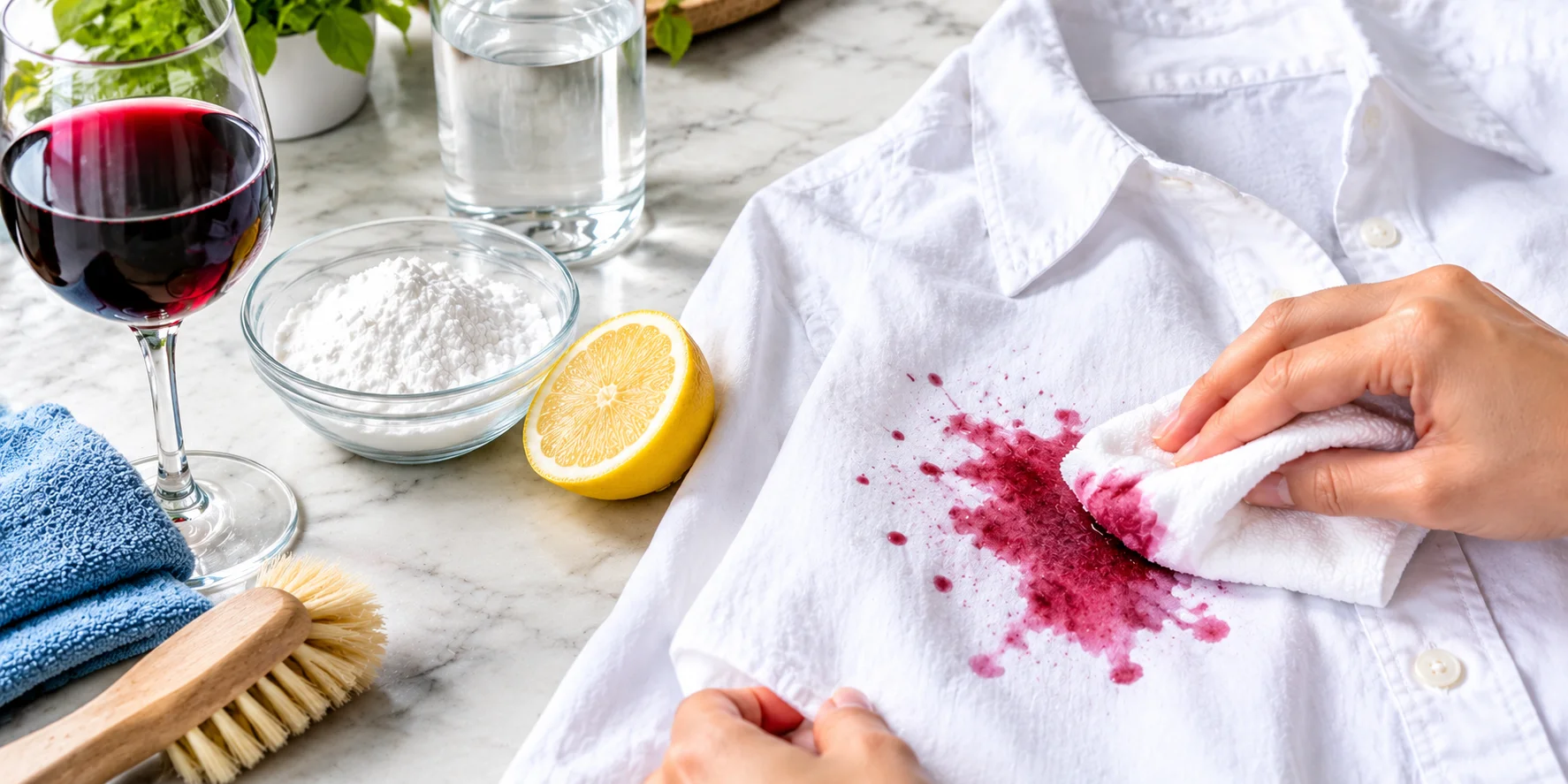
I ruined a shirt three years ago. Not because the stain won — because I panicked, half-treated it, then tossed it in the dryer figuring a hot cycle would finish the job. It didn’t. That shirt’s gone for good. And weirdly, it’s the thing I still think about whenever the topic of stain removal comes up.
People talk about red wine stains like they’re some unbeatable final boss. Fair enough — they’re fast, they’re dark, and they seem to shrug off whatever you throw at them in the first panicked minute. But once you’ve actually gone through the process a handful of times, you realize something most guides don’t say outright: these stains are very manageable. You just need to understand what’s actually happening in the fabric, and skip a couple of mistakes that almost everyone makes without realizing it.
This is a long one, on purpose. It covers the emergency response for a fresh spill, the full at-home treatment, what to do once a stain already dried in, how fabric type changes everything, and the specific mistakes that turn something fixable into something permanent. If you’re standing there right now with a wine glass in one hand and a ruined sleeve in the other, skip ahead to whichever section actually applies to you.
Why These Stains Fight Back So Hard
Worth understanding the enemy first, because it genuinely changes how you should approach the whole thing.
Red wine isn’t just colored liquid sitting on top of fabric. It’s pigment — mostly compounds called anthocyanins — plus tannins, plus a decent amount of acidity, all working together. Tannins are the real culprit here. They behave almost like a natural mordant, which is the kind of substance traditional dyers actually use to make color bond permanently to Fiber. So, the second wine hits your shirt, it isn’t just resting there. It’s already starting to lock itself in.
And it moves fast. Within a few minutes, pigment is already working its way into the Fibers. Give it an hour and it’s gone deeper still. Leave it overnight, and depending on the fabric, it may have set enough that one round of treatment simply won’t cut it anymore.
Heat is what really seals the deal, though. Hot water, a warm iron, a dryer cycle — all of them essentially cook the pigment into place, the same basic mechanism as setting a dye on purpose. Nearly every “I tried everything and nothing worked” story has a hot dryer hiding somewhere in the timeline. Mine certainly did.
So really, two things matter more than anything else: how fast you move, and whether you keep heat away from the fabric until you’re sure the stain’s gone. Everything past that is just detail.
The First Sixty Seconds: What to Do the Moment It Happens
Catching a spill in real time is a real advantage. Don’t waste it by panicking, and definitely don’t scrub.
Scrubbing feels productive, which is exactly the problem. It’s instinct — something spills, you rub at it. But rubbing wine into fabric drives the pigment deeper into the weave and drags it sideways into fabric that was clean a second ago. You end up with something bigger and more stubborn than if you’d just left it alone for ten seconds and thought first.
Here’s what actually helps in that first minute:
- Blot, don’t rub. Take a clean cloth, napkin, or paper towel and press straight down onto the stain, lifting up. Repeat with a clean section of cloth each time so you’re not just smearing wine back and forth.
- Work from the outer edge inward. This keeps the stain contained instead of spreading it into a bigger circle.
- Remove as much liquid as you can before applying anything else. You want to be treating a damp stain, not standing water.
Someone spills wine, and within seconds three people are dumping table salt on it like it’s some kind of ritual. I’ve seen it happen more times than I can count. Salt does absorb liquid, which genuinely helps. What it doesn’t do is dissolve pigment or lift a stain out on its own — think of it as first aid that buys you a few minutes, not an actual fix.
If You’re Out Somewhere Without Supplies
Nobody carries stain remover to a dinner party. If you’re caught empty-handed, club soda’s your best option — the carbonation lifts a bit of the pigment, and it won’t damage the fabric the way some acidic substitutes can.
Plain cold water does the job reasonably well too, in a pinch. Just steer clear of hot water here, no matter how tempting. It feels like it should help — heat usually “cleans better,” right? — but with a tannin-heavy stain like this, heat is working against you from the first second.
The Real Fix: A Step-by-Step Method for Fresh Stains
Once you’re home and the immediate panic has settled, here’s the process that consistently gets good results, particularly on cotton, linen, and most synthetic blends.
Step 1: Blot One More Time
Before applying any treatment, blot the area again to pull out as much remaining wine as possible. If the item is still wearable and manageable, stretch the stained section taut over a bowl or over the edge of a sink. This matters more than it sounds like it should — a taut surface lets whatever you apply next soak in evenly, rather than pooling unevenly in the loose fabric.
Step 2: Apply Dish Soap and Hydrogen Peroxide
Ask around in textile care circles and this combo comes up again and again — it’s earned that reputation the hard way. Mix a tablespoon of regular dish soap with a tablespoon of 3% hydrogen peroxide, the kind you’ll find on any pharmacy shelf. Apply it right onto the stain, then leave it alone for about ten minutes.
Here’s the part I still find satisfying every time: you can actually watch it happen. The stain fades right in front of you, which is rare in household cleaning — usually the “before and after” only exists in marketing photos, not in real life.
One caution, because this step catches people off guard: hydrogen peroxide bleaches, even if only mildly. On dark or cooled fabric, it can lighten more than just the stain. Test it somewhere hidden first — an inside seam, a hem — before you go near anything visible. And silk or wool? Skip peroxide on those entirely. Not worth the gamble.
Step 3: Rinse Thoroughly with Cold Water
Rinse from the back of the fabric so the treatment, and the stain riding along with it, exits the way the wine originally came in, rather than pushing deeper through the weave. Cold water only, every time. This is not the moment to switch to warm water because it “feels” more thorough — it isn’t, and it can undo the progress you’ve already made by re-setting whatever pigment is still loosening up.
Step 4: Wash As Normal — But Inspect Before It Goes Anywhere Near Heat
Launder the item according to its care label as usual. This next part is the single most important rule in this entire guide, so it’s worth repeating clearly: never put a treated item in the dryer until you’ve confirmed, under good light, that the stain is completely gone. Dryer heat will set any remaining pigment permanently. A stain that was still fixable an hour ago becomes a lifetime resident of that garment after one dryer cycle.
If there’s any trace of color left after washing, repeat the treatment before drying. It’s repetitive and a little tedious, yes, but it beats losing the item entirely, and it’s exactly the step that made the difference for the shirt I mentioned at the start — except in my case, I skipped it, which is exactly why that shirt didn’t survive.
What About Stains That Have Already Dried?
Most generic advice gets frustratingly vague right here, which is a real gap, because dried wine stains are incredibly common. Nobody spots the small splash on the back of their shirt until three days later — usually while pulling laundry out of the basket, staring at it, trying to remember what even happened.
Harder to remove, sure, but rarely a lost cause. The pigment’s had time to settle deeper into the fibres by now, so don’t expect one round of treatment to finish the job. Patience and repetition are really your only tools once a stain’s gone dry.
Here’s what tends to work:
- Soak the garment in cold water for around 30 minutes first. This loosens whatever’s bonded to the fabric and sets up everything after it to actually work.
- Mix baking soda with a little water into a thick paste, apply it to the stain, and leave it for 15 to 20 minutes.
- Rinse well, then move into the dish soap and hydrogen peroxide method from earlier.
- Expect to repeat this. Dried stains often need two or three full rounds before they actually give up — a faint mark after the first attempt isn’t failure, it’s just where you are in the process.
I’ll be straight with you: some stains that have been through a full dry-set-then-dry-again cycle just aren’t coming out completely, no matter how many rounds you throw at them. That’s the point where a professional cleaner earns their fee — enzyme treatments they have access to are considerably more aggressive than anything you can safely use at home, and for anything expensive or sentimental, it’s worth the money rather than giving up on it yourself.
Fabric Changes Everything, and Most Guides Skip This
A method that works great on a cotton t-shirt can genuinely wreck a silk blouse. Treating every fabric the same way is a fast route from “stain problem” to “now I’ve ruined the whole garment” problem.
Cotton and Linen
The most forgiving fabrics you’ll come across. Hydrogen peroxide, vinegar-based treatments, repeated washing — they take all of it without much complaint. Stick to the standard method above and you’ll usually get solid results, even on a stain that’s had some time to settle.
Wool
Needs more caution. It doesn’t handle high heat well, and repeated exposure to harsh chemicals — hydrogen peroxide included — can leave it yellowed or brittle over time. Cold water, a wool-safe detergent, and gentle blotting should be your default. If you decide to try peroxide anyway, test it somewhere completely hidden first, an inner seam works well, and keep an eye on it while it sits.
Silk
Silk deserves the gentlest treatment of all, full stop. Skip the dish soap and hydrogen peroxide combination entirely — it’s simply too harsh for the Fiber. Blot with cold water and, if needed, a small amount of a silk-specific stain remover. When there’s real doubt, and with silk there often is, taking the item to a professional cleaner is the safer route. This isn’t the fabric to experiment on with kitchen-cupboard remedies.
Synthetic Fabrics (Polyester, Nylon, and Blends)
These generally hold up well to the standard treatment. One thing worth watching for: polyester in particular can trap oily residue from dish soap if you don’t rinse thoroughly enough, which can leave a faint greasy mark even after the wine stain itself is gone. Give synthetics a slightly longer rinse than you think is necessary.
A Real Example Worth Mentioning
A colleague of mine spilled red wine straight across a white tablecloth exactly a week before hosting a big family dinner. Not great timing, to put it mildly. She didn’t have the luxury of fussing over it right then, so she soaked the whole thing in cold water overnight, then ran the dish soap and peroxide treatment early the next morning before work — leaving it on a bit longer than the usual ten minutes, since the stain had already started drying by then.
It came out almost completely. What was left was a faint mark, the kind you’d only catch if you already knew where to look and the light happened to hit it right. She used the tablecloth anyway. Nobody at dinner said a word about it — either they didn’t notice, or they were kind enough to keep it to themselves.
The lesson isn’t really about the exact timeline she followed. It’s that even under real-world pressure — limited time, no perfect conditions, a stain that had already started drying — the basic method still worked, as long as she stayed patient with it and didn’t rush the process by reaching for heat too early.
Mistakes That Consistently Make Wine Stains Worse
- Using hot water. It feels productive in the moment, but it actively sets protein and pigment-based stains rather than lifting them.
- Scrubbing aggressively. This spreads the stain outward and can damage the fabric’s Fibers, sometimes leaving a rough or fuzzy patch even after the color is gone.
- Drying the item before confirming the stain is fully gone. This is the single biggest cause of “permanent” wine stains. Heat locks in whatever pigment remains.
- Relying entirely on salt. Useful for absorbing liquid in the first moment, but not capable of lifting a stain on its own.
- Waiting too long to address it. Time is genuinely the biggest factor in how removable a stain ends up being. A stain treated within the hour behaves very differently than one left for a day or two.
Do the Old Home Remedies Actually Work?
There’s a persistent claim that pouring white wine over a red wine stain somehow cancels it out. It’s mostly myth. White wine does have a mild diluting effect, and its acidity can loosen the stain slightly, but it’s not doing anything meaningfully more than cold water and prompt blotting would accomplish on their own. Save the white wine for drinking — it’s not earning its keep as a stain remover.
Milk soaking is a slightly more interesting case. There’s some basis in older laundry tradition for soaking a stained item in milk overnight, since the proteins in milk can bind with certain pigments and help lift them out. That said, it’s inconsistent in practice and generally more effort, and more mess, than simply using hydrogen peroxide from the start.
Vinegar sometimes gets recommended as a stand-alone fix. It can help loosen very fresh, very light stains, but on its own it’s rarely strong enough to fully clear anything beyond that. It works better as a supporting step than a solution by itself.
Building a Small Wine Stain Kit (So You’re Never Caught Off Guard)
If wine spills are a semi-regular occurrence in your household — and if you host people often, they probably are — it’s worth putting together a tiny dedicated kit rather than scrambling every single time. This doesn’t need to be elaborate. A small pouch or box with a handful of items, kept somewhere accessible, makes the difference between calm, effective treatment and a stressed-out search through the kitchen cabinets while a stain sets deeper by the minute.
Here’s what’s genuinely worth including:
- A small bottle of 3% hydrogen peroxide. It has a shelf life, so replace it every few months if it’s not getting used regularly, since it loses potency over time.
- A travel-size dish soap. Any basic, unscented dish soap works fine — you don’t need anything fancy or specifically marketed for stain removal.
- A few clean white cloths or a stack of paper towels. White specifically, so you’re not accidentally transferring dye from a colored cloth onto the stained fabric.
- A small container of baking soda, useful both for the paste method on dried stains and as a general deodorizer if the fabric picks up any residual wine smell.
- A travel bottle of club soda, if you want to be extra prepared for events away from home, though this one’s more of a nice-to-have than essential.
Keeping this together in one spot means that when a spill happens — at your own dinner table or someone else’s — you’re not improvising with whatever’s nearby. You’re just following a process you already know works.
Why “Immediate Panic” Usually Backfires
There’s a specific pattern that shows up constantly with wine stains, and it’s worth naming directly: the person who panics tends to do worse than the person who takes ten seconds to think before acting. Panic leads to scrubbing. It leads to grabbing the nearest liquid, sometimes something actively harmful like a strongly scented cleaning spray, and dumping it on the fabric without checking whether it’s appropriate for the material. It leads to throwing the item in the wash immediately without pre-treating, which very often isn’t enough on its own.
The people who get the best results are usually the ones who pause, blot calmly, and then move through the process methodically rather than trying every remedy they’ve ever heard of all at once, layered on top of each other. Mixing treatments — say, applying vinegar, then salt, then dish soap, then hydrogen peroxide, all within a few minutes — can actually interfere with each other and, in some cases, make the fabric’s reaction less predictable. Pick one method, follow it through, and only move to a different approach if the first genuinely isn’t working after a fair attempt.
This matters especially in social situations, where there’s an added layer of embarrassment pushing people to act fast and look like they’ve got it handled. It’s worth resisting that instinct. A calm, correct response that takes an extra thirty seconds will always outperform a fast, incorrect one.
When It’s Genuinely Time to Call a Professional
Not every stain is a DIY project, and there’s no shame in recognizing that early rather than after you’ve already made things worse. A few situations where it’s worth skipping the home remedies entirely and going straight to a professional cleaner:
- The garment is silk, delicate lace, or another fabric where you’re genuinely unsure how it will react to any treatment.
- The item has significant financial or sentimental value — a wedding dress, a tailored suit, an inherited piece of clothing — where the cost of a mistake far outweighs the cost of professional cleaning.
- You’ve already attempted home treatment two or three times without meaningful improvement, which usually signals the stain has bonded deeply enough that stronger, enzyme-based products are needed.
- The stain covers a large area or involves a mix of substances beyond just wine, such as wine combined with food or sauce, which can complicate the chemistry of what’s actually happening in the fabric.
A good dry cleaner has access to solvents and enzyme treatments that aren’t safely available for home use, and describing exactly what happened — what the fabric is, roughly how long the stain has been there, and what you’ve already tried — helps them choose the right approach rather than starting from scratch.
FAQs
Can toothpaste remove red wine stains?
Not reliably. Toothpaste is often suggested for ink or grease-based stains, but it doesn’t do much against the tannin-and-pigment combination in wine. It’s not worth relying on here.
Does club soda actually work, or is that just a party myth?
It genuinely helps as an emergency measure. The carbonation and mild acidity lift some of the pigment before it has a chance to fully set. It’s not a complete solution on its own, but it buys valuable time until you can treat the fabric properly at home.
Is it safe to use bleach on red wine stains?
Only on fabrics explicitly labelled bleach-safe, and typically only white ones. Even then, chlorine bleach can react unpredictably with wine tannins and sometimes leaves behind a yellowish tint rather than a clean white. Hydrogen peroxide tends to be a gentler and more predictable alternative for most household situations.
What if the stain has already been through the dryer?
It’s a harder situation, but not always a hopeless one. Try the dried-stain method described above, and be prepared to repeat it several times. Some heat-set stains do eventually respond to persistent treatment, though results vary considerably depending on the fabric type and exactly how hot the dryer ran.
How long does it typically take before a wine stain becomes essentially permanent?
There’s no exact cutoff, but the first few hours make the biggest difference by far. Stains left completely untreated for several days — especially if they’ve already gone through a full wash-and-dry cycle — become significantly harder to remove, sometimes to the point where full removal isn’t realistic.
Can this method be used on carpets or upholstery?
The blotting and dish soap/hydrogen peroxide approach can work on certain types of upholstery, but always test an inconspicuous, hidden area first, since fabric reactions vary considerably between materials. Carpet in particular tends to respond better to a carpet-specific stain remover formulated for that Fiber type rather than a general clothing method.
Does the type of red wine matter?
To some extent, yes. Darker, more tannic wines — a deep Cabernet Sauvignon, for instance — tend to stain more aggressively and set faster than lighter-bodied reds like a Pinot Noir. The treatment method stays the same either way, but a heavier wine may require an extra round of treatment.
Is there a difference between machine-washing and hand-treating for this type of stain?
Hand-treating first is important regardless of how you eventually wash the item, because a washing machine alone, without pre-treatment, generally isn’t strong enough to fully lift a set-in wine stain. Pre-treat by hand, then machine wash as a follow-up step, not a substitute.
Final Thoughts
Red wine stains feel catastrophic in the moment they happen, but in practice, most of them are entirely manageable if you move with reasonable speed and match your treatment to the specific fabric you’re dealing with. Blot instead of scrubbing. Hold off on any heat — warm water, ironing, the dryer — until you’ve fully confirmed the stain is gone. Cotton and linen will forgive quite a few mistakes along the way; silk and wool ask for a much gentler, more careful hand.
And if a stain does slip past you and dries in overnight, or even over a few days, don’t write the garment off immediately. As the tablecloth example above shows, patience and the right combination of treatments can undo more damage than people typically expect, even under less-than-ideal circumstances.
If you host dinners or gatherings with any regularity, it’s worth keeping a small bottle of hydrogen peroxide and some dish soap on hand specifically for this purpose. It’s a small, low-cost habit, but it’s quietly saved more clothing, tablecloths, and the occasional couch cushion than most people realize until they’ve actually needed it.