


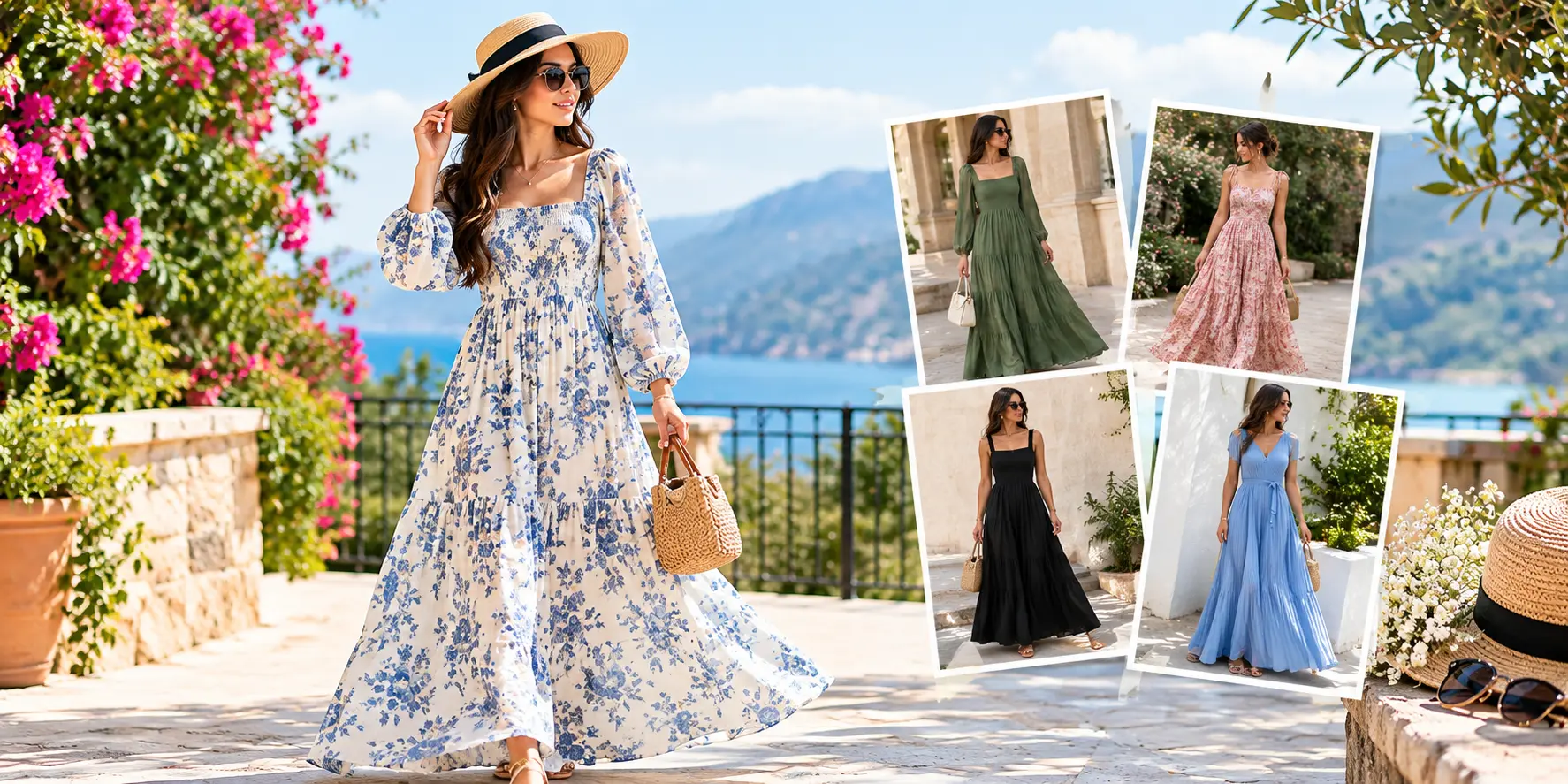
I bought a maxi dress off a mannequin once. Didn’t try it on first. The sales girl at Kohinoor Mall in Faisalabad told me “yeh sab pe achi lagti hai” — this looks good on everyone — and I believed her because I was in a hurry and twenty-something and, apparently, easily convinced.
It did not look good on me. I’m 5’2″, and the hem just… pooled. Around my ankles. Like I’d wrapped myself in a bedsheet and added sleeves for effect. I tripped on it walking to the car, in front of people, and had to laugh it off because what else do you do.
Three years later and, somehow, I own around a dozen of these things now. So clearly I got over the trauma. What actually happened in between is I kept making smaller versions of the same mistake — wrong fabric for the weather, wrong waist for my shape, once a slit that was way higher than I’d realized in the store lighting until enough of it added up into something I could actually write down.
Quick heads up before you scroll further this got long. I sat down to write a quick guide and then kept remembering one more thing I’d screwed up, or one more thing I’d watched a friend screw up, and just didn’t stop. Would rather give you too much than the usual short, forgettable version of this article.
What Actually Counts as a “Maxi” Dress
People overcomplicate this. It’s ankle-length to floor-length. That’s the definition, full stop.
Shorter than that and it’s a midi. Something that pools on the floor when you’re standing up straight isn’t really a maxi either that’s a gown, technically, though nobody’s going to stop you from calling it a maxi at a wedding.
Within that one length category you’ll come across a handful of different builds. Fitted maxis hug your shape and usually have some stretch to them. A-line ones flare out from the waist or bust. Wrap maxis tie at the waist so the fit adjusts to you rather than you adjusting to it. There are shirt-style maxis with a button front and collar, which read more daytime, and kaftan-style ones that skip the waistline entirely and go for comfort over shape. There’s also the slip-dress maxi, usually satin or a satin-like fabric, cut on the bias so it skims rather than clings, and the tiered maxi, which is built out of stacked layers of fabric and tends to have more movement and volume than the others.
I own two A-line and two wrap, plus a jersey slip-style one I reach for more than I’d like to admit. The wrap ones still get worn the most, and I’ll explain why a little further down.
A Short, Honest History of the Maxi Dress
Small tangent here, and I’ll be upfront I went and looked this up purely out of curiosity halfway through writing this, not because I planned some big history lesson from the start. Turned out to be more interesting than expected though, so keeping it in.
The loose, ankle-skimming version most of us picture when we hear “maxi dress” really came out of the late 1960s and rolled through the 70s, largely as a pushback against the mini skirts and stiff, structured shift dresses that had ruled the decade before it. Looser silhouettes, natural fabrics, way less tailoring, way more movement bohemian, basically, back before that word got slapped onto every floral print in a fast-fashion catalog.
Then it kind of quieted down through the 80s and 90s, when fitted, structured shapes came back around, before making a real comeback in the early-to-mid 2010s think festival season, summer holidays, that whole aesthetic. What I find more interesting, honestly, is where it’s landed now. It’s not really one “look” anymore. You’ve got office-adjacent structured maxis worn with blazers, sporty maxi styles with built-in pockets and sneaker-friendly hems, and the more traditional flowy, bohemian version all coexisting under the same umbrella term. It’s less a trend at this point and more a permanent length category that different aesthetics borrow from.
Here in Pakistan it’s taken on a bit of its own identity, especially in ready-to-wear and lawn collections. It often blends into kurta silhouettes longer hems, fuller sleeves, embroidery around the neckline instead of sticking to that strictly Western, beach-cover-up version everyone pictures. Which, honestly, is part of why shopping for one locally can get confusing fast. A “maxi” on some Western fast-fashion site and a “maxi” in a local lawn catalog are frequently two different things wearing the same name.
The Length Rule Nobody Tells You
Back to that rust-colored A-line dress. Cotton blend, cost about 3,200 rupees, and again I hadn’t tried it on before paying for it, which in hindsight was the actual mistake, not the dress itself.
My cousin Amna saw me in it at dinner and said, and I remember this exactly, “tumhara pao kahan hai?” Where are your feet?
That’s the moment the length thing clicked. A maxi should hit around your ankle bone, maybe an inch above it if you’re planning to wear flats with it. Heels give you more room to work with because they lift you off the ground and take up the slack. Wear flats with something cut for heels and you end up with exactly what happened to me swallowed feet, tripping, a cousin who still brings it up sometimes.
I had it altered eventually. Problem solved, dress saved. I just wish someone had mentioned this before I spent money on something sight unseen.
There’s a version of this rule that applies to online shopping too, which almost nobody thinks about until they’re standing in front of a mirror holding a dress that’s clearly six inches too long. Product listings usually give the “model height” and the dress length measured flat, but they rarely translate that into what it’ll actually look like on someone shorter or taller than the model. If the listing says the model is 5’8″ and wearing a size small with no mention of hemming, and you’re 5’2″, assume you’ll need at least two to three inches taken off, sometimes more. It’s a good habit to just build that alteration cost into your budget before you even click buy, rather than treating it as a surprise expense afterward.
Picking the Right Length for Your Height
Not complicated, but specific, and this is the part most articles skip past.
Under 5’3″? Empire-waist or wrap styles are your friend here, more than anything else in the category. Waistline sits up near the bust, and it just… stretches you out visually, works better than you’d think. Drop-waist cuts do the opposite, so skip those if you can help it. And genuinely just plan on a tailor from day one. These dresses are mostly cut for someone taller to begin with, so if you’re on the shorter side, hemming isn’t optional. It’s just part of what you end up paying, even if the price tag never admits it.
Somewhere between 5’4″ and 5’7″? You lucked out. Most silhouettes just work, no adjustment needed, which is honestly a little annoying if you ask anyone shorter than that.
5’8″ and up, pretty much anything goes, including the kaftan cuts that tend to swallow shorter frames. High-slit maxis in particular look more intentional on taller bodies — there’s just more leg for the slit to actually do something with.
Waist placement, hem length, your actual height. Line those three up and the dress takes care of the rest.
What About Body Shape, Not Just Height
Height gets most of the attention in these guides, but body shape matters just as much and gets talked about far less. A few things I’ve noticed, from my own trial and error and from watching friends shop:
Carry more weight through your midsection? Go for a wrap-style, or something with a proper empire seam it gives you definition at the waist without actually clinging to it, which is the part that matters. Broader through the shoulders or bust? A V-neck does you more favors than a high boat neck, which tends to just add width where you don’t need it. If your hips are the widest part of you, look for an A-line that starts flaring from the waist itself, not one that clings through the hip and only kicks out near the knee — that second version draws the eye exactly where you probably don’t want it. And if you’re small-framed generally, not just short this one’s easy to miss be careful with kaftans and heavily tiered styles. All that fabric can swallow a petite frame whole, regardless of your actual height.
None of this is a rule you have to follow. It’s just useful to know before you buy, rather than after.
Fabric Matters More Than the Print
I used to shop by print alone, which was a mistake I made for longer than I’d like to admit. The fabric is what actually decides whether you’re comfortable through a Faisalabad summer or sweating by noon regardless of how good the dress looks on the hanger.
Cotton and cotton blends are the safe everyday pick breathable, practical, wrinkles fast though, so don’t expect it to look crisp past 10am. Chiffon and georgette move beautifully when you walk, which is half the appeal, but a lot of it needs lining underneath or it’s basically see-through I learned that one the hard way at a cousin’s mehndi, wearing white pants underneath because I hadn’t checked in time. A lot more brands are selling pre-lined chiffon these days though, so just check the tag before you hand over your money and save yourself the scramble. Linen’s the one I have the strangest relationship with. It breathes even better than cotton, wrinkles about ten times worse, and somehow that whole rumpled, slightly-undone look still ends up reading as intentional rather than like you slept in it. I own exactly one linen maxi. I love it. I also iron it every single time before wearing it, no exceptions, which kind of defeats the entire “low effort” point of owning one, but here we are.
Then there’s jersey or knit, which is stretchy, forgiving, and doesn’t wrinkle when you shove it in a suitcase. If you’ve never owned a maxi and want the lowest-risk first purchase, start there.
Silk and satin maxis live in a slightly different world more elevated look, drapes beautifully, but shows every trace of sweat or deodorant almost the second you step outside, which rules them out for anywhere with actual sun involved. Keep those for evenings, somewhere with AC. Rayon and viscose show up in most mass-market maxi dresses for a reason — they fake the drape of silk without the silk price tag. Fine for most purposes, though I’d warn you the cheaper versions can go a bit static-y and cling in places you’d rather they didn’t, especially in dry weather.
Honestly, I think chiffon gets more praise than it’s earned when it comes to actually living in it day to day. Sure, it photographs gorgeous. Doesn’t help much when you’re running errands or stuck in traffic for forty minutes sweating through it. Jersey wins that particular fight every single time save the chiffon for whenever someone’s actually pointing a camera at you.
How to Actually Style One
This is where people get stuck, honestly. They fall in love with the dress in the fitting room and then get it home and just… stare at it hanging there, no clue what to actually do with it.
For something casual during the day, I usually go denim jacket thrown over it, sleeves rolled up, flat sandals, whatever crossbody bag is closest. Want it slightly dressed up? Drop the jacket, add heels and something with a bit of statement to the earrings, maybe a belt at the waist if the dress isn’t already doing any shaping on its own. Cold weather means a cardigan or a proper long coat on top, boots underneath yes, you really can wear these past summer, I’ll get into that further down. And if it’s an actual formal-ish thing you’re headed to, keep it simple: solid color, a clutch, heels, jewelry kept minimal, and just let the dress carry the whole outfit on its own.
The belt trick specifically is underrated. Any shapeless kaftan sitting in your closet because it feels too much like a tent a wide belt at the natural waist fixes that in about five seconds. Suddenly it reads as intentional instead of like you grabbed the nearest piece of fabric on your way out the door.
Layering is the other underused tool here, beyond just cardigans and jackets. A structured blazer over a solid maxi is one of the easiest ways to make the dress read as slightly more office-appropriate without changing the dress itself I’ll get into this more in the work section below. A long vest or waistcoat does something similar, just with more texture to it. And if a plain maxi ever feels a bit too plain on its own which happens a scarf tied loosely at the neck, or knotted at one shoulder, adds enough without you having to build a whole second outfit around it.
My personal rule for jewelry, which I did not invent, someone probably told me this years ago and I’ve just been repeating it since: busier print, quieter jewelry. Plainer dress, go bigger — statement earrings, a chunky necklace, stack the bangles if you feel like it. I break this rule sometimes and regret it every time.
What Changed for My Friend Sana
My friend Sana teaches grade 6 at a school in Lahore. Last year she mentioned she was tired of her closet too many separates that didn’t feel easy to put together some mornings, nothing that just worked without thinking. On her non-uniform days, she basically switched over to maxi dresses.
She bought four over about two months. One jersey, two cotton, one wrap-style in a print. Total spend landed around 14,000 rupees, which she pointed out was still less than what she used to spend replacing random tops and bottoms that never quite matched each other anyway.
Her words, not mine: “ab subah sochna nahi parta.” Now I don’t have to think in the morning. She just grabs a dress, throws on sandals or sneakers depending on what kind of day it is, and she’s out the door in under two minutes, no standing in front of the closet debating anything.
Kind of the whole point of the category, if I’m being honest about it. Less about how it looks and more about not having to make one more decision in a morning when you already don’t have the energy for it.
Maxi Dresses for Specific Occasions
Wedding Guest
Honestly, this is probably the number one reason most people go looking for a maxi dress in the first place and it’s also where I’ve watched the most mistakes happen, mine included. First rule: don’t get anywhere near bridal territory. That mostly means steering clear of all-white or very pale ivory unless the invite specifically says otherwise, which, let’s be real, it almost never does. Embellished pieces beading, sequins, embroidery work fine for evening functions but can come off like overkill at a daytime nikkah or a more low-key mehndi. What tends to actually work well, and photograph well too, is a structured solid in a rich color with jewelry that makes a statement on its own, so it doesn’t fight with whatever’s going on around it. One more thing worth doing: check the dress code twice before you show up in something too casual, fabric-wise, like plain cotton. Some of these events expect real formality, and a maxi dress alone won’t always get you there.
Office and Business-Casual Settings
A maxi dress can absolutely work at the office, but it needs a bit of engineering to get there. Structured fabric over flowy fabric, solid colors or subtle prints over anything loud, and a blazer or cardigan layered on top to break up the length and add a more “put together” silhouette. Sleeveless maxis usually need a layer over them in professional settings regardless of how hot it is outside. And this is worth saying directly a slit that goes above mid-thigh, no matter how good it looks, tends to read as too casual or too revealing for most office environments, so it’s worth checking the slit height before buying anything you’re planning to wear to work.
Travel
This is where jersey and knit fabrics earn their keep. A maxi dress genuinely might be the single most efficient travel garment that exists it doesn’t wrinkle if you pick the right fabric, it works as both daywear and something you can dress up slightly for dinner, and it takes up less suitcase space than a full outfit of separates. I’ve packed three maxi dresses and worn nothing else for an entire week-long trip before and never felt like I was repeating an outfit, mostly because a scarf, different shoes, and different jewelry did enough work to make each one feel new.
Everyday, Around-the-House Wear
Not every maxi needs an occasion. Some of mine exist purely for running errands, sitting around at home, or picking up something from the market without getting properly “dressed.” Cotton and jersey maxis specifically are worth having a couple of just for this no waistband digging in, no fitted anything, just something you can throw on in the time it takes to find your phone and keys.
Mistakes I’ve Made (So You Don’t Have To)
Buying it too long and never getting it altered is the big one, already covered above, but it’s worth saying twice because it’s the single most common issue. Too much fabric doesn’t read as elegant. It reads like you’re drowning in it.
Not checking for lining on sheer fabric is another. Hold it up to a light in the store before you buy it if you can see through it and there’s no lining sewn in, that’s a slip you didn’t plan on buying, added to your total later.
Owning six of the exact same silhouette is a smaller mistake but a real one. If every maxi in your closet is A-line, the wardrobe starts to feel repetitive even though technically you have variety on paper. Mixing in something wrap-style or fitted breaks that up.
There’s also ignoring whether you actually like waist definition or not. Kaftans are supposed to be loose that’s the entire point of them. But if shapeless clothing genuinely bothers you, an unbelted kaftan is going to annoy you every time you put it on, and no amount of “it’s supposed to look like that” will fix the feeling. Know that about yourself first.
And assuming maxi automatically means formal. It doesn’t. A plain cotton maxi in a simple print is about as casual and low-effort as clothing gets.
A newer mistake, one I only really started making once I began shopping online more, is trusting product photos without reading the actual fabric composition listed in the description. A dress can look like heavy, structured cotton in the photo and turn out to be a thin polyester blend once it arrives. Always check the material percentage listed, not just the photo, especially for anything you’re buying without seeing it in person first.
One more, specific to buying maxis online generally: ignoring the return policy. A lot of maxi dresses, because of the fabric volume involved, fit noticeably differently from the size chart depending on the brand’s cut. If a seller doesn’t offer returns or exchanges, that’s a real risk with this category specifically, more than it is with something like a t-shirt where sizing is more predictable.
How to Actually Care for a Maxi Dress
Nobody talks about this part, and honestly it matters more than people think, mostly because there’s just so much more fabric involved than in a regular top.
Cotton and linen you can generally throw in the machine on a gentle cycle, though I’d skip the tumble dryer for linen specifically it shrinks and roughs up the fibers faster than you’d expect. Chiffon and georgette, anything sheer or delicate, I hand wash, or if it’s something I actually paid decent money for, I just take it to the dry cleaner and don’t risk it. That fabric snags in a machine way too easily, especially if there’s any embellishment on it. Jersey’s the forgiving one out of the whole group cold wash, hang dry, done, and it’ll hold up for years without any fuss, which is honestly half the reason I keep recommending it throughout this entire guide.
The ironing is where I’ve actually ruined things, more than washing ever did. High heat on anything synthetic will shine or straight-up melt the fabric almost instantly, so check the tag first, keep it on the lowest setting that still gets the wrinkles out, and put a cloth between the iron and anything delicate or printed if you’re not sure.
Storage is the part people skip thinking about entirely, and it shouldn’t be. Leave a maxi hanging on a thin wire hanger for a few months and you’ll stretch the shoulder seams out of shape, especially with something heavier like linen. Get a wider, padded hanger instead — it genuinely makes a difference over time. And if you’re packing dresses away seasonally, make sure they’re completely dry and clean first. Any moisture or body oil left sitting in there for months tends to set into the fabric permanently, and by the time you pull it back out it’s too late to do much about it.
Wearing Maxi Dresses Beyond Summer
Summer’s the obvious season breathable, cool, easy to move in without thinking about it. But there’s no real reason to pack them away come September.
For fall, switch to something a little heavier a light wool blend or a denser jersey and layer with boots and a jacket. Winter takes more effort: tights underneath, a long coat over the whole thing, boots. It’s doable even if it’s less common, and it’s a decent way to keep getting use out of pieces that would otherwise just sit there from October to March doing nothing. Spring is basically summer with a lighter cardigan thrown on, maybe closed flats instead of sandals depending on how cold it still is.
One trick I picked up from Sana, actually, for cooler months specifically: thermal leggings or tights under a maxi dress do almost all the work of keeping you warm without changing how the dress looks from the front. Nobody can tell you’re wearing anything underneath unless the slit is unusually high, and it means you’re not stuck choosing between “warm” and “wearing the dress you actually want to wear” every time the weather turns.
Solid or Print?
Depends what you actually need it for, honestly.
Solids are more versatile easier to accessorize, easier to dress up or down, easier to repeat across different settings without anyone clocking that you’ve worn it before. If you’re building a small maxi collection from scratch and can only afford two or three right now, I’d lean solid for at least half of them.
Prints are more fun but harder to remix into different outfits, mostly because the print is already doing most of the visual work on its own. Skip the statement jewelry, skip the patterned bag, let it breathe.
There’s a middle ground worth mentioning too small-scale prints, like a fine floral or a subtle geometric, that read as almost solid from a distance but add texture up close. These tend to be more versatile than a bold, large-scale print while still giving you more visual interest than a flat solid color. If you’re on the fence between the two categories, this is usually a safe place to start.
My own closet is split three and three, roughly, plus a couple of the smaller-scale prints I just mentioned. If I had to pick a direction going forward I’d probably lean print, mostly because solids bore me faster than they should. That’s just a preference though, not something you need to follow.
Budgeting for a Maxi Dress Collection
I get asked this a fair bit, usually by people who’ve seen my closet and assumed I dropped a small fortune building it out. I didn’t. You don’t need to either.
For a first maxi dress in the local market, something in cotton or basic jersey from a mid-range brand, you’re realistically looking at 2,500 to 5,000 rupees more if you’re eyeing branded lawn collections or anything with embroidery on it. Chiffon and georgette pieces, especially the lined ones from recognizable brands, run higher, usually 6,000 to 10,000 depending on how much detailing is going on. And here’s the thing you can genuinely build a decent five or six-piece rotation for less than a lot of people spend on one single formal outfit, as long as you’re not spending evenly across everything. Mix your budget basics, the cotton and jersey pieces, with maybe one or two pricier statement pieces, an embroidered chiffon say, rather than treating every single dress like it needs to be special.
Tailoring’s a separate line item worth planning for too, since I keep bringing up hemming altering a maxi typically costs a small fraction of the dress itself, but across several dresses that adds up fast. Personally I’d rather own three dresses hemmed properly, that I actually wear, than five sitting untouched in the closet because the length’s wrong and I never got around to fixing it.
A Quick Checklist Before You Buy
Does the hem actually match your height, and the shoes you’re planning to wear it with? Is the waist placement empire, natural, drop actually flattering on you, not just on the model? Right fabric for the season you’ll wear it in most? If it’s sheer, is it lined, or are you also buying a slip now? Will it need a belt to look finished, and do you even own one that works? And, seriously, can you sit down in it without a fight try this in the fitting room, don’t just take my word for it and find out the hard way at a dinner table.
That last one’s the one people skip, and it’s the one that bites you later. A dress that looks perfect standing in front of a mirror can turn into an actual problem the second you’re in a car or seated somewhere, if the fabric’s too restrictive or the slit’s landed somewhere it shouldn’t have.
If you’re buying online, add a few more to that list: has the seller actually listed the fabric composition, not just the photo. Is there a real return policy, not just a “no returns on sale items” footnote. And are there recent photos from actual buyers, not only the studio shots. Those three alone would’ve saved me from at least two disappointing orders in the last couple of years.
Questions People Actually Ask Me About This
I get some version of these almost every time this topic comes up with friends or cousins, so figured I’d just answer them properly instead of burying the answers inside the sections above.
Can short girls even pull off maxi dresses? Yes, obviously I’m living proof, five foot two and all. You just have to be more careful than someone 5’6″ would need to be. Empire waist, hemmed to your actual height and not whatever length it happens to be on the hanger. Don’t cross the category off your list, just shop it a bit smarter than you would otherwise.
What shoes actually go with a maxi dress? Depends entirely on where you’re headed. Flat sandals for running around during the day, heels if you want it dressier, and honestly sneakers work with the more relaxed cotton ones better than most people expect I wore mine with white trainers to a brunch last month and nobody blinked. Boots once it gets cold.
Is a maxi dress okay to wear to the office? It can be, but it depends a lot on your specific office. Structured, solid-colored, in a decent fabric, thrown under a blazer that reads fine in most business-casual places. Something sheer and loud and flowy, less so. I’d say look at what your coworkers actually wear before assuming the whole category is either fine or off-limits.
How do I stop a maxi dress from making me look shorter? Empire waist. Vertical prints if you’re doing a print at all. Get it hemmed properly instead of leaving it long. Heels, if your feet will forgive you for it. And maybe skip the drop-waist cuts and horizontal stripes if height’s something you’re actively thinking about.
Can you actually wear these in winter, or is that just a summer thing? You can, it just takes more effort than most people are willing to put in. Tights or leggings underneath, a proper coat over the whole thing, boots. If you’re buying specifically with winter in mind, go for something a bit heavier than what you’d pick for July.
What’s actually the difference between a maxi dress and a gown? Mostly how formal and structured it is. Gowns tend to be floor-length, more built-up, made for actual formal events, sometimes with a train dragging behind you. Maxis are ankle-length and built for regular life. Sometimes the two blur into each other and honestly, nobody’s standing there measuring the hem to decide which category you’re in.
Do maxi dresses work on a plus-size frame the same way? Better, if anything, in my experience watching friends shop for them. All that extra fabric and length can create a genuinely flattering, elongated line once the waist placement is right. Same rules as everyone else, just pay a little more attention to where the fullest part of the dress sits against your body.
How many maxi dresses should I actually start with? Two or three is plenty to start. One solid, one print, maybe one in a fabric that’s different from the other two so you’ve got something for more than one season. You can build from there once you actually figure out what you reach for on a regular Tuesday, not just what looked good in the store.
That mannequin dress from Kohinoor Mall still hangs in my closet, altered now, actually wearable. I keep it around mostly as a reminder to try things on before I pay for them, and to actually read the fabric label instead of trusting a sales pitch. Some lessons you only learn the annoying way, apparently more than once.