


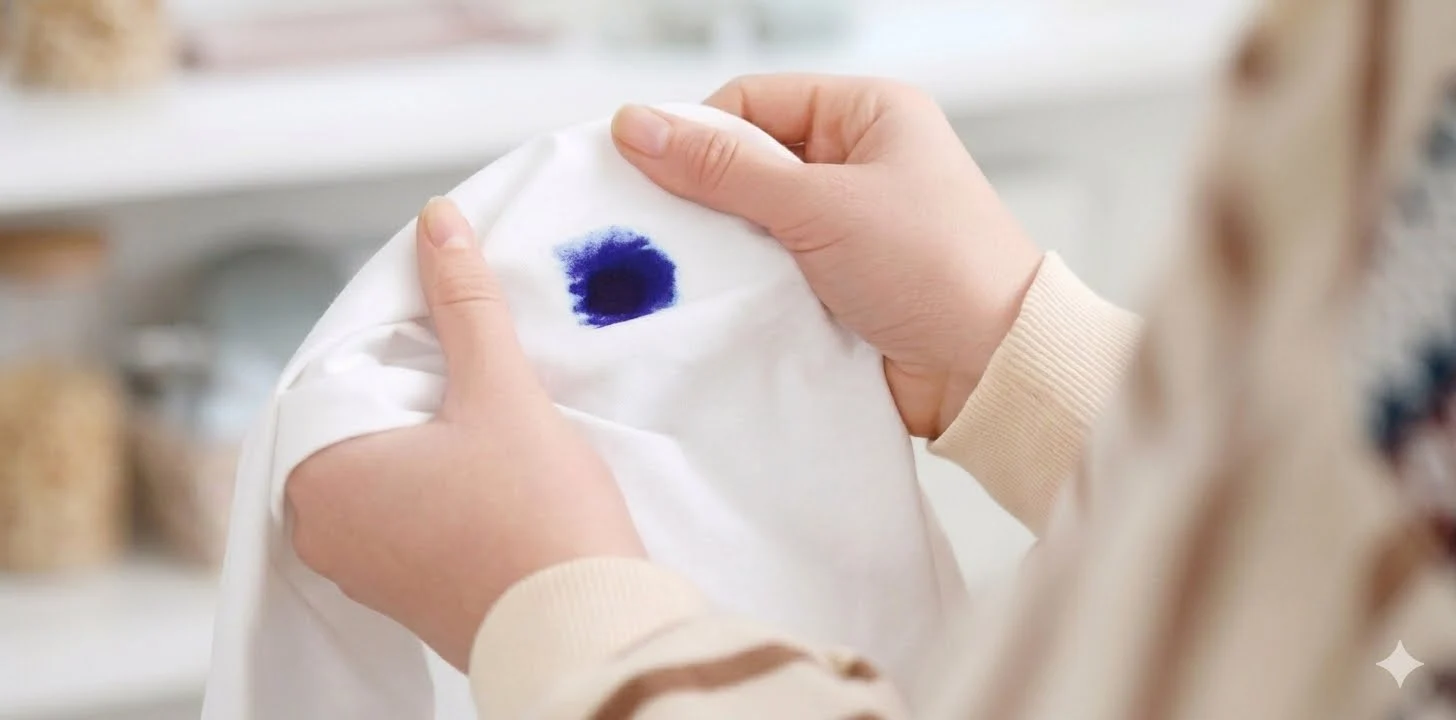
It was a white shirt. Which matters here, and I’ll admit I’d have grabbed a different one that morning if I’d given the pen in the pocket any thought at all.
I’d left a ballpoint clipped in the pocket and then left the car in an open lot for most of a July afternoon. This was outside a bank, and I remember the detail because the form took nine minutes to fill in and about forty to hand over. Came back to a steering wheel I had to grab through my sleeve. Didn’t think about the pen once.
Got home. Blue. Spreading. Bottle-cap sized and pretty clearly not finished.
Then I did the dumbest thing on the menu, which was hot water and a nail brush, and in roughly a minute and a half I took a stain I could’ve covered with my thumb and turned it into one I could just about cover with my hand.
Here’s what I’ve figured out since, mostly by ruining things. Getting pen ink out of clothes isn’t about owning some miracle spray. It’s about knowing which liquid dissolves which ink and then being extremely boring about applying it. Dab and wait, blot, do it again, don’t get impatient. That’s most of the job. The rest is knowing what not to touch.
The first minute decides most of it
If the ink’s still wet you’re in the best position you’ll ever be in, so don’t waste it.
Blot, don’t rub. Take a paper towel, fold it over a few times, press it flat down onto the stain. Then lift it straight up, and I do mean up rather than sideways. Clean bit of the towel, press again. Every sideways drag pushes ink into fibres that were fine two seconds ago, and this is the mistake I made, and I’d guess it’s the mistake behind about half the “nothing worked” stories you read.
The water has to be cold, and I mean actually cold, not lukewarm, not “well, it isn’t hot.” Heat is the single reason my shirt went from a bad afternoon to a write-off. Warm fibres relax and open up a little, synthetics worst of all, and oily ink reads that as an invitation to settle in properly. Something else worth knowing here, which took me embarrassingly long to work out: washing machines fudge this. Plenty of cycles labelled cool or cold still run warmer than your tap does, so for this first stage I’d stay at the sink and do it by hand.
And slide something absorbent underneath before you put any liquid on it. Paper towels folded into a pad, an old white rag, a bit of card wrapped in kitchen roll, whatever’s near. Skip this and you rinse the ink straight through the front of the shirt and onto the back of the shirt, which is how one stain becomes two. I’ve done that as well.
Last thing, and it belongs at the end really but people get it wrong so often it’s worth saying up front: nothing goes in the dryer until the stain is actually gone. Not nearly gone. Gone. A dryer will bake a faint grey shadow into the weave and after that there’s no undoing it, no matter what you throw at it later.
What kind of pen was it, though?
Most stain advice skips this and it’s the reason the same trick works brilliantly for one person and does nothing at all for the next one. Pen ink isn’t a single substance. It’s four or five quite different chemistries wearing the same plastic tube.
Ballpoint
Ballpoint ink is a thick oily paste. Dye sitting in something much closer to oil than water, which is exactly why a ballpoint keeps writing on a damp receipt and a rollerball just gives up.
Oil doesn’t come out with water. That’s the one fact you need. You could soak a ballpoint stain in cold water for half a day and barely change it. Alcohol is what breaks the oily carrier apart so the dye can float loose and get blotted away.
The good news is ballpoint stays cooperative for a surprisingly long time. Days, sometimes.
Gel pens
Gel pens are water-based too, which sounds like the same good news, and only about half of it is. What’s doing the colouring in a gel pen is pigment, not dye, and it’s carried in something thick enough that a fair bit of it never soaks all the way through. Cuts both ways, that. Rinse a fresh gel stain in cold water and a decent chunk of it simply leaves. Whatever did get in, though, holds on harder than dye would, because pigment particles physically wedge between the fibres rather than just colouring them.
Cold water first. Properly, not a token rinse. Alcohol afterwards for the rest.
Rollerball and fountain pen
Thin water-based dye. Runs fast, which is why a single drop of fountain pen ink on cotton is twice the size you expected within about four seconds.
That thinness is also the good part, though. This stuff dissolves in water, which is the entire reason a cold tap gets you most of the way there if you’re quick. I’ve had fountain pen ink off a cotton sleeve using nothing but tap water and a bit of dish soap on my thumb, and it took about a minute, but that was maybe forty seconds after it happened. An hour later and it’s a different job altogether.
Permanent marker
This one’s a different problem. Sharpies and similar markers use dye dissolved in alcohol along with a resin binder, and the whole design is that once the alcohol evaporates the resin locks the dye onto whatever it’s on. It is meant not to come off.
Alcohol still helps, since it re-dissolves that binder. You’ll just need more of it and more rounds, and you should decide now that “faded a lot” might be where this ends. White cotton gives you more room. A navy polo, less so.
The awkward ones
India ink, calligraphy ink, some artists’ inks — these often contain shellac or carbon black. Carbon black is basically soot, chemically it doesn’t want to dissolve in anything you own, and shellac sets hard. If a bottle of that has gone over something you care about, wrap it up and take it to a proper cleaner, and tell them what it was rather than letting them guess.
The method that handles most cases
Nine times out of ten this is what you’re doing.
Grab:
- 70% isopropyl alcohol (rubbing alcohol; the pharmacy near me labels it surgical spirit)
- White paper towels, more than you think
- Cotton wool or a cotton bud
- Dish soap
- Cold water, straight from the tap
Then:
- Pad goes inside the garment first, right beneath the stain. You want that stain sandwiched, fabric above it and something absorbent below.
- Dab alcohol on from the outside edge inward. Not a flood, but enough that the fabric goes properly damp in that patch. Working inward stops you widening the border of the stain.
- Now leave it alone for thirty to sixty seconds. Alcohol needs contact time. This step feels like doing nothing and it’s one of the important ones.
- Blot straight down. You want to see blue or black coming off onto the towel underneath — you’re not making ink vanish, you’re relocating it from the shirt to a towel.
- Fresh towel, more alcohol, wait, blot. Again. Five rounds, eight rounds, however many it takes until the transfer stops. Each cycle is under a minute.
- Rinse the spot under a cold tap, rub in a drop of dish soap with your fingertips, walk away for fifteen minutes.
- Cold machine wash with a decent enzyme detergent. On its own, or with similar colours, because loose ink will happily transfer to a towel it’s sharing a drum with.
- Air dry, then look at it in real daylight. Wet fabric hides faint marks and will lie to you.
Shadow still there? Run the alcohol cycle again before you let it anywhere near heat. Second passes work more often than you’d expect.
Hand sanitizer will stand in for alcohol at a pinch. Use the clear kind, not the blue gel with glitter and not the moisturising one, because the thickeners and emollients leave a ring you then have to wash out separately. Fine in an office bathroom. At home just use the real thing.
Try this: the three-rung ladder
If you’d rather not think about ink chemistry at all, use this instead. Start at the top, stop the second ink stops lifting.
Rung one, cold water and dish soap
Flush the back of the stain under a cold tap for half a minute, then soak the area in a bowl of cool water with a teaspoon of dish soap in it. Thirty minutes. This finishes off most fresh fountain pen, rollerball and gel stains all by itself and costs nothing, so it’s a stupid step to skip.
Rung two, isopropyl alcohol
The full dab-wait-blot cycle above. Ballpoint lives here.
Rung three, the soak
In a bowl:
- 1 tsp dish soap
- 1 tbsp white vinegar
- 2 cups cool water
Submerge the stained bit, thirty minutes, blot with a clean towel, rinse cold. For older stains do this after rung two rather than instead of it. Alcohol loosens the ink, the soak carries it out.
Three rungs, maybe ninety minutes, most of which is waiting around. If a mark survives all three you’re probably looking at permanent marker, an art ink, or a fabric that needs someone with a solvent cabinet.
Hairspray, milk, and the rest of the internet’s greatest hits
Hairspray. I think it’s overrated at this point, and here’s why. It worked in 1985 because hairspray then was mostly denatured alcohol in a pressurised can. Today’s formulas are largely water, film-forming polymers and conditioning agents, so you get a small amount of solvent plus a sticky residue you now have to deal with as a second problem. A bottle of rubbing alcohol is about $2.40 and lasts three years in a cupboard. Buy the alcohol.
Milk soaking survives mainly because it’s harmless. There’s a thin logic to it — mildly acidic, has fat and protein in it, can nudge water-based dye loose. But cold water and dish soap does the same job better, and doesn’t leave your shirt smelling like the back of a fridge if you forget about it overnight. Which you will.
Nail polish remover works and also carries the single biggest risk in this whole piece. Acetone dissolves acetate, triacetate and modacrylic. Not the stain. The fabric. You get a hole. A lot of linings, blouses, formalwear and older garments are acetate and the care label is the only warning you’re getting. If you’re going to use it at all, use non-acetone, test it on a hidden seam, and keep it off anything you couldn’t replace.
WD-40 does break down ballpoint ink, because naturally it does, and then you’ve swapped an ink stain for an oil stain. Salt and lemon juice is great on rust and does very little to pen ink.
Chlorine bleach deserves its own warning. On most inks it doesn’t remove the stain so much as unevenly attack the dye, and what you’re often left with is a yellowish brown halo that looks worse than what you started with. Oxygen bleach — the sodium percarbonate powders — is a far better bet, as a soak, on white or colourfast cotton, and only after the alcohol work is done. Not on wool. Not on silk. And never mixed with anything else, particularly not ammonia-based cleaners.
Fabric changes everything
Same ink, same technique, completely different result depending on what the thing is made of.
Cotton and linen are the forgiving ones. They put up with alcohol, soaking, agitation, and oxygen bleach if they’re white. Almost every ink-stain success story you’ve read is a cotton story.
Polyester and poly blends are harder than they look, because polyester is essentially plastic and oily ink takes to plastic in a way it doesn’t take to cotton. Alcohol still works, just slower, more rounds. The rule you cannot break with polyester is heat. Any warmth at all — hot water, an iron, twenty minutes in a dryer — and the ink is a permanent feature.
Denim copes well with solvents and doesn’t mind being handled, but indigo shifts, and you can end up with a pale patch that’s more obvious than the ink was. Test inside a hem. Work from the inside out where you can, since pushing ink back out the way it came in is easier than dragging it through.
Silk and wool. Protein fibres. They dislike alcohol soaks, they dislike agitation, and oxygen bleach damages them. Light dabbing only, and then get it to a cleaner within a day or two while it’s fresh. Silk ties especially: don’t experiment on a silk tie. Even plain water leaves rings.
Rayon and viscose go weak when wet and distort permanently if you work at them.
Leather and suede are a different job altogether. On finished leather a very light touch of alcohol on a cotton bud sometimes lifts fresh ink, and sometimes strips the finish and leaves a lighter patch instead. Suede is nap, and ink sinks into nap and stays. Specialist.
Spot testing takes twenty seconds. Inside a seam, under the collar, inside the hem. Dab, wait a minute, check whether any colour came off onto your cloth. If dye lifted, stop there.
The ink dried three weeks ago. Now what?
You’ve still got a decent shot. It’s just slower, and you should be honest with yourself about the ceiling.
Dried ink has bonded itself to the fibres and whatever was carrying it evaporated off long ago, which means the first job here isn’t getting the ink out, it’s getting it soft again.
Glycerin is what I’d reach for. Any pharmacy stocks it, it costs very little, and it goes straight onto the dry stain — rub it in with a fingertip, then walk away for fifteen or twenty minutes before you touch any alcohol. The dry cleaner two streets over told me about this one and seemed faintly offended that I didn’t already know it.
You can also skip the glycerin and just give the alcohol far longer than you’d give it on a fresh stain. Soak a pad. Lay it over the mark and top it up whenever the edges start drying, because a dry pad isn’t doing anything for you. Ten minutes, or fifteen if the mark’s dark, and then blot the way you normally would.
After that it’s repetition. Five gentle rounds will always beat one aggressive one, and scrubbing hard at old ink fuzzes the fabric surface so you end up with a dull worn patch even in the happy case where the ink does come out.
Realistically, on set-in ballpoint you’re looking at mostly gone with a faint ghost that only you can find. On a light fabric an 80% fade reads as clean to everybody except the person who put the stain there.
The one I actually remember: a school shirt, dictation day
My neighbour turned up at my door on a Thursday evening holding her son’s school shirt out in front of her like evidence in a case. White cotton, green crest stitched on the pocket, and a fountain pen stain running from the pocket seam down maybe four inches.
Bilal is nine. He had been refilling a cartridge pen in the middle of a dictation test and squeezed it in the way a nine-year-old squeezes things.
Two complications. It had happened around eleven that morning, so it was eight hours dry by the time I saw it. And she’d already had a go with hot water and washing powder, which had pushed the top edge of the stain out into a soft grey haze that hadn’t been there originally.
We ran it in three stages, about an hour and a half in total, most of it waiting.
Cold tap from the reverse side first, and I let it run a full two minutes. Fountain pen ink is water-based, so even eight hours in there was more loose dye than she expected. The water came out blue for longer than either of us thought it would.
Then the alcohol. Surgical spirit from the pharmacy on the corner, dabbed on with cotton wool over a folded towel, minute of contact each time, blot, swap the towel, again. Six or seven rounds. You could clearly see transfer onto the towel for the first four, and by round six it had basically stopped.
Then the dish soap and vinegar soak for half an hour, purely because of that grey haze from the hot water. That’s what finally brought the haze down, and I don’t think alcohol alone would have.
Cold wash, line dried. Main stain completely gone. What was left was a faint shadow about the size of a fingernail right at the pocket seam, where the ink had had the longest to sit. She ironed the pocket flap down over it and he wore it on Monday.
Not perfect. Nobody noticed. And she brought up the hot water thing again weeks later, unprompted, because that one reflex had added about forty minutes to the job.
Short list of things that make ink permanent
- Heat. Any form of it. Hot water, iron, dryer. This is the big one and it’s not close.
- Scrubbing.
- No barrier layer underneath, so the ink goes straight through to the other side.
- Chlorine bleach as an opening move — halos, wrecked dye, and the ink often survives anyway.
- Acetone on fabric you haven’t identified. Actual holes in actual clothes.
- Leaving it for weeks. Not fatal, but it’s the difference between a two-minute rinse and an evening’s project.
Not having to do this again
Mostly one habit, honestly.
Retractable pens are the real problem. A capped pen has a physical barrier between the ink and your shirt. A click pen has a spring and your general optimism about springs. If you’re carrying a pen in a pocket, carry a capped one and clip it writing-end up.
Second thing: pens and parked cars in summer don’t mix. That’s how my shirt died. Anything with ink in it that spends an afternoon on a dashboard in July is a small pressurised event waiting to happen.
Third, keep a small bottle of rubbing alcohol wherever the stains actually occur. Desk drawer, glove box, laundry shelf. The reason people lose to pen ink usually isn’t that they didn’t know what to do, it’s that the right bottle was in the wrong room for six hours while the ink made itself comfortable.
FAQs
Will rubbing alcohol bleach or fade my clothes?
On most colourfast fabric, no. It’s a solvent, not a bleach, so it dissolves the ink’s carrier rather than attacking dye. That said, some cheaper dyes and a lot of denim will bleed a bit. Spot test inside a seam first. Takes twenty seconds and I’ve stopped skipping it.
Does vinegar remove pen ink on its own?
Not really, no. It helps as part of a soak, mostly by adjusting the water chemistry and loosening what’s already been broken down. On its own against a ballpoint stain, you’ll be disappointed.
Can I use hand sanitizer instead of rubbing alcohol?
Yes, if it’s the clear alcohol-based kind. Avoid the coloured gels and anything labelled moisturising, since the additives leave a residue ring behind.
It’s already been through the dryer. Be honest?
Honestly? Your odds drop a lot. Heat-set ink is the hardest version of this problem. Still worth one attempt — glycerin for twenty minutes to soften it, then several long alcohol soaks with real contact time, then the vinegar soak. I’ve seen heat-set ballpoint fade by half. I’ve also seen it not budge at all, and there wasn’t an obvious reason for the difference either time. If the garment matters, take it to a cleaner and mention that it’s been dried, because that changes what they’ll reach for.
What removes pen ink from a white shirt collar specifically?
Collars are usually the easiest win, since it’s white cotton and there’s an interlining you can use as a natural barrier. Alcohol cycles, then a cold soak in oxygen bleach powder for a few hours, then wash. Comes out clean most of the time.
Do I need a proper commercial stain remover?
The good solvent-based ones do work, and if you deal with ink often they’re worth having. For a stain or two a year, alcohol plus dish soap covers the same ground for a fraction of the money.
Can I iron the shirt after treating it?
Once the stain is completely gone and the garment is dry, yes. While anything’s still visible, absolutely not.
The label says dry clean only. Should I just try anyway?
Depends what you’d feel worse about. On silk, wool, acetate or anything structured like a suit jacket, I’d take it in and not touch it — you can make a $60 stain into a $200 problem quickly. On a dry-clean-only cotton shirt, I’d probably try a careful alcohol dab and accept the risk. Your call, your shirt.