


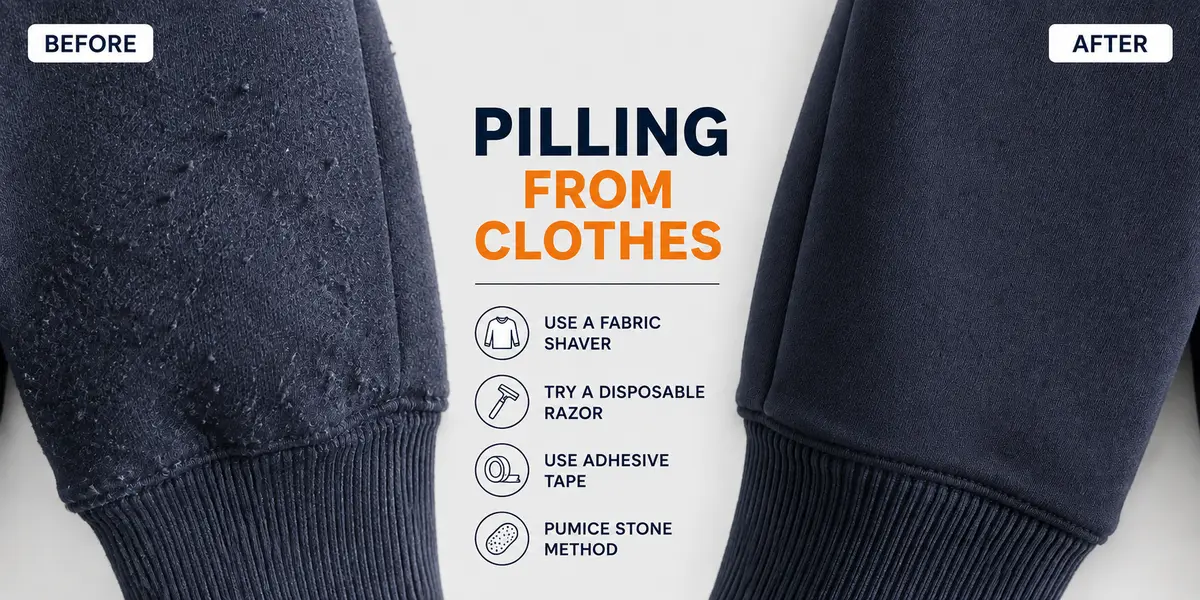
My favourite grey crewneck lasted about six wears before it started looking like it had a skin condition.
Not all over. Just two patches where my laptop bag strap crossed it, plus a fuzzy zone under each arm. Hundreds of tiny grey balls, sitting exactly where the fabric had been rubbing against something for hours a day. So I stood at the bathroom mirror picking them off one at a time with my fingernails, which took about twenty minutes and somehow made the whole thing look worse, because now there were thin flat spots sitting right next to the fluffy ones.
That was the week I finally bothered to learn how to remove pilling from clothes properly, instead of just attacking it and hoping.
There’s a right way. There’s a way that works but quietly costs the garment a year of its life. And then there’s the fingernail method, which is what most of us default to. The difference makes sense the second you understand what a pill actually is.
First, what you’re actually looking at
A pill isn’t dirt. It isn’t lint that landed on your sweater from somewhere else.
It’s your sweater.
Yarn gets spun from thousands of short fibre ends twisted together. Friction works some of those ends loose, they poke up out of the surface, more friction rolls them around, and eventually they tangle into a ball. The ball stays put because one or two stubborn fibres are still anchored down in the fabric. That’s the entire mechanism. Nothing arrived from outside — material migrated out and knotted itself up.
Which matters for exactly one reason: every pill you take off is fibre that came out of your clothes. There’s no free removal. So the goal was never a permanently pill-free sweater. The goal is getting the balls off without slicing into the healthy yarn underneath, and doing it as rarely as you can stand.
This is also why picking them off with your fingers is the worst option on the table. You’re not cutting the anchor fibre, you’re yanking it. Sometimes it lets go. Sometimes it brings three inches of yarn with it and now you’ve got a run instead of a pill.
The spots are never random
Look at any pilled garment and you can more or less reconstruct the owner’s week.
- Underarms and sides — arms swinging against the body, all day, every day
- Inner thighs — walking
- Lower back and seat — chair contact, and office chairs with that rough mesh weave are brutal
- One side of the torso only — that’s a bag strap
- Forearms and cuffs — desk edge
- Collar and upper back — hair, especially long hair with product in it
- A diagonal band across the chest — seatbelt
But the friction that does the most damage isn’t from wearing the thing at all. It’s the wash. Forty minutes of your clothes grinding against each other and against a metal drum, soaking wet, which is precisely when fibres are weakest. Then the dryer, which is the same abuse plus heat and more tumbling. A sweater that pilled “after three wears” usually pilled after three washes.
Blends pill worse, and that’s not bad luck
Here’s something that changed how I shop.
Pure cotton pills, sure, but the pills tend to fall off on their own because everything holding them on is also cotton and also weak. Same with a lot of wool — it sheds and fuzzes rather than forming hard little beads.
Now mix cotton with polyester. The cotton fibres break and work loose exactly the same way. But the polyester filaments are strong, smooth and basically indestructible by comparison, so they hold that ball of broken cotton onto the surface indefinitely. The pill can’t leave. It just sits there getting denser and greyer.
That’s why a cheap 60/40 sweatshirt turns into a beaded mess by February and a good merino jumper mostly doesn’t. It’s not always about price. It’s about what’s twisted together in the yarn.
The tools, ranked honestly
I’ve tried basically all of these. Some are worth the shelf space, some absolutely aren’t.
Electric fabric shaver — for most people this is the whole answer
Get one. If you take one thing from this article, take that.
It’s a small handheld unit with a spinning blade behind a metal mesh screen. Pills poke through the holes, the blade shears them off at the base, the fuzz drops into a chamber. Because the screen holds the blade at a fixed distance from the fabric, it’s much harder to cut into the garment than with anything you’re steering by hand.
Mine cost about nineteen dollars, plugs into the wall, and has been going for three winters. What to actually look for:
- A metal screen, not plastic, with a mix of hole sizes
- An adjustable spacer ring so you can lift the blade further off delicate fabric
- Mains power or a proper rechargeable battery — AA-powered ones lose torque fast and a slowing blade tugs instead of cutting
- A chamber that pops open easily, because you’ll be emptying it constantly
The novelty ones for five or six dollars with one tiny screen and a whining little motor? Skip. That’s not me being snobby about tools, it’s that a weak motor stalls in dense knit and stalling is what causes damage. This is one of the rare cases where the cheap version is worse at the job in a way you’ll notice in ten seconds.
Sweater comb — for anything you’d be nervous about
A flat metal comb with very fine teeth, sometimes described as a “sweater stone” alternative. Cheap, no battery, no motor, and near-impossible to destroy a garment with.
Slow, though. You’re combing in short strokes and lifting pills mechanically rather than cutting them, which takes real patience on a large area. Where it earns its place is cashmere, loose gauge knits, anything hand-knitted, and any garment expensive enough that you feel slightly sick pointing a blade at it. My mother’s lambswool cardigan is something like twelve years old and still presentable because she combs it once a season and has never once put it in a machine.
Sweater stone — cheap, effective, genuinely messy
A block of light pumice-like material. You rub it over the fabric and it grabs pills through sheer abrasion.
Great on chunky cotton knits, sweatshirts, blankets and fleece. Too aggressive for fine merino or anything thin. And it crumbles as you use it, so do this over a bin or outside unless you enjoy vacuuming. Costs almost nothing and lasts a couple of years.
The disposable razor method — free, but you’re gambling
Yes, it works. It’s also how people put holes in sweaters.
If you’re going to do it anyway, and plenty of people will:
- New blade. A dull one drags and pulls loops instead of cutting.
- Peel off or avoid the lubricating strip. It leaves gel on the fabric.
- Fabric flat on a hard surface, pulled smooth but not stretched.
- Short strokes, five or six centimetres, always the same direction.
- Barely any pressure. The blade’s own weight is nearly enough.
- Stop and shake the fuzz off every few strokes so you’re not pushing a wad of lint around.
Fine on flat woven fabric like cotton trousers. On any knit with visible loops, you’re one twitch away from a hole. I’d rather spend the nineteen dollars.
Tape, lint rollers, Velcro — finishing, not fixing
These lift pills that were already nearly detached, and pick up loose fuzz after you’ve shaved. That’s it. Nobody has ever de-pilled an actual sweater with a lint roller and if that’s the advice you got somewhere, that person hadn’t tried it.
Small scissors — for one-off offenders
Chunky hand-knit with four big pills and nothing else? Don’t get the shaver out. Slide the closed blades under the pill, snip the anchor threads flush with the surface, leave it alone. Nail scissors work. Curved cuticle scissors work better.
The actual method, which is where people rush
I’ve watched someone lay a jumper over their thigh and go at it with a shaver, and I understand the instinct, but that’s how you find out your leg is not a flat surface.
Six steps. Ten minutes for a sweater.
- Clean and fully dry. Damp fibres stretch and swell, so they cut unevenly and tear more easily. Body oils and detergent residue also gum up a shaver screen fast.
- Flat, hard surface. Dining table, ironing board, kitchen counter. Never your lap, never a bed, never while wearing the garment — I know, I’ve done it, and the hole was exactly where you’d expect.
- Smooth the fabric, don’t stretch it. This is the single biggest one. Stretched knit opens up, the blade drops between the loops, and you cut yarn instead of fuzz. Pat it flat with your palm and let it sit at its natural size.
- Test somewhere hidden. Inside hem, inside the waistband, under a cuff. Ten seconds of shaving there tells you whether the setting is too aggressive before you find out on the chest.
- Small sections, one direction. Work an area about the size of your hand. Light, short, overlapping strokes, all going the same way. No circles — circles catch loops and lift the weave.
- Empty the chamber constantly. Every twenty or thirty seconds on a badly pilled area. A full chamber presses fuzz back against the screen and the blade stops reaching anything.
Then go over the finished piece with a lint roller and hold it up to a window. The light shows you the thin spots that a table lamp won’t.
The rule I actually use
If you want one thing to remember from all of this:
Flat surface + fabric at rest + almost no pressure + short strokes in one direction + empty the chamber often.
Get those five right and you can de-pill nearly anything. Get one wrong — usually the “at rest” part — and you’ll damage something eventually, no matter how good the tool is.
And be careful around seams, ribbing, buttonholes and zips. Raised edges push up into the screen where the fabric is thinnest, and those are the spots that go through. I lift the shaver clear of a seam and come back to it from the other side.
Fabric by fabric, because they don’t behave the same
Cotton and cotton knits. Shaver on a normal setting, or a sweater stone for heavier weights. Cotton pills are soft and come off easily. It recurs, but it’s forgiving.
Cotton-polyester and other synthetic blends. The most pill-prone thing in your wardrobe and also the most annoying to fix, because the pills are hard and glued on tight. A shaver handles them fine. It’ll be back in six weeks. Manage the expectation.
Acrylic. Pills constantly and forever. You can shave it, it looks decent for a while, and then it doesn’t. There’s no version of this fabric that stops pilling. I’ve stopped buying acrylic knits entirely and it’s genuinely made a difference to how my wardrobe looks in year two.
Merino and other fine wools. Shaver with the spacer ring set to its highest setting, or a comb if you’re cautious. Good merino often stops pilling after the first few washes — that’s loose surface fibre shedding, not the fabric failing.
Cashmere. Comb only. I mean it. Cashmere fibres are extremely fine and a shaver at the wrong height takes them out by the hundred. Combing also makes it feel softer, which is a nice bonus.
Fleece. Sweater stone or shaver, low setting. Fleece pilling is basically inevitable since the entire surface is loose fibre by design. Never use fabric softener on it, ever — it flattens the pile permanently.
Viscose, rayon, modal. Weak wet, weak dry, pills readily. Comb it. A shaver is usually too much.
Linen and silk. These don’t really pill. If you’re seeing fuzz on silk it’s abrasion damage, not pilling, and shaving it will make it worse rather than better.
The black trousers thing
Two identical pairs of black work trousers, cotton with about four percent elastane, bought the same afternoon from the same shop in a two-for sale. Same size, same colour, worn on roughly alternating days.
I only started washing them differently because I got lazy. One pair I’d been turning inside out and putting in a mesh bag on a cold thirty-minute cycle, then hanging to dry, because that was the pair I liked slightly better and it was already in the bag from the last time. The other pair just went in with everything else on the normal cycle and into the dryer.
Four months, maybe eighteen washes each.
The dryer pair had gone visibly grey along both inner thighs and across the seat. Not just fuzzy — the pilling had scattered enough light that the black looked faded, which is what most people are actually reacting to when they say something looks old. The bagged pair had a bit of fuzz at the inner thigh and that was it. Sixty seconds with the shaver and it looked new.
Same trousers. Same body. Same amount of walking. The only variable was the machine, and it cost the second pair about a year.
Two mesh bags cost me a bit over four dollars. That’s the whole intervention.
Stopping it before it starts, which is the boring answer
You cannot make clothes pill-proof. You can slow it down enormously, and most of it happens in the laundry room rather than in your closet.
- Turn things inside out. The friction lands on the inside face. Costs you two seconds.
- Mesh laundry bags for knits. The single highest-return habit here.
- Cold water, shortest cycle you can justify. Heat swells fibres and long cycles are just more minutes of abrasion.
- Don’t cram the drum. Overloading means garments are pressed hard against each other while they tumble, which is exactly the condition that makes pills.
- Liquid detergent for knits, not powder. Undissolved granules are little abrasive stones rolling around in there.
- Wool wash for wool. Standard detergents contain protein-digesting enzymes and wool, cashmere and silk are protein. Over time it weakens fibre and you get more shedding.
- Skip the dryer for anything knitted. Lay it flat on a towel. This is the biggest single win after the mesh bag.
- Rest between wears. Two wears then hang it up for a day or two. Wool in particular recovers its shape and springs back if you let it.
- Fold knits, don’t hang them. Hanging distorts the shoulders and stretched fabric abrades faster.
On fabric softener — I think it’s overrated as a pilling fix. It coats fibres so things feel smoother right after a wash, and that’s most of what people are noticing. But it builds up as residue, it kills fleece and towels, and it does nothing about the actual cause. Half a cup of white vinegar in the rinse does the softening job without the buildup and it’s cheaper. That’s a preference, not a law, but I’ve been on the vinegar side for years now.
There’s also the wearing side of it, which nobody mentions. Switch which shoulder your bag sits on. Take the wool coat off in the car instead of letting the seatbelt grind a stripe into it for a forty-minute commute. Don’t wear a stiff canvas backpack over cashmere and then be surprised. Small things, but the friction map earlier is basically a list of habits.
The shop test
Before you buy a knit, pinch a bit of the fabric between thumb and forefinger and rub it briskly for ten or fifteen seconds. If tiny fibres start balling up right there in the shop, that garment is going to pill and there is nothing you can do about it later. Put it back.
Also worth glancing at: single-fibre content over blends, tightly twisted smooth yarn over fluffy soft yarn, and long-staple cotton where it’s labelled. Fluffy and soft in the shop very often means fuzzy and grey by spring. That trade-off is real and it’s worth knowing which side of it you’re choosing.
Mistakes that turn a fixable sweater into a rag
Working on stretched fabric. Number one cause of holes. Over your knee, hanging off the edge of a table, or while wearing it — all bad.
Pressing hard. More pressure doesn’t remove more pills, it just pushes the blade into the weave. If it isn’t working, the blade is dull or the chamber is full.
Going in circles. Circular motion catches loops and lifts them into the blade. One direction only.
Doing it too often. Every pass removes fibre. Once or twice a season per garment is plenty. If you’re shaving something monthly, that fabric is thinning out and you’re accelerating it.
Ignoring a dull blade. Most fabric shavers have replaceable blades and nobody replaces them. A dull blade tugs rather than shears, and tugging is what makes holes. Mine gets a new one every second winter.
Shaving over hardware. Buttons, zips, hooks, decorative seams — go around them.
Trying to fix an already-thin area. If it’s transparent held up to a window, shaving it just finishes the job.
When to stop trying
Some clothes are done, and getting good at this makes it easier to tell.
Hold the pilled area up to a bright window. If light comes through noticeably more than the surrounding fabric, that area has lost most of its material and no amount of de-pilling brings it back. Same if the pilling has spread to the whole garment rather than the friction points — that’s usually a sign the fabric itself is breaking down rather than just wearing where it rubs.
Acrylic and heavy synthetic blends hit this wall fastest. You can keep them looking fine for a season or two with maintenance, and then they cross over.
Which is fine, honestly. A pilled sweatshirt is a perfectly good sweatshirt for working at home in. It’s just not one you wear to meet a client.
FAQS
Can you remove pilling from clothes permanently?
No, and anything promising otherwise is selling you something. De-pilling is maintenance. As long as the fabric gets friction, new pills form. What you can change is the interval — from every six weeks down to twice a season, mostly through how you wash it.
Does fabric softener stop pilling?
Not in any real way. It coats the fibres so things feel smoother straight out of the wash, which is what people are reacting to, but it doesn’t touch the cause and it builds up as residue on fleece and towels.
Why did my new sweater start pilling after two washes?
That’s usually loose surface fibre shedding, not failure, and on decent wool it settles down after three or four washes. If it keeps going past that, check the label — acrylic or a heavy polyester share will pill for the life of the garment.
Can I use a razor to remove pilling from clothes?
You can. New blade, flat woven fabric like cotton trousers, fabric laid flat and not stretched, short strokes in one direction. On knits with visible loops I’d skip it — the failure mode is a hole, not a bad haircut.
Should I shave a brand-new sweater before pills appear?
No. I’ve seen this suggested and I think it’s genuinely bad advice, because you’d be stripping healthy surface fibre off a garment for no reason. Wait until there’s something to remove.
How often should I de-pill the same jumper?
Once or twice a season. Every pass takes fiber with it, so a monthly habit is quietly thinning the fabric.