


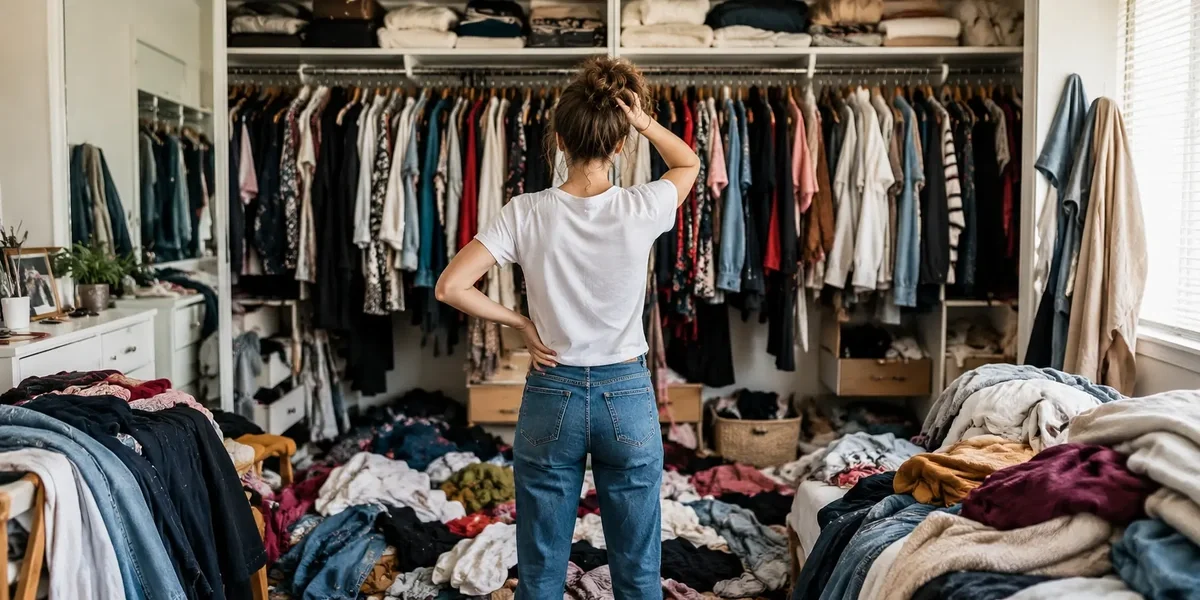
Eleven minutes. That’s how long I stood in front of an open closet last February, one shoe on, late for a lunch I’d already moved twice.
The annoying part wasn’t that nothing fit. Everything fit. Nothing went with anything else, which is a completely different problem and a worse one, because you can’t shop your way out of it in an afternoon.
A closet full of clothes and nothing to wear. Probably the most irritating sentence in the language, mostly because it keeps turning out to be accurate.
What actually fixed it wasn’t more clothes. It was about five repeatable formulas I now use without thinking about it. Most writing about outfit ideas for women skips straight to the pictures instead. Thirty looks, scroll, save, forget.
So here’s the boring version. Why seven things in your closet get worn constantly, why the other twenty-seven just sit there taking up hanger space, and the formulas that changed it for me.
They do just sit there, by the way. You know they do.
Count your tops. I’ll wait
Count how many you own, then how many you’ve actually worn since the start of the month.
The gap is usually humiliating. Mine was 34 and 7.
And the seven weren’t the seven I’d have named as favourites, which is the strange bit. They were just the ones with partners. My black jeans have four tops that work with them so the black jeans go on constantly. The blue printed blouse I genuinely love has exactly one skirt it agrees with, that skirt needs ironing, and the shoes I used to wear with it went to my sister in 2023.
An outfit isn’t a garment. It’s a small committee of garments that get along.
Once that clicks, shopping changes shape. You stop hunting single beautiful things and start looking for the one piece that makes four existing things wearable. Unromantic, yes. Works, also yes.
The three-piece outfit formula (steal this one)
Two pieces read as clothed. Three read as dressed.
So: base, bottom, third piece.
Base is your tee, tank, bodysuit, camisole, fitted knit. Bottom is jeans, trousers, a skirt, shorts, or a dress doing both jobs at once. The third piece is where it actually happens, and that’s a blazer, cardigan, denim jacket, shacket, waistcoat, long coat, or an oversized shirt worn open over everything.
Jeans and a white tee, fine. Jeans, white tee, and an unbuttoned striped shirt hanging open, outfit. You added one item and roughly forty seconds.
Why it works is geometry more than taste. The open layer draws two vertical lines down your front and gives the eye a route to travel instead of one flat block of fabric.
In July none of this is survivable, obviously. So in real heat the third piece stops being a layer and turns into a belt, or a bag in a colour that does something, or sandals with one interesting strap, or four thin chains instead of one.
Try it tomorrow. Dress normally, add one thing at the door.
(A woman at a pharmacy counter once asked me where I’d got a scarf. Roadside stall on the way to Sialkot, 2019, cost almost nothing, and I’d only put it on because I was cold. So don’t overthink which one thing.)
Outfit formulas sorted by energy, not by occasion
Occasion isn’t what defeats you at 7:40 in the morning. Energy is.
Four minutes, barely awake
- Straight-leg jeans, white tee, white sneakers, denim jacket
- Midi t-shirt dress, sneakers, crossbody bag
- Matching sweatshirt and joggers in one colour, with actual shoes on your feet instead of slides. The one-colour part is the thing keeping it off the pyjama register
- Leggings, oversized button-down left loose and open, chunky trainers, hair up
Fifteen minutes, functional
- Trousers, knit tucked in, thin belt, blazer, sleeves shoved up. Works for an office, a dinner, a school thing, all of it
- Midi slip skirt, plain tee tucked in, chunky boots. The delicate-skirt-heavy-shoe clash is deliberate
- One colour family, three shades of it. Cream, oatmeal, camel. Or all black in three different textures so it doesn’t flatten out
- Shirt dress belted at the waist, ankle boots, tights if it’s cold
- Jeans, silky blouse tucked in, heeled sandals
Looks like effort, isn’t
One loud piece, everything else quiet. A red coat over grey and black. Printed trousers with a plain tee. Or just tuck something in, even a lazy half-tuck at the front changes your whole silhouette in about four seconds.
Which reminds me of a mistake I keep making. Skip past this bit if you came for the work outfits.
The mustard coat
I bought a mustard coat in autumn 2022. Beautiful thing, proper wool, slightly too big in a way I told myself was intentional. I have worn it four times. Four.
It doesn’t work with a single one of my accent colours. It makes every neutral I own look muddy rather than warm. I bought it because it looked incredible on a hanger under shop lighting, and I still haven’t given it away, which tells you something about me that isn’t flattering. There’s probably a lesson in there about buying single beautiful things. Mostly I’m telling you so you don’t picture me writing this from some colour-coded wardrobe with everything facing the same direction. I have a mustard coat problem.
Anyway.
Work outfit ideas when the dress code is “use your judgement”
Which is the worst dress code there is, because now it’s your problem, every morning, forever.
Aim one notch above the room’s average. One. Two notches up and everyone quietly assumes you’re interviewing somewhere else.
Three combinations carry most weeks. Tailored trousers with a fine knit and loafers, blazer added if there’s a meeting. A midi dress with flat boots and a cardigan that lives permanently on your chair. Or dark straight jeans, shirt tucked in, blazer, clean leather sneakers, assuming jeans fly at all in your office, and if they do, dark and un-ripped.
Trousers are the thing most women underbuy for work. I’d put money on it. One pair of properly hemmed straight-leg or wide-leg trousers in charcoal or navy will out-earn four dresses, because they go with what you already own and they read professional even over a plain cotton tee with zero jewellery.
Also, if your office runs cold, buy a cardigan you’d be happy to be photographed in. I kept a stretched-out grey one on the back of my chair for two years and there is photographic evidence from a leaving do.
Hira and the six things
My friend Hira runs a small bakery. On her feet all day, in and out of a hot kitchen, then straight out front to a counter where she’s talking to customers face to face. Last February she told me she owned too many clothes and had nothing to wear, and I said, alright, prove it.
We put everything on her bed. Sixty-one items, not counting underwear or actual pyjamas. Nine of them had been worn in the previous month.
So she picked six and committed to a month. Two pairs of trousers, black and olive. Two plain tees, white and black. A denim shirt. A long grey cardigan. Shoes and bag stayed as they were, since she’d been wearing the same ones daily regardless.
The obvious result showed up in two days. Dressing took under a minute and stopped taking up any room in her head at all. Expected. That’s the whole pitch for this sort of experiment.
The result I didn’t expect was how precise she got about what was missing. Not “I need more clothes.” She wanted one skirt she could wear out front at the counter, and one jacket that wasn’t denim. Two items, named, by week three. This is a woman who’d been buying four or five things a month on instinct and wearing almost none of them.
She got a khaki utility skirt and a cheap black blazer. Both got absolutely hammered. Twenty-odd items from the original sixty-one went to her cousin and when I asked her about it in June she couldn’t name one she missed.
I’m not telling you to live on six things. That gets grim around week five and it isn’t the point anyway. The point is that restriction shows you your real gaps, and your real gaps are never what’s sitting on the sale rack.
Shoes
Same floral midi dress, three different outfits.
White sneakers: errands, coffee, Saturday. Tan flat sandals: brunch, holiday, hot evening. Black ankle boots and a leather jacket: out, at night, somewhere with a queue.
Nothing changed except your feet.
Most women I know own shoes for two of those three registers and then can’t work out why their dresses feel repetitive. If you’re starting from close to nothing, the order that gets used is clean white sneakers, then one flat sandal or loafer in tan or black, then an ankle boot with a low block heel, then one dressier heel or dressy flat you can genuinely walk in.
Four pairs, and it covers nearly everything. A fifth pair of trainers doesn’t. I say that owning three.
About jeans, briefly
Half of everything above assumes you own jeans that fit, and a lot of women don’t. They own jeans that are fine.
Two pairs is the number. One dark straight or slim leg that can pass as smart with a blazer, one looser pair, wide or barrel or whatever shape you like, for actual weekends. That’s it. The seven other pairs at the back of the drawer are usually one size wrong in either direction and being kept for emotional reasons.
Rise matters more than cut, and it’s the thing people get wrong. If a waistband digs in when you sit, the jeans are too low for your body, not too small. Try the same size one rise up before you size up.
And the length thing again, because it’s the one that shows. Straight-leg jeans should either sit on top of your shoe or stop cleanly above the ankle. The half-inch of bunching in between is what makes an otherwise good outfit look slightly off in photos, and nobody can ever say why.
The occasions that cause actual paralysis
Wedding, daytime. Midi dress, solid or small print, block heels or dressy flats because there is always grass or gravel involved. Something for your shoulders when the sun goes down. Nothing you have to hold up while walking.
First date, casual. What you’d wear on a good normal day, plus one thing. New shoes are a trap. So is anything you keep having to pull down or adjust, because you’ll spend two hours managing fabric instead of listening to a person.
Travel day. Soft wide-leg trousers or decent leggings, a tee, a long cardigan or oversized shirt that doubles as a blanket, slip-ons with socks you don’t hate.
Meeting someone’s family for the first time. Modest, comfortable, not new. And sit down in it at home first. A lot of outfits are lovely standing up and unbearable in a chair for three hours.
The thing you got invited to at 4pm for 7pm. This is what the default outfit at the bottom of this article is for. Don’t attempt anything ambitious three hours out with wet hair.
Big family function where you’ll be photographed a hundred times. Solid colours over busy prints, because prints do odd things in flash photography and you’ll be looking at those pictures for years. Also check the back view in a mirror, which sounds obvious and almost nobody does it.
Pick a colour lane
Sounds restrictive. Does the opposite.
Two neutrals to build on. Black and cream, navy and camel, grey and white, whatever suits you. Then two or three accents you actually enjoy seeing near your own face, so rust and forest green, or cobalt and dusty pink.
Then buy inside that, mostly.
The reason isn’t aesthetic, it’s arithmetic. If your neutrals agree with each other, nearly every top works with nearly every bottom and you stop owning orphans. Ten pieces in one palette will beat twenty-five in random colours. I find that mildly irritating, and it’s held true every time I’ve tested it.
One exception worth taking seriously. Don’t wear a colour you dislike because somebody called it neutral. If black near your face makes you look unwell, and for a lot of people it does, use navy or chocolate brown as your dark instead.
Overrated, in my opinion
Statement necklaces. They date fast and they fight with your face. Earrings do the same job and you can take them off halfway through an evening.
Owning three little black dresses. One is useful. Three is the same situation covered three times over.
“Investing” in trend pieces. Investment implies a return. An expensive version of something that’ll look dated by 2028 is a want with better branding, which is fine, buy it, just don’t file it under strategy.
Very high heels for anything over two hours. Nobody has ever looked elegant limping.
Worth it though: bodysuits. They solve tucking permanently, nothing rides up, the line under a blazer stays clean. Slightly awful in a public bathroom. Still worth it.
And a tailor, which needs its own bit.
Fit beats price, and it’s cheap
Hardly anyone uses a tailor and it’s the best money in the entire category.
I nearly gave away a pair of trousers. Good fabric, colour I liked, about three inches too long so they pooled at the ankle and made me look shorter than I am. Hemming cost roughly what two coffees cost, plus twenty minutes of somebody else’s afternoon. They’re now the trousers I wear most weeks.
Worth altering: trouser and jean length first, always, biggest change for the least money. Blazer sleeves, which should stop at your wrist bone rather than halfway down your hand. The waist on trousers that fit your hips but gape at the back. A dress or skirt stuck at that awkward mid-calf point. One button moved on a shirt that gapes across the chest.
Not worth altering: anything touching the shoulder seam of a jacket, and anything that means rebuilding the shape of a garment. Expensive, and it rarely comes out the way you pictured it.
Your body, without the fruit chart
I don’t trust apple-pear-hourglass. Most people don’t fit one cleanly and the advice attached to them is mostly about concealment.
Better questions: where do you want the eye to land, and where does your waist actually sit? (Often higher or lower than clothing brands assume, which explains a lot of dresses that felt wrong for no obvious reason.)
Things that hold regardless of shape.
Define a waist somewhere and you get structure. Belt, tuck, wrap, cropped jacket, any of them will do it. Or don’t define it, but then commit to the whole outfit being loose on purpose rather than shapeless by accident. People can tell the difference even when they couldn’t explain it.
Balance volume. Loose with fitted, one or the other. Loose on loose is doable but it’s a harder outfit and it needs fabric with some weight to it.
Vertical lines lengthen. Open jackets, long cardigans, a crease down the front of a trouser, one colour running top to bottom.
Hem placement matters more than hem length. A skirt ending at the narrowest part of your calf looks better than one ending at the widest, which is about your legs specifically and not about any category anyone put you in.
And look from six feet back, not two. Fit problems only show up at distance. Distance is where everybody else is standing.
Same clothes, different season
Warm months, the third piece goes light or becomes an accessory. Linen shirt open over a tank. Slip dress, sandals. Shorts, tucked tee, belt.
Cold months, layer thin to thick and make the outer layer the piece you actually like, because it’s the only thing most people will see all day. A great coat over an ugly jumper is completely fine. The reverse isn’t. Your jumper is a secret between you and your desk.
The in-between weeks are the worst and that’s what cardigans and shackets and denim jackets exist for. Tights as well, they’ll drag a summer dress into October for almost nothing.
Cheapest version of all this: change shoes and outerwear with the season, leave the middle of the outfit alone.
Try this: twenty minutes on a Sunday
More useful than reading another list of casual outfit ideas, including mine.
- Pull out the six to eight things you’ve actually worn most this month. Worn. Not liked. Not intended to wear.
- Find what they have in common. Colour, fit, fabric weight, something. That pattern is data about you.
- Build four complete outfits from those plus whatever’s left in there. Complete means shoes and third piece, not “and then something over it.”
- Photograph all four. Phone, bad light, unmade bed in the shot, doesn’t matter. Everyone skips this step and it’s the one that pays, because on Wednesday morning you will not remember what you worked out on Sunday. You’ll look at your camera roll.
- Write the gaps down. Two or three items, as specific as Hira’s skirt and blazer.
- Then shop, from the list.
Small things, disproportionate returns
- Steam it, or hang it in the bathroom while you shower. Creases read as “didn’t try” faster than any styling mistake
- One good neutral bag does more than four trendy ones
- Sleeves pushed up. Instantly less stiff
- Clean white sneakers versus grey-white sneakers is a bigger visual difference than most outfit swaps you could make
- When you find the plain tee that fits you, buy three
- Match your metals roughly, or don’t, but pick one and stop thinking about it
For bad mornings
Decide a default now, while you’re calm and not standing in a towel.
Mine is dark straight jeans, black fitted tee, white sneakers, grey blazer. That combination has been to a client meeting, a birthday dinner, and a nine-hour flight. It isn’t interesting. It has never once been wrong, and on a bad morning never-wrong beats interesting by a distance.
Keep those four things findable. Same shelf, same hook, no digging.
Fewer clothes that agree with each other, worn again and again without apologising for it. That’s most of it, really. The women whose outfits always look right don’t have bigger wardrobes than you. They’ve just stopped experimenting on weekday mornings.
FAQs
Why do I have a closet full of clothes and nothing to wear?
Usually because your clothes don’t have partners. Most of us buy single items we liked in a shop rather than items that combine with what’s already hanging there, so you end up owning thirty tops that each work with one specific bottom. Count how many of your clothes have at least two possible outfits. That number is the real one.
How many clothes does one person actually need?
Fewer than you’d think, though the honest answer depends on your weather and your job. As a starting frame: two pairs of jeans, two or three pairs of trousers, five or six tops that all work with those bottoms, two or three third pieces, and four pairs of shoes. Build up from there rather than trying to trim down to it.
What is the three-piece rule?
An outfit reads as finished when it has three visible elements instead of two. A base layer, a bottom, and a third piece like a blazer, cardigan, or open shirt. Two pieces look like you got dressed. Three look like you chose something.
How do I make outfits from clothes I already own?
Pull the six to eight things you’ve actually worn most this month, build four complete outfits from those plus whatever else is in there, then photograph each one. The photos matter more than the outfits do. On a rushed morning you won’t remember what worked on Sunday, but you will look at your camera roll.
Is a capsule wardrobe actually worth it?
As a permanent way of living, I’m not convinced. As a one-month experiment, definitely. Restricting yourself to six or eight items for a few weeks tells you exactly which two or three things are genuinely missing, and that’s information you cannot get by browsing shops.
How do I stop buying clothes I never wear?
Two rules. Don’t buy anything that works with only one thing you already own, and don’t buy anything you can’t name three occasions for. Also stop shopping without a written list. The list is boring and it works.