


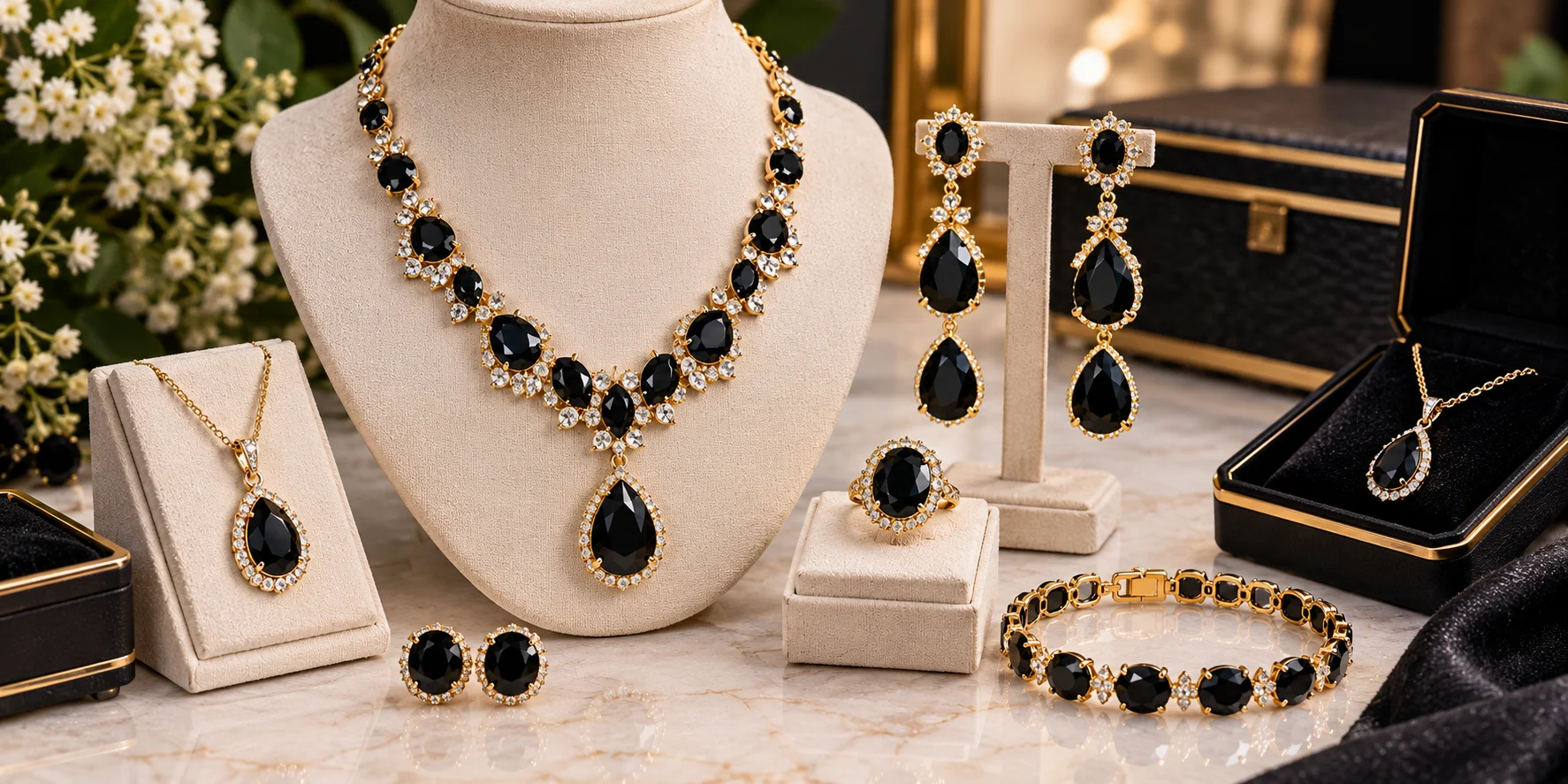
My cousin showed up to her own engagement party with this big chunky black ring on her finger. She’d picked it up from some roadside stall for maybe eight hundred rupees. Didn’t think too hard about it. Thought it looked cool, slipped it on, showed up. That was the whole plan. Then some aunty not even close family, just someone who appears at functions, eats, and has opinions walked straight up to her mid-party and said, “Oh is that hematite? Very Victorian.” My cousin stared at her. I stared at her. Neither of us had any idea what hematite was or why it was Victorian. We smiled and nodded and then spent the rest of the night quietly confused.
But that comment stuck with me. Because that aunty clearly knew something. There was a whole world inside an eight-hundred-rupee ring that my cousin had grabbed on a whim, and neither of us could see it. Black stone jewelry is like that. It doesn’t announce itself. Doesn’t come with the drama of diamonds or the obvious romance of rubies. Most people walk right past it. But once you start actually looking like really looking you realize it’s everywhere. On the wrists of people who seem to have quietly figured out something about style that you haven’t. In the corner of every vintage shop. On every third person at a dinner party who looks effortlessly put together without seeming like they tried. So here’s what I know now. Written the way I wish someone had explained it to me no gemology jargon, no pretending everything is simple when it isn’t, just the actual stuff that matters.
“Black Stone” Isn’t One Thing That’s the First Thing to Know
This trips people up before they even start. When someone says black stone jewelry, they could mean seven completely different things. Each one looks different, costs different, feels different in your hand, and has a completely different history. Grouping them all together under “black stone” is a bit like calling every beverage “a drink.” Technically true. Practically useless.
The color black shows up in gemstones for different reasons depending on the stone. Sometimes it’s tiny carbon particles trapped inside the mineral, just sitting there absorbing every bit of light that enters. Sometimes it’s iron or manganese in the structure. Sometimes the crystal grows so dense that light physically cannot pass through it. And with black diamonds, the blackness comes from millions of microscopic dark inclusions spread throughout the entire stone — which is why they look completely different from a black onyx even though both appear black at a glance.
This matters because it affects the way each stone actually looks. Some are completely opaque flat, solid, nothing behind them. Some have real depth, like there’s something going on underneath the surface if you tilt them in the right light. Some have a glossy mirror finish. Some look almost matte. And some like rainbow obsidian will genuinely surprise you the first time you hold one up to a lamp and suddenly see purples and greens swirling inside what looked like a plain black rock five seconds ago. Same color family. Completely different experience. That’s the whole reason it’s worth knowing what you’re actually holding.
The Stones, One by One
Black Onyx
Probably the one you’ve already encountered without knowing it. If you’ve ever bought black stone jewelry without thinking too hard about what it was, there’s a solid chance it was onyx. It’s been used in jewelry for thousands of years — ancient Romans wore it for protection, Victorians carved it into mourning pieces, and today it turns up everywhere from fast fashion to proper jewelers.
Polished black onyx has this smooth, glassy surface. It looks almost lacquered like someone poured black nail polish into a mold and let it harden into a gemstone. Very clean, very consistent, very satisfying to look at. It’s a popular choice for signet rings specifically because it holds an engraving beautifully. It’s also forgiving on price, which is part of why it’s everywhere.
One thing worth knowing upfront: most commercial black onyx is dyed. Natural onyx often has lighter bands or uneven coloring, so it gets treated to achieve that deep, uniform black. This doesn’t mean it’s fake or that you’ve been scammed treated onyx is still genuine onyx and it still looks great. But if a seller is charging you extra because the color is “completely natural,” that’s a claim worth pushing back on.
Black Tourmaline
Completely different from onyx. Where onyx is sleek and polished, tourmaline is raw and earthy. In its natural form it has these vertical grooves running along its surface striations, they’re called that make it look like a piece of dense dark charcoal that hardened into something permanent. It doesn’t look refined. It looks like something you’d find with both hands in the ground, which is more or less what it is.
In jewelry you’ll mostly see it two ways. Either polished into smooth beads and strung into bracelets, or left rougher and set into silver wire wrappings. The second type is huge right now in the crystal wellness space. People keep it in their bags, wear it as pendants, put chunks of it by their front doors for protection. Whether you believe in that or not is entirely your business the stone itself is genuinely interesting to look at regardless.
Hematite
This is the one that aunty recognized. And honestly, once you know hematite, you can’t unsee it anywhere. It has a metallic shimmer silver-grey-black, almost mirror-like that doesn’t look like any other stone in this category. Pick it up and it’s immediately heavier than you expected. There’s also magnetic hematite, usually synthetic, that will actually stick to other magnetic hematite pieces. It’s a strange little trick that genuinely confuses people at markets and jewelry shops.
The look of hematite is distinctly modern. Geometric, cool, slightly industrial. It doesn’t have the warm depth of onyx it reads sharper, crisper, more architectural. Which is why you see it constantly in minimalist jewelry and men’s pieces. It suits clean lines.
Black Spinel
This one deserves more attention than it gets. I’ll say that clearly. Black spinel when it’s properly cut and faceted has this brilliance to it. Light goes in and bounces around inside the stone. It doesn’t sit flat and dull the way low-quality onyx can sometimes look. It looks like something is happening inside it. And because it’s still relatively unknown compared to black diamond, the prices are still honest. That won’t last forever as more people discover it, but right now it’s one of the best value options in the category.
It was passed off as black diamond for a long time, which was doing it a disservice because it’s a completely different stone that’s stunning on its own terms. Harder than glass, takes a beautiful polish, holds up in jewelry over years of wear. If you want something that genuinely looks luxurious without the price tag that usually comes with that, black spinel is the answer I keep coming back to.
Black Diamond
The famous one. The one that’s been in engagement rings and editorial shoots and those conversations at parties where someone says they don’t want a regular diamond. Real diamonds, just loaded with dark inclusions that make the whole stone appear black.
Here’s the thing though not all black diamonds are the same thing. Natural fancy black diamonds, the kind that actually formed this way underground over millions of years, are genuinely rare and genuinely expensive. Treated black diamonds are heavily included or off-color stones that got irradiation treatment to turn them black. Both are real diamonds. Both can be beautiful. But the price difference between them is significant, and sellers don’t always volunteer which category you’re looking at. Ask directly before you buy.
Jet
The odd one out in this group, because jet isn’t actually a mineral at all. It’s fossilized wood specifically from an ancient tree species called Araucaria and it was mined most famously in Whitby, England. Victorian mourning jewelry made from Whitby jet is still collected as an antique today. It’s lightweight, slightly warm to the touch unlike actual stones which always feel cool, and has this rich deep black with a subtly different texture you notice when you hold it.
Real jet is genuinely rare now. Most of what gets sold as “jet” is actually black glass, dyed onyx, or something called vulcanite hardened rubber all of which were used as substitutes even back in Victorian times when demand outstripped supply. If you’re specifically looking for real jet, buy from antique dealers with proper provenance documentation, not from a random online listing.
Obsidian
Volcanic glass. Literally. When lava cools so fast it doesn’t have time to form proper crystals, this is what you get. Humans have been using it for tens of thousands of years first as tools, blades, arrowheads, then as ornaments and mirrors. The Aztecs made polished obsidian mirrors for ritual practice and tied the stone to Tezcatlipoca, their god of darkness and the night sky. It’s one of the oldest materials in human history that people are still making things from.
In jewelry it mostly shows up as smooth rounded cabochons, carved pendants, and beads. The look is very glossy, very deep. And then there’s rainbow obsidian which looks completely plain black until you hold it under direct light and suddenly purple, green, and gold shimmer across the surface. The first time I saw that I genuinely did a double take. Worth seeking out just to see it once.
The Styles Which Direction Are You Going
Minimal and Modern
This is where black stone jewelry has really found its ground over the last few years. A single polished onyx in a clean silver band. A tiny pendant on a fine chain. Small matte studs. Nothing extra, nothing competing. The stone is the entire point and the setting is just there to hold it in place.
It pairs with almost everything because it isn’t fighting your outfit for attention. A hematite ring on a bare hand. A black pendant sitting against a white shirt. It’s the jewelry equivalent of a well-cut black t-shirt not trying to be interesting, just quietly is.
Victorian and Gothic
Black stone jewelry has deep roots in mourning tradition, specifically Victorian England, where grief had a whole visual language and jet cameos and onyx lockets were part of it. These pieces are heavily detailed ornate settings, gold lettering, black enamel work, pieces that look like they’ve been somewhere.
This aesthetic has been revived repeatedly and right now it’s having a real moment with the dark academia and goth-revival crowds. If you like jewelry that looks like it has a story, antique shops carry genuine Victorian pieces and there are independent jewelers making new work in this exact tradition. It’s a whole world.
Earthy and Raw
Rough tourmaline wrapped in copper wire. Chunky unpolished stones on leather cords. Hammered silver settings that look handmade because they are. This style leans into the natural, unrefined quality of the stones and pairs them with materials that feel grounded copper, bone, leather, wood. More casual, more layerable, generally cheaper. Also the style most associated with the crystal wellness community, which means it carries a spiritual dimension that some people actively want and others just treat as aesthetic. Both are completely fine.
High and Fine
Black diamonds in platinum. Black spinel set alongside white diamonds. Black onyx in Art Deco geometric patterns. This is where things get serious. Investment territory. Pieces that get passed down. Every major jewelry house has worked with black stones. Cartier has a long history with black onyx. David Yurman uses it constantly. And there’s a whole category of custom fine jewelry where black stones get specifically chosen because they don’t compete with the metalwork they let the setting breathe while still giving the piece weight.
Men’s Black Stone Jewelry
Worth its own paragraph because the history is long and people forget it. Men have been wearing black stone signet rings, cufflinks, and bracelets for centuries. This predates the current “men’s jewelry is acceptable now” conversation by a very long time. Black stones work in men’s pieces because they read as substantial rather than decorative. A thick onyx ring in silver doesn’t look like you’re making a statement it just looks like you have taste. If you’re shopping for a man who doesn’t usually wear jewelry, this is genuinely one of the least intimidating places to start.
Which Metal Goes With Which Stone
This doesn’t get enough attention, and it changes the entire mood of a piece.
Silver is the most common pairing and there’s a reason. It’s cool-toned, clean, doesn’t compete. The contrast between silver and a black stone is high without being dramatic. It’s also the most accessible price point for fine metal settings, which is part of why most mid-range black stone jewelry defaults to it.
Yellow gold completely shifts the feeling. Black onyx in yellow gold feels warm, vintage, almost Egyptian in the right shape. The contrast is bolder, the statement louder. More dramatic than silver, but in a way that reads rich rather than showy.
Rose gold is the unexpected one. It softens black stones in a way that feels romantic rather than stark. A black spinel in rose gold doesn’t feel gothic or severe it feels almost gentle. It’s a combination that consistently surprises people who assumed they wouldn’t like it.
Oxidized silver is darkened silver, almost charcoal-toned, and paired with black stones it creates a moody, monochromatic effect. Less contrast, more depth. Shows up a lot in artisan and handmade jewelry.
Platinum is for serious pieces. It doesn’t yellow over time, doesn’t corrode, is hypoallergenic, and doesn’t compete with anything. If you’re spending real money on a black diamond or high-quality spinel, platinum is the setting that makes sense.
Copper is earthy and warm. Raw black tourmaline in copper has an almost alchemical quality something between ancient and handmade that doesn’t look like anything you’d find in a chain store.
How to Actually Choose The Practical Part
Start With What You Already Wear
Seriously, just look at your jewelry. What metal do you actually reach for? What scale delicate, medium, chunky? When do you wear jewelry daily, just for going out, formal occasions only?
The best black stone piece you can buy is one that fits into your actual life. Not the aspirational version of yourself you imagine. Your real wardrobe, your real schedule, your real habits. If you wear silver every day and keep it simple, a black onyx pendant in sterling silver is a completely right choice that you’ll wear for years without thinking about it. If you mostly wear gold, a pair of black spinel studs in yellow gold will slot right in beside everything you already own.
A Formula That Actually Works
I’m usually skeptical of style formulas but this one is genuinely useful:
Stone finish + Metal tone + Setting type = the whole look
Stone finish: Glossy and polished (onyx, hematite) → modern, sleek, clean Raw or matte (tourmaline, rough obsidian) → earthy, casual, textured Brilliant and faceted (spinel, black diamond) → fine jewelry, luxurious
Metal tone: Silver or platinum → cool, crisp, contemporary Yellow gold → warm, vintage, confident Rose gold → soft, romantic, unexpected Copper or oxidized silver → rustic, artisan, bohemian
Setting type: Bezel (metal wrapped all around the stone) → minimal, smooth, modern Prong (metal claws holding the stone) → classic, more stone visible Wire wrap → handmade feeling, artisan Pavé (cluster of small stones together) → detailed, luxe
Pick one from each line that matches what you want. That combination is your starting point. Then find it.
Think About When You’re Actually Wearing It
This sounds obvious but people skip it. A chunky cocktail ring and a tiny stud earring are both technically black stone jewelry and they serve completely different moments in life.
For daily wear in a professional environment lean small, lean simple. A slim hematite ring or a small pendant that sits close to the neck. Something that says “I have taste” without requiring a second look. For evenings and events, go bigger, go bolder, stop worrying about whether it works with everything else you own. It doesn’t need to.
Real Numbers on Price
Nobody gives you straight numbers so here:
- Under $30 — Fashion jewelry. Dyed stone, resin, low-grade metal. Looks fine for a few months. Don’t expect it to survive.
- $30–$150 — Genuine sterling silver with real onyx, hematite, or tourmaline. Sweet spot for everyday pieces. Worth it.
- $150–$500 — Better stone quality, better metal, real craftsmanship. Gold-fill or silver from independent jewelers. Pieces worth keeping.
- $500–$2,000 — Real gold or platinum, high-quality stones, fine jewelry. Things you’ll wear for twenty years.
- $2,000+ — Black diamonds, exceptional craftsmanship, investment territory. Different category entirely.
Know your number before you start browsing. Black stone jewelry exists at all of these levels and it’s very easy to either overpay for something mediocre or underpay and end up with something that falls apart before the year is out.
Building an Actual Set: Here’s What It Looks Like in Practice
Say you want a small cohesive collection a few pieces that look intentional together without being matchy in that obvious way. You wear mostly silver. You dress fairly simply. You want things you’ll actually reach for regularly.
The main piece: A black onyx ring in sterling silver. Medium weight band, smooth stone, clean bezel setting. Not too thin, not chunky. This is your most-noticed piece without being loud. It just sits there looking certain of itself.
The everyday piece: A small black spinel pendant on a thin silver chain. Stone about the size of a small pea. Sits at your collarbone. Nobody walking past you will consciously register it — but you’d notice if it was missing.
The third piece: A single-strand bracelet. Black tourmaline beads or a thin cord with a small polished stone. Opposite wrist from the ring. Minimal. Doesn’t compete with anything.
Three pieces. They work together without being a matched set. Total if you shop patiently: somewhere between $180 and $380 for solid quality. These three things go with almost everything and will hold up for years.
Taking Care of It
Onyx and spinel are fine for daily wear. Soft cloth, drop of dish soap, warm water. Don’t soak dyed onyx for long periods and skip ultrasonic cleaners they can strip the dye.
Hematite is harder than it seems but also brittle. Don’t drop it. Keep it away from water for extended periods iron oxide and moisture aren’t a great combination over time.
Black tourmaline in a polished, set form is reasonably tough. In raw form the edges chip. Store it away from other pieces.
Obsidian is glass. It will chip if you’re not careful with it. Store it separately from everything else.
Jet is the most delicate. No harsh chemicals, no prolonged heat or sunlight. Soft pouch, stored alone.
Black diamonds are diamonds. As hard as any diamond. Clean them the same way warm water, mild soap, soft brush.
The general rule that covers most situations: take rings off before your hands are working hard. Keep jewelry away from perfume, hairspray, and chlorine. Store pieces in separate pouches so they don’t scratch each other. That’s the majority of what you actually need to know.
What to Watch Out For When You’re Buying
Glass and resin imitations are everywhere in cheaper jewelry. They look fine in photos and in-person for a while, then they scratch and chip and fade. A genuine stone feels cooler when you first pick it up and is heavier than plastic or resin of the same size. Not a perfect test but it catches a lot.
Treatments are normal in this industry dyed onyx, irradiated black diamonds, heated tourmaline. This is standard practice and the results are usually fine. The problem is when sellers don’t disclose treatments and price things as if the color or quality is entirely natural. Just ask. A good seller will tell you without hesitation.
For expensive pieces anything where you’re spending a few hundred dollars or more on a black diamond or high-end spinel ask for a certificate from GIA or IGI. For everyday pieces under a couple hundred dollars it’s not really necessary. But for serious purchases it matters.
Black Stones in Different Cultures
This is something Western jewelry writing usually skips and it’s worth knowing. In South Asian tradition across Pakistan, India, and the broader region black beads and black stones in jewelry go back a very long time, specifically connected to warding off nazar, the evil eye. It’s not just decorative. Families take it seriously. Black stone amulets appear across Middle Eastern and Mediterranean traditions for the same reason. The Aztecs used polished obsidian mirrors in ritual practice and associated the stone with Tezcatlipoca, their deity of darkness and the night sky. Obsidian wasn’t casual jewelry for them. It was something closer to sacred technology.
In Victorian England, jet mourning jewelry became almost a social requirement after Prince Albert died and Queen Victoria wore black for the next forty years. The entire country followed her lead. Jet pieces were worn to mark grief in a formal, visible way and when demand outstripped the supply of real jet, black glass and rubber substitutes followed immediately. I find this worth knowing even if you’re buying a black stone ring just because it’s pretty. These stones carry real history from real people who found meaning in them. Wearing something with that kind of background even casually connects you to something older than whatever trend you found it through.
A Few Honest Opinions on Wearing This
Don’t match everything to the same stone. Ring, necklace, earrings all in matching black onyx reads costumey. One anchor piece, maybe one smaller companion. That’s the ceiling. Layer with plain metal. Simple chains, thin plain rings, a basic bangle. They don’t compete with the black stones they let them breathe. Adding colored stones into the mix is fine but do it with intention, not just because everything ended up together.
Wear black stones against lighter colors if you actually want them to show. Against dark clothing they disappear. Against white or cream or light grey they pop. Not a rule you have to follow, just how light works. And don’t make it complicated. A black stone ring with jeans and a plain shirt is enough. These pieces work precisely because they don’t demand anything from you.
Is It Formal Enough for Formal Events?
Yes with the right piece. Polished black onyx in a gold setting is completely appropriate at a wedding or a formal dinner. A black diamond in platinum is obviously fine. Raw tourmaline on a leather cord is not. Formality comes from the quality and finish of the piece, not the color of the stone. A well-made, polished piece in a real metal reads formal regardless of what’s inside it. That’s the only rule that actually applies here.
FAQs
Q: I’ve heard black stones bring bad luck. Is that actually true?
A: Depends entirely on where that belief is coming from. In many traditions including South Asian ones black stones are considered protective. They absorb negative energy rather than attract it. In other folk traditions there are general superstitions about darkness, stones included. These beliefs are old, culturally specific, and not universally agreed on. If you grew up in a household where this was taken seriously, that’s worth sitting with personally. But there’s no global consensus that black stones are bad luck if anything, plenty of cultures say the complete opposite.
Q: What’s actually different between black onyx and black obsidian? They look the same.
A: In photos, yes hard to tell apart. In person they’re actually pretty different once you know what to look for. Onyx has that smooth, even, very consistent surface that lacquered quality. Obsidian has a bit more depth to it, sometimes a faint warm undertone, and in certain varieties those iridescent rainbow effects. Obsidian also chips much more easily because it’s volcanic glass, not a proper mineral. Once you’ve held both a few times, you’ll be able to tell immediately.
Q: Can I wear black stone jewelry every day or will it break down?
A: Depends on the stone. Onyx, hematite, and spinel are all tough enough for daily wear. Tourmaline in a secure, well-made setting is mostly fine. Obsidian I’d be careful with if you’re rough on your hands it chips. Jet is too delicate for everyday wear full stop. For a daily ring specifically: onyx, spinel, or hematite in a solid bezel or prong setting. Those will hold. Avoid raw stones or anything with exposed, unprotected edges if you’re planning to wear it constantly.
Q: Why is some black onyx so cheap and some so expensive? How do I tell if it’s real?
A: Because the quality range inside “black onyx” is enormous. Cheap onyx is heavily dyed to look uniform, set in low-grade metal, and it’s still technically real onyx just the bottom of the category. Better pieces have finer stone quality, better treatment if treated, and actual silver or gold settings made with real craft behind them. To check if a stone is genuine: it should feel cool when you first touch it and noticeably heavier than plastic or glass of the same size. Consistent color without visible bubbles or streakiness is a good sign. And just buy from sellers who tell you what it is. If they’re straightforward about treatments and materials without being pushed, that’s a good seller.
Q: Are black diamonds actually worth it or should I get black spinel instead?
A: I lean spinel most of the time, honestly. Black spinel is an excellent stone on its own terms not a substitute for diamond, just a different and genuinely beautiful stone. It facets well, has real brilliance, is harder than most gems, and right now it’s still priced below what it’s actually worth because the name recognition hasn’t caught up yet. Black diamonds have the name, and if that matters to you or whoever you’re buying for, that’s real. Treated black diamonds are actually quite affordable sometimes occasionally less than comparable spinel. Natural fancy black diamonds are rare and priced accordingly. Just know which one you’re paying for before you hand over the money.
Q: Does black stone jewelry have any real symbolic meaning or is that just something people say?
A: The meaning is real, it’s just not magic. Black stones have been connected to protection, grounding, mourning, power, and mystery across dozens of cultures over thousands of years. Those associations weren’t invented by a marketing team they’re genuinely old. If symbolism matters to you in what you wear, there’s a real tradition to draw from. If it doesn’t, wear it because it looks good. Both are completely valid.
Q: How do I clean black stone jewelry at home?
A: Warm water, a small drop of dish soap, soft cloth or very soft toothbrush. Works for most pieces. Rinse, pat dry, let it air for a few minutes before putting it away. Don’t soak anything for extended periods. Avoid commercial jewelry cleaners unless the label specifically says they’re safe for your stone a lot of them contain things that strip dye treatments or react badly with softer materials. Store pieces in separate pouches or compartments so they don’t scratch each other. Don’t spray perfume or hairspray while wearing jewelry. That’s genuinely the majority of what you need.