


Talha rang me at about quarter to eleven on a Thursday. Couldn’t sleep, he said, which I already knew, because he’d sent three voice notes before that.He had an app idea. Gym trainers here still run everything off WhatsApp screenshots and paper diet charts, and someone, he reckoned, should build them something proper. He’s not wrong about the diet charts. I’ve seen a few. Half of them are photos of photos, printed once back in 2019 and forwarded ever since, calorie column smudged to nothing.
So I asked the boring question. Who pays, how much, and how often?Silence. Then, “The trainers, obviously.”
Okay. But how many trainers are we talking about? What would one of them actually pay per month, when his own income swings between twenty and sixty thousand rupees depending on how many clients show up? And why not the gym owner, since he’s the one actually holding cash at the end of the month? Or the trainee pays something small, fifty rupees, whatever, and the trainer takes a slice of that?
He didn’t have those answers. What he had was a product and four features scribbled on the back of a delivery slip. Which is fine, honestly, most things start about there. But there was a piece missing, and the annoying thing about that piece is that once someone points it out to you, you notice it everywhere. Bakeries. Barbers. Your own mobile package.
It’s the business model.
So what is a business model, in plain words
A business model is basically the answer to this question: how does this thing make something people want, get it to them, and collect enough money doing it that it’s still here next month?
That last bit does more work than people give it credit for. Not “made money once.” Still here next month. Anyone can make money once. My cousin sold his PlayStation last Eid and made money once.
Strip everything else away and you’re answering three questions:
- Who has the problem, and how badly do they feel it?
- What do they actually get from you, and why you instead of the guy two shops down?
- How does money come in, from whom, how often, and what’s left after you’ve paid for everything?
Three questions. That’s the whole thing. People build 40-slide decks around it, and sometimes those decks are useful, but a business model that can’t survive being explained on a napkin usually has a hole in it somewhere.
Here’s the version I use with clients who are just starting out: we help [this specific person] do [this specific thing], and we get paid [this way], and each sale leaves us [this much]. If you can fill those four blanks without hedging, you’re ahead of most people who’ve been trading for two years.
And people avoid this, which I understand. It’s not fun. Answering these questions properly means admitting you don’t know something, and it’s much nicer to spend the afternoon picking brand colours than working out that your margin is eleven percent. I’ve done it myself. Spent a full week on a landing page for a project whose numbers, when I finally sat down with them, needed about forty minutes to show that the whole thing didn’t work.
It’s not a business plan. It’s not a strategy either.
People mix these three up constantly. Costs them weeks sometimes, and they don’t notice until much later.
A business plan is a document. Market research, projections, a marketing section, a five-year forecast that everyone knows is fiction. Banks want it. Investors sometimes want it. It’s a snapshot of intentions, usually about thirty pages long, usually never opened again after month two.
A business model is the machine underneath. How value gets made and how money comes back. It fits on one page, and it either works or it doesn’t, regardless of how nicely the plan was written.
Strategy is the choice of where to point the machine. Who to serve, who to ignore, what to be known for, what to refuse. Two companies can run identical business models and have completely opposite strategies. Two hotels both rent rooms by the night. One targets backpackers at four thousand a night, the other targets corporate travellers at forty. Same model. Different strategy. Different everything else.
I’ve watched people spend six weeks writing a business plan for something whose model falls apart in eleven minutes of arithmetic. Do the arithmetic first. The document can wait.
The pieces that actually matter
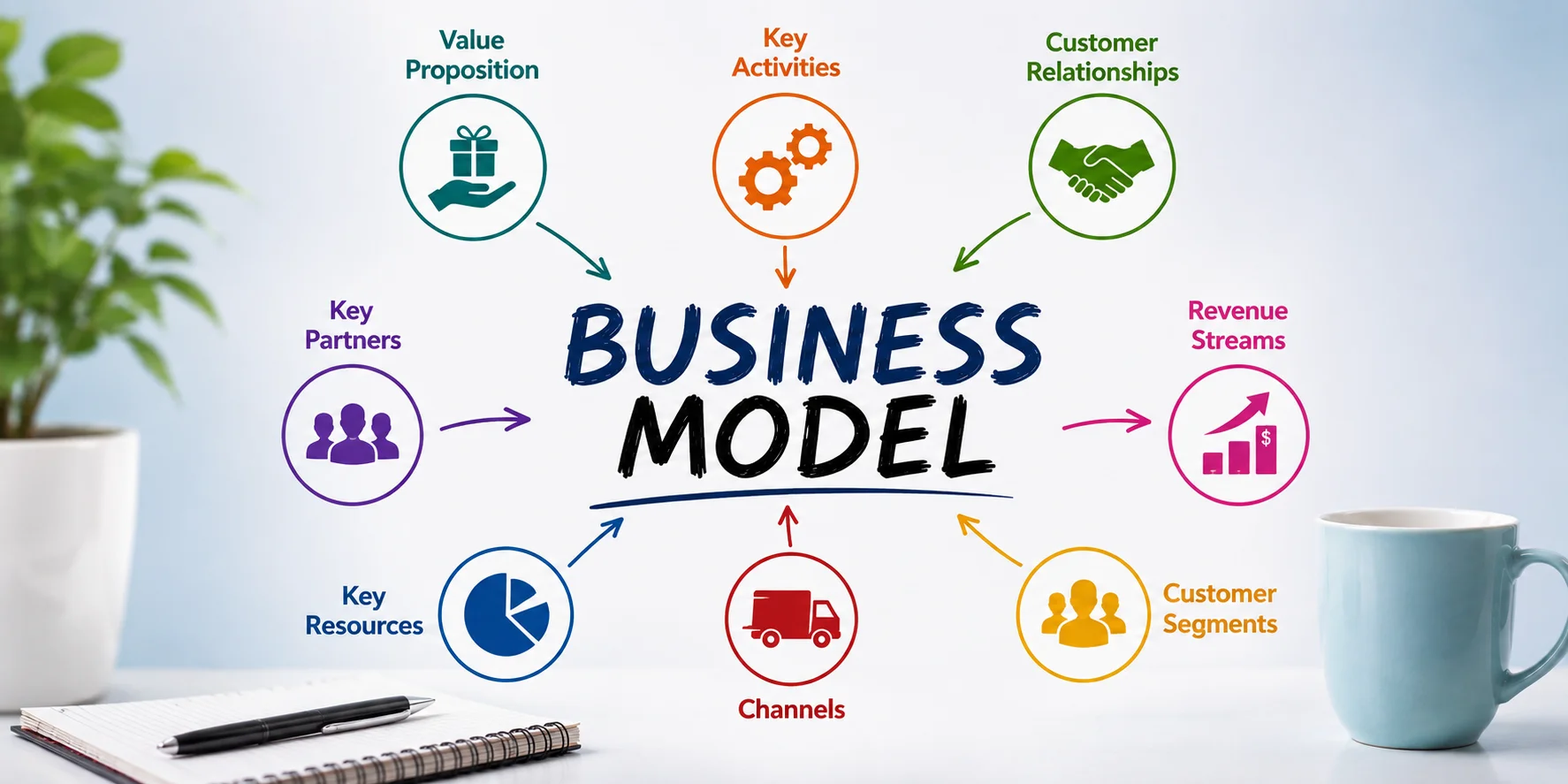
You’ve probably come across the Business Model Canvas by now. Nine boxes on a big sheet, you fill them in, everyone feels productive for about an hour.
Honestly? For beginners I think it’s overrated. It’s a decent tool and I’m not telling you to throw it out, and once you actually know your numbers it’s useful for spotting the gaps. The problem is what goes in the boxes. “Quality service.” “Social media.” “Word of mouth.” Then the sheet goes up on the wall and everyone acts like the thinking is finished. It isn’t. They’ve filled in a form.
What I’d rather you get clear on is six things:
Who exactly you serve. Not “women aged 25 to 45.” That’s a census category, not a customer. “Mothers in DHA who order custom birthday cakes about three times a year and care more about how it photographs than how it tastes” is a customer. Uncomfortable specificity is the whole point.
What they get. The result, not the feature list. Nobody buys a project management tool. They buy not being the person who forgot something in front of their boss.
How they find you and how you deliver. Walk-in, referral, Instagram, a marketplace listing, a distributor. Each of these has a different cost attached, and people forget that referrals aren’t free either, they’re just paid for in reputation and time.
How you charge. One-time, monthly, per use, commission, markup, retainer, license. This choice shapes the business more than almost anything else. Charging monthly for something people need twice a year is a slow way to lose customers.
What it costs you. Split it in two. Costs that go up with every sale, and costs you pay whether you sell anything or not. Muddling these together is probably the single most common mistake I see.
Why it keeps working. Because if the model is easy to copy and there’s nothing holding your customers in place, you’ll spend the next three years defending your prices against someone with lower overheads.
That sixth one is the one people skip. It’s also the one that decides whether you’re building a business or just buying yourself a demanding job.
Common types of business models, with real examples
Most businesses run some combination of these. Very few run just one.
Markup and resale. Buy at one price, sell at a higher one. Every retail shop, every wholesaler, most Daraz and Amazon sellers. Simple, old, still works. Margins get squeezed the moment somebody nearby sources cheaper.
Subscription. Customers pay on a repeating schedule. Netflix, Spotify, gym memberships, Adobe, your mobile package. Predictable revenue is the appeal. The catch is churn, because a subscriber leaving quietly is worse than a customer who never bought, since you already paid to get them.
Freemium. Free tier, paid upgrade. Canva, Dropbox, Spotify again. It works brilliantly at scale and painfully at small scale, because you’re carrying the cost of thousands of people who will never pay you a rupee. If you’re a two-person team, I’d think very hard before choosing this.
Marketplace or commission. You connect two sides and take a cut. Airbnb, Careem, Fiverr, Daraz, every property portal. Hard to start because you need both sides at once, but genuinely powerful once it turns.
Advertising. The user is free, the advertiser pays. Google, Meta, free newspapers, most YouTube channels. Needs volume. Lots of it.
Razor and blades. Cheap base product, profitable refills. Gillette did it with handles and cartridges. Printer companies do it with ink, which is why a printer costs less than three sets of cartridges. Nespresso does it with pods. Consoles did it with games for years.
Licensing and franchise. You built something once, other people pay to use or operate it. McDonald’s, Subway, software licenses, brand partnerships.
Pay-per-use. Charge by consumption. AWS bills by the second. Rolls-Royce sells airlines flying hours rather than engines, which flipped their entire relationship with customers, because suddenly Rolls-Royce is the one who benefits from engines that break down less.
Service and time. Agencies, salons, repair shops, consultants, most freelancers. Money comes in per hour or per project. Reliable, respectable, and capped by the number of hours that exist.
Bundling. Sell several things as one package at a price that beats buying them separately. Microsoft Office did it to word processors and spreadsheets. Amazon Prime bundles shipping, video, music and storage into one habit you stop questioning. Bundles hide individual prices, which is either honest convenience or a quiet way to protect a weak product, depending on who’s doing it.
Pick any business you walk past and you’ll usually spot two or three of these sitting on top of each other. Take a gym, since we started there. Memberships are subscription. Personal training is a service, sold by the hour. And there’s a fridge by the counter with protein shakes in it at a fat markup, which is the part nobody plans for and everybody ends up doing anyway. Three revenue lines. Money landing on three completely different schedules.
A real one: how Xerox sold a machine nobody could afford
This is the one I keep coming back to, mostly because the machine sat there working, more or less, for years before anybody worked out how to actually sell it.
September 1959. A company called Haloid Xerox puts the 914 in front of a room full of journalists in New York. First plain-paper office copier that genuinely worked. One of the two machines they’d brought along caught fire during the demonstration, which tells you roughly how early days this was. Big thing. Heavy. Slow by today’s standards, seven copies a minute. And priced at $29,500 to buy outright, which in 1959 was an absurd amount of money for office equipment. That price was set high deliberately, because buying wasn’t the plan.
Instead, they leased it. Ninety-five dollars a month, and that covered your first 2,000 copies. Every copy after that cost about four cents, counted on a meter fitted to the machine. Customers could walk away with two weeks’ notice.
Two things happened.
First, the objection disappeared. Nobody had to approve a thirty-thousand-dollar purchase. An office manager could approve ninety-five dollars a month without a meeting.
Second, and this is the part that matters, offices used the thing far more than anyone predicted. Consultants had studied the market and concluded there was barely any demand for office copying. They were asking the wrong people. Secretaries and clerks found reasons to copy everything. Machines were running around 2,000 copies a day, not a month. Every one of those copies past the free allowance was pure meter revenue.
Xerox went from around $32 million in revenue in 1959 to over a billion by 1970. Same machine, roughly. The technology was the invention. The leasing-plus-metered-copies structure was the business.
And notice what the model did that a sales price never could have. It got the machine into rooms where people would discover uses for it, then it charged in proportion to how useful it turned out to be. Customers who copied a little paid a little. Law firms copying briefs at midnight paid a lot, and paid happily, because the value was obvious every time.
Rolls-Royce pulled a version of this decades later with jet engines, selling airlines flying hours instead of hardware. Different industry, same move underneath. You stop selling the object and start charging for what the object does. Which, incidentally, also makes you the one who wants it breaking down less often.
The math that tells you whether it works
This is the part people skip and then wonder why a “growing” business has no money in it.
You need three numbers. That’s it to start.
One. Contribution per sale.
Price − variable cost of that sale = contribution
Variable cost means only the money that leaves your hands because that specific sale happened. Materials, packaging, delivery, payment gateway fee, commission. Not your rent. Not your phone bill.
Two. Break-even volume.
Monthly fixed costs ÷ contribution per sale = sales needed to break even
Three. What a customer costs to acquire.
Total spent on getting customers ÷ number of customers gained = cost per customer
Let me run it with real numbers, because formulas float away otherwise.
Say you bake celebration cakes from home. You sell one at Rs 2,500. Ingredients come to Rs 900. Box and board, Rs 120. Delivery, Rs 200. Total variable cost, Rs 1,220.
Contribution per cake: Rs 1,280.
Now fixed costs. Extra gas and electricity, Rs 6,000. Rent, or the share of it you’d fairly charge to the business, Rs 15,000. Instagram ads, Rs 8,000. Phone and internet, call it Rs 4,000. Then the things you always forget until they happen, a replacement nozzle, a turntable that gives up, a box order that turned out to be the wrong size. Say Rs 5,000. So Rs 38,000 a month, give or take.
Divide that by 1,280 and you get 30 cakes a month.
Thirty cakes. That’s one a day, near enough. Suddenly the question isn’t “is this a good idea,” it’s “can I find one customer a day and bake for them,” which is a question you can actually answer.
Then the acquisition number. You spent Rs 8,000 on ads and got 10 orders from it. That’s Rs 800 per customer, against Rs 1,280 of contribution. So you make Rs 480 on the first order. Thin.
Which is where most people stop, and it’s too early to stop. Because if she likes the cake and comes back, say three times across the year, two birthdays and an anniversary, she’s worth Rs 3,840 in contribution. Against Rs 800 to get her through the door the first time. Same ad spend, and suddenly it reads completely differently.
That single ratio, what a customer is worth over time against what she costs to win, is the hinge that most small businesses never calculate. And it’s why “just raise the price” and “just get them to reorder” fix more broken models than any amount of rebranding.
Raise the cake to Rs 2,900 with no extra cost, by the way, and contribution jumps to Rs 1,680, and break-even drops to 23 cakes. Four hundred rupees of price is worth seven cakes of effort. Price is the fastest lever you own and the one people are most scared to touch.
One more number worth knowing, and it’s the one that kills otherwise healthy businesses. Timing. Not how much money, but when it arrives. If you pay your suppliers on delivery and your clients pay you sixty days later, you can be profitable on paper and completely broke in practice, especially while growing, because growth means buying more before you’ve been paid for the last lot. Agencies feel this constantly. So do wholesalers. Advance payments, partial deposits, and shorter payment terms aren’t admin details, they’re part of the model, and switching a client from “net 60” to “50% upfront” can change more about your year than adding two new clients would.
Try this: the one-page business model test
Twenty minutes, one sheet of paper, no software. I make everyone do this before we discuss anything else.
Write these seven lines, and finish every one of them with something specific:
- My customer is ________ (specific enough that you could name three real people who fit).
- Before me, they solve this problem by ________.
- They pick me instead because ________.
- They pay ________ rupees, ________ (once / monthly / per use).
- Every sale costs me ________ in variable costs, leaving ________.
- My fixed costs are ________ per month, so I need ________ sales to break even.
- They buy again roughly every ________ because ________.
If line 3 says “quality and good service,” you don’t have an answer yet, you have a slogan. If line 7 is blank, you’re running a business where every month starts at zero, and that’s exhausting in a way people underestimate until they’ve lived it.
Do this before you register a company name. Do it before you buy a domain. Definitely do it before you start designing a logo, which is the single most popular way to avoid thinking about any of the above.
Business models change, and usually not gently
Nothing here is permanent. That’s the uncomfortable part.
Newspapers had a beautiful model for a century. Readers paid a little, advertisers paid a lot, and classified ads printed money. Then classifieds moved online and got unbundled by sites that did one category better and cheaper. The journalism didn’t get worse. The model got hollowed out underneath it.
Netflix mailed DVDs in red envelopes, profitably, and then walked away from that to stream video, which cannibalised their own business on purpose. Painful choice. Right one.
You don’t need to be that big to feel it. Think of photocopy shops near any university. For years, the model was volume printing of lecture notes at a few rupees a page. Then everything moved to PDFs shared in WhatsApp groups, and printing volume dropped off a shelf. The shops that survived didn’t fight it, they moved into thesis binding, laminating, ID cards, application forms, passport photos, and courier drop-offs. Same shop, same shelf space, different money.
If you do decide to change something, test it small first. Offer the new pricing to five customers, not fifty. Run the packaged version alongside the hourly one for a month and see which people actually choose. Announcing a full switchover on a Monday morning to everyone at once is how you find out the hard way that your assumption had a flaw in it.
The signals that a model is aging are usually quiet. Discounting more often to close the same sales. Customers asking why they’re paying for a part they don’t use. A new competitor charging in a way that makes your pricing look old-fashioned. None of these feel like emergencies. All of them are.
Mistakes I keep running into
Confusing revenue with money you keep. “We did fifteen lakh last month” tells me nothing. Fifteen lakh at 6% margin is a stressful hobby.
Assuming the user is the payer. Talha’s app is a good example. The trainer uses it, but the gym owner has the budget, and the trainee has the emotional reason to want it. Three different people. Three different pitches. Pick wrong and you’ll spend a year selling to someone with no authority to say yes.
Pricing by looking sideways. Competitor charges 5,000, so you charge 4,800. Now you’ve inherited their cost structure without knowing anything about it. Maybe they own their premises. Maybe they’re quietly losing money. You’ve copied someone’s homework without seeing the question.
Ignoring purchase frequency. A product bought once every seven years needs a completely different model to one bought weekly. Wedding photography and a chai shop are not the same business wearing different clothes, even if both take payments and both need customers.
Building for everyone. Which reliably produces something that’s nobody’s first choice. Narrow is not a limitation, it’s how you get referred.
Waiting for the model to be perfect. It won’t be. You’ll learn more from eleven real customers than from three more weeks of planning. Sell something, watch what happens, fix the model with actual information.
Where this leaves you
The business model isn’t the exciting part. Nobody gets a rush from calculating contribution margin on a Sunday afternoon. The exciting part is the product, the name, the shopfront, the launch post.
But the model is the thing that decides whether all of that is still standing in eighteen months.
Talha, by the way, rebuilt his idea after that phone call. Charging gyms instead of trainers, monthly, per branch. Fewer customers to chase, bigger cheques, someone with a budget on the other end of the conversation. Same app. He hasn’t launched yet, and it might still not work.
But at least now he can answer the boring question.
FAQs
What is a business model in simple terms?
It’s how a business makes something valuable, gets it to customers, and collects enough money doing it to keep going. Three questions: who you help, what they get, and how you get paid enough to cover costs and have something left.
What’s the difference between a business model and a business plan?
The model is the engine, the plan is the brochure. A business model explains how value and money move through the business, and it fits on one page. A business plan is a longer document with market research, marketing, and financial projections, usually written for a bank or an investor. You need the model first. The plan just describes it at length.
What are the most common types of business models?
Markup and resale, subscription, freemium, marketplace or commission, advertising, razor and blades, licensing or franchise, pay-per-use, and service or time-based work. Most real businesses run two or three of these together rather than just one.
How do I know if my business model works?
Do the arithmetic. Take your price, subtract everything that specific sale costs you, and see what’s left. Divide your monthly fixed costs by that number to find how many sales you need to break even. Then compare what a customer costs you to win against what they’re worth to you over a year. If acquisition costs more than the customer will ever contribute, the model is broken regardless of how much revenue is coming in.
Can a small business or freelancer have a business model?
Yes, and usually a clearer one than large companies. A freelancer charging by the hour is running a service model with a hard ceiling on income. Switching to project pricing, retainers, or productised packages is a business model change, not just a pricing tweak, and it often does more for income than working longer hours ever will.
How often should I revisit my business model?
Properly, about once a year, plus any time something shifts. Rising costs, a new competitor pricing differently, customers pushing back on price, or a channel that used to bring leads going quiet. Small reviews beat big rescues.
Does a business model need to be original?
No. Most successful businesses use models that already exist and apply them somewhere they haven’t been applied well. Xerox didn’t invent leasing. Netflix didn’t invent subscriptions. The originality is usually in the match between a known model and an underserved customer, not in inventing a new way to get paid.
What’s the biggest business model mistake beginners make?
Assuming whoever uses the product is whoever pays for it. They’re often different people with different budgets and different reasons to care. Work out who signs off on the money before you build anything for them.